监管政策

Search documents
比特币跌至8万美元!一个月跌去超30%,熊市要来?
Bei Jing Shang Bao· 2025-11-23 11:54
Core Viewpoint - The cryptocurrency market is experiencing a significant downturn, with Bitcoin dropping to around $80,000, marking a decline of over 30% from its historical peak of $126,000 in early October, and reaching a seven-month low [1][3] Market Performance - Bitcoin's latest price is $86,161, with a daily increase of 2.91% but a weekly decline of 8.32% [1] - Ethereum is priced at $2,805, with a weekly drop of 10.12% and a monthly decline of 26% [3] - Other cryptocurrencies like SOL, BNB, and Dogecoin have also suffered losses exceeding 20% [3] Market Dynamics - The downturn is attributed to multiple factors, including reduced expectations for a Federal Reserve interest rate cut in December, tightening liquidity, and a negative correlation between Bitcoin and the US dollar index [3] - Institutional funds that previously supported Bitcoin's rise are showing signs of withdrawal, influenced by the post-US election environment and a cooling of pro-crypto policies [3] Investor Sentiment - The market is experiencing heightened fear, with significant liquidation events occurring, including over $1 billion in liquidations and 183,500 individuals affected [3] - Experts indicate that the drop below $80,000 is a significant marker of the current market's deep correction, leading to widespread panic and a substantial blow to market confidence [3] Risk Factors - Investors face various risks, including liquidation risk due to leveraged trading, market liquidity risk, and policy risk, which can exacerbate market volatility [4] - The effectiveness of the $80,000 support level is crucial for potential market recovery, with uncertainty surrounding the strength and sustainability of any rebound [4] Long-term Outlook - In the medium to long term, Bitcoin's price is influenced by macro liquidity, institutional participation, and regulatory policies [5] - Investors are advised to manage their positions carefully, avoid high leverage, and stay informed about macroeconomic and policy signals to navigate the volatile market [5]


风险资产与避险资产齐跌 比特币与黄金共同拉响流动性警报
2 1 Shi Ji Jing Ji Bao Dao· 2025-11-17 14:50
Core Viewpoint - Bitcoin has experienced significant volatility, reaching a peak of $126,251 on October 6, only to drop below $94,000 by November 17, erasing all gains for the year due to tightening dollar liquidity and changing market conditions [1][2][3] Market Dynamics - The recent decline in Bitcoin's price is attributed to a combination of macro liquidity tightening, decreased market risk appetite, and cyclical factors within the cryptocurrency industry [2][3] - The uncertainty surrounding U.S. fiscal and monetary policy has led to a cautious trading environment, affecting both risk and safe-haven assets [3][9] - Bitcoin's price drop has coincided with a decline in traditional safe-haven assets like gold, indicating a broader market liquidity crisis [1][9] Institutional Involvement - Institutional investors have been a key support for Bitcoin's price, but recent outflows have raised concerns about market stability [6][7] - The recent tightening of macro liquidity and increased political and policy uncertainties have prompted some institutions to withdraw from the market, contributing to Bitcoin's price decline [6][7] Future Outlook - Despite the current volatility, the long-term fundamentals for Bitcoin remain intact, supported by global asset diversification trends and increasing institutional participation [6][7] - The narrative of Bitcoin as a hedge against inflation and currency devaluation still holds potential, but it requires a shift from a speculative tool to a value storage asset [7][8] - The need for a more robust regulatory framework and technological trust is critical for Bitcoin's future acceptance as a mainstream asset [7][8] Correlation with Other Assets - The simultaneous decline of risk assets like Bitcoin and safe-haven assets like gold suggests a systemic liquidity issue, where investors are forced to liquidate assets for cash [9][10][11] - The current market environment indicates that various asset prices are increasingly correlated, reflecting a deeper liquidity pressure test [11]
中信证券:经济周期回升的预期才是今年大类资产定价的最重要主线
Zheng Quan Shi Bao Wang· 2025-10-18 01:30
Core Viewpoint - The report from CITIC Securities suggests that the expectation of an economic cycle recovery is the most important theme for asset pricing this year, despite various influencing factors such as liquidity, regulatory policies, monetary policies, and risk appetite [1] Group 1: Economic Cycle Indicators - The resistance to the recovery of the economic cycle is diminishing, as indicated by leading indicators [1] - The slope of fundamental changes may be more critical for short-term asset performance [1] Group 2: Policy and Liquidity - The characteristics of short-term policies include a high utilization rate of effective fiscal policies, while incremental policies may focus on small-scale policy financial tools and loose monetary policies [1] - There is a risk of slowing M1 expansion, which may affect the willingness of active funds to enter the market [1]

大行评级丨中银国际:中资科网股宜采取相对防御性配置策略 首选腾讯
Ge Long Hui· 2025-10-17 06:23
Core Insights - The report by Zhongyin International identifies six key factors that will influence the financial performance and valuation of Chinese internet-listed companies over the next 6 to 12 months: artificial intelligence, macro environment, competitive landscape, regulatory policies, shareholder return execution, and Sino-U.S. relations [1] Group 1: Market Strategy - In the current volatile market environment, the company suggests a relatively defensive asset allocation strategy, focusing on short-term earnings capability and shareholder return execution [1] - The priority ranking for short-term investments is: Tencent > NetEase > Huya > Tencent Music [1] Group 2: Company Performance Expectations - Tencent's third-quarter performance is expected to exceed expectations, with total revenue projected to grow by 14% year-on-year, driven by strong gaming and online advertising businesses [1] - Adjusted operating profit for Tencent is anticipated to reach 73 billion yuan, reflecting a year-on-year growth of 20% [1] - The target price for Tencent has been raised to 710 HKD, maintaining a "Buy" rating [1] Group 3: Alibaba's Market Dynamics - Alibaba's recent stock price movements are expected to be highly dependent on the company's performance during the Double Eleven shopping festival, particularly in real-time retail and core e-commerce sectors [1] - The company maintains a "Buy" rating for Alibaba with a target price of 170 USD [1]

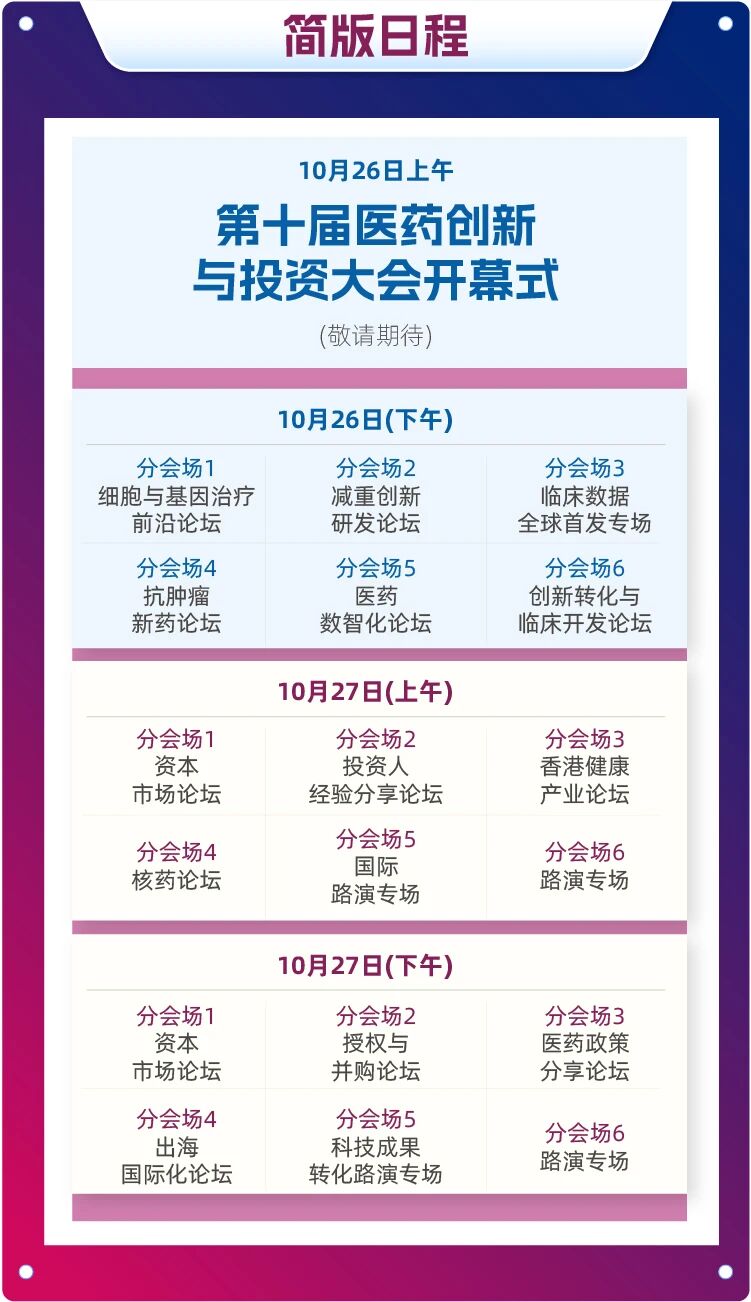
剧透抢先看|第十届医药创新与投资大会初版日程正式发布
Xi Niu Cai Jing· 2025-10-10 12:32
Core Insights - The 10th Pharmaceutical Innovation and Investment Conference will be held on October 26-27, 2025, in Nanjing, focusing on global pharmaceutical frontiers and capital trends, gathering top minds in the pharmaceutical innovation and investment fields [1][2]. Conference Information - The conference will take place at Fengda International Hotel, Nanjing, and will cover multiple thematic forums including innovative drug research and development, clinical research, cell and gene therapy, investment mergers and acquisitions, capital markets, and commercial insurance policies [2]. - The agenda includes various sub-forums such as cell and gene therapy, weight loss innovation, clinical data, anti-tumor new drugs, and international roadshows, ensuring comprehensive coverage of the pharmaceutical industry [3][4]. Key Topics - The conference will address core challenges and development trends in the pharmaceutical industry, emphasizing internationalization, investment financing, and regulatory policies, with a focus on the synergy between basic medical insurance and commercial health insurance [5]. - Discussions will include the strategies of Chinese innovative pharmaceutical companies in global markets, particularly in terms of licensing, mergers, and new investment trends [5][6]. Expert Participation - The conference will feature senior experts, clinical specialists, industry leaders, and frontline investors who will share insights on breakthrough technologies, practical experiences in investment mergers, and policy interpretations [4][6]. - Notable speakers include leaders from prestigious institutions and companies, contributing to discussions on the construction of innovative ecosystems and cross-sector collaboration [4][6]. Forum Structure - The conference will be structured around multi-dimensional forums designed to promote deep dialogue and knowledge sharing across clinical, industrial, capital, and policy fields, with three core discussion directions: global strategic layout, capital collaborative innovation, and market trend outlook [6].
部分淘宝商家暂停黄金回购
Sou Hu Cai Jing· 2025-09-11 07:16
Core Viewpoint - Recent surge in gold prices has led many investors to consider liquidating their gold holdings, but several online platforms, including Taobao, have suspended their gold buyback services due to regulatory changes and risk management concerns [1][2]. Group 1: Online Gold Buyback Services - Multiple Taobao merchants have paused their gold buyback operations, citing adjustments in platform rules as the reason [1]. - The tightening of online gold buyback services is attributed to stricter regulatory policies and the need for enhanced risk control measures [1]. - The implementation of the "Anti-Money Laundering and Counter-Terrorism Financing Management Measures for Precious Metals and Gemstone Practitioners" starting August 1, 2025, requires large cash transactions to be reported to the central bank, increasing compliance burdens on platforms like Taobao [1]. Group 2: Merchant Perspectives - Merchants are exercising caution in their buyback operations due to the volatility in gold prices, which poses a risk of price declines after repurchase [2]. - The complexity of gold identification and purity testing, which requires specialized equipment and personnel, adds to the operational challenges and potential for disputes in the buyback process [2]. Group 3: Offline Gold Recovery Market - Despite restrictions on online buyback services, the offline gold recovery market remains active, with a noticeable increase in gold recovery volumes reported by industry insiders [3][4]. - A Shanghai gold recovery merchant noted that they have been actively purchasing gold, achieving satisfactory profits during price stabilization periods [4].

你并不知道高利贷陷阱如此普遍
虎嗅APP· 2025-08-27 00:01
Core Viewpoint - The article discusses the emergence of new regulations in the lending industry, particularly focusing on the "assisted lending" sector, which has been criticized for hidden fees and high-interest rates that often exceed legal limits [9][10][12]. Group 1: Industry Signals - The push for new regulations in assisted lending is driven by increasing consumer complaints, with significant numbers reported regarding "usury" and "violent collection" practices [13][14]. - The original intent of consumer finance was to stimulate consumption and reduce reliance on exports and fixed asset investments, but many institutions have deviated from this goal [16][17]. - Regulatory measures have been implemented to address industry chaos, with over 300 small loan companies reportedly exiting the market due to various issues [20]. Group 2: Regulatory Changes - The new assisted lending regulations will take effect on October 1, 2025, requiring all fees to be included in the comprehensive annualized interest rate, which cannot exceed 24% [10][11]. - The regulations aim to eliminate high-interest loans in the 24%-36% range, which have been associated with high default rates [21][22]. - The market is expected to undergo significant consolidation, with a shift in market share towards compliant and well-operated platforms [22]. Group 3: Industry Response - In anticipation of the new regulations, many lending institutions are exploring new product models to circumvent the rules and maintain profitability [26][27]. - Current strategies include bundling loans with membership benefits or insurance, although these may not fully cover the costs associated with higher interest rates [28][30]. - Some companies are also offering credit risk assessment services, which may not provide substantial value to borrowers [33]. Group 4: Funding Challenges - The supply of funds for loans in the 24%-36% range is tightening, with significant shortages reported across the industry [39]. - Traditional funding sources, such as city commercial banks and small loan companies, are becoming increasingly difficult to access [38]. - There are indications that some companies may attempt to bypass regulations by using trust companies, although these are also subject to oversight under the new rules [42][43].

普蕊斯: 华泰联合证券有限责任公司关于普蕊斯(上海)医药科技开发股份有限公司持续督导期2025年培训情况报告
Zheng Quan Zhi Xing· 2025-08-26 08:11
Group 1 - The core viewpoint of the report is that Huatai United Securities has conducted a comprehensive training program for the management of Pursis (Shanghai) Pharmaceutical Technology Development Co., Ltd. to ensure compliance with regulatory requirements and enhance corporate governance [1][2] - The training covered key topics such as the use and management of raised funds, transaction norms, corporate governance, internal control, and significant financial risks, emphasizing the importance of compliance and ethical behavior for listed companies and their stakeholders [1][2] - The training aimed to strengthen the legal awareness and integrity of the participants, enhancing their understanding of the responsibilities and obligations of management in corporate governance and compliance [1][2] Group 2 - The training team consisted of experienced professionals with expertise in securities, law, and finance, ensuring a thorough and systematic approach to the training [2] - The training resulted in improved understanding of relevant laws, regulations, and business rules among Pursis's board members, supervisors, and senior management, contributing to better corporate governance [2] - The overall effectiveness of the training is expected to further elevate Pursis's governance standards and operational compliance [2]
银行行业跟踪报告:理财存续规模环比上升
Wanlian Securities· 2025-08-12 11:08
Investment Rating - The industry is rated as "Outperforming the Market" with an expected increase of over 10% relative to the market index in the next six months [5][19]. Core Insights - As of the end of 1H25, the total scale of wealth management products reached 30.67 trillion yuan, reflecting a year-on-year growth of 7.53% and a quarter-on-quarter increase of approximately 1.53 trillion yuan [2][11][17]. - There is an observed increase in the risk appetite among individual investors, with the proportion of aggressive investors rising by 1.25 percentage points compared to the same period in 2024 [2][12][17]. - The recent adjustments in deposit rates, particularly the significant drop in one-year deposit rates below 1%, are expected to drive a gradual increase in demand for fund reallocation, as investors seek better returns in a low-interest environment [2][13][17]. - Regulatory policies and their implementation pace are crucial to monitor, especially following the negative feedback from the bond market in 2022, which has affected overall risk appetite [3][14][16]. Summary by Sections Wealth Management Scale - The total number of wealth management products in existence reached 4.18 million, with a year-on-year growth of 4.54% [11]. - Wealth management products from companies accounted for 89.61% of the total market scale, with a total scale of 27.48 trillion yuan, reflecting a year-on-year growth of 12.98% [12]. Fund Reallocation Demand - Recent adjustments in deposit rates have led to a significant decline, with the average reduction exceeding 15 basis points, marking the largest cut in three years [13]. - The low-interest environment, combined with a recovering capital market, is expected to enhance risk appetite and increase the demand for fund reallocation [2][13][17]. Regulatory Policy Focus - The focus on regulatory policies is heightened, particularly in light of the need to stabilize net asset values and manage risk [3][14][16]. - The ongoing regulatory adjustments are anticipated to continue, necessitating close attention to the direction and pace of policy changes [3][16]. Investment Recommendations - The expectation is for the wealth management scale to maintain steady growth throughout 2025, driven by increasing risk appetite and the need for diversified investment products [2][17]. - Attention should be given to valuation differentiation and the evolving regulatory landscape as key factors influencing future performance [3][17].
Physicians Realty Trust(DOC) - 2025 Q2 - Earnings Call Transcript
2025-07-25 15:00
Financial Data and Key Metrics Changes - The company reported FFO as adjusted of $0.46 per share and AFFO of $0.44 per share, with total portfolio same store growth of 3.5% [19] - CCRC business reported same store growth of 8.6%, driven by rate growth of 5% and higher entrance fee sales [19] - Outpatient medical segment achieved 85% tenant retention, a positive rent mark to market of 6%, and same store cash NOI growth of 3.9% [20] Business Line Data and Key Metrics Changes - Outpatient medical segment showed strong performance with same store growth near record levels, driven by aging population and consumer preference for lower-cost settings [9][10] - CCRC portfolio generated approximately $200 million of annual NOI, which is 50% higher than in 2019 before the pandemic [14] - Lab R&D business is seeing positive indicators with new supply quickly going to zero, and regulatory changes promoting innovation [11][12] Market Data and Key Metrics Changes - The company has significant concentration in key markets such as Dallas, Houston, Nashville, Atlanta, Phoenix, and Denver, which are expected to drive future growth [10] - Recent broker reports indicated over 4 million square feet of inventory being removed from the supply pipeline in the lab sector [12] - The political and regulatory environment has improved, with favorable changes to drug pricing and tax treatment for research and manufacturing [5][6] Company Strategy and Development Direction - The company is focusing on internalizing property management to enhance tenant relationships and operational efficiency [7][8] - Strategic goals include deepening competitive advantages in core markets and capitalizing on outpatient medical development opportunities [10][11] - The company is also investing in AI capabilities to optimize operations and enhance asset performance visibility [17][18] Management's Comments on Operating Environment and Future Outlook - Management expressed optimism about the outpatient medical segment and the potential for growth in the CCRC business due to strong market fundamentals [23][24] - There are concerns about occupancy declines in the lab sector due to tenant capital raising challenges, but recent positive market indicators are encouraging [39][46] - The company remains confident in its diversified portfolio and the ability to deliver results despite challenges in the lab sector [24][82] Other Important Information - The company has completed an enterprise-wide technology upgrade to improve data integration and productivity [4][5] - The balance sheet remains strong with a net debt to adjusted EBITDA of 5.2 times and nearly $2.3 billion of liquidity [22] - The company is monitoring the bond market for refinancing opportunities to strengthen its balance sheet further [22][23] Q&A Session Summary Question: Can you break down the occupancy decline in the lab segment? - Management indicated that the decline was due to lease expirations, tenant migrations, and some tenants unable to raise capital [28][29] Question: What are the latest thoughts on capital allocation? - Maintaining a strong balance sheet is the priority, with potential for opportunistic asset sales and stock buybacks [32][34] Question: How much impact do you expect from unsuccessful capital raises on occupancy? - There will be some headwinds from occupancy, but the overall portfolio remains diversified with a majority of credit tenants [41][42] Question: Can you provide insights on the development pipeline and capitalized interest? - Recent tenant capital raising challenges affected pre-leases, but capitalized interest is expected to trend down as projects come online [68][72] Question: What is the quality of space being returned from tenant move-outs? - The quality varies, with some spaces ready for re-leasing and others requiring capital investment [119]