
经济增速放缓

Search documents
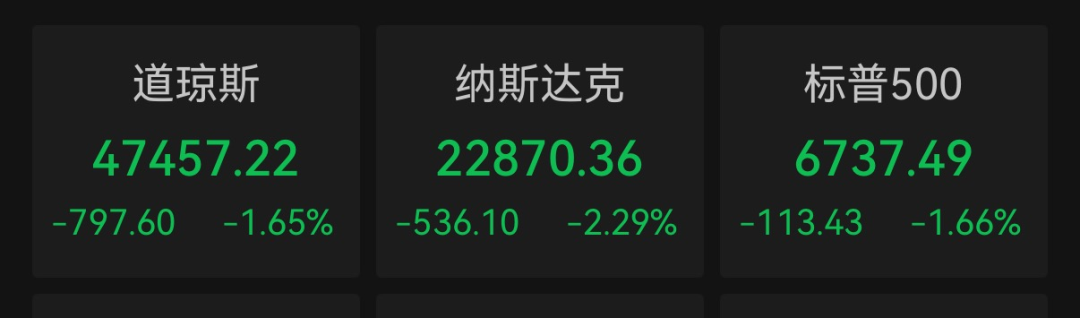
特斯拉大跌!美股三大股指集体下挫
Zhong Guo Zheng Quan Bao· 2025-11-13 23:53
Market Overview - On November 13, the US stock market experienced a widespread decline, primarily driven by a sell-off in technology stocks, with Tesla leading the drop by over 6% [1][2] - The Dow Jones Industrial Average fell by 1.65%, the S&P 500 decreased by 1.66%, and the Nasdaq Composite dropped by 2.29% [2] Technology Sector Performance - The index of the seven major US technology companies decreased by 2.28%, with Tesla down 6.64%, Nvidia falling over 3%, and both Google and Amazon declining by more than 2% [4] - Microsoft saw a decline of over 1%, while Apple experienced a slight drop of 0.19%, and Meta Platforms had a minor increase of 0.14% [4] Chinese Stocks - The Nasdaq Golden Dragon China Index fell by 1.59%, and the Chinese technology leaders index decreased by 0.63% [4] - Notable movements included BYD and Alibaba, which rose by 1.25% and 1.22% respectively, while Baidu dropped over 6%, and Xiaomi, JD.com, Meituan, and Pinduoduo all fell by more than 1% [4] Commodity Prices - Gold prices declined, with the London spot price down by 0.55% to $4,172.24 per ounce, and COMEX gold futures falling by 0.81% to $4,179.50 per ounce [5] - In contrast, international oil prices saw a slight increase, with light crude oil futures rising by $0.20 to $58.69 per barrel, and Brent crude oil futures up by $0.30 to $63.01 per barrel [7] Investment Activity - BlackRock's third-quarter holdings report revealed significant increases in positions for Microsoft, Nvidia, and Chevron, with Microsoft being the most heavily increased position [8] Economic Outlook - The International Monetary Fund (IMF) indicated that the recent US government shutdown would negatively impact economic growth, projecting a fourth-quarter growth rate below the previously estimated 1.9% [10] - The shutdown, lasting 43 days, is estimated to have caused approximately $11 billion in economic losses [10]


国际货币基金组织预计政府“停摆”使美四季度经济增速放缓
Xin Hua She· 2025-11-13 23:10
Core Viewpoint - The U.S. federal government shutdown is expected to negatively impact the economy, with the IMF predicting a lower economic growth rate for Q4 compared to previous forecasts [1] Economic Impact - The IMF spokesperson indicated that the economic growth rate for the U.S. in Q4 is now expected to be below the previously predicted rate of 1.9% [1]
如何解读三季度经济增速放缓?
2025-10-21 15:00
Summary of Conference Call Records Industry Overview - The records discuss the economic performance of China in 2025, focusing on GDP growth, investment trends, and consumer behavior, highlighting a slowdown in economic growth with a projected GDP growth of 4.8% in September 2025, primarily driven by external demand while internal demand shows a declining trend [1][4][2]. Key Points and Arguments Economic Growth - Actual GDP growth for September 2025 is expected to be 4.8% year-on-year, driven by external demand, while internal demand is receding [1][4]. - The nominal GDP growth rate decreased from 3.9% to 3.7% in the third quarter, indicating a slowdown in economic momentum [2]. Investment Trends - Fixed asset investment growth turned negative in the first three quarters, declining by approximately 0.5%, with infrastructure, manufacturing, and real estate all showing monthly declines [9][12]. - Equipment updates are driving a recovery in investment in tools and machinery, while service sector investment is gradually improving due to supportive policies [9][12]. Consumer Behavior - Consumer spending continues to decline due to multiple factors, with traditional sectors like construction and automotive experiencing weak demand, while new sectors like home appliances and cultural products are showing growth [6][7]. - A shift towards service consumption is anticipated as policies promoting service retail are beginning to take effect [7]. Real Estate Market - The real estate market is experiencing continued declines in investment and demand, with sales area weakening and prices showing a narrowing year-on-year decline [8]. - New policies aimed at stabilizing the real estate market are expected to take time to show effects, indicating a need for both economic and policy support [8]. Manufacturing Sector - Manufacturing investment is facing challenges due to various factors, including trade tensions and external uncertainties, leading to a general weakening, although high-end manufacturing remains robust [11]. Infrastructure Investment - Infrastructure is viewed as a crucial counter-cyclical tool, with recent policy measures, including a 500 billion yuan financial tool, expected to support infrastructure investment in the fourth quarter [10][13]. Capital Market Outlook - The capital market is focusing on long-term trends rather than short-term fluctuations, with potential positive changes expected in 2025 due to the resolution of real estate bubbles and a recovery in internal demand [15]. Other Important Insights - The overall economic environment is characterized by strong supply but weak demand, with a need for policies to stimulate consumption and investment [1][4]. - The employment situation is under pressure, with rising unemployment rates indicating a challenging job market [6]. - The PPI has shown signs of improvement, which could positively influence investment returns and nominal growth [12]. This summary encapsulates the key insights from the conference call records, providing a comprehensive overview of the current economic landscape in China as of 2025.
粤开宏观:三季度经济增速为何放缓?四季度经济前景如何?
Yuekai Securities· 2025-10-20 12:40
Economic Growth Overview - In Q1 and Q2 of 2025, China's GDP grew by 5.4% and 5.2% year-on-year, respectively, but slowed to 4.8% in Q3, resulting in a cumulative growth of 5.2% for the first three quarters[1] - The nominal GDP growth for Q3 was 3.7%, with a cumulative nominal GDP growth of 4.1% for the first three quarters[10] Reasons for Q3 Slowdown - The slowdown is attributed to reduced macro policy support in the second half of the year, with a decrease in funding from 162 billion yuan in Q1 to 138 billion yuan in Q3 for consumption incentives[11] - The effectiveness of certain policies, such as the trade-in program for durable goods, has diminished, leading to a decline in retail sales growth from 5.1% in H1 to 3.0% in September[11] - There is a lack of internal growth momentum, with the average consumption propensity dropping from 68.6% in Q2 to 68.1% in Q3[11] Positive Economic Indicators - Industrial capacity utilization has stabilized, with the Producer Price Index (PPI) showing a year-on-year improvement, and profits for large industrial enterprises turning positive[14] - Exports remained resilient, with a year-on-year growth of 8.3% in September, supported by diversified markets and competitive pricing[15] - High-tech industries saw a 9.6% increase in production value, with significant growth in sectors like integrated circuits and industrial robots[16] Q4 Economic Outlook - The economic performance in Q4 will depend on the introduction of new policies, with a potential GDP growth of 4.8% if policies are strengthened, or a decline to 4.6% if current trends continue[23] - Achieving the annual growth target of around 5% is considered highly likely, with projections estimating a final growth rate of 5.0% to 5.1%[23] Policy Recommendations - It is suggested to increase fiscal policy efforts, with a recommendation for the 2026 fiscal deficit to be no less than 4%[24] - Monetary policy should leverage the Federal Reserve's rate cuts to further reduce reserve requirements and interest rates[27] - A comprehensive approach to real estate policy is recommended to stabilize the market, including the establishment of a "Real Estate Stability Fund" of approximately 2 trillion yuan[29]
世界银行:尼泊尔2025/26财年经济增速或降至2.1%
Zhong Guo Xin Wen Wang· 2025-10-07 16:03
Core Insights - The World Bank's latest South Asia Development Report indicates that Nepal's economic growth for the fiscal year 2025/26 is expected to slow down to 2.1%, with fluctuations projected between -1.5% and 2.6% [1] - The Nepalese government had initially set a growth target of 6% for the same fiscal year [1] - Recent large-scale protests on September 8 and 9 have disrupted public and private infrastructure, impacting sectors such as tourism and insurance, which has severely weakened investor confidence [1] - The report also highlights that a delayed end to the rainy season in 2025 may further affect agricultural production in Nepal [1] Regional Economic Outlook - The overall economic growth for South Asia in 2025 is projected to be 6.6%, slowing to 5.8% by 2026 [1] - India is expected to grow at 6.5%, Bhutan at 7.3%, Bangladesh at 4.8%, Sri Lanka at 3.5%, and the Maldives at 3.9% [1]
【环球财经】巴西央行预计2026年经济增速放缓至1.5%
Xin Hua Cai Jing· 2025-09-26 06:27
Group 1 - The Brazilian Central Bank has lowered its GDP growth forecast for 2025 from 2.1% to 2% and introduced a new forecast of 1.5% for 2026, citing factors such as high interest rates, global economic slowdown, and unsustainable agricultural growth [1] - The report indicates that inflation in Brazil remains above target, with an expected inflation rate of 4.8% for 2025, exceeding the target range of 3% ± 1.5 percentage points [1] - To combat inflation, the Central Bank has maintained the benchmark interest rate at a high of 15%, with expectations that rate cuts may not occur until 2026 [1] Group 2 - The Brazilian Finance Minister has criticized the 15% benchmark interest rate, suggesting there is room for rate cuts and emphasizing the need for annual GDP growth above 3% to support employment and income goals ahead of the 2026 elections [2] - The Central Bank Governor has attributed the persistent inflation to factors such as economic overheating, exchange rate volatility, rising electricity costs, and extreme weather impacts, asserting that high rates are essential for controlling inflation and protecting workers' purchasing power [2] - The GDP growth forecast for 2024 is set at 3.4%, the highest since 2021, while a potential slowdown to 1.5% in 2026 could mark the lowest growth since the economic contraction caused by the pandemic in 2020 [2]
美联储“三把手”呼应鲍威尔鸽派言论,为降息扫除障碍
Jin Shi Shu Ju· 2025-09-05 00:18
Group 1 - The core viewpoint is that there is currently no evidence that higher tariffs on imported goods are causing an overall surge in inflation trends, according to New York Fed President Williams [2] - Williams predicts that interest rate cuts will become appropriate over time, although he did not specify the timing or pace of these cuts [2][3] - The labor market has shown signs of cooling due to high interest rates, with significant slowdowns in job growth since May [2][3] Group 2 - Williams expects the unemployment rate to gradually rise to around 4.5% next year due to the combined impact of trade and immigration policies [3] - Short-term inflation rates may spike above 3%, but are projected to decline to 2.5% by 2026 and further to 2% by 2027, aligning with the Fed's inflation target [3] - The path of interest rates post-September meeting remains unclear, with some officials advocating for a series of rate cuts in the next three to six months [4]
【环球财经】加拿大第二季度经济增速大幅放缓
Xin Hua She· 2025-08-30 03:14
Group 1 - The core viewpoint of the article is that Canada's GDP growth rate significantly slowed in the second quarter, with a quarter-on-quarter annualized growth rate declining by 1.6%, aligning with the central bank's expectations from July [1] - The economic contraction is primarily attributed to a substantial decline in goods exports and reduced investment by businesses in machinery and equipment [1] - Exports fell by 7.5% in the second quarter due to the impact of U.S. tariffs, with passenger car and light truck exports plummeting by 24.7% [1] Group 2 - Exports of industrial machinery, equipment, and parts decreased by 18.5%, while tourism service exports also saw a decline of 11.1% [1]
高科桥(09963.HK)上半年总收入约3870万港元 同比减少约46.9%
Ge Long Hui· 2025-08-27 08:45
Core Viewpoint - The financial performance of Gaoke Bridge (09963.HK) for the six months ending June 30, 2025, was disappointing, with significant revenue decline and continued losses [1] Financial Performance - Total revenue recorded was approximately HKD 38.7 million, representing a year-on-year decrease of about 46.9% [1] - Loss attributable to shareholders for the reporting period was approximately HKD 12.6 million, which is an 8.0% reduction compared to the previous period [1] - Basic loss per share was approximately HKD 0.049, compared to HKD 0.053 for the six months ending June 30, 2024 [1] Industry Context - The Chinese telecommunications industry is facing dual pressures of demand contraction and intensified competition due to global geopolitical fluctuations and a slowdown in domestic economic growth [1] - The challenges and uncertainties faced by fiber optic and cable companies in the current market environment remain significant [1] - The company is vigilant regarding these developments and is continuously assessing their impact while taking necessary measures to mitigate effects on its business [1]
宏观周报:国内7月经济增速边际放缓-20250815
Nan Hua Qi Huo· 2025-08-15 13:03
Report Industry Investment Rating No relevant content provided. Core View of the Report The economic growth rate in China showed a marginal slowdown in July, but there's no need for excessive concern as a package of stable - economy policies are gradually taking effect, and more consumption - promotion policies are expected. The uncertainty of a September interest rate cut in the US remains, and attention should be paid to US economic data and Powell's speech at the Jackson Hole Annual Meeting [1]. Summary of Each Section 1. Domestic Economic Growth Slowdown in July 1.1 Economic Growth Slowdown in July - In July, economic data indicated a marginal slowdown in economic growth. The total retail sales of consumer goods were 387.8 billion yuan, a year - on - year increase of 3.7%, down 1.1 percentage points from the previous month. The added value of industrial enterprises above the designated size increased by 5.7% year - on - year, 1.1 percentage points lower than the previous month. The year - on - year growth rate of fixed - asset investment was 1.6%, a decline of 1.2 percentage points from the previous month [2]. - The marginal decline in the production side in July was affected by seasonal factors, the "anti - involution" policy, and extreme weather. The decline in consumption growth might be related to the early release of some demand by the trade - in policy, and the consumption confidence index has not significantly recovered. Investment in manufacturing, real estate, and infrastructure all showed a marginal downward trend, with decreases of 1.3, 0.8, and 1.61 percentage points respectively from the previous month, and the growth rates dropped to 6.2%, - 12%, and 9.29% [3]. 1.2 Decision - makers' Consumption - Promotion Policies - On August 12, the Ministry of Finance, the People's Bank of China, and the Financial Regulatory Administration jointly issued the Implementation Plan for the Fiscal Interest Subsidy Policy on Personal Consumption Loans, and the Ministry of Finance and eight other departments issued the Implementation Plan for the Interest Subsidy Policy on Loans to Service - Industry Business Entities [7]. - The personal consumption loan interest subsidy policy has a one - year implementation period, covering various consumer areas. It will promote the total retail sales of consumer goods to some extent, but the specific effect is difficult to measure, and its signaling significance is relatively strong. The service - industry business entity loan interest subsidy policy provides a 1 - percentage - point annual interest subsidy for eligible service - industry business entities, with a maximum subsidy of 10,000 yuan per household, mainly benefiting service - industry consumption [8]. 1.3 Uncertainty of a September Interest Rate Cut - The US CPI in July increased by 2.7% year - on - year, lower than market expectations, while the core CPI reached the highest level since February. The PPI in July showed an unexpected performance, with a month - on - month increase of 0.9% and a year - on - year increase of 3.3%. Whether the US will cut interest rates in September remains uncertain, and attention should be paid to US economic data and Powell's speech [14]. 2. Key Economic Data and Events 2.1 Domestic Key Events - Important policies include the public solicitation of opinions on the Implementation Regulations of the Value - Added Tax Law of the People's Republic of China, the simplification of account - opening materials for overseas central - bank - type institutions, and the issuance of consumption - loan and service - industry business - entity loan interest subsidy policies [17]. - Key economic data: Since the start of the summer travel season, the national railway has sent 599 million passengers, a year - on - year increase of 3.9%. In July, automobile production and sales decreased by 7.3% and 10.7% month - on - month respectively, but increased by 13.3% and 14.7% year - on - year. China's July financial data showed that M2 increased by 8.8% year - on - year, and the new social financing in the first seven months was 23.99 trillion yuan, 5.12 trillion yuan more than the same period last year [20]. 2.2 Overseas Key Events - In the US, Trump's team included several people in the list of candidates for the Fed Chair. The US debt exceeded 37 trillion US dollars for the first time. The US CPI in July was 2.7% year - on - year, and the core CPI reached a five - month high. After the data release, traders increased their bets on a September interest rate cut, but the unexpected PPI data dampened the enthusiasm [21][23]. - In Europe, German government said European leaders and Ukrainian President Zelensky would talk to Trump, and the EU hopes to pass the 19th round of sanctions against Russia next month [25]. - Regarding tariffs, Trump stated that gold would not be taxed, India hopes to continue bilateral trade negotiations, and Brazil has sued the US over tariff measures [26]. - Geopolitically, Iraq and Iran signed a security memorandum, Trump hopes to meet Putin again, and there are discussions about a possible new arms agreement between the US and Russia [27]. 3. Key Events and Data to be Focused on Next Week - Key events and data include the US 6 - month Treasury bill auction rate on August 18, China's central bank's 1 - year LPR on August 20, the eurozone CPI on August 20, the US initial jobless claims on August 21, and the US existing - home sales annualized month - on - month on August 21 [28]. 4. Weekly Performance of Major Asset Classes No specific summary of asset price changes is provided in the text, only charts of domestic stock indexes, bond markets, and various commodity indexes are presented.