
股票发行注册制

Search documents
证监会主席吴清:截至今年8月底 各类中长期资金合计持有A股流通市值约21.4万亿元
Zheng Quan Ri Bao Wang· 2025-09-22 09:07
Group 1 - The core viewpoint of the news is that the China Securities Regulatory Commission (CSRC) has made significant reforms in the capital market over the past five years, focusing on market-oriented, legal, and international approaches to enhance the quality of the financial system [1][2][3] Group 2 - Major breakthroughs in investment-side reforms include the implementation of a high-quality development action plan for public funds, establishing a performance evaluation system centered on investment returns, and a comprehensive fee reduction reform [1] - As of August 2023, various long-term funds held approximately 21.4 trillion yuan in A-share market value, representing a 32% increase compared to the end of the 13th Five-Year Plan [1] Group 3 - Financing-side reforms have deepened with the full rollout of the stock issuance registration system, focusing on supporting new productive forces through various initiatives such as the "16 Articles for Science and Technology Innovation" and "6 Articles for Mergers and Acquisitions" [2] - The introduction of the "1+6" reform measures on the Sci-Tech Innovation Board has led to the registration of three unprofitable tech companies under the new standards [2] Group 4 - The institutional mechanisms for promoting high-quality development of listed companies have been continuously improved, with two revisions of the information disclosure management measures and systematic enhancements to corporate governance standards [2] - Since the release of the "6 Articles for Mergers and Acquisitions," 230 major asset restructuring cases have been disclosed, supporting industry consolidation among listed companies [2] Group 5 - The high-level institutional opening of the capital market has been steadily expanded, with the complete removal of foreign ownership limits in various sectors during the 14th Five-Year Plan [3] - The foreign investment in A-shares reached 3.4 trillion yuan, and 269 companies have listed overseas, indicating an expanding "circle of friends" for China's capital market [3]
事关十四五时期金融业发展情况,潘功胜、李云泽、吴清、朱鹤新最新发声
Zhong Jin Zai Xian· 2025-09-22 08:40
Core Viewpoint - The press conference highlighted the significant achievements of China's financial sector during the "14th Five-Year Plan" period, emphasizing long-term development rather than short-term policy adjustments [2][4]. Financial Sector Achievements - As of June 2023, China's banking sector total assets reached nearly 470 trillion yuan, ranking first globally, while the stock and bond markets ranked second [2]. - The average annual growth rate of loans to technology-based small and medium-sized enterprises exceeded 20% during the "14th Five-Year Plan" [3]. - The financial system remains generally stable, with healthy financial institutions and smooth market operations [5]. Monetary Policy and Financial Stability - A modern monetary policy framework with Chinese characteristics is gradually taking shape, enhancing policy transmission effectiveness [4]. - The dual objectives of currency stability and financial stability were achieved during the "14th Five-Year Plan" [8]. - The People's Bank of China aims to further explore and expand its macro-prudential and financial stability functions [12]. International Financial Cooperation - China's participation, influence, and voice in international financial governance have significantly increased [6]. - The issuance of Panda bonds by foreign institutions exceeded 1 trillion yuan, indicating growing international engagement [14]. Regulatory Developments - The total assets of the banking and insurance sectors surpassed 500 trillion yuan, with an average growth of over 9% in the past five years [16][17]. - The financial regulatory authority has issued 171 regulations over the past five years, enhancing the regulatory framework [26]. - The number of high-risk small and medium-sized institutions has significantly decreased, with many provinces achieving dynamic clearance of such institutions [19]. Capital Market Developments - The A-share market's annualized volatility decreased by 2.8 percentage points compared to the "13th Five-Year Plan" period, indicating improved market resilience [28]. - The total financing through stock and bond markets reached 57.5 trillion yuan over the past five years, with a steady increase in direct financing's share [32]. - The market capitalization of the technology sector in A-shares now accounts for over one-fourth of the total market [30]. Investor Protection and Market Confidence - The regulatory authority has implemented measures to enhance investor protection, including a comprehensive compensation system for investors [45]. - The confidence of investors and market expectations have significantly improved due to coordinated efforts to stabilize the market [41].
吴清:股票发行注册制由试点到全面推开,逐步走深走实
Sou Hu Cai Jing· 2025-09-22 08:12
9月22日,在介绍"十四五"时期金融业发展成就时,中国证监会主席吴清在国新办新闻发布会上表示, 股票发行注册制由试点到全面推开,逐步走深走实。聚焦服务新质生产力发展,证监会接续推出"科创 十六条""科创板八条""并购六条"等举措,在发行上市、并购重组、畅通募投管退循环等方面作出一系 列优化完善。6月,在科创板推出设置科创成长层等"1+6"改革举措,目前已有3家未盈利科技企业在重 启科创板第五套标准后完成注册,创业板第三套标准也迎来首单受理。(人民财讯) ...
证监会主席吴清: “并购六条”发布以来已披露230单重大资产重组
Zheng Quan Shi Bao Wang· 2025-09-22 08:06
Core Insights - The China Securities Regulatory Commission (CSRC) has fully implemented the stock issuance registration system, enhancing support for the development of new productive forces [1] - A series of measures, including the "16 Articles for Sci-Tech Innovation" and "6 Articles for Mergers and Acquisitions," have been introduced to optimize the processes of issuance, mergers, and capital management [1] - The CSRC has conducted two rounds of delisting reforms, resulting in the smooth delisting of 207 companies during the "14th Five-Year Plan" period [1] Group 1 - The stock issuance registration system has transitioned from pilot to full implementation, focusing on serving the development of new productive forces [1] - The CSRC has introduced various initiatives, such as the "1+6" reform measures for the Sci-Tech Innovation Board, which have led to the registration of three unprofitable tech companies under the new standards [1] - Since the release of the "6 Articles for Mergers and Acquisitions," 230 significant asset restructuring cases have been disclosed, supporting industry consolidation among listed companies [1] Group 2 - The CSRC has broadened exit channels through delisting reforms, effectively removing "bad apples" and "zombie companies" from the market [1] - During the "14th Five-Year Plan" period, 13 foreign-controlled securities, fund, and futures institutions have been approved to operate in China, with foreign ownership in A-shares reaching 3.4 trillion yuan [1] - The number of Chinese companies listed overseas has increased to 269, expanding the capital market's international connections [1]
上市冲刺阶段董事长离世,菊乐股份走到“十字路口”
Xin Jing Bao· 2025-09-10 07:03
Core Viewpoint - The passing of the founder and chairman of Jule Food Co., Ltd. marks a critical juncture for the company as it approaches its fifth attempt at going public, raising concerns about leadership succession and market positioning [2][5]. Group 1: Leadership Transition - The actual controller and chairman, Tong Enwen, passed away on September 6, 2025, at the age of 78 [1]. - Gao Zhaohui, Tong's son-in-law, has been appointed to assume the chairman's responsibilities since July 2025 due to Tong's health issues [4]. - Tong Enwen had initiated leadership succession planning in 2011, ensuring a smooth transition of management [4]. Group 2: Company History and Achievements - Tong Enwen had a significant career, holding various leadership roles since 1966, including the founding of the "Jule" brand in 1984 [3]. - The company has been recognized for its innovation, particularly in the development of the steviol glycoside extraction process [3]. Group 3: IPO Attempts and Challenges - Jule Food has made five attempts to go public, with the latest application submitted to the Beijing Stock Exchange shortly before Tong's passing [5]. - Previous attempts at listing on the Shenzhen Stock Exchange faced multiple setbacks, including the withdrawal of applications and regulatory issues [5][6]. - The company has faced scrutiny from the China Securities Regulatory Commission due to financial irregularities, which have since been addressed [6]. Group 4: Financial Performance and Market Position - Jule Food's revenue for 2022, 2023, and 2024 was reported at 1.472 billion, 1.562 billion, and 1.641 billion respectively, with net profits of 172 million, 196 million, and 232 million [7]. - The company holds approximately 0.82% market share in China's dairy beverage market, ranking eighth, and 0.97% in the blended yogurt market, ranking fourth [7]. - The company has reduced its reliance on the Sichuan market, with revenue from this region dropping to about 76.03% in 2024 [7][8]. Group 5: Regulatory and Market Expansion Concerns - The Beijing Stock Exchange has raised questions regarding Jule Food's market position and expansion capabilities, particularly in light of its reliance on the Sichuan market [8]. - The company has faced declining revenue in its fermented dairy segment, attributed to increased competition and limited consumer demand [8]. - Experts suggest that while Jule Food has potential for profitability, its competitive strength remains concentrated in Sichuan, making broader market penetration challenging [9].
中国证监会原主席易会满被查 其银行学校多名同学先期落马
经济观察报· 2025-09-06 04:41
Core Viewpoint - Yi Huiman, former chairman of the China Securities Regulatory Commission (CSRC), is under investigation for serious violations of discipline and law, with implications for the financial industry and regulatory environment in China [2][3]. Group 1: Background Information - Yi Huiman was born in December 1964 in Wenzhou, Zhejiang Province, and graduated from Zhejiang Banking School, which has a reputation for training financial professionals [3][4]. - He worked at the Industrial and Commercial Bank of China (ICBC) for 34 years, holding various positions, including chairman [4][5]. - In January 2019, he became the chairman of the CSRC, succeeding Liu Shiyu, and was promoted to a ministerial level position [5][6]. Group 2: Investigation Details - Yi Huiman was taken away for investigation around August 29, 2025, along with several family members, following the earlier fall of his classmates from the same banking school [3][8]. - Prior to Yi's investigation, there were signs of trouble, including the investigation of his classmates, such as Lin Peng and Shen Rongqin, for serious violations [8][9]. Group 3: Regulatory Impact - During Yi's tenure at the CSRC from January 2019 to February 2024, over 1,800 new stocks were issued, marking the highest number under any CSRC chairman [6]. - His leadership focused on implementing a comprehensive stock issuance registration system, which has significant implications for the capital markets [6].

新三板挂牌条件优化 多套指标精准衔接北交所上市条件
Zheng Quan Ri Bao· 2025-09-01 02:33
Core Viewpoint - The implementation of the third set of listing standards on the ChiNext board allows unprofitable companies to go public, enhancing the inclusiveness and coverage of the ChiNext market, and providing more opportunities for companies to list on the A-share market [1][3]. Group 1: New Listing Standards - The third set of listing standards requires a minimum market value of 5 billion yuan and a minimum revenue of 300 million yuan in the most recent year for unprofitable companies to list on the ChiNext board [1][4]. - Since the introduction of the registration system, the majority of companies have opted for the first set of standards, with 97% of the 418 newly listed companies using this standard [2][7]. - The new standards are designed to support high-tech and strategic emerging industries, aligning with national industrial policies [4][6]. Group 2: Market Conditions and Implications - The timing for implementing the third set of standards is deemed mature due to the stable operation of the market and the optimization of its structure over the past two years [3][6]. - The new standards are not seen as a relaxation of requirements but rather as an optimization based on practical experience, aimed at broadening the listing pathways for quality market entities [3][5]. - The opening of the ChiNext board to unprofitable companies is expected to enhance the capacity and quality of the board, allowing more companies to access long-term financing and support the development of strategic emerging industries [7][8].
投资股票、债券、黄金等,啥收益最高?咋选才稳赚不赔?快来看
Sou Hu Cai Jing· 2025-08-19 21:00
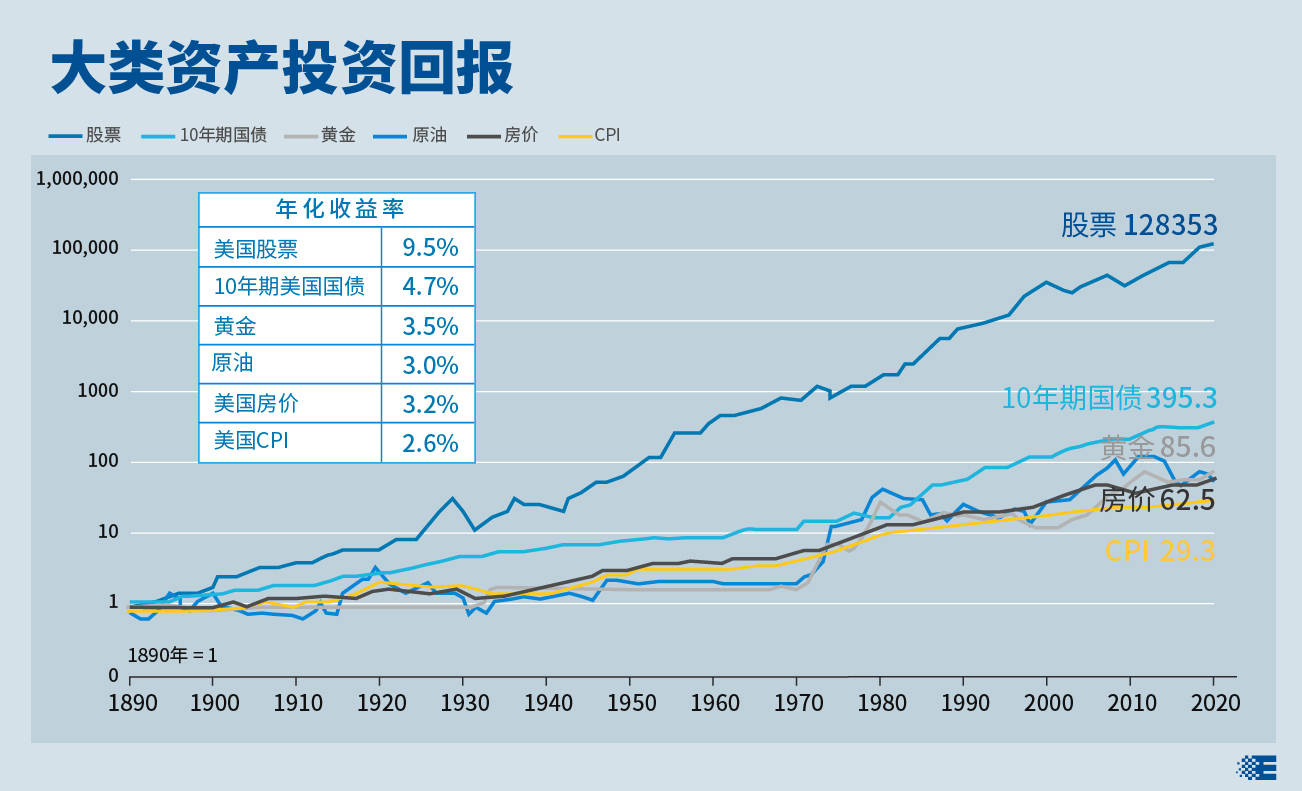
Core Insights - The article emphasizes the importance of investment in various asset classes to enhance wealth, highlighting that stock investments yield the highest long-term returns compared to other assets [1][3]. Group 1: Historical Performance of Assets - From 1890 to 2020, the average annual growth of the Consumer Price Index in the U.S. was 2.6%, while stocks had an annualized return of 9.5%, 10-year Treasury bonds returned 4.7%, gold returned 3.5%, oil returned 3.0%, and real estate returned 3.2% [1]. - A $1 investment in the S&P Composite Index in 1890 would grow to $128,000 by 2020, while the same amount in 10-year Treasury bonds would only be worth $395, gold would be $85, and real estate would be $62 [1]. Group 2: Investment Strategies - Investing in stocks provides the most significant opportunity to benefit from economic growth, with two main methods: direct stock trading and investing through stock mutual funds, which offer professional management and risk diversification [3]. - The annualized return of the CSI 300 Total Return Index from December 31, 2004, to May 12, 2021, was 12.58%, with a cumulative return of 558% [4]. Group 3: Future Outlook - China's economy is expected to achieve high-quality and sustainable growth due to its large market size and domestic demand potential, supported by technological innovation strategies [4]. - The implementation of a registration-based IPO system and a normalized delisting mechanism is anticipated to enhance the vitality and overall quality of the Chinese stock market [4].
深市两板合并一周年 主板近1500家公司总市值超22万亿元
Xin Hua Wang· 2025-08-12 06:28
Group 1 - The merger of the Shenzhen Main Board and the SME Board has been completed for one year, resulting in 28 companies going public (IPO) and raising over 23 billion yuan [1] - Total financing and transactions involving over 660 companies reached more than 730 billion yuan, with nearly 1,500 main board companies having a total market value exceeding 22 trillion yuan [1][2] - The merger has enhanced market vitality and resilience, improving direct financing and resource allocation efficiency, thereby better serving the real economy and supporting national development strategies [1][2] Group 2 - In the past year, 166 refinancing transactions were completed by main board companies, raising a total of approximately 329.99 billion yuan, with manufacturing companies accounting for 66.62% of this amount [2] - A total of 43 major asset restructuring transactions were completed, with a transaction amount of approximately 230.53 billion yuan [2] - The merger has created a broader and deeper market segment, catering to the financing needs of companies at different development stages [2] Group 3 - As of the end of March, 547 main board companies reported an average revenue of 15.46 billion yuan, reflecting a year-on-year growth of 29.61%, and an average net profit of 1.11 billion yuan, with a year-on-year increase of 26.47% [3] - Notable companies such as BOE Technology Group, BYD, and SF Express reported revenues exceeding 100 billion yuan, while 32 companies achieved net profits over 5 billion yuan [3] - The manufacturing sector showed strong performance, with 279 companies in industries like chemicals, machinery, electronics, and pharmaceuticals reporting net profit growth exceeding 50% [3] Group 4 - The government has emphasized the need for capital market reforms, including the implementation of a stock issuance registration system to promote stable and healthy market development [4] - The merger has led to effective operation of various institutional rules, contributing to a stable market environment that aligns with market expectations [4] - The merger is seen as a necessary step in building a clear market system and strengthening the foundation for comprehensive registration system implementation [4]




漳州发展: 第八届董事会2025年第四次临时会议公告
Zheng Quan Zhi Xing· 2025-08-04 16:36
Core Viewpoint - Fujian Zhangzhou Development Co., Ltd. has approved a plan to issue A-shares to specific investors, including its controlling shareholder, Zhanglong Group, to raise funds for various projects [1][2][3]. Group 1: Meeting Resolutions - The board of directors confirmed that the company meets the conditions for issuing A-shares to specific investors [1]. - The proposal for the issuance of A-shares was approved with a vote of 4 in favor and 0 against [2]. - The controlling shareholder, Zhanglong Group, intends to subscribe for at least 20% of the total shares issued [3][4]. Group 2: Issuance Details - The shares will be domestic listed ordinary shares (A-shares) with a par value of RMB 1.00 each [2]. - The issuance will be subject to approval from the Shenzhen Stock Exchange and the China Securities Regulatory Commission [2][5]. - The maximum number of shares to be issued will not exceed 30% of the company's total share capital prior to the issuance, which is approximately 297,444,321 shares [6]. Group 3: Fund Utilization - The total amount to be raised from this issuance is capped at RMB 1,050 million, which will be allocated to specific projects, including ecological restoration and solar power generation [9]. - The company will adjust the investment priorities based on the actual amount raised and project needs if the net amount raised is less than planned [9]. Group 4: Related Transactions - The issuance constitutes a related party transaction due to Zhanglong Group's involvement, and the related director has abstained from voting [2][17]. - The board has proposed to seek shareholder approval for Zhanglong Group to be exempt from making a tender offer for additional shares due to its existing stake exceeding 30% [18]. Group 5: Future Steps - The company plans to hold a shareholder meeting on August 20, 2025, to discuss and approve the proposed issuance and related matters [21].
