资产定价

Search documents
【UNforex财经事件】达里奥警示黄金大涨信号 货币价值变化重塑资产定价
Sou Hu Cai Jing· 2026-01-07 18:46
Group 1 - The core message highlights that the recent rise in gold prices reflects deeper concerns about the weakening value of fiat currencies, rather than just short-term safe-haven demand [1][3] - Bridgewater's founder Ray Dalio emphasizes that the current environment of low interest rates and technology investment sentiment supports risk appetite, but discussions about the long-term impact of currency purchasing power on asset pricing are intensifying [1][2] - The comparison of asset performance using gold as a benchmark indicates that the actual returns of U.S. stocks in 2025 will be significantly weaker than what is presented in nominal terms, suggesting that evaluating asset performance solely based on nominal returns may obscure real risk exposure [1] Group 2 - The market is currently experiencing a structural differentiation in asset performance, influenced by policy expectations, economic data, and valuation factors, necessitating a greater focus on risk control and timing in investment allocation [2] - The upcoming U.S. non-farm payroll report is anticipated to be a crucial reference for assessing labor market resilience and the direction of interest rate policies, which could impact the performance of the dollar, precious metals, and overall risk asset pricing [2] - Both gold and stocks have benefited from the accommodative environment over the past year, but as price levels have significantly increased, their sensitivity to macro changes is also rising, indicating the need to pay attention to relative value relationships between assets [2][3]
泓德基金:人民币走强有利于中国权益资产定价
Xin Lang Cai Jing· 2026-01-06 07:44
Market Performance - The domestic equity market continued to strengthen last week, with major broad-based indices generally rising around 3%, and both the Wind All A and CSI 2000 indices reached new highs for the year [1][5] - The average daily trading volume increased to a high level of 2.2 trillion yuan, driven primarily by the cyclical sector led by non-ferrous metals [1][5] - In the Hong Kong market, the Hang Seng Index and Hang Seng Technology rose by 0.5% and 0.4%, respectively [1][5] Currency Exchange Rate - The Chinese yuan has significantly appreciated against the US dollar this year, particularly after the Busan talks in late November, which eased bilateral relations [1][6] - The offshore yuan exchange rate even briefly surpassed the 7 yuan mark, attracting significant investor attention [1][6] - As of the end of November, China's official foreign exchange reserves were approximately 3.35 trillion USD, an increase of over 140 billion USD since the beginning of the year [6] Impact on Export and Import Companies - The appreciation of the yuan means that Chinese export goods have become more expensive in the international market, posing challenges for export-oriented companies, especially those in labor-intensive industries that rely on price advantages [2][6] - Export companies receiving payments in USD will find that converting to yuan results in lower amounts, potentially reducing profits, which raises concerns about exchange losses for companies with high export ratios in Q4 [2][6] - Conversely, companies that need to import raw materials, energy, components, and high-end equipment will benefit from a stronger yuan, as it reduces procurement costs and can enhance profit margins [2][6] Trade Balance and Economic Strategy - China's long-term trade surplus has been a source of friction with other economies, particularly the US and Europe [3][7] - The proactive balancing of trade is seen as beneficial for creating a more favorable international economic environment [3][7] - The central government's focus on domestic circulation and expanding domestic demand is a key task for high-quality economic development in the coming year [3][7] Bond Market Outlook - In the bond market, short- to medium-term interest rates declined while long-term rates saw slight increases, with secondary capital bonds showing little change [3][7] - The bond market is expected to remain within a narrow range, supported by stable year-end liquidity and potential new monetary policies from the central bank [3][7] - Despite current economic pressures, there is a possibility of a simultaneous bull market in both stocks and bonds in the near future [3][7]
嘉宾建言资产证券化未来发展:夯实基础,回归价值|2025债券市场高质量发展大会
Sou Hu Cai Jing· 2025-12-17 18:51
Core Viewpoint - The conference on high-quality development of the bond market emphasizes the importance of asset securitization as a means to transform dormant assets into liquid financial products, aligning with the policy direction of optimizing incremental and revitalizing existing assets [1] Group 1: Strategic Importance of Asset Securitization - The General Manager of the Financial Management Department of Guangxi Tourism Development Group, Lin Baosheng, states that asset securitization is not merely a financing tool but a profound "asset revolution" and a catalyst for strategic transformation [3] - Lin Baosheng outlines the need for systematic internal asset assessment and categorization into five main types, including stable cash flow-generating physical assets and receivables, to design feasible securitization paths [5] Group 2: Key Considerations in Asset Securitization - Zeng Yingfeng, Vice President of Anrong Credit Rating Co., emphasizes three key attributes for quality underlying assets in securitization: predictability, diversification, and cyclical resilience [5] - The future of asset securitization hinges on accurate asset pricing, as stated by Pu Yi, Executive General Manager of the Sales and Trading Division at Ping An Securities, who calls for more issuers to engage in this product type [7] Group 3: Transformation and Local Industry Integration - Han Jian, General Manager of the Credit Enhancement Business at Henan Zhongyu, highlights the importance of transformation to shed ineffective assets and align with local industry characteristics to uncover high liquidity and high-yield quality assets [9] - Wu Lan, Deputy General Manager of Shanghai Yuanshuo Equity Investment Fund Management Co., suggests incorporating investment banking thinking from the project's planning and operational stages to ensure cash flow generation and capital operation potential [12] Group 4: Building Trust and Transparency - Zeng Yingfeng reiterates the need for enterprises to solidify their foundations and transparently disclose cash flows to withstand pressure tests, viewing ratings as a diagnostic tool to reveal value and risks [14] - Zhao Haotian, Executive General Manager of the Fixed Income Team at Ping An Trust, discusses the evolution from traditional corporate bonds to ABS and REITs, emphasizing the necessity of presenting genuine asset conditions to attract long-term capital [14] Group 5: Collective Insights on Asset Securitization - The six panelists, despite differing perspectives, converge on the idea that the vitality of asset securitization lies in the real value of assets, comprehensive information disclosure, forward-thinking strategies, and accountability across the entire chain [17]


在东方红,我看到了“固收+”的另一种可能
点拾投资· 2025-12-09 08:32
Core Viewpoint - This year marks a renewed understanding of "fixed income +" in the market, evolving from a focus on "low bonds, high stocks" to a diverse range of strategies and asset classes, making "fixed income +" a comprehensive investment category that accommodates various risk levels and investment strategies [1][2]. Group 1: Investment Strategy and Team Structure - The "fixed income +" team at Dongfanghong Asset Management emphasizes a holistic approach to asset allocation, aiming for an overall optimal solution rather than optimizing each investment step individually [4]. - The team has established a unified management model that allows for better risk diversification and asset allocation, which has become a common operational model in the industry [4][6]. - The team categorizes "fixed income +" products based on volatility, asset class, and strategy type, ensuring that different assets align with a consistent product objective [6][12]. Group 2: Asset Pricing and Dynamic Allocation - The team's strong asset pricing capability underpins their dynamic asset allocation strategy, allowing them to identify high-value assets during market fluctuations [8][9]. - Historical performance demonstrates the team's ability to adjust asset allocations based on market conditions, such as increasing equity positions during the COVID-19 pandemic when risk premiums favored stocks over bonds [8][9]. - The team employs a multi-dimensional approach to macro research, assessing both high-frequency and low-frequency data to inform their asset allocation decisions [9][10]. Group 3: Product Differentiation and Risk Management - The "fixed income +" products are stratified into low, medium, and high volatility categories, allowing clients to select products that match their risk-return profiles [12][15]. - The team has developed a comprehensive communication mechanism to facilitate collaboration and timely identification of investment opportunities and risk management [15]. - Long-termism is a core principle, with a focus on sustainable performance and risk management rather than short-term gains, ensuring that the team aligns with client needs and market trends [17][18].

高盛重磅预测:美股“躺赢”时代结束了?未来十年回报率恐腰斩
3 6 Ke· 2025-11-27 04:51
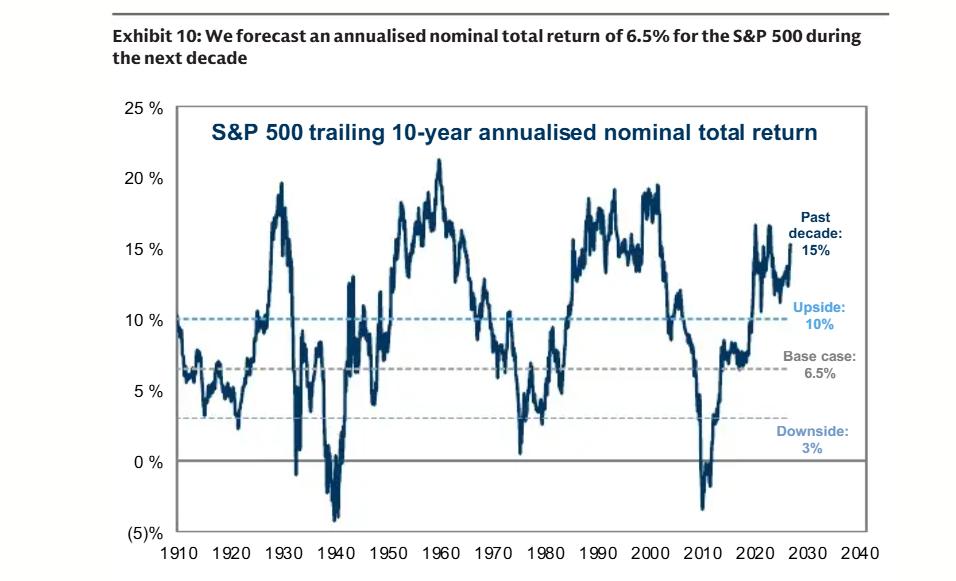
Core Insights - Goldman Sachs released a report titled "2025-2035 Global Stock Market Decadal Outlook," which emphasizes a shift from the previous decade's "U.S. stock dominance" and warns of potential corrections in asset pricing [1] - The report suggests that the S&P 500's annualized nominal total return is expected to decline to 6.5% over the next decade, a significant drop from the 15% annualized return seen in the past ten years [1][3] Return Attribution Analysis - Earnings growth is projected to contribute positively, with an expected annual compound growth rate of approximately 6%, indicating robust fundamentals for U.S. stocks [3] - Dividend returns are anticipated to contribute around 1.4% to total returns [4] - Valuation adjustments are expected to be the largest drag on returns, with the current forward P/E ratio at 23x, which is historically high. A gradual contraction in valuation multiples is predicted to negatively impact total returns by about 1% annually [4] Global Market Opportunities - As U.S. stock returns are expected to decline, relative value in global assets is becoming more apparent. Goldman Sachs forecasts a 7.7% annualized return for global equities (MSCI ACWI), surpassing U.S. stocks [6] - Non-U.S. markets, both developed and emerging, are expected to outperform U.S. stocks due to structural advantages and more attractive valuations [8] Regional Performance Expectations - Emerging markets are projected to have a 10.9% annualized return, driven by strong EPS growth in China and India [10] - Asia (excluding Japan) is expected to yield a 10.3% return, supported by approximately 9% EPS growth and a 2.7% dividend yield [10] - Japan is forecasted to achieve an 8.2% return, bolstered by EPS growth and policy-led improvements in shareholder payouts [12] - Europe is expected to deliver a 7.1% return, with half of this driven by earnings and the other half by shareholder returns [10] Strategic Recommendations - The report suggests a shift from a concentrated investment strategy focused on U.S. stocks, particularly tech giants, to a more balanced global allocation to mitigate risks associated with declining Sharpe ratios [15] - It advocates for increasing exposure to emerging markets and non-U.S. developed markets to capture potential valuation recovery and benefits from currency fluctuations [16]

中金:黄金、分红与成长
中金点睛· 2025-10-19 23:59
Core Viewpoint - The article discusses the unusual performance of various asset classes in 2023, where traditionally opposing assets such as gold, dividends, and growth stocks have shown simultaneous gains, challenging the conventional inflation and deflation asset pricing framework [2][6][7]. Group 1: Asset Performance Analysis - In the first quarter of 2023, gold and growth stocks rose together, followed by a period in the second quarter where dividends and growth stocks also increased, and again in the third quarter where gold and growth stocks performed well together [2][4]. - The traditional asset pricing theory suggests that gold benefits from inflation, dividends are more attractive in deflationary environments, and growth stocks thrive in moderate inflation and risk-on conditions [6][7]. - The article posits that the current market dynamics cannot be solely explained by inflation or deflation, indicating that other factors, such as geopolitical risks and central bank gold purchases, are influencing asset prices [7][11]. Group 2: Macro Environment and Credit Cycles - The macroeconomic environment in China is characterized by a decline in overall prices, particularly in PPI, while excess liquidity is causing "scarce" assets to appreciate, reflecting a localized inflation phenomenon [11][15]. - The article emphasizes that the credit cycle framework is a more effective tool for understanding asset rotation in China, as it considers the underlying causes of inflation and deflation rather than just the outcomes [16][17]. - The credit cycle can be influenced by three main factors: new industry trends (e.g., AI), government-led fiscal stimulus, and traditional demand from the private sector [19][20]. Group 3: Future Outlook - The article forecasts that the credit cycle in China is likely to shift towards a "fiscal strong + credit weak" or "fiscal weak + credit weak" phase, influenced by high base effects and slowing fiscal stimulus [28][36]. - Key indicators such as the broad fiscal deficit pulse and private sector credit pulse are expected to show downward trends, indicating a potential tightening of credit conditions [30][32]. - The article concludes that without significant policy intervention, the market is likely to continue along its current trajectory, focusing on sectors that remain resilient amid a weakening credit cycle [36][37].

长城基金杨光:挑战传统资产配置方法的新思路
点拾投资· 2025-10-14 00:46
Core Viewpoint - The article emphasizes the need for a paradigm shift in asset pricing and investment management, moving from traditional models to a more dynamic and adaptive approach that considers the non-linear relationships between assets and their roles within a portfolio [4][11][18]. Group 1: Asset Pricing Theory - Traditional asset pricing theories, such as the Capital Asset Pricing Model (CAPM), are based on strict assumptions of market efficiency and rational investors, which fail to explain market anomalies like momentum and value effects [4][12]. - The article argues that asset prices are influenced not only by their expected returns and risks but also by their roles in the overall investment portfolio and the dynamic relationships with other assets [4][11]. Group 2: Investment Strategy - The new investment philosophy focuses on systematically and proactively enhancing the risk-adjusted returns of investment portfolios rather than merely seeking absolute returns [4][11]. - The investment framework proposed is not about finding the "true value" of assets but about creating an adaptive system that can achieve stable growth across different market environments [7][16]. Group 3: Multi-Asset Allocation - The article discusses the importance of low correlation among assets in a multi-asset allocation strategy, which can significantly reduce the probability of negative monthly returns [22][23]. - A two-stage strategy combining CPPI (Constant Proportion Portfolio Insurance) and risk budgeting is suggested to enhance traditional methodologies and improve risk-adjusted returns [17][23]. Group 4: Market Dynamics - The article highlights that the correlation between assets is dynamic and can change with market conditions, which poses risks to traditional asset allocation frameworks that rely on historical data [12][15]. - The concept of "free lunch" in asset allocation, derived from low correlation, may diminish as market environments evolve, necessitating a deeper understanding of the underlying factors driving asset correlations [15][18]. Group 5: Future of Asset Pricing - The future of asset pricing is seen as a transition from a focus on historical data to an understanding of technological trends, industry changes, and collective human behavior [34]. - The new asset pricing framework is described as a three-dimensional investment model centered around technological advancement, new productive forces, and consensus-driven narratives [18][28].

美联储吵翻了!黄金跌金融涨,降息快慢,影响你房贷、股票、菜价
Sou Hu Cai Jing· 2025-10-13 11:12
Core Viewpoint - The ongoing debate around interest rate cuts in the U.S. is creating uncertainty in global markets, with traders expecting two more cuts this year while Federal Reserve officials express concerns about persistent inflation [1][15]. Group 1: Interest Rate Dynamics - The Federal Reserve lowered interest rates to 4.25%-4.5% at the end of last year, but this followed a period of rates above 5% for two years, leading to significant capital inflows into the U.S. [3]. - The expectation of slower interest rate cuts by the Federal Reserve could lead to renewed capital outflows from emerging markets, as higher U.S. interest rates attract funds [3][5]. Group 2: Impact on Domestic Economy - The high U.S. interest rates limit the Chinese central bank's ability to lower domestic interest rates, affecting mortgage rates and housing market stimulation efforts [5]. - A strong U.S. dollar puts pressure on the Chinese yuan, leading to increased costs for imported goods, which could contribute to domestic inflation [8]. Group 3: Market Reactions - The anticipation of interest rate changes has led to volatility in various sectors, with gold prices dropping significantly in response to reduced rate cut expectations [10]. - The financial sector benefits from a high-interest environment, with U.S. financial stocks performing well while other sectors, like technology, face challenges [10]. Group 4: External Trade Considerations - The U.S. unemployment rate is projected to rise, which may reduce consumer spending and impact export orders from China, particularly in manufacturing hubs like the Yangtze River Delta [11]. - The upcoming Federal Reserve meetings are closely monitored by businesses involved in foreign trade, as decisions made can significantly affect their operations [13]. Group 5: Investment Strategies - Investors are advised to focus on long-term strategies, such as selecting undervalued stocks with high dividends or investing in broad market indices, rather than reacting to short-term fluctuations driven by Federal Reserve communications [13][15].

长城基金杨光:在理智与感性的边缘寻找更优解
Xin Lang Ji Jin· 2025-10-10 09:10
Core Insights - The investment landscape is undergoing profound changes driven by "technological advancement, new productive forces, and collective consensus" as the new paradigm for asset pricing [2][3] - The traditional valuation models are becoming less effective, necessitating a shift towards quantitative discipline to translate qualitative insights into actionable investment strategies [2][3] Group 1: Investment Philosophy - The investment approach emphasizes the balance between rational calculation and human insight, seeking optimal solutions through a dynamic equilibrium [1][2] - A strategic direction is established through qualitative research, which serves as a guiding compass for investment decisions [2] Group 2: Quantitative Tools - A precise navigation system is essential for executing investment strategies, consisting of two main components: CPPI technology for dynamic risk control and a risk budgeting model for resource allocation [3] - The CPPI technology includes mechanisms for dynamic adjustment of risk exposure based on net value performance and automatic asset allocation during market fluctuations [3] Group 3: Balancing Act - The essence of investment management lies in finding a delicate balance across multiple dimensions, including short-term versus long-term coordination and maintaining flexibility while adhering to core strategies [4][7] - The investment model aims to filter out short-term noise while capturing long-term signals, ensuring that the strategy remains robust against market volatility [6] Group 4: Communication and Adaptation - Clear communication with investors is prioritized, with regular reports to explain performance and investment rationale, helping to set rational expectations [8] - The investment process involves a step-by-step adjustment strategy to minimize market impact while ensuring that asset selection aligns with emerging productive forces [8] Group 5: Continuous Improvement - The investment methodology focuses on building a self-evolving system that withstands the test of time, with quantitative tools playing a crucial role in achieving investment objectives [9] - Each analysis, model optimization, and allocation adjustment is part of a continuous search for better solutions, emphasizing a sustainable approach over chasing short-term trends [9]
香港,跟进降息!如何影响中国资产?
券商中国· 2025-09-18 15:08
Core Viewpoint - The Federal Reserve has lowered interest rates by 25 basis points and indicated the possibility of two more rate cuts within the year, leading to a corresponding reduction in Hong Kong's base rate by the Hong Kong Monetary Authority (HKMA) to 4.5% [1][3]. Group 1: Interest Rate Changes - On September 18, the HKMA announced a reduction of the Hong Kong dollar base rate by 25 basis points to 4.5%, following the Federal Reserve's rate cut [3]. - The HKMA's base rate is set based on the lower limit of the U.S. federal funds rate target range plus 50 basis points or the average of the overnight and one-month Hong Kong Interbank Offered Rate (HIBOR) [3]. - The recent rate cut comes after a period of tight liquidity in Hong Kong, where interbank borrowing rates had surged, with the overnight HIBOR reaching 4.03% on September 1 [3][4]. Group 2: Market Reactions and Predictions - Analysts suggest that the market had already priced in the recent rate cut, leading to limited short-term trading opportunities, but maintaining a positive long-term outlook for both A-shares and Hong Kong stocks [2][5]. - The potential for the Chinese yuan to appreciate is highlighted, with Hong Kong stocks being more sensitive to changes in liquidity conditions [2][5]. - The overall sentiment in the domestic market remains positive, with expectations of policy adjustments in response to the easing of U.S. monetary policy [5][6]. Group 3: Future Considerations - The HKMA will continue to monitor market developments closely, as future U.S. rate cuts could impact Hong Kong's interest rate environment [4]. - There is a cautionary note regarding the potential for overpricing of easing expectations, which could lead to increased market volatility if contrary economic signals emerge [5][6].