
资本市场回暖

Search documents
东吴证券:资本市场持续回暖 大型券商优势仍显著
智通财经网· 2025-09-02 03:33
Core Insights - The report from Dongwu Securities indicates a strong performance in the securities industry for the first half of 2025, with significant growth in trading volumes and net profits for listed brokerages [1][3][7] Group 1: Market Performance - In H1 2025, the average daily trading volume of stock funds reached 15,703 billion yuan, a year-on-year increase of 63% [1][2] - The number of new investor accounts in the Shanghai market averaged 2.35 million per month, up 32% year-on-year [1][2] - The financing and securities balance stood at 1.85 trillion yuan, a 25% increase year-on-year [1][2] Group 2: IPO and Refinance Activity - The number of IPOs in H1 2025 was 51, raising 37.4 billion yuan, representing increases of 15% and 16% year-on-year, respectively [2] - The amount raised through refinancing reached 725.5 billion yuan, a significant increase of 509% year-on-year [2] Group 3: Financial Performance of Brokerages - The 50 listed brokerages reported a total revenue of 27.22 billion yuan, a 29% increase year-on-year, and a net profit of 11.24 billion yuan, up 64% year-on-year [3][4] - The average return on equity (ROE) for these brokerages was 3.39%, an increase of 0.54 percentage points year-on-year [3] Group 4: Revenue Breakdown - Brokerage commission income rose to 59.2 billion yuan, a 47% increase year-on-year, while investment banking revenue increased by 18% to 15.7 billion yuan [4][5] - Investment net income for the brokerages reached 117.8 billion yuan, reflecting a 51% year-on-year increase [5] Group 5: Dividend and Valuation Insights - Cash dividends from brokerages increased by 40% year-on-year, with an average dividend yield of 1.30% as of August 29, 2025 [6] - The static valuation of the CITIC Securities II index was 1.63x PB, indicating potential for upward movement in ROE and valuations for major brokerages [8] Group 6: Future Outlook - The industry net profit is projected to grow by 32% year-on-year for 2025, driven by active market trading and growth in various revenue streams [7][8] - Major brokerages are expected to benefit from ongoing capital market reforms and consolidation trends, enhancing their competitive advantages [8]

中金公司:保险、证券直接受益于资本市场回暖
Zheng Quan Shi Bao Wang· 2025-09-02 00:28
Core Viewpoint - The insurance and securities sectors are directly benefiting from the recovery of the capital market, with significant growth in premium income and asset scale observed in the insurance industry [1] Insurance Industry - In July, the insurance industry's premium income increased by 6.8% year-on-year [1] - The total assets of insurance companies grew at an approximate rate of 16.8% year-on-year [1] - The recovery in market sentiment is supporting investment returns, leading to a steady expansion of insurance asset scale [1] Securities Industry - Since August, the average daily trading volume of all A-shares, margin financing balance, number of new investor accounts, and the proportion of margin trading in total market turnover have been continuously rising [1] - The securities industry is experiencing high growth in performance, and the valuation of the sector is expected to recover [1]

1.8万亿!A股五大险企,股票资产增超28%,关注这些投资机会
券商中国· 2025-08-31 14:44
Core Viewpoint - The investment trends of listed insurance companies are gaining attention as they significantly increase their equity asset allocations, reflecting a positive outlook on the capital market and a strategic shift towards long-term investments [1][2][4]. Group 1: Investment Trends - As of the end of Q2 2025, five A-share listed insurance companies held over 1.8 trillion yuan in stock assets, an increase of over 400 billion yuan, representing a growth rate of 28.7% compared to the previous year [2][3]. - The proportion of equity assets has risen, with stock and fund allocations for major insurers like China Life, Ping An, and China Pacific reaching 13.6%, 12.6%, and 11.8% respectively, marking increases of 0.9 to 2.7 percentage points from the previous year [3][4]. - New China Life has notably increased its equity asset allocation, with its stock allocation rising from 7.9% to 11.1% over the past year, reflecting a strategic shift towards equities [4]. Group 2: Investment Returns - The recovery of the capital market has led to significant increases in investment returns for several listed insurance companies. For instance, China Life reported total investment income of 127.5 billion yuan, a year-on-year increase of 4.2% [5][6]. - China Pacific achieved a total investment income of 414.78 billion yuan, up 42.7% year-on-year, while New China Life's investment income rose by 43.3% to 452.88 billion yuan [5][6]. - China Pacific's net profit for the first half of 2025 reached 358.88 billion yuan, a 17.8% increase, driven by a substantial rise in investment income [7][8]. Group 3: Market Outlook and Strategy - The outlook for equity investments remains positive, with industry leaders emphasizing the stability and potential of the domestic equity market. Factors such as government support for capital markets and emerging industries are seen as key drivers [9][10]. - Companies are adopting flexible asset allocation strategies, focusing on sectors like technology, advanced manufacturing, and new consumption, while maintaining a cautious approach to risk management [10][11]. - The emphasis is on increasing allocations to long-term bonds and innovative assets, while also expanding equity investments in the public market and alternative assets to enhance long-term returns [11].





中信证券(600030):25年半年报业绩点评:自营与经纪持续发力,巩固龙头地位
Tianfeng Securities· 2025-08-29 05:11
Investment Rating - The investment rating for the company is "Buy" with a target price set at 31.5 CNY [6]. Core Views - The company's performance in Q2 2025 and the first half of 2025 met expectations, with significant growth in proprietary trading and brokerage businesses, solidifying its leading position in the market [1][2]. - The capital market is showing signs of recovery, with brokerage fees playing a crucial role in supporting revenue growth [2]. - The company is expected to benefit from favorable policies and a recovering capital market, which will enhance its performance [5]. Summary by Sections Financial Performance - In Q2 2025, the company achieved adjusted revenues of 166.4 billion CNY, a year-on-year increase of 15.2%, and a net profit of 71.7 billion CNY, up 27.9% [1]. - For the first half of 2025, revenues reached 329.2 billion CNY, reflecting a 20.5% year-on-year growth, with net profit increasing by 29.8% to 137.2 billion CNY [1]. - The return on equity (ROE) reached 9.8%, an increase of 1.9 percentage points compared to the same period last year [1]. Brokerage Business - The brokerage business generated revenues of 30.8 billion CNY in Q2 2025 and 64.0 billion CNY in the first half, with year-on-year growth rates of 26.2% and 31.2%, respectively [2]. - The average daily trading volume for stocks significantly increased, with Q2 and H1 figures showing year-on-year growth of 56.8% and 63.9% [2]. Investment Banking - The investment banking segment reported revenues of 11.2 billion CNY in Q2 2025 and 21.0 billion CNY in H1, with year-on-year growth of 29.6% and 20.9% [2]. - The company’s IPO and refinancing scales for H1 2025 were 84.3 billion CNY and 1799.8 billion CNY, marking substantial increases of 66.4% and 574.2% year-on-year [2]. Asset Management - Asset management revenues were 28.8 billion CNY in Q2 2025 and 54.4 billion CNY in H1, with year-on-year growth of 12.7% and 10.8% [3]. - The non-monetary public fund management scale of the company’s subsidiary, Huaxia Fund, reached 824.3 billion CNY, a 39.2% increase year-on-year [3]. Proprietary Trading - Proprietary trading revenues surged to 101.9 billion CNY in Q2 2025 and 190.5 billion CNY in H1, reflecting year-on-year growth of 62.5% and 62.4% [4]. - The financial asset scale for proprietary trading stood at 882.6 billion CNY, with an investment return rate of 2.16%, up 0.64 percentage points year-on-year [4]. Credit Business - The credit business faced challenges, with revenues of 4.2 billion CNY in Q2 2025 and 2.2 billion CNY in H1, showing declines of 46.4% and 80.1% year-on-year [5].

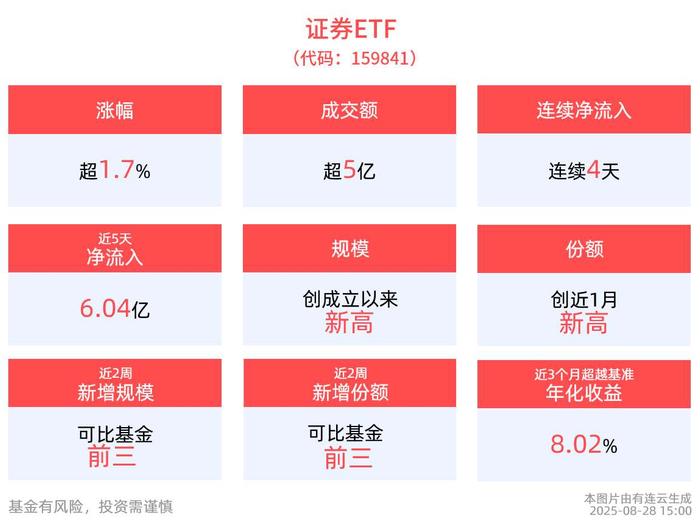
成交量3万亿新常态,深市最大的证券ETF(159841)近4日“吸金”6.5亿元,规模续创新高!
Xin Lang Cai Jing· 2025-08-29 01:47
Group 1 - The A-share market experienced a collective rebound on August 28, 2025, with the ChiNext Index leading the gains and the Sci-Tech 50 Index significantly rising. The semiconductor sector was the top performer, with AI hardware segments such as CPO, PCB, and lithography machines showing strong growth. The market's activity level has been consistently increasing, with an average daily trading volume of 3 trillion yuan becoming the new norm [3] - The Securities ETF (159841) rose by 1.78% with a turnover of 7.89%, achieving a transaction volume of 539 million yuan. Key constituent stocks such as Xinda Securities (601059), Xiangcai Securities (600095), and Great Wall Securities (002939) saw increases of 6.38%, 4.51%, and 4.04% respectively [3] - The latest scale of the Securities ETF (159841) reached 6.951 billion yuan, marking a new high since its inception. The latest share count reached 5.786 billion shares, the highest in nearly a month [3] Group 2 - The Securities ETF (159841) has been closely tracking the CSI All Share Securities Company Index, which focuses on large-cap securities leaders in the A-share market, including both traditional and fintech leaders. The ETF also allocates to off-market securities ETF linked funds [4] - On the same day, several leading brokerages reported their semi-annual performance, with CITIC Securities, known as the "king" of brokerages, achieving an operating income of 33.039 billion yuan, a year-on-year increase of 20.44%, and a net profit attributable to shareholders of 13.719 billion yuan, up 29.80%, marking the best mid-year performance in history [4] - Other brokerages such as China Galaxy Securities, CITIC Jiantou, and China Merchants Securities also reported impressive results, with both revenue and net profit showing year-on-year growth, indicating a positive operational trend [5] Group 3 - East China Securities noted that the recent disclosure of interim reports by listed brokerages reflects a significant improvement in performance driven by a recovering capital market, suggesting that all brokerage business segments are expected to show notable marginal improvements. The firm recommends paying attention to the investment opportunities arising from the disclosure window period [5]



存款搬家进A股?机构:仍是起步期
3 6 Ke· 2025-08-22 10:11
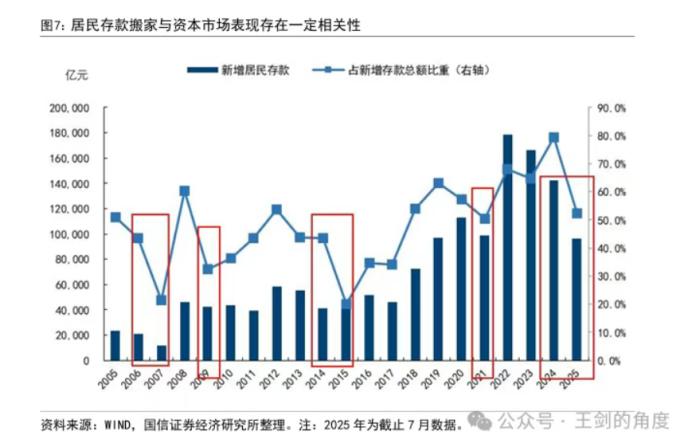
Core Viewpoint - The article discusses the phenomenon of "deposit migration" among residents in China, driven by declining deposit rates and improving capital market performance, indicating a potential shift of funds from banks to non-bank financial institutions and the stock market [1][2][3]. Group 1: Reasons for Deposit Migration - The continuous decline in deposit rates is a significant factor driving deposit migration, as residents seek higher returns in capital markets [2]. - Historical patterns show that deposit migration is a common response to changing market conditions, with previous instances occurring in 2006-2007, 2009, 2012-2015, and currently in 2024-2025 [2][3]. - The current low interest rate environment, with savings rates dropping to 0.2%-0.3% for demand deposits and some fixed deposits below 2%, has intensified residents' anxiety over returns, prompting a search for better investment opportunities [2]. Group 2: Potential Scale of Funds Released - Estimates suggest that the current round of deposit migration could release over 5 trillion yuan, with 90 trillion yuan in deposits maturing by 2025, and 5%-10% of these funds potentially seeking higher returns [6][7]. - The concept of "excess savings" accumulated since 2018, exceeding 30 trillion yuan, indicates a significant pool of funds that could be redirected towards consumption or investment [6][7]. Group 3: Impact on A-shares - The relationship between deposit migration and A-shares is complex, with historical data indicating that stock market performance often precedes deposit migration [9][10]. - Past trends show that significant stock market gains typically occur before residents begin to move their deposits, suggesting that the migration is a reaction to established market conditions rather than a catalyst for market growth [9][10]. Group 4: Flow of Funds - The initial phase of deposit migration is expected to favor stable assets such as bank wealth management products and money market funds, with a gradual shift towards equity assets as market conditions stabilize [11][12]. - The potential for indirect entry into the equity market through "fixed income plus" products is highlighted, allowing residents to maintain a balance between stable returns and equity exposure [13]. Group 5: Conditions for Future Migration - Four key conditions for a new round of deposit migration are identified: continued decline in deposit rates, expansion of liquidity, emerging asset profitability, and supportive policies [14]. - The pace of fund migration is anticipated to accelerate as the stock market shows sustained performance, with evidence of increased margin trading and insurance company investments in equities [14][15].

存款搬家进A股?机构:仍是起步期
财联社· 2025-08-22 09:10
Core Viewpoint - The article discusses the phenomenon of "deposit migration" in China, where residents are shifting their savings from banks to non-bank financial institutions and capital markets due to declining deposit interest rates and improving stock market performance [3][4][6]. Group 1: Reasons for Deposit Migration - The continuous decline in deposit interest rates is a significant factor driving deposit migration, as residents seek higher returns in capital markets [3][4]. - Historical patterns show that deposit migration has occurred multiple times since 2005, with low interest rates being a key driver, but capital market performance being the core motivator [3][4]. - As of 2022, the interest rates for savings accounts have dropped to 0.2%-0.3%, prompting residents to look for better investment opportunities [3][4]. Group 2: Potential Scale of Funds Released - Estimates suggest that the current round of deposit migration could release over 5 trillion yuan into the capital markets, based on excess savings and maturing deposits [6][7]. - Specifically, over 30 trillion yuan in excess savings has been accumulated since 2018, with 5 trillion yuan formed post-2022 likely to be more flexible for investment [7]. - By 2025, over 90 trillion yuan in deposits are expected to mature, with 5%-10% potentially seeking higher returns, translating to a possible outflow of 4.5 trillion to 9 trillion yuan [7]. Group 3: Impact on A-shares - The relationship between deposit migration and A-shares is complex, with historical data indicating that stock market performance often precedes significant deposit migration [8][10]. - Past trends show that deposit migration typically accelerates in the later stages of a bull market, suggesting caution as this could indicate a market peak [10]. - Current data indicates that the ratio of household deposits to total stock market value remains high, suggesting ample room for wealth reallocation into equities [10]. Group 4: Asset Allocation Trends - Initially, funds from deposit migration are expected to flow into stable assets such as bank wealth management products and money market funds, reflecting residents' risk aversion [11][12]. - Over time, as market conditions stabilize, a gradual shift towards equity assets is anticipated, supported by favorable policies and market performance [14][18]. - By 2025, it is projected that approximately 70% of the migrating funds will be allocated to stable assets, with 25% directed towards equities [12][14]. Group 5: Conditions for Future Deposit Migration - Four key conditions for a new round of deposit migration have been identified: declining deposit rates, liquidity expansion, emerging asset profitability, and supportive policies [15][17]. - Historical patterns indicate that deposit migration often follows a significant stock market rally, with a lag as residents confirm market trends [16][17]. - The current environment shows that all conditions for a potential new wave of deposit migration are in place, suggesting an increasing likelihood of funds flowing into the capital markets [17][18].



居民存款“搬家” 7月非银存款大增2.14万亿元
Sou Hu Cai Jing· 2025-08-19 01:20
Group 1 - The core viewpoint of the articles highlights a significant shift in deposit trends, with a notable increase in non-bank financial institution deposits and a decrease in household deposits, indicating a "seesaw" effect between the two [2] - In July, new RMB deposits increased by 500 billion, with household deposits decreasing by 1.11 trillion and non-bank financial institution deposits rising by 2.14 trillion, marking the highest level since 2015 [2] - The analysis suggests that the recovery of the capital market and declining interest rates are the main drivers behind the movement of funds from banks to non-bank financial institutions [2] Group 2 - Current market entry funds are primarily from high-net-worth investors, including private equity, leveraged funds, and speculative capital, while retail investor participation remains cautious [3] - Data indicates that retail investors' participation is lower than the previous year's market surge, with limited net buying amounts and a marginal decline in bank-securities transfer balances [3] - The phenomenon of fund migration reflects a trend towards diversified asset allocation among residents, although market volatility risks should be monitored [3]

资本市场回暖信号释放,睿盛环球融资新机遇
Sou Hu Cai Jing· 2025-08-15 02:39
Group 1 - The capital market is showing positive signals, with increased activity in domestic markets like the Sci-Tech Innovation Board and the Beijing Stock Exchange, as well as renewed interest from international markets in quality targets, creating new financing opportunities for companies [1] - Improved risk appetite among investment institutions and enhanced investment efficiency are key benefits of the capital market recovery, particularly for companies in expansion, technology iteration, or market development phases [1] - Companies that can respond promptly to market changes and implement precise financing strategies will gain a competitive edge [1] Group 2 - Ruisheng Global has extensive practical experience in corporate financing and capital operations, offering tailored financing paths based on the industry, development stage, and capital needs of clients [3] - The company provides comprehensive services in the IPO field, including risk assessment, financial compliance, valuation modeling, and investor roadshow planning to ensure successful market entry [3] - For companies seeking international expansion, cross-border financing remains a viable option, with Ruisheng Global leveraging its global network to match clients with overseas investors and strategic partners [3] Group 3 - The existence of a limited financing window necessitates proactive preparation; companies should not wait until urgent needs arise to start their financing efforts [5] - Ruisheng Global advocates for a strategy of "early layout and step-by-step advancement," encouraging companies to optimize internal governance, adjust financial structures, and refine business models during favorable market conditions [5] Group 4 - The current recovery in the capital market presents rare funding and resource allocation opportunities for various enterprises [6] - Ruisheng Global will continue to leverage its deep experience in capital markets and international resources to develop practical financing strategies that support clients in achieving leapfrog development [6]

7月非银存款同比激增 居民存款入市信号增强
Sou Hu Cai Jing· 2025-08-14 16:49
Core Viewpoint - The significant increase in non-bank deposits indicates a trend of residents shifting their savings towards financial products, influenced by a recovering capital market and declining interest rates [1][2][6]. Group 1: Non-Bank Deposits - In July, non-bank deposits increased by 2.14 trillion yuan, a year-on-year increase of 1.39 trillion yuan, while household deposits decreased by 1.1 trillion yuan [2]. - The total increase in non-bank deposits from January to July reached 4.69 trillion yuan, which is 1.73 trillion yuan more than the same period last year [2]. - Analysts attribute the shift from household deposits to non-bank deposits to the recent stock market rally and the end of the mid-year bank assessment period [2][4]. Group 2: Money Supply and Liquidity - The M2 growth rate increased by 0.5 percentage points to 8.8% in July, surpassing market expectations of 8.3% [2]. - M1 growth rate rose to 5.6%, a 1.0 percentage point increase from the previous month, indicating enhanced liquidity in the market [2][3]. - The narrowing of the M1-M2 gap to -3.2% suggests an increase in the liquidity of funds, as residents and businesses convert time deposits into demand deposits for consumption or investment [3]. Group 3: Capital Market Outlook - There is a strong expectation that capital markets will become a significant destination for the outflow of household deposits, supported by a large volume of maturing deposits [4][5]. - By 2025, approximately 105 trillion yuan of time deposits will mature, which could lead to substantial liquidity impacts if these funds flow into asset markets [5]. - The current environment of declining deposit attractiveness and ongoing asset scarcity is expected to drive more funds into the capital market, potentially increasing trading activity and stock price elasticity [6]. Group 4: Monetary Policy and Economic Signals - Despite recent market optimism, July's financial data revealed a slowdown in demand, with new credit showing a negative growth for the first time in 20 years [7]. - The implementation of fiscal subsidy policies is expected to support the economy without necessitating further monetary easing [8]. - Analysts suggest that while the economic recovery may be slow, the increase in M1 growth and the activation of deposits are positive signals for future economic momentum [7][8].