
逼仓行情

Search documents
又创新高!白银年内涨超125%成黑马 机构解读后市
2 1 Shi Ji Jing Ji Bao Dao· 2025-12-17 07:11
Core Viewpoint - The silver market has reached historic highs, with prices increasing over 125% this year, significantly outperforming gold, which has risen around 64% during the same period [1]. Market Performance - On December 17, silver futures on the Shanghai Futures Exchange peaked at 15,477 yuan per kilogram, marking a rise of over 4% and setting a record since the contract's inception [1]. - In the international market, COMEX silver prices surged over 3%, reaching a peak of $65.909 per ounce, while London silver also hit a high of $66.005 per ounce [1]. Market Dynamics - The recent surge in silver prices is attributed to strong overseas demand for physical silver, which is currently being hoarded rather than flowing into industrial use, creating a concentrated squeeze effect [1]. - Market sentiment is heavily influenced by speculative activities, contributing to the upward pressure on silver prices [1]. Supply and Demand Outlook - A structural supply-demand gap is expected to support silver prices, with global silver demand projected to reach 36,207 tons in 2024, of which industrial demand will account for 58.5% [2]. - The compound annual growth rate (CAGR) for industrial silver demand from 2019 to 2024 is estimated at 5.4%, contributing to 98% of the total growth in silver demand during this period [2]. - On the supply side, the CAGR for global silver supply from 2024 to 2027 is forecasted to be only 1.2%, leading to an increasing supply-demand gap from 4,498 tons in 2025 to 6,791 tons by 2027 [2]. Regulatory Actions - In response to the overheated silver market, regulatory authorities have adjusted margin requirements and price fluctuation limits for silver futures contracts [3]. - The margin for holding positions in the AG2602 silver futures contract has been set at 16%, with a general trading margin of 17% [3]. Investment Recommendations - Investors are advised to consider more stable alternatives like gold or explore new products such as platinum and palladium, as current silver volatility may pose risks [3].
白银再创新高,年内大涨超125%成黑马
2 1 Shi Ji Jing Ji Bao Dao· 2025-12-17 05:40
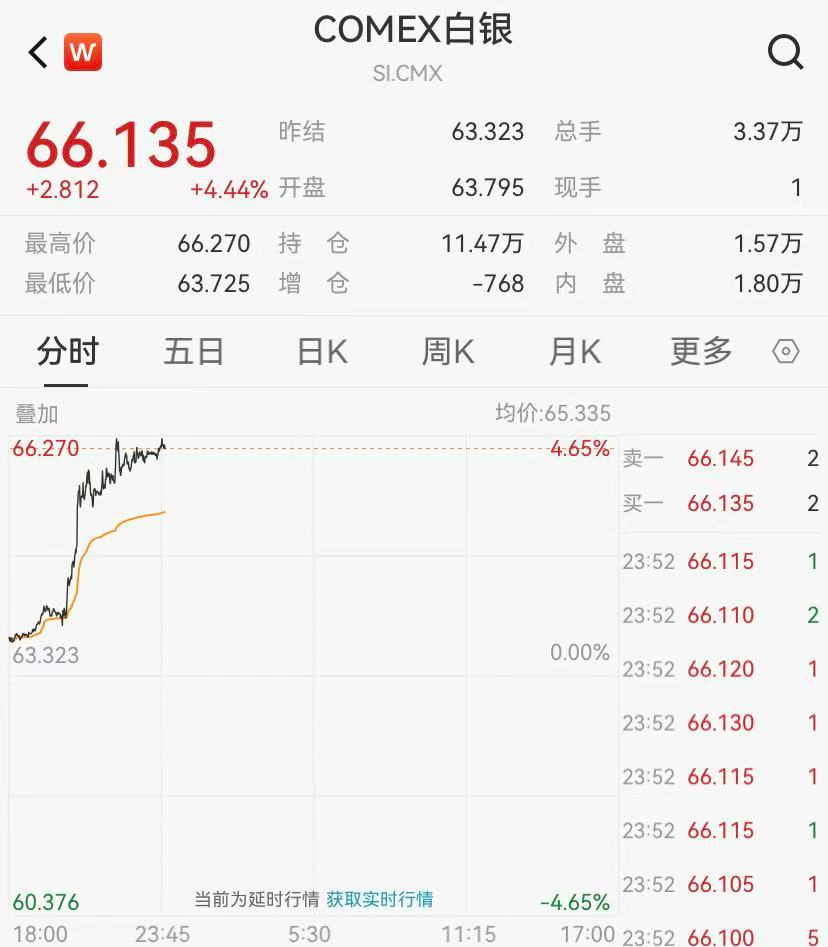
Core Insights - The silver market has reached a historic moment with significant price increases in both domestic and international markets, with Shanghai Futures Exchange silver futures hitting a record high of 15,477 yuan per kilogram, up over 4% [1] - Internationally, COMEX silver surged over 4%, peaking at $66.27 per ounce, while London silver also reached a high of $66.068 per ounce, both marking new highs since their listings and showing year-to-date increases exceeding 125%, significantly outperforming gold's approximately 64% rise [1] Market Dynamics - The current surge in silver prices is attributed to strong overseas demand for physical silver, which is primarily being stockpiled rather than flowing into industrial use, creating a concentrated squeeze effect [4] - Market sentiment remains bullish, with predictions suggesting that while the emotional trading may stabilize after Q1 2026, there is still upward momentum above $60 in the short term, with potential new price levels between $50 and $60 [4] Supply and Demand Fundamentals - A structural supply-demand gap is providing solid support for rising silver prices, with global silver demand projected to reach 36,207 tons in 2024, of which industrial demand accounts for 58.5% [5] - The compound annual growth rate (CAGR) for industrial silver demand from 2019 to 2024 is expected to be 5.4%, contributing to 98% of the total increase in silver demand during this period [5] - In contrast, silver supply is projected to grow at a CAGR of only 1.2% from 2024 to 2027, leading to an increasing supply-demand gap, which is expected to widen from 4,498 tons in 2025 to 6,791 tons by 2027 [5] Regulatory Actions - In response to the overheated silver market, regulatory authorities have adjusted trading margins and price limits for silver futures contracts to manage volatility [6] - Recommendations for investors include prioritizing more stable investments like gold or exploring platinum and palladium, while advising caution in the silver market due to increased volatility [6]

白银再创新高,年内大涨超125%成黑马
21世纪经济报道· 2025-12-17 05:35
Core Viewpoint - The silver market has reached a historic moment with significant price increases in both domestic and international markets, driven by strong demand and speculative sentiment [1][4]. Market Performance - On December 17, the main silver futures contract on the Shanghai Futures Exchange peaked at 15,477 yuan per kilogram, marking a rise of over 4% and setting a new record since its listing [1]. - In the international market, COMEX silver rose over 4%, reaching a peak of $66.27 per ounce, while London silver also saw gains, hitting $66.068 per ounce, with both core products achieving over 125% growth year-to-date, significantly outperforming gold [1]. Demand and Supply Dynamics - The global silver demand is projected to reach 36,207 tons in 2024, with industrial demand accounting for 58.5%. The compound annual growth rate (CAGR) for industrial silver demand from 2019 to 2024 is expected to be 5.4%, contributing 98% to the total growth in silver demand during this period [5]. - The supply side is characterized by rigidity, with a forecasted CAGR of only 1.2% for global silver supply from 2024 to 2027. The supply-demand gap is expected to widen from 4,498 tons in 2025 to 6,791 tons by 2027 [5]. Market Sentiment and Speculation - Current market sentiment is heavily influenced by strong overseas demand for silver, primarily in stockpiling rather than industrial use, creating a concentrated squeeze-like scenario. This, combined with heightened speculative activity, has contributed to the surge in silver prices [4]. - Short-term predictions suggest that while silver prices may stabilize after Q1 2026, there remains upward momentum above $60, with potential new support levels between $50 and $60 [5]. Regulatory Actions - In response to the overheated silver market, regulatory bodies have adjusted trading margin requirements and price fluctuation limits for silver futures contracts to mitigate excessive volatility [6]. Investment Recommendations - Analysts suggest that investors may consider more stable alternatives like gold or explore new products such as platinum and palladium, given the increased volatility in silver prices. It is advised to implement timely profit-taking and stop-loss strategies to manage risks effectively [6].

抢粮、惜售!玉米2601罕见涨过2605,逼仓行情?
Hong Ye Qi Huo· 2025-12-05 06:47
Group 1: Investment Rating - No investment rating information provided Group 2: Core Views - The main corn 2601 contract has seen a rare continuous sharp rise and formed a squeeze market, with a premium over the far - month 2605 contract. The spot price has risen steadily but with a small increase, and the corn basis has continued to weaken. The main starch 2601 contract has followed the corn's continuous rebound, and its basis has weakened in an oscillating manner. The new grain sales are accelerating, the market's grain - grabbing and stockpiling sentiment is rising, but the main futures price of the 2601 contract has shown an irrational rise. It is recommended that grain - using enterprises purchase spot goods on dips and moderately increase safety reserves, and traders buy low and sell high. Do not chase the high of the 2601 contract, and pay attention to the low - price opportunities of the 2605 contract [4][7] Group 3: Summary of Key Factors Supply - side Factors - **Grain - grabbing and hoarding in the Northeast**: Due to the serious differentiation of grain quality in North China, the damaged corn offsets the impact of the national corn production increase. Industrial players go to the Northeast to stockpile grain actively. The cold weather makes corn easy to store, and farmers are reluctant to sell, expecting price increases. As of December 4th, the national grain sales progress was 36%, 5% faster than the same period last year, with the Northeast region being 34%, 9% faster [4] - **Port inventory and downstream demand**: As of November 28th, the corn inventory in the northern ports was 136900 tons and continued to rise, while the weekly shipping volume was 53500 tons, a decline from the previous week. The domestic - trade corn inventory in Guangdong Port was 18100 tons and continued to decline, and the foreign - trade corn inventory was 33600 tons, a slight increase. Downstream deep - processing procurement has slowed down, while feed enterprises are still increasing their inventory. As of December 5th, the corn inventory of deep - processing enterprises was 275400 tons, a slight increase, and the corn inventory of feed enterprises was 28.67 days and continued to rise, but still lower than the same period in previous years [4] - **Grain substitution and imports**: The price difference between wheat and corn has narrowed to around 177, and substitution is still not feasible. In October, domestic corn imports rebounded significantly, with 35900 tons imported, a five - fold increase from the previous month and a 114.7% increase year - on - year. From January to October, the cumulative import volume was 129200 tons, a 90.2% decrease year - on - year. Imports of barley and other grains decreased month - on - month. If the domestic corn supply is tight in the later stage, there may be a possibility of expanding and resuming imports [5] - **Foreign market situation**: The US corn in the external market has continued to rebound in an oscillating manner, but the amplitude is limited. Attention should be paid to the guidance of the US Department of Agriculture's December supply - demand report [5] Demand - side Factors - **Feed demand**: Pig prices are low, and pig farming is suffering large losses. As of December 5th, the profit of purchasing piglets for breeding was -$259.39 per pig, and the self - breeding and self - raising profit was -$167.69 per pig, both with increasing losses. The adjustment of the sow inventory is slow. In September, the national sow inventory was 40.35 million, a decrease of 30000 from the previous month, far from the regulatory target. The sow inventory of large - scale farms increased in October. Market pig retention and secondary fattening have increased. At the end of the third quarter, the live - pig inventory was 436.8 million, a 29% increase from the previous quarter and a 23% increase year - on - year. In the short term, the inventory is difficult to decrease. In the poultry sector, egg prices have fallen, egg - laying hen farming has continued to lose money, chicken - chick sales have decreased, and the culling of old hens has increased. In October, the inventory of laying hens in production decreased slightly. Feed demand is relatively strong. In October, the national industrial feed production was 2.907 million tons, a month - on - month increase and a 6% year - on - year increase [6] - **Deep - processing demand**: The processing profits of starch processing enterprises have been differentiated, and the operating rate has stopped falling and rebounded. As of December 5th, the operating rate of starch processing enterprises was 61.66%, a month - on - month increase. Starch inventory remains at a high level and continues to decline. Alcohol processing enterprises are still in a loss, but the operating rate is at a high level of 70.28%. The operating rate of downstream starch - sugar enterprises is insufficient, while the operating rate of paper - making enterprises is relatively strong [6]
锌:外盘支撑
Guo Tai Jun An Qi Huo· 2025-10-22 02:09
Report Summary 1. Report Industry Investment Rating - No investment rating provided in the report 2. Core Viewpoints - The zinc market shows external support, with the LME zinc market facing a severe squeeze due to Western smelter production cuts and depleting inventories, leading to a significant increase in the spot premium [2] - The zinc trend strength is neutral, with a value of 0 [3] 3. Summary by Relevant Catalogs 3.1 Fundamental Tracking - **Prices**: The closing price of SHFE zinc main contract was 21,970 yuan/ton, up 0.55%; the LME zinc 3M electronic disk closed at 2,976 dollars/ton, up 1.24% [1] - **Volumes and Positions**: The trading volume of SHFE zinc main contract was 108,521 lots, an increase of 10,835 lots; the LME zinc trading volume was 8,609 lots, a decrease of 2,492 lots. The open interest of SHFE zinc main contract was 130,442 lots, an increase of 5,270 lots; the LME zinc open interest was 224,013 lots, a decrease of 200 lots [1] - **Premiums and Discounts**: The premium of Shanghai 0 zinc was -50 yuan/ton, a decrease of 10 yuan/ton; the LME CASH - 3M premium was 230.29 dollars/ton, an increase of 100.29 dollars/ton [1] - **Inventories**: SHFE zinc futures inventory was 66,268 tons, a decrease of 151 tons; LME zinc inventory was 37,275 tons, a decrease of 50 tons [1] 3.2 News - **LME Zinc "Squeeze"**: The LME zinc market is experiencing its most severe squeeze in decades, with available zinc inventories less than one - day's demand and the spot premium soaring to the highest level since 1997 [2] - **Russia - Ukraine Process**: The preparation for the "Trump - Putin meeting" has encountered obstacles, and the call for an "immediate cease - fire" by European countries has created uncertainty for the meeting [2][3] 3.3 Trend Strength - The zinc trend strength is 0, indicating a neutral outlook [3]
贵金属盘中跳水不期而至 投资者忧心“高处不胜寒”
Zheng Quan Shi Bao· 2025-10-14 17:40
Core Insights - Precious metals, particularly gold and silver, have reached historic highs, with gold surpassing $4,000 and silver hitting a 45-year peak, drawing significant market attention [1][2] - Despite the recent surge, there are concerns about short-term volatility, leading some institutions to adopt a cautious stance on precious metals [1][3] Market Performance - On October 14, gold futures rose initially but faced a significant drop, with gold futures down 3% at one point and silver futures fluctuating over 6%. By the end of the day, gold futures closed at 938.98 yuan per gram, up 2.7%, while silver futures closed at 11,533 yuan per kilogram, also up 2.64% [2] - The London spot market saw gold prices recover above $4,100 after a brief decline [2] Drivers of Price Movement - The recent surge in precious metals is attributed to the "TACO trade" initiated by the Trump administration, alongside a liquidity crisis in the silver market that has driven prices higher [2][4] - The Philadelphia Fed's new chair's support for two more rate cuts this year, combined with the fragile Middle East ceasefire, has contributed to the bullish trend in precious metals [2] Institutional Outlook - Major U.S. institutions express a consensus of being "long-term bullish but short-term cautious" on precious metals. Bank of America raised its 2026 gold price target to $5,000 per ounce and silver to $65 per ounce, citing ongoing support from unconventional policies [3] - Goldman Sachs also sees potential for silver price increases driven by private investment inflows but warns of liquidity risks [3][5] Silver Market Dynamics - The silver market is experiencing a historic short squeeze, with London spot inventories down 75% since 2019, leading to soaring leasing rates and increased delivery costs for short sellers [4] - Year-to-date, silver prices have risen nearly 80%, outperforming gold recently [4] Long-term Investment Considerations - Despite gold's rise above $4,000, its unique safe-haven value remains highly regarded, with suggestions for investors to allocate 15% of their portfolios to gold [6] - Goldman Sachs predicts further increases in gold prices, raising its 2026 forecast to $4,900, driven by central bank diversification and expected rate cuts [7] - The ongoing strong performance of gold in 2025 is attracting renewed investor interest, with ETF inflows turning positive [8]
基本金属短期交易因素影响超过基本面
2025-06-30 01:02
Summary of Key Points from Conference Call Records Industry Overview: Non-Ferrous Metals Core Insights and Arguments - **Copper Price Expectations**: The anticipated copper price for 2025 is around $10,000 per ton, aligning with current fundamentals. The decline in the spot-futures price spread indicates a rationalization of speculative sentiment, with large enterprises slowing down purchases [1][4]. - **Weakening Fundamentals**: The non-ferrous metals sector has shown a marginal weakening over the past three to four weeks, with inventory levels for copper and aluminum halting their decline and slightly increasing. Downstream operating rates, processing fees, and profitability for copper and aluminum are all on a downward trend [1][6]. - **Seasonal Weakness**: The non-ferrous metals market is expected to enter a traditional off-season from July to early August 2025, with high temperatures and holidays negatively impacting consumption. Previous tariff policies have preemptively exhausted some demand, posing short-term risks of returning to fundamental market conditions [1][7]. - **Valuation and Price Caution**: The current valuation of the non-ferrous metals sector is neutral, with commodity prices and sector valuations reflecting caution [1][8]. Additional Important Insights - **Aluminum Industry Conditions**: The aluminum sector is experiencing weak conditions, with aluminum rod margins at their lowest in nearly a year. While aluminum rod factory inventories have decreased by approximately 16,000 to 17,000 tons, social inventories have increased by over 10,000 tons, indicating weak demand [1][9]. - **Copper Demand and Inventory**: Copper demand is relatively weak, with electrolytic copper production declining for four consecutive weeks while factory inventories are rising, indicating insufficient demand. Downstream copper rod production has also decreased for three weeks, further confirming the downward trend in demand [1][10]. - **Future Price Adjustments**: It is expected that commodity prices may undergo two adjustments in the coming year, influenced by short-term factors such as tariff-related behaviors and seasonal effects, as well as the long-term negative impacts of U.S. tariff policies [1][11]. Industry Overview: Gold Core Insights and Arguments - **Gold Price Stability**: Short-term inflation expectations support gold prices, with significant adjustments unlikely. Long-term support for gold prices is provided by central bank purchases in emerging markets, with expectations for gold prices to fluctuate between $3,100 and $3,400 [2][12]. Additional Important Insights - **Investment Opportunities**: The current investment climate suggests that as other sectors present more opportunities, the opportunity cost of holding gold is high. However, as gold prices adjust to reasonable levels, capital may flow back into gold [2][13]. Industry Overview: Steel Core Insights and Arguments - **Steel Industry Performance**: The steel industry performed well in Q1, with Q2 profitability levels expected to remain similar. Investment opportunities may arise if "anti-involution" policies are extended to the steel sector, potentially improving profit margins [14]. Industry Overview: Minor Metals Core Insights and Arguments - **Investment Opportunities in Tungsten and Cobalt**: There are notable investment opportunities in tungsten and cobalt, with tungsten prices currently stabilizing at high levels. The demand for tungsten is supported by growth in electronics and new energy vehicles, while cobalt may see significant changes in July and August due to inventory dynamics [15].