现货升水

Search documents
深夜,集体飙升!暴涨50%!黄金、白银,却突然跳水!发生了什么?
券商中国· 2026-03-02 15:09
Group 1: Energy Market Dynamics - European natural gas futures surged by over 50% due to drone attacks on Qatari LNG facilities, which are crucial as Qatar accounts for approximately 20% of global LNG exports [1][4] - The price of European diesel futures spiked by 23%, reaching a two-year high, significantly outpacing the 8% increase in Brent crude oil prices [1][4] - The conflict in the Middle East has disrupted oil tanker traffic through the Strait of Hormuz, impacting the supply of over 4 million barrels of oil products daily [5] Group 2: Precious Metals Reaction - Spot silver experienced a sharp decline, with intraday losses nearing 6%, while gold's gains were reduced to under 1% [2] - Analysts suggest that the drop in precious metals may be attributed to profit-taking by investors [2] Group 3: Stock Market Response - The U.S. stock market showed a V-shaped recovery after an initial decline, with major indices like the Dow Jones and S&P 500 reducing their losses to below 1% [3]


中国市场仍挤压白银供应 COMEX银激战92/64美元关键位
Jin Tou Wang· 2026-02-13 08:25
Core Viewpoint - Silver prices are experiencing upward pressure due to ongoing consumption in China's investment and industrial sectors, leading to a tight supply situation and significant premiums in the spot market [3]. Group 1: Market Dynamics - March silver futures rose by $3.121 to $83.505 per ounce during the Asian trading session on February 12 [1]. - Despite recent price volatility, silver's price fluctuations have narrowed, indicating a more stable market environment [3]. - Domestic producers and traders are facing significant challenges in fulfilling backlogged orders, which has contributed to rising prices and a situation where spot prices exceed futures prices [3]. Group 2: Supply and Demand Factors - The current tight supply of silver is attributed to ongoing inventory depletion and a severe shortage of deliverable silver, prompting institutions to continue exerting pressure on the market for profit [3]. - The Shanghai Futures Exchange has seen recent contracts trading at record premiums, reflecting strong market preference for physical delivery [3]. - Short sellers in the Shanghai Gold Exchange have been paying carry costs to long positions since late December to avoid delivery, highlighting the scarcity of available silver for settlement [3]. Group 3: Price Resistance and Support Levels - The bullish target for March silver futures is to successfully break above the strong resistance level of $92.015, while the bearish target is to drop below the strong support level of $63.90 [4]. - Key resistance levels are identified at $86.12 and $87.50, while the first support level is at $80.41, followed by $80.00 [4].
GTC泽汇资本:避险需求升温 金银价格强势反弹
Xin Lang Cai Jing· 2026-02-12 13:25
Core Viewpoint - The precious metals market is experiencing a significant upward trend due to increased safe-haven demand ahead of key employment reports, with gold and silver prices showing resilience, particularly silver leading the gains [1][4]. Group 1: Market Performance - As of February 12, April gold futures have reached $5,119.10, while March silver prices have risen to $85.465, indicating a positive rebound in the overall market [1][4]. - The market is characterized by a cautious sentiment as investors await the January non-farm payroll report, influenced by previous government shutdowns that delayed data releases [1][5]. Group 2: Supply and Demand Dynamics - A tight supply of physical metals is supporting prices, with Asian market investment and industrial demand rapidly depleting inventories, leading to order backlogs for local producers [5]. - The Shanghai Futures Exchange's near-month contracts have reached record premiums, indicating a market deeply entrenched in a backwardation structure due to a delivery material shortage [5]. Group 3: External Market Influences - A slight pullback in the US dollar and rising oil prices are creating favorable conditions for gold and silver to rise [2][5]. - GTC Zhehui Capital identifies short-term targets for gold bulls at the resistance level of $5,250.00 and for silver bulls at $92.015, suggesting strong support dynamics in the precious metals market amid inflationary pressures and macroeconomic uncertainties [2][5].

国际银价趋稳之际,中国白银现货仍趋紧:上期所近月合约创纪录升水
Hua Er Jie Jian Wen· 2026-02-11 05:11
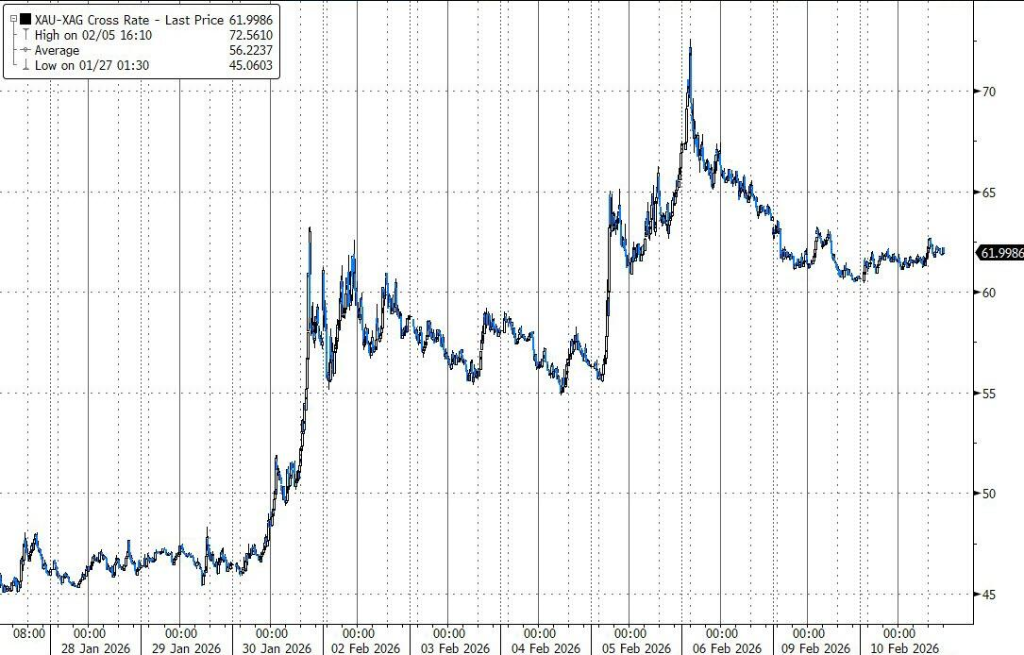
Core Viewpoint - International silver prices have stabilized after significant fluctuations, but supply tightness in the Chinese market persists, driven by investment and industrial demand depleting inventories [1]. Group 1: Market Conditions - As of February 10, international spot silver prices are fluctuating around $80 per ounce, with the gold-silver ratio stabilizing near 61 times [1][2]. - The Shanghai Futures Exchange's near-month silver contract premium has surged to record levels, indicating strong demand for immediate delivery silver [3]. Group 2: Supply and Demand Dynamics - The extreme spot premium is driven by a supply crisis and depletion of deliverable materials, with silver inventories at the Shanghai Futures Exchange and Shanghai Gold Exchange at their lowest levels in over a decade [3]. - Analysts believe the tight supply situation is unlikely to ease in the short term unless smelters can significantly increase production during the upcoming Chinese New Year holiday, which is traditionally a low production season [3]. Group 3: Investment and Industrial Demand - Current market demand is fueled by two main drivers: sustained high physical investment demand and concentrated procurement in industrial sectors such as solar energy [4]. - In Shenzhen, the largest gold and jewelry wholesale market in China, demand for silver investment bars remains strong, with sellers quickly finding buyers willing to pay premiums [5]. - Industrial demand is also a significant factor, as Chinese solar manufacturers require large amounts of silver for photovoltaic panel production, leading to increased purchasing ahead of the April 1 export tax rebate policy expiration [7].
伦敦金银价格罕见反超纽约
Di Yi Cai Jing· 2026-01-22 07:31
Core Viewpoint - The London spot prices for gold and silver have surpassed the New York COMEX futures prices, marking a rare market anomaly that typically occurs under extreme supply-demand imbalances [1]. Group 1: Price Comparison - As of 15:10 Beijing time, the London gold spot price was reported at $4,832 per ounce, while the COMEX gold futures price was at $4,826 per ounce [1]. - The London silver spot price was $94 per ounce, compared to the COMEX silver futures price of $93 per ounce [1]. Group 2: Market Implications - The unusual situation of London spot prices exceeding COMEX futures prices could lead to supply-demand imbalances and hinder arbitrage opportunities, potentially triggering cross-market adjustments [1]. - This scenario may result in increased borrowing rates and heightened short squeeze risks in the short term [1].
LME铜现货溢价飙升!创纪录价差暗示库存争夺战打响
Jin Shi Shu Ju· 2026-01-20 12:17
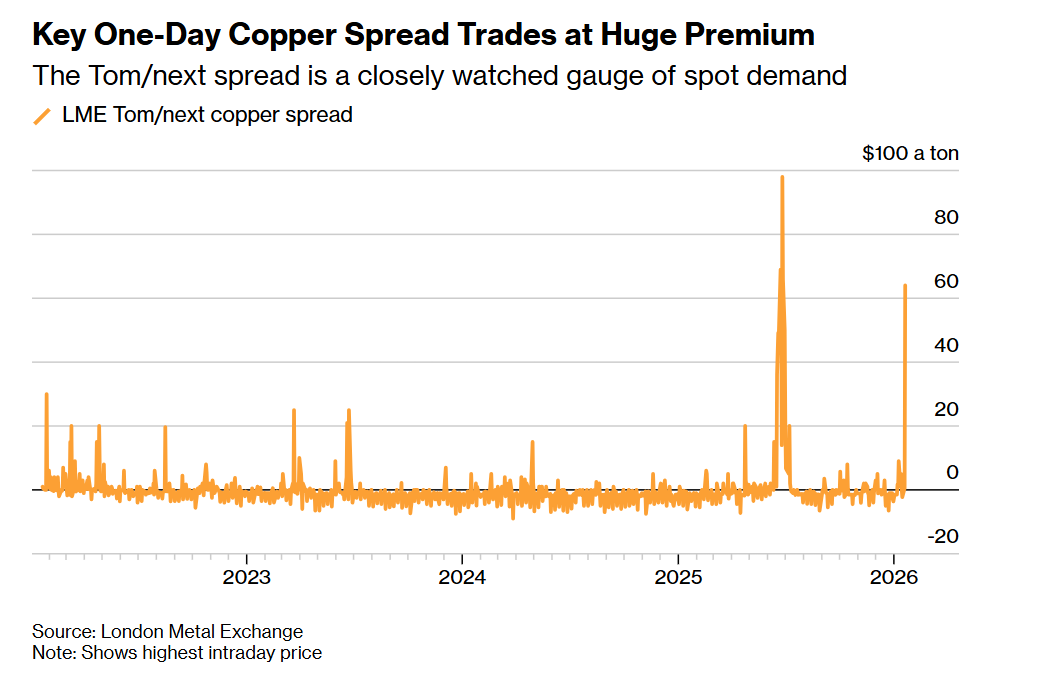
Group 1 - The LME copper spot price has significantly risen compared to future contract prices, indicating that traders may be extracting large amounts of inventory from the exchange's warehouses [1] - The premium for the copper contract expiring on Wednesday was $64 higher than the next day's contract, a market condition known as backwardation, suggesting an increase in immediate demand [1] - This price movement is among the highest levels recorded since 1998, reflecting increased volatility in the LME copper market [1] Group 2 - As of Thursday, three independent institutions held at least 30% of the open interest in the January contracts, which could allow them to withdraw over 160,000 tons of copper, exceeding the available inventory in the LME network [4] - The surge in the Tom/next spread indicates that short position holders may face significant losses if they do not roll over their contracts [4] Group 3 - The current market conditions signal a more severe structural supply constraint in the global copper industry, with many analysts predicting a deep shortage by the end of 2028 [5] - Although global copper inventories are currently sufficient, they are heavily concentrated in U.S. warehouses, leading to record shipments to the U.S. due to anticipated tariff changes [5] Group 4 - The recent increase in LME copper inventory, with an addition of 8,875 tons, brings the total to 156,300 tons, driven by inflows into New Orleans and Baltimore warehouses [8] - The fluctuations in the price spread have had minimal impact on the three-month copper contract, which experienced a maximum daily drop of 1.4% due to broader market sell-offs [8]
长江有色:美指下跌及多头强劲支撑 13日锌价或上涨
Xin Lang Cai Jing· 2026-01-13 03:17
Group 1 - The geopolitical risk premium is rising, and the continued decline of the US dollar index supports the zinc market, with overnight London zinc prices increasing by over 2% [1] - The overnight London zinc price opened at $3,157 per ton, reached a high of $3,222.5, and closed at $3,214, up $65 or 2.05%, with a trading volume of 11,180 lots [1] - The Shanghai zinc market also showed strength, with the main contract closing at 24,320 yuan per ton, up 250 yuan or 1.04% [1] Group 2 - The Chinese Ministry of Finance announced the cancellation of the VAT export rebate for photovoltaic products starting April 1, 2026, which is expected to trigger a rush for exports and create short-term demand benefits [2] - Domestic zinc smelting plants are experiencing increased losses, leading to further production cuts, while the import window for zinc concentrate has reopened after a significant reduction in losses [2] - Despite the recovery of production in previously restricted enterprises, the cold weather in northern China has dampened end-user purchasing enthusiasm, leading to cautious attitudes towards future demand and winter stockpiling [2]
贵金属数据日报-20260109
Guo Mao Qi Huo· 2026-01-09 03:07
Report Summary 1. Industry Investment Rating - Not provided in the given content. 2. Core Viewpoints - In the short term, gold and silver prices are expected to continue their weak performance with high volatility due to factors such as geopolitical risk subsiding, index adjustment concerns, and risk - control measures from the exchange. Long - term, the upward logic of precious metals remains intact, and investors can wait for opportunities to buy on dips after the current risks are released [5][6]. 3. Summary by Related Sections 3.1 Price Tracking - On January 8, 2026, London gold spot was at $4434.31/oz, down 0.2% from the previous day; London silver spot was at $76.44/oz, down 3.2%. COMEX gold was at $4442.80/oz, down 0.3%, and COMEX silver was at $76.12/oz, down 3.4%. Shanghai gold futures' main contract closed at 997.94 yuan/g, down 0.73%, and Shanghai silver futures' main contract closed at 18450 yuan/kg, down 5.91% [3][4]. - The price differences and their changes were also presented, such as the gold TD - SHFE active price difference, which decreased by 6.1% from January 7 to January 8 [4]. 3.2 Position Data - As of January 7, 2026, the gold ETF - SPDR held 1067.13 tons, with no change from the previous day. COMEX gold non - commercial long positions decreased by 5.02% compared to January 6 [4]. 3.3 Inventory Data - On January 8, 2026, SHFE gold inventory was 97653 kg, unchanged from the previous day, while SHFE silver inventory increased by 15.22% to 637647 kg [4]. 3.4 Interest Rates/Exchange Rates/Stock Market - On January 8, 2026, the USD/CNY central parity rate was 7.02, up 0.01% from the previous day. The US dollar index was 98.74, up 0.14% [4]. 3.5 Market Analysis - After the geopolitical risk in Latin America subsided, concerns about the adjustment of the Bloomberg Commodity Index and risk - control measures from the exchange led to a sharp decline in precious metal prices. In the short term, prices may remain weak and volatile. In the long term, the upward logic of precious metals remains valid [5][6].
新能源及有色金属日报:现货升水保持强势-20260108
Hua Tai Qi Huo· 2026-01-08 03:25
Report Summary 1. Investment Rating - Unilateral: Cautiously bullish. [5] - Arbitrage: Neutral. [5] 2. Core View - The spot market supply remains tight, with strong premium quotes from traders. Although downstream procurement is hesitant due to high prices, rigid demand still exists. The TC of domestic zinc mines has stopped falling, while that of imported mines is still slightly declining. After winter storage, smelters' raw material inventories have increased, but the available days are still low, and procurement demand remains. The comprehensive smelting losses of domestic smelters have widened, with more maintenance in December, and the supply pressure has decreased significantly month-on-month. There is a possibility that the output in January may fall short of expectations. The fundamental data is still bullish, and the market is optimistic about future consumption. The expectation of interest rate cuts remains unchanged, and re - inflation has not yet been reflected. The market sentiment may decline, but the decline range of zinc prices may be limited. [4] 3. Key Data Summary Spot Market - LME zinc spot premium is -$36.67/ton. SMM Shanghai zinc spot price is 24,300 yuan/ton, down 40 yuan/ton from the previous trading day, with a spot premium of 110 yuan/ton. SMM Guangdong zinc spot price is 24,210 yuan/ton, down 30 yuan/ton, with a spot premium of 20 yuan/ton. Tianjin zinc spot price is 24,220 yuan/ton, down 40 yuan/ton, with a spot premium of 30 yuan/ton. [1] Futures Market - On January 7, 2026, the main SHFE zinc contract opened at 24,300 yuan/ton and closed at 24,330 yuan/ton, up 195 yuan/ton from the previous trading day. The trading volume was 187,735 lots, and the open interest was 91,603 lots. The highest price during the day was 24,515 yuan/ton, and the lowest was 24,145 yuan/ton. [2] Inventory - As of January 7, 2026, the total inventory of zinc ingots in seven regions monitored by SMM was 114,800 tons, an increase of 8,700 tons from the previous period. As of the same date, LME zinc inventory was 105,500 tons, a decrease of 275 tons from the previous trading day. [3]
四万多吨铜搬去美国,国际铜商摩科瑞亮出底牌,就是要逼空铜
Sou Hu Cai Jing· 2025-12-06 00:39
Core Viewpoint - A Swiss trading company, Mercuria, executed a significant copper withdrawal from LME warehouses in Asia, indicating a strategic move to capitalize on price differentials and potential tariff implications in the U.S. market [1][3]. Group 1: Market Dynamics - Mercuria's withdrawal of over 40,000 tons of copper on December 2, valued at approximately $460 million, led to a surge in LME warehouse copper withdrawal requests, reaching the highest single-day increase since 2013 [1]. - The U.S. market is experiencing heightened demand for copper, driven by policy expectations and potential tariffs, prompting traders to rush shipments to the U.S. before any new tariffs are implemented [3][5]. - The current market conditions have resulted in a significant price disparity, with Comex copper futures trading over $1,400 per ton higher than LME prices, creating what Mercuria's executives describe as an optimal arbitrage opportunity [3]. Group 2: Inventory and Pricing Effects - The movement of copper to the U.S. has caused a severe imbalance in global inventory distribution, with U.S. warehouses overflowing while LME inventories are rapidly depleting; Mercuria's withdrawal accounted for 35% of LME's total inventory at that time [6]. - The drastic reduction in LME inventory has led to a sharp increase in spot prices, with the premium for immediate delivery copper rising to $88 per ton by early December, a reversal from the previous month when futures prices were higher [8]. - The upcoming LME contract settlement date on December 17 raises concerns for short sellers who may struggle to fulfill delivery obligations due to low inventory levels, potentially triggering a "short squeeze" that could further elevate prices [8]. Group 3: Supply Chain and Production Challenges - Global copper supply is under pressure, with significant production disruptions reported from major mines, including a projected reduction of 200,000 tons from Indonesia's Grasberg mine due to a landslide [11]. - Chilean copper mines are also facing operational issues, leading to lowered production targets, highlighting the fragility of the copper supply chain [11]. - The increasing demand for copper from sectors such as electric vehicles, renewable energy, and data centers is expected to sustain long-term growth in copper consumption, further complicating supply dynamics [11]. Group 4: Mercuria's Strategic Positioning - Mercuria has transitioned from a traditional oil trading giant to a significant player in the metals trading sector, employing a "light asset" model that leverages financial instruments to secure upstream supply agreements [13]. - The recent copper withdrawal exemplifies Mercuria's ability to influence market dynamics and pricing structures, showcasing its growing power in the copper market [13]. - The ongoing "copper relocation" led by trading giants like Mercuria is reshaping global resource flows, reflecting broader concerns over resource security amid geopolitical uncertainties [13].