
大模型

Search documents
软件板块开盘走高,软件ETF(515230)涨超1.5%,AI产业深化继续
Mei Ri Jing Ji Xin Wen· 2026-02-27 07:51
Group 1 - The software sector opened higher on February 27, with the software ETF (515230) rising over 1.5%, indicating a continued deepening of the AI industry [1] - Domestic advancements in AI, including large models and applications such as robotics, are meeting or slightly exceeding expectations, with significant new releases occurring around the Spring Festival [1] - The competition in large models may reshape the competitive landscape from the traffic entry point, while the overall bullish logic of the industry is strengthening despite further differentiation in competition [1] Group 2 - The software ETF (515230) tracks the software index (H30202), which selects listed companies involved in software development and services from the Shanghai and Shenzhen markets [1] - The software index reflects the overall performance of listed companies related to software, covering a wide range of representative enterprises in application software and system software [1] - This index serves as an important indicator of the overall development status and market trends within the software sector in the information technology field [1]
中国大模型token调用量首超美国!云天励飞20cm涨停,科创人工智能ETF汇添富(589560)大涨2%,科技龙头陆续发布财报,AI营收贡献突出!
Sou Hu Cai Jing· 2026-02-27 06:48
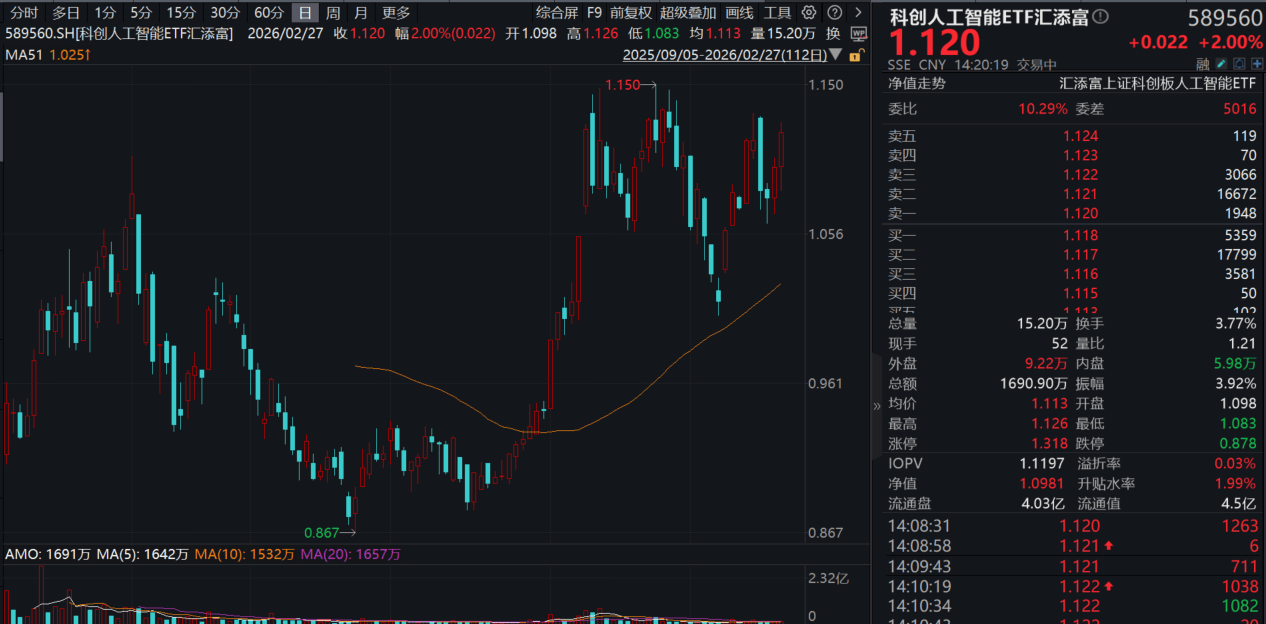
Group 1 - The A-share market experienced a volatile upward trend on February 27, with the AI sector remaining strong, particularly the computing power leasing segment, leading to a significant increase in the ETF Huatai-PineBridge AI (589560) by 2% [1] - The component stocks of the Huatai-PineBridge AI ETF showed mixed performance, with Yuntian Lifei hitting the daily limit up by 20%, Chipone Technology rising over 4%, and Fudan Microelectronics increasing by 2.5%, while other stocks like Lanke Technology and Kingsoft experienced pullbacks [2][3] Group 2 - As of February 27, 2026, China's token usage surpassed that of the United States for the first time, with a total of 4.12 trillion tokens used, indicating a growing dominance in AI model usage [6] - Baidu's recent financial report revealed that AI business revenue reached 40 billion yuan, accounting for 43% of its total revenue in Q4, exceeding market expectations [6] - The global foundry market is projected to grow from $155.6 billion in 2024 to $268.3 billion by 2032, driven by increasing demand for AI chips [7] - The semiconductor manufacturing equipment market is expected to reach $133 billion in 2025, with significant growth in NAND flash and DRAM equipment sales [8] - The shift from traditional SEO to GEO in AI applications is accelerating commercialization, with ByteDance's Doubao model projected to reach 100 million daily active users by the end of 2025 [9] - The Huatai-PineBridge AI ETF (589560) tracks a selection of 30 stocks, focusing on both hardware and software in the AI sector, benefiting from policy support, technological advancements, and stable growth fundamentals [9]


中国大模型第三股要来了?
Shang Hai Zheng Quan Bao· 2026-02-27 06:45
Core Viewpoint - AI model company Jumpspace is considering an IPO on the Hong Kong Stock Exchange within the year, aiming to raise approximately $500 million [1]. Group 1: Company Overview - Jumpspace was established in April 2023 and is headquartered in Xuhui, Shanghai, focusing on achieving AGI (Artificial General Intelligence) and developing foundational models along with AI+ terminal applications [3]. - The company has developed a core matrix of 1+2 in model research, which includes continuous exploration of intelligent limits and significant investment in foundational language models, having released three generations of foundational models [3]. Group 2: Market Context - Other AI model startups like Zhipu and MiniMax have successfully listed on the Hong Kong market, demonstrating strong market performance and providing valuation references for companies in the primary market [2]. - Jumpspace is viewed as a strong candidate for being the third major player in China's large model sector, alongside Kimi, which has no immediate plans for an IPO [3]. Group 3: Recent Developments - Jumpspace completed a B+ round of financing exceeding 5 billion RMB, setting a record for the largest single financing in the Chinese large model sector over the past 12 months [3]. - The financing round included participation from various institutional investors and will be used for foundational model research and to accelerate the AI+ terminal strategy [3]. Group 4: Leadership and Innovations - Jumpspace announced the appointment of Yin Qi as the chairman, who brings extensive experience in AI technology evolution, business judgment, and organizational development [4]. - The company released a new generation of open-source agent foundational model, Step 3.5 Flash, designed for real-time agent workflow scenarios, achieving a maximum inference speed of 350 tokens per second [4]. - Step 3.5 Flash utilizes a sparse MoE architecture, activating approximately 11 billion parameters per token out of a total of 196 billion parameters, significantly enhancing inference efficiency while maintaining model capability [4].
五角大楼要求“所有权限”,Anthropic拒绝,但xAI同意!
Ge Long Hui· 2026-02-27 06:17
Group 1 - The Pentagon demands Anthropic to authorize Claude for "all lawful uses," but Anthropic refuses due to concerns over "mass surveillance" and "fully autonomous attacks," stating it "cannot in good conscience comply" [1] - The military threatens to terminate a $200 million contract if Anthropic does not comply by Friday, while Elon Musk's xAI has agreed to the terms [1] Group 2 - In simulated war games, top large models suggest using nuclear weapons 95% of the time [2] Group 3 - Over 200 employees from Google and OpenAI have signed an open letter urging their companies to unite with Anthropic, calling for a halt to the Department of Defense's requests for using models for domestic mass surveillance and autonomous killing without human intervention [3]
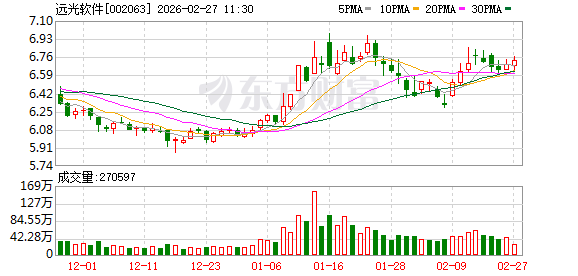
远光软件:目前公司主要接入或适配了智谱、阿里千问等大模型
Zheng Quan Ri Bao Wang· 2026-02-27 05:57
Group 1 - The company, Yuanguang Software, has integrated or adapted to major models such as Zhipu, Alibaba Qianwen, DeepSeek, and Pangu [1]

国产大模型调用量首超美国,恒生科技ETF(513130)交投踊跃
Xin Lang Cai Jing· 2026-02-27 05:14
Core Insights - Recent breakthroughs in domestic large models have instilled confidence in the capital market, with Chinese models surpassing U.S. models in token usage for the first time [1][4] - The weekly token usage of Chinese models reached 5.16 trillion, marking a 127% increase over three weeks, indicating a rapid market share capture [1][4] - The Hang Seng Technology Index has seen a rebound, with its latest P/E ratio at 21.09, reflecting a low historical percentile, providing a window for capital allocation [1][4] Industry Overview - The Hang Seng Technology ETF (513130) closely tracks the Hang Seng Technology Index, focusing on the AI industry, including AI computing power, models, and applications [2][5] - The ETF has a significant scale of 490.86 billion, with an average daily trading volume exceeding 53 billion, making it a prominent tool for investors in the Hong Kong tech sector [2][5] - The ongoing integration of large models and increasing AI penetration across industries are expected to drive the commercialization of AI, presenting a revaluation opportunity for leading tech companies [2][5] Fund Management - The fund manager of the Hang Seng Technology ETF, Huatai-PB Fund, is one of the first ETF managers in China, focusing on providing transparent, convenient, and low-cost index products [3][6] - The management fee for the ETF is 0.2% per year, while the management fees for other popular ETFs under Huatai-PB are among the lowest in the market [3][6]
AI四小龙再掀出海热潮:Kimi靠「养龙虾」暴富,MiniMax默赚老外钱
3 6 Ke· 2026-02-27 05:04
Core Insights - DeepSeek R1 has successfully established a brand for Chinese AI startups in the global large model market, with other notable companies including Kimi, GLM, and MiniMax [1] - Kimi has made a strong comeback by launching the Kimi K2 series and K2.5 models, achieving significant revenue growth [6][10] - Kimi's K2.5 model has generated more revenue in less than 20 days than the total revenue for the previous year, and the company has raised over $1.2 billion in funding [7][27] - The Chinese AI large model market is evolving, with companies focusing on vertical markets and expanding internationally to meet specific global user needs [7][42] Company Developments - Kimi's K2.5 model emphasizes long memory, multi-modal understanding, and task execution capabilities, positioning itself as a more functional AI rather than just a conversational agent [10][12] - Kimi's overseas market revenue has surpassed domestic revenue, primarily from subscription fees and API usage [27] - MiniMax has achieved over 70% of its revenue from overseas markets, demonstrating a successful international strategy [32] Market Trends - The global foundational model market is projected to grow from $10.7 billion in 2024 to $20.65 billion by 2029, indicating significant opportunities for companies like MiniMax and Kimi [32] - The competition in the domestic market is intensifying with major players like Alibaba, ByteDance, Tencent, and Baidu, making international expansion a more viable strategy for smaller AI companies [40][42] - Companies are increasingly focusing on meeting the specific needs of the "global 1%" user segment as a strategic approach to growth [42]
远光软件:目前公司主要接入或适配了智谱、阿里千问、DeepSeek、盘古等大模型
Mei Ri Jing Ji Xin Wen· 2026-02-27 04:29
Group 1 - The company has integrated or adapted several large models, including Zhipu, Alibaba's Qianwen, DeepSeek, and Pangu [2]
竞业达2025年净利预计800万至1150万元,同比下降超七成
Jing Ji Guan Cha Wang· 2026-02-27 03:46
Core Viewpoint - The company, Jingyeda, is forecasting a significant decline in net profit for 2025 due to increased expenses from AI research and development investments [1][2]. Financial Performance - The 2025 annual performance forecast indicates that the net profit attributable to shareholders is expected to be between 8 million and 11.5 million yuan, representing a year-on-year decrease of 73.06% to 81.26% [2]. - The net profit, excluding non-recurring gains and losses, is anticipated to incur a loss ranging from 2 million to 4 million yuan [2]. - The increase in sales, research, and management expenses is approximately 33 million yuan compared to the previous year, although improvements in collection efforts have led to a reduction in credit impairment losses [2]. Financial Reporting - The official annual report for 2025 is expected to be released in March or April 2026, providing more detailed financial data, business progress, and future plans [3]. Strategic Development - The company continues to focus on the "AI + scenario" strategy, increasing investments in artificial intelligence and large model technologies within the education and rail sectors [4]. - The IT services sector may experience a rotation effect due to digitalization policies, but the company currently faces pressure on its fundamentals, as indicated by a negative price-to-earnings ratio [4].

未知机构:国联民生电子英伟达业绩会Preview领导好英伟达将于明早-20260227
未知机构· 2026-02-27 02:35
【国联民生电子】英伟达业绩会Preview 领导好,英伟达将于明早公布4Q26财年(对应自然年4Q25)财报。 我们对业绩展望,及市场关注的核心要点解读如下: ➠业绩预期: ✔彭博一致预期:4Q25 收入659亿美元,YOY+67.58%;1Q26 收入728亿美元,YOY+65.17%。 ✔当然,对于NV来说,更重要的是市场一致预期,目前已经攀升至:#4 【国联民生电子】英伟达业绩会Preview 领导好,英伟达将于明早公布4Q26财年(对应自然年4Q25)财报。 我们对业绩展望,及市场关注的核心要点解读如下: ➠业绩预期: ✔彭博一致预期:4Q25 收入659亿美元,YOY+67.58%;1Q26 收入728亿美元,YOY+65.17%。 ✔当然,对于NV来说,更重要的是市场一致预期,目前已经攀升至:#4Q25收入680亿美元、1Q26收入750亿美 元。 前期云厂商给出了乐观需求指引。 其中谷歌最为激进,指引26年Capex 1800亿美元,同比翻倍。 而Meta也给出了1200亿美元的指引,同比77%。 同时,基于Openrouter统计的大模型Token数也在持续创新高。 旺盛的需求,是NV业绩潜在 ...
