硬科技

Search documents
万亿“活水”精准滴灌硬科技,科创100ETF富国(589950)、科创200ETF富国(589780)涨超2%!
Sou Hu Cai Jing· 2026-01-23 06:53
Core Viewpoint - The A-share market is experiencing active performance in the technology sector, particularly with the Sci-Tech 100 ETF and Sci-Tech 200 ETF showing significant gains, driven by the central bank's liquidity support and targeted funding towards strategic "hard technology" sectors like AI computing and commercial aerospace [1] Group 1: Market Performance - The Sci-Tech 100 ETF (589950) and Sci-Tech 200 ETF (589780) have reported gains of 2.95% and 2.24% respectively [1] - The central bank has conducted a 900 billion yuan MLF operation, marking the 11th consecutive month of increased operations [1] Group 2: Monetary Policy - Since January 2026, the central bank has achieved over 1 trillion yuan in net liquidity injection through MLF and reverse repos, indicating a substantial release of liquidity [1] - The central bank's actions are characterized as "drip irrigation" rather than broad-based flooding, with funds directed towards key strategic sectors [1] Group 3: Investment Opportunities - The Sci-Tech 100 ETF and Sci-Tech 200 ETF are seen as efficient tools for investors to access core assets aligned with China's innovation-driven strategy, focusing on small and medium-sized tech enterprises [2] - Investors can also utilize the Sci-Tech 100 ETF and Sci-Tech 200 ETF connect products to facilitate their investment strategies [2]
港股科技ETF(513020)涨超1%,港股科技龙头正加速推进AI与业务生态融合
Mei Ri Jing Ji Xin Wen· 2026-01-23 05:44
Group 1 - The core viewpoint is that Hong Kong's technology leaders are accelerating the integration of AI with their business ecosystems, with Alibaba and Tencent leading the charge in productization and application expansion [1] - Alibaba is leveraging its Qianwen platform to enhance product offerings in core scenarios such as e-commerce and transportation, while Tencent is using its WeChat ecosystem to lower development barriers for AI applications [1] - The growth momentum of Alibaba Cloud's overseas business is strong, and the recent performance of domestic semiconductor and hard tech companies listed in Hong Kong is robust, indicating a continued influx of quality tech firms to the Hong Kong market [1] Group 2 - The Hong Kong Stock Connect Technology Index has a higher allocation in sectors like new energy vehicles, innovative pharmaceuticals, and semiconductors compared to the Hang Seng Technology Index [2] - From the base date at the end of 2014 to the end of 2025, the cumulative return of the Hong Kong Stock Connect Technology Index is 224.25%, significantly outperforming the Hang Seng Technology Index, which has a return of 83.87% [2] - The Hong Kong Stock Connect Technology Index has consistently outperformed other indices, including the Shanghai-Hong Kong-Shenzhen Internet Index and the Hang Seng Healthcare Index [2]
恒旭资本完成第四期旗舰基金首轮关账,募资规模超20亿元
Zheng Quan Shi Bao Wang· 2026-01-23 05:43
1月23日,恒旭资本宣布完成第四期旗舰基金的首轮关账,募集规模超20亿元,计划终关规模达35亿 元。 在江苏常州,基于过往上汽时代等标杆项目及多期基金合作所建立的深度互信,江苏省市区联动参与本 期基金,再次体现了地方对恒旭资本过往业绩与独特赋能模式的高度认可。在四期基金的合作洽谈过程 中,恒旭资本已同步推动卓驭科技(智能驾驶域控制器龙头)、什方科技(工业数字喷印解决方案商)等多 个重大项目落地常州,形成了"资本投入-产业落地"的良性循环与双向赋能。 恒旭资本是创投圈最活跃的CVC之一。截至目前,其投资组合中已涌现包括毓恬冠佳(301173)、经 纬恒润、先锋精科、爱博医疗、长风药业、国富氢能、通行宝(301339)等在内的19家上市企业,覆盖 科技制造、健康消费等重点领域。2025年,恒旭资本投资了包括东方算芯、望圆科技、泉意光罩、新石 器、海尔新能源等在内的19个项目,投资总额近14亿元,当中投早投新的项目占比超过20%。 恒旭资本合伙人朱家春近期接受证券时报记者专访时指出,与2025年相比,2026年的一级市场的运行逻 辑不会出现颠覆性的系统变化,但结构性深化的趋势将更加显著:其一,投资主题深化,从广泛的 ...
姜诚:价值投资不是策略而是理念,它回答的是“我们的收益来源是什么”
中泰证券资管· 2026-01-23 05:02
Core Viewpoint - The market is experiencing significant volatility, and the pressure in investment comes from the continuous tracking, dynamic assessment, and evaluation of portfolio status rather than the relative performance of net asset value [2][3]. Group 1: Market Dynamics and Investment Pressure - The pressure faced by the company is primarily due to the downward pressure on fundamentals in cyclical industries, which has been a consistent challenge over the past two to three years [3]. - The company emphasizes that the performance of net asset value is not the main source of pressure; rather, it is the ongoing need to dynamically assess new fundamental facts, including changes in demand and supply [3][4]. - The company does not focus on how much others are earning compared to them; the key is whether they can earn money themselves, which is the main source of investment pressure [4]. Group 2: Value Investment Philosophy - Value investment is not merely a strategy but a philosophy that addresses the source of returns, focusing on long-term value creation rather than short-term market performance [5][6]. - The company argues that the performance of the CSI 300 index does not necessarily reflect the effectiveness of value strategies, as the index's style can shift due to periodic adjustments [5][6]. - The company believes that the current weakness in the value strategy does not imply its failure; rather, it is a reflection of market dynamics and should not deter long-term value investment [7][8]. Group 3: Long-term Value Assessment - The company highlights the importance of assessing whether a company's long-term competitive advantage and governance can sustain good dividend returns, which is a core source of pressure [11][12]. - It is noted that identifying companies with sustainable competitive advantages is challenging, leading to a concentrated investment strategy due to the scarcity of such opportunities [12]. - The company emphasizes that the assessment of long-term value is complex and cannot be simplified into a one-size-fits-all approach, especially in a market with over 5,000 stocks [12][13]. Group 4: Industry Trends vs. Market Performance - The company distinguishes between market style performance and actual industry trends, asserting that the two are not synonymous [15][16]. - It is stated that while certain industries may show strong performance, this does not necessarily correlate with sustainable investment opportunities [15][16]. - The company advocates for a focus on genuine industry trends and competitive landscapes rather than being swayed by short-term market fluctuations [16]. Group 5: Investment Strategy and Risk Management - The company discusses the concept of a "barbell strategy," which depends on the investor's ability circle and the clarity of investment goals [20][21]. - It is acknowledged that while short-term performance may be slow, the focus should remain on avoiding permanent capital loss and aligning with investor expectations [21]. - The company emphasizes that the ability to assess long-term value is crucial, and the risk of "value traps" must be carefully managed [13][21]. Group 6: Valuation Models and Cash Flow - The company asserts that valuation models are fundamentally based on cash flow discounting, with current cash returns holding more weight in valuations [26][27]. - It is noted that while growth companies may have high valuations, their long-term value assessment remains complex and requires careful consideration of future cash flows [23][24]. - The company stresses that reasonable valuation levels are determined by long-term value rather than short-term profit performance or market style [27]. Group 7: Knowledge and Information Sources - The company advocates for a balanced approach to learning, emphasizing the importance of both reading financial reports for information and engaging with broader literature to build analytical skills [29][30]. - It is highlighted that understanding financial reports is essential for making informed investment decisions, but this should be complemented by a well-rounded knowledge base [29][30].


北证50强势涨超3.2%,板块汇聚“专精特新”标的具有结构性机会
Sou Hu Cai Jing· 2026-01-23 03:31
Group 1 - The Beizheng 50 index continues its strong momentum from the end of 2025, showing a "volume increase and price rise" pattern, with a notable increase of 3.29% as of January 23, 2026 [1] - Key stocks contributing to this rise include Liancheng Numerical Control, which increased by 25.85%, Minshida by 14.89%, and Xingtum Measurement and Control by 13.55% [1] - The Beizheng 50 index is heavily concentrated in strategic emerging industries such as power equipment, machinery, computers, and electronics, which are aligned with advanced manufacturing and are expected to benefit from policy support and market demand [1] Group 2 - Since the implementation of the "19 measures for the deep reform of the Beijiao Exchange," the institutional supply has been continuously optimized, including a "small and fast" review channel for mergers and acquisitions, significantly shortening resource integration cycles [2] - The introduction of differentiated institutional frameworks aligns with the growth patterns of small and medium-sized enterprises, enhancing liquidity through the launch of market-making transactions [2] - Structural opportunities remain for "specialized, refined, unique, and innovative" companies in sectors like semiconductors and robotics, with a focus on strong performance certainty and clear policy benefits [2]
港股科技30ETF(513160)涨近1%,阿里巴巴-W涨超3%,机构:港股短期有望延续结构性上涨
2 1 Shi Ji Jing Ji Bao Dao· 2026-01-23 02:16
Group 1 - The Hong Kong stock market opened high on January 23, with the Hong Kong Technology 30 ETF (513160) rising by 0.88% and trading volume exceeding 1 billion yuan [1] - Major constituents of the Hong Kong Technology 30 ETF include leading tech companies such as Alibaba-W, Meituan-W, and Tencent Holdings, with Alibaba-W increasing by over 3% [1] - The ETF has attracted over 110 million yuan in capital over the last 10 trading days, indicating strong investor interest [1] Group 2 - Haitong International Securities suggests that Hong Kong tech stocks will benefit from an upcoming window of intensive AI product releases, with companies like Alibaba and Tencent integrating AI into their business ecosystems [1] - The market sentiment is supported by expectations of a Federal Reserve interest rate cut and a recovery in A-share sentiment, leading to a structural upward trend in the Hong Kong stock market [2] - The long-term outlook for the AI and semiconductor industries remains positive, with a vibrant IPO market in Hong Kong, particularly in the new economy sector, providing structural opportunities for investors [2]



独家|开年最大募资诞生,20亿
投资界· 2026-01-23 01:01
Core Viewpoint - The article highlights the successful fundraising of Hengxu Capital's fourth flagship fund, which raised over 2 billion RMB in its first closing, indicating a strong start to the new year and showcasing the firm's unique position in the private equity market as a market-oriented corporate venture capital (CVC) with substantial industry background and resources [2][3]. Fundraising and LP Structure - Hengxu Capital's fourth flagship fund received continued support from significant shareholders such as SAIC Group and various financial institutions, along with strong backing from local governments in the Yangtze River Delta [3]. - The fund has innovatively split into two sub-funds based in Changzhou and Ningbo to better address the diverse needs of different LPs, aiming to create a comprehensive investment ecosystem that covers the entire lifecycle of innovative enterprises [3][4]. Regional Cooperation and Project Development - In Changzhou, local governments have actively participated in the fund, reflecting their recognition of Hengxu Capital's past performance and unique empowerment model, which has facilitated the landing of major projects [4]. - In Ningbo, the fund has attracted multiple large industrial projects due to the region's favorable business environment and efficient communication during the fund establishment process [6]. Investment Strategy and Focus Areas - Hengxu Capital plans to leverage its experience in complex industrial chain investments to expand into broader hard technology sectors, including artificial intelligence, semiconductors, aerospace, quantum technology, nuclear energy, and biomanufacturing [9]. - The firm aims to act as an industrial enabler, not just providing capital but also connecting technology, manufacturing, and market needs [9]. Performance and Exit Strategy - In the past year, Hengxu Capital successfully exited 12 projects through various means, with over 30 invested companies achieving subsequent financing and valuation growth, showcasing its strong exit capabilities and return potential [9][10]. Investment Activity and Portfolio - In 2025, Hengxu Capital invested nearly 1.4 billion RMB across 19 projects, with over 20% of investments in early-stage projects, marking a strategic shift from automotive to emerging industries and health consumption [10]. - The firm has made significant investments in various sectors, including embodied intelligence and semiconductor technology, demonstrating its proactive approach to identifying high-potential projects [11][12]. Long-term Vision and Ecosystem Development - Hengxu Capital aims to become one of the most market-oriented industrial capital entities, focusing on independent judgment and financial returns while leveraging its industry insights and resources to create strategic co-creation capabilities across diverse fields [13]. - The firm has established a comprehensive empowerment system covering post-investment management, talent acquisition, follow-up financing, and IPO planning, enhancing the competitive advantages of its portfolio companies [14][15]. Future Outlook - Hengxu Capital is well-positioned to capitalize on the historical opportunities presented by the convergence of policy, capital, and technology in the hard technology sector, as it prepares for future investments and strategic developments [16].

科创50ETF刷新近一个月高点
Mei Ri Jing Ji Xin Wen· 2026-01-22 15:58
科创50ETF(588000)追踪科创50指数,指数持仓电子行业超70%,与当前人工智能、机器人等前 沿产业的发展方向高度契合。同时涉及半导体、医疗器械、软件开发、光伏设备等多个细分领域,硬科 技含量高,看好中国硬科技长期发展前景的投资者建议持续关注。 相关ETF:科创50ETF(588000)。 每日经济新闻 (责任编辑:张晓波 ) 截至2026年1月22日 10点43分,科创50指数上涨0.43%,成分股龙芯中科上涨7.91%,中国通号上涨 5.11%,澜起科技上涨4.99%,天合光能上涨4.30%,西部超导上涨4.04%。科创50ETF(5880000)上涨 0.43%,最新价报1.62元,刷新近一个月高点,近1周累计上涨2.34%。 流动性方面,科创50ETF盘中换手3.31%,成交27.69亿元。近1月日均成交48.94亿元,居可比基金 第一。 财通证券认为,台积电CAPEX与业绩双超预期 先进制程封装加速增长,台积电作为全球半导体行 业的领导者,其持续投入先进制造技术和产能扩展表明,行业在技术革新和生产能力方面正在加速发 展。随着半导体需求的不断增长,相关领域的投资也将迎来新的机遇。基于这一背景, ...
大批知名投资人集聚深圳,2026机遇在哪?
Xin Lang Cai Jing· 2026-01-22 13:38
Core Insights - The Chinese private equity investment industry has reached a historic turning point in 2025, with a total fundraising amount exceeding 1.16 trillion yuan, a year-on-year increase of 8%, and the number of new funds surpassing 3,500, up 18% from the previous year [1][35] - A significant structural change is observed, with state-owned limited partners (LPs) contributing 89% of the funding, and hard technology investments accounting for over 60% of the total [1][36] Group 1: Dominance of State Capital - The role of state capital has been further strengthened, with local guiding funds and state-owned enterprises contributing over 50% of the funding, while the proportion of RMB funds exceeds 99% [2][36] - State-owned LPs are integrating national strategies and regional economic development goals into their investment decisions, focusing 70% of their funds on early-stage technology companies [2][36] - The investment strategy of VC/PE has shifted from broad-based approaches to more targeted investments, with a noticeable decrease in the concentration of large funds exceeding 5 billion yuan [2][36] Group 2: Focus on Hard Technology - Hard technology is identified as the primary investment focus for 2025 and the coming years, encompassing areas such as artificial intelligence, robotics, semiconductors, and renewable energy [3][37] - The establishment of key platforms like the Sci-Tech Innovation Board and the Hong Kong Stock Exchange has created critical windows for capitalizing on hard technology investments [3][37] - Early-stage financing transactions (A-round and earlier) accounted for 62% of total deals, with small investments under 100 million yuan making up over 67% [3][37] Group 3: Diversification of Exits - The exit landscape has improved significantly, particularly in the IPO market, with the number of IPOs in mainland China and Hong Kong accounting for 16% and 33% of the global total, respectively [4][38] - The number of IPO cases for invested companies in Hong Kong increased by 148.1% year-on-year, while A-share IPO cases rose by 26.5% [4][38] - Mergers and acquisitions (M&A) have also seen a surge, with a year-on-year increase of 84% in exit cases, highlighting the growing importance of M&A strategies for VC/PE [4][38] Group 4: Long-term Vision and Future Opportunities - Despite the positive performance in investment and exits, the private equity market faces numerous challenges, necessitating a long-term vision to navigate policy directions and market demands [5][39] - The 15th China Capital Annual Conference, themed "Visionaries Win," aims to gather industry leaders to discuss emerging trends and strategies in the investment landscape [5][39] - The conference will also unveil the "2025 Private Equity Investment Annual Series Rankings," recognizing outstanding institutions and individuals in various sectors [6][40]

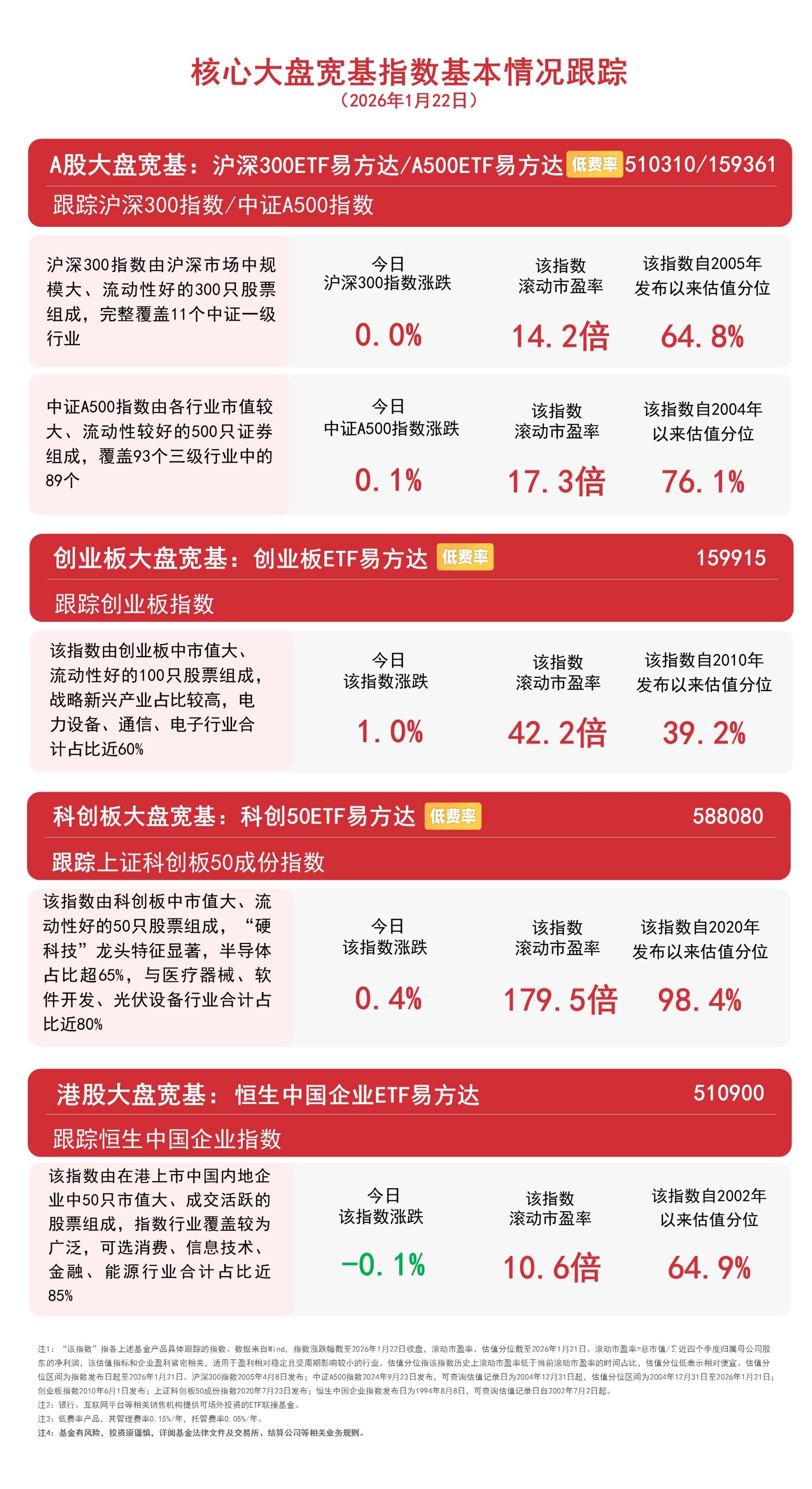
市场午后震荡回升,A500ETF易方达(159361)、沪深300ETF易方达(510310)助力一键布局核心资产
Sou Hu Cai Jing· 2026-01-22 11:35
Market Overview - The A-share market experienced a rebound in the afternoon on January 22, with all three major indices turning positive. The total trading volume exceeded 2.7 trillion yuan, an increase of nearly 100 billion yuan compared to the previous day, with over 3,500 stocks rising across the market [1]. - Key sectors that saw significant gains included oil and gas extraction and services, military equipment, photovoltaic equipment, commercial aerospace, building materials, coal mining and processing, steel, and glyphosate [1]. - Conversely, sectors such as insurance, photolithography machines, precious metals, batteries, semiconductors, and innovative pharmaceuticals underperformed [1]. Index Performance - The CSI A500 Index rose by 0.1% [4]. - The CSI 300 Index increased by 0.01% [1]. - The ChiNext Index saw a rise of 1.0% [1]. - The STAR Market 50 Index increased by 0.4% [1]. - The Hang Seng China Enterprises Index declined by 0.1% [4]. Sector Composition - The ChiNext Index consists of 100 stocks with high market capitalization and liquidity, with a significant proportion from strategic emerging industries, particularly power equipment, communications, and electronics, which together account for nearly 60% [4]. - The STAR Market 50 Index is composed of 50 stocks from the STAR Market, with a strong focus on "hard technology," where semiconductors represent over 65%, and combined with medical devices and software development, they account for nearly 80% [4]. - The Hang Seng China Enterprises Index includes 50 large-cap, actively traded stocks from mainland Chinese companies listed in Hong Kong, covering a wide range of industries, with consumer discretionary, information technology, finance, and energy sectors making up nearly 85% [4].