
车路云一体化

Search documents
申银万国期货早间策略-20251017
Shen Yin Wan Guo Qi Huo· 2025-10-17 06:23
Report Investment Rating - No investment rating for the industry is provided in the report. Core Viewpoints - After a high - level oscillation in September, the stock index is expected to enter a direction - selection phase again and is likely to maintain a bullish trend. In terms of capital, the domestic liquidity environment is expected to remain loose, and residents may increase their allocation of equity assets. With the Fed's interest - rate cuts and the RMB's appreciation, external funds may also flow into the domestic market. In Q4, the market style may return to value and become more balanced compared to Q3 [2]. Summary by Directory 1. Stock Index Futures Market - **IF Contracts**: The previous day's closing prices of IF contracts (current month, next month, next quarter, and the quarter after next) were 4614.00, 4599.60, 4590.00, and 4566.80 respectively, with increases of 17.60, 15.80, 17.40, and 15.60. The trading volumes were 30168.00, 23168.00, 87781.00, and 12356.00, and the open interests were 23420.00, 32933.00, 161774.00, and 56692.00 respectively. The changes in open interests were - 12399.00, 8673.00, 1346.00, and 100.00 [1]. - **IH Contracts**: The previous day's closing prices of IH contracts were 3019.20, 3019.60, 3019.00, and 3019.00 respectively, with increases of 22.40, 25.60, 24.00, and 23.00. The trading volumes were 13559.00, 10295.00, 47257.00, and 5200.00, and the open interests were 9009.00, 11468.00, 69593.00, and 13814.00 respectively. The changes in open interests were - 4694.00, 4554.00, 5999.00, and 514.00 [1]. - **IC Contracts**: The previous day's closing prices of IC contracts were 7225.40, 7126.40, 7062.00, and 6895.20 respectively, with decreases of 46.60, 64.00, 72.40, and 76.80. The trading volumes were 29413.00, 23838.00, 88010.00, and 17287.00, and the open interests were 23203.00, 39176.00, 138071.00, and 52601.00 respectively. The changes in open interests were - 11052.00, 6383.00, - 3447.00, and - 343.00 [1]. - **IM Contracts**: The previous day's closing prices of IM contracts were 7403.40, 7293.20, 7205.00, and 6981.40 respectively, with decreases of 48.20, 64.40, 68.80, and 72.80. The trading volumes were 39286.00, 30514.00, 153865.00, and 26088.00, and the open interests were 33142.00, 54135.00, 185185.00, and 83019.00 respectively. The changes in open interests were - 14769.00, 7917.00, - 6410.00, and - 1488.00 [1]. - **Inter - month Spreads**: The current inter - month spreads of IF (next month - current month), IH (next month - current month), IC (next month - current month), and IM (next month - current month) were - 14.40, 0.40, - 99.00, and - 110.20 respectively, compared to previous values of - 15.00, - 1.20, - 82.00, and - 93.20 [1]. 2. Stock Index Spot Market - **Major Indexes**: The previous - day values of the CSI 300, SSE 50, CSI 500, and CSI 1000 indexes were 4618.42, 3019.20, 7231.53, and 7401.84 respectively, with changes of 0.26%, 0.59%, - 0.86%, and - 1.09% [1]. - **Industry Indexes**: Among different industries, the energy, raw materials, industrial, and optional consumption sectors had changes of 2.26%, - 1.95%, 0.57%, and - 0.12% respectively. The major consumption, medical and health, real - estate and finance, and information technology sectors had changes of 0.80%, 0.36%, 0.84%, and - 0.67% respectively. The telecommunications and public utilities sectors had changes of 1.58% and 0.71% respectively [1]. 3. Futures - Spot Basis - **CSI 300 - related Basis**: The previous - day basis values of IF (current month - CSI 300), IF (next month - CSI 300), IF (next quarter - CSI 300), and IF (the quarter after next - CSI 300) were - 4.42, - 18.82, - 28.42, and - 51.62 respectively [1]. - **SSE 50 - related Basis**: The previous - day basis values of IH (current month - SSE 50), IH (next month - SSE 50), IH (next quarter - SSE 50), and IH (the quarter after next - SSE 50) were 0.00, 0.40, - 0.20, and - 0.20 respectively [1]. - **CSI 500 - related Basis**: The previous - day basis values of IC (current month - CSI 500), IC (next month - CSI 500), IC (next quarter - CSI 500), and IC (the quarter after next - CSI 500) were - 6.13, - 105.13, - 169.53, and - 336.33 respectively [1]. - **CSI 1000 - related Basis**: The previous - day basis values of IM (current month - CSI 1000), IM (next month - CSI 1000), IM (next quarter - CSI 1000), and IM (the quarter after next - CSI 1000) were 1.56, - 108.64, - 196.84, and - 420.44 respectively [1]. 4. Other Domestic and Overseas Indexes - **Domestic Indexes**: The previous - day values of the Shanghai Composite Index, Shenzhen Component Index, Small and Medium - sized Board Index, and ChiNext Index were 3916.23, 13086.41, 8054.30, and 3037.44 respectively, with changes of 0.10%, - 0.25%, - 0.65%, and 0.38% respectively [1]. - **Overseas Indexes**: The previous - day values of the Hang Seng Index, Nikkei 225, S&P 500, and DAX Index were 25888.51, 47672.67, 6629.07, and 24272.19 respectively, with changes of - 0.09%, 1.76%, - 0.63%, and 0.38% respectively [1]. 5. Macroeconomic Information - **China's Commerce Ministry**: The Ministry responded to multiple hot issues, was open to equal consultations with the US on an equal - footing basis, would optimize the permit process for rare - earth export controls, take measures to safeguard Chinese enterprises' rights, and introduce new policies to stabilize foreign trade [2]. - **US Treasury Secretary**: Stated that if China stopped strict rare - earth export controls, the US might extend the three - month exemption for additional tariffs on Chinese goods, and that President Trump was ready to meet Chinese leaders soon [2]. - **National Tax Data**: National enterprises accelerated equipment updates, and the consumer goods trade - in policy was effective. In the first three quarters, industrial enterprises' procurement of mechanical equipment increased by 9.4% year - on - year, with private enterprises' procurement up 13% year - on - year, and new - energy vehicle sales increased by 30.1% year - on - year [2]. 6. Industry Information - **Photovoltaic Industry**: Since the second half of this year, the "anti - involution" in the photovoltaic industry has attracted attention. New photovoltaic capacity control policies may be introduced, and the rumor of a polysilicon storage platform is false, with the potential storage plan facing many obstacles [2]. - **Solid - state Battery**: Chinese scientists solved a key charging problem, enabling a leap - forward upgrade in solid - state battery performance, with the potential to break through the 1000 - kilometer range ceiling [2]. - **Intelligent Connected Vehicles**: The 2025 World Intelligent Connected Vehicles Conference was held, and a national application pilot base for AI in the automotive field was launched. The Ministry of Industry and Information Technology will promote "vehicle - road - cloud integration" and standard - setting for autonomous driving [2]. - **Computing Power**: The Ministry of Industry and Information Technology launched a "millisecond computing power" initiative, aiming for a 70% coverage rate of the millisecond - latency computing power circle in urban areas by 2027 [2].
智能早报丨李飞飞团队发布世界模型新成果;吉利旗下具身智能公司成立5个月就解散
Guan Cha Zhe Wang· 2025-10-17 02:28
Group 1: RTFM Model Release - The RTFM (A Real-Time Frame Model) was launched by Li Feifei's team, capable of real-time operation, persistence, and 3D consistency, running on a single H100 GPU [1] - The model is designed based on three core principles: efficiency, scalability, and persistence, allowing real-time inference at interactive frame rates with just one H100 GPU [1] - RTFM can autonomously learn from massive video data without relying on explicit 3D representations, and users can interact with it indefinitely, with all scenes permanently retained [1] Group 2: OneStar Robotics Dissolution - OneStar Robotics, a company founded by Li Xingxing, son of Geely's founder, has announced its dissolution after being established in May 2025 [2][3] - The company was positioned in the "embodied intelligence" sector and had received investments from notable firms, including Baidu Ventures [2] - The dissolution may lead to a split where the original platform and business return to Geely, while the technology team may pursue independent ventures [2] Group 3: Smart Connected Vehicles Conference - The 2025 World Intelligent Connected Vehicle Conference has commenced, focusing on the establishment of a national AI automotive application pilot base [4] - The Ministry of Industry and Information Technology aims to advance "vehicle-road-cloud integration" applications and optimize industry standards and competition [4] - Xiaomi's founder, Lei Jun, emphasized the importance of industry unity in developing smart connected vehicles, advocating for collaboration and shared growth [4][6] Group 4: AI and Robotics Developments - Microsoft has launched a series of AI upgrades for Windows 11, enhancing the Copilot feature to support natural interactions through voice, vision, and actions [6] - The Ministry of Industry and Information Technology has initiated a "millisecond computing" action plan, targeting a 70% coverage rate for millisecond latency in urban areas by 2027 [7] - Zhiyuan Robotics has released the new industrial-grade interactive robot, G2, which has already secured several hundred million yuan in orders and is set for commercial delivery [8] Group 5: AI Innovations and Collaborations - Google has updated its Veo 3.1, enhancing narrative and audio control capabilities, and integrating with Gemini API and Vertex AI [9] - Oracle has introduced the OCI Zettascale10, a large-scale AI supercomputer capable of connecting tens of thousands of NVIDIA GPUs, achieving peak performance of 16 zettaFLOPS [10] - Yingmu Technology has launched the INMO GO3 AI smart glasses and plans to create a global AI+AR ecosystem in collaboration with Tencent and Ant Group [11]







工信部:加快组合驾驶辅助、自动驾驶等标准制定
Xin Hua Wang· 2025-10-17 01:58
Core Viewpoint - The Chinese government is accelerating the development of standards for advanced driving assistance and autonomous driving, aiming to deeply integrate artificial intelligence with the automotive industry [1][2] Group 1: Industry Development - The smart connected vehicle industry in China has made significant progress, establishing a complete industrial system that includes smart cockpits, autonomous driving, and connected cloud control [1] - New passenger cars equipped with combined driving assistance features account for over 60% of new car sales [1] Group 2: Future Initiatives - The Ministry of Industry and Information Technology plans to promote smart connected vehicles as a key force in advancing new industrialization and developing new productive forces [1] - There will be a focus on technological breakthroughs in key areas such as next-generation electronic and electrical architecture and high-performance computing chips [1] Group 3: Cross-Industry Collaboration - The government will promote integrated applications of "vehicle-road-cloud" and support collaboration among automotive, information communication, energy, and transportation sectors to build a trustworthy data space [1] Group 4: Policy and Cooperation - A comprehensive policy framework will be developed, including the "14th Five-Year" plan for the smart connected new energy vehicle industry, optimizing production access management and regulating industry competition [2] - Support will be provided for both domestic and foreign enterprises to deepen practical cooperation in technology and standards, aiming to build a safe and efficient industrial supply chain [2]
2025WICV拉开帷幕,“车路云一体化”应用试点阶段性成果公布
Zhong Guo Jing Ji Wang· 2025-10-17 01:55
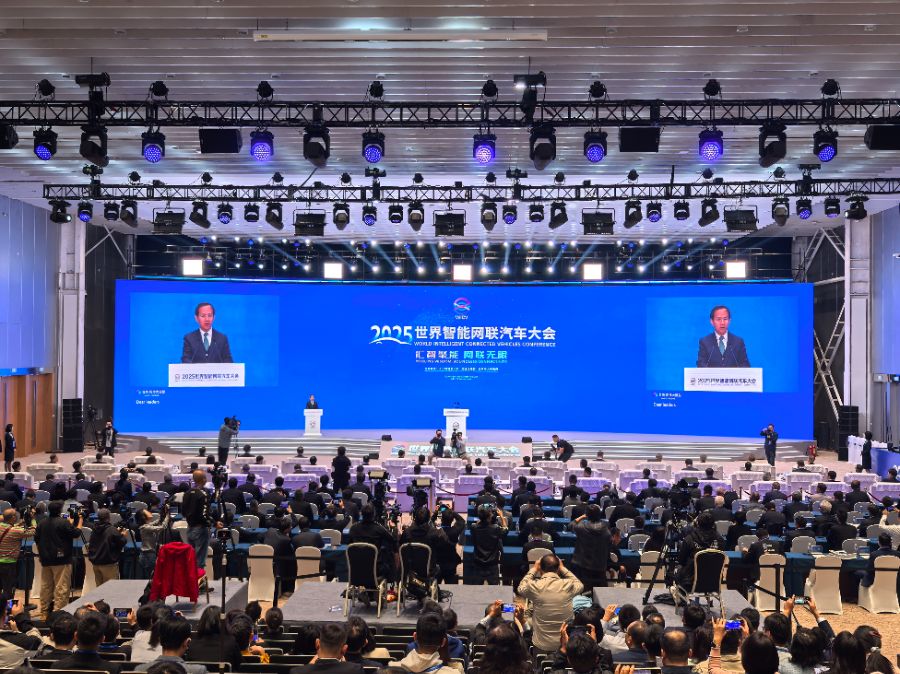
Core Insights - The 2025 World Intelligent Connected Vehicle Conference opened in Beijing, focusing on the theme "Gathering Wisdom and Energy, Unlimited Connectivity" with over 4,000 representatives from more than 10 countries and regions attending [1] Group 1: Industry Development Initiatives - Beijing aims to become a hub for the intelligent connected vehicle industry, promoting key technology innovation and collaboration between enterprises, universities, and research institutions [2] - The Ministry of Transport emphasizes the integration of artificial intelligence in transportation, enhancing the development and application of intelligent connected vehicles and autonomous driving technologies [3] - The Ministry of Industry and Information Technology plans to implement the "14th Five-Year" development plan for intelligent connected new energy vehicles, focusing on technological innovation and cross-industry integration [4] Group 2: Application Scenarios and Innovations - The conference introduced ten functional scenarios for the "Vehicle-Road-Cloud Integration" application, aimed at improving traffic safety and efficiency through innovative technologies [4][5] - Scenarios include traffic signal information services, traffic event warnings, and collaborative avoidance for vulnerable road users, enhancing vehicle perception and response capabilities [6][7] - Additional scenarios focus on intelligent parking guidance and vehicle platooning, addressing challenges in complex traffic environments and optimizing resource utilization [7]
财经早知道|我国将全面推进医保基金即时结算
Sou Hu Cai Jing· 2025-10-17 00:55
Macro Economy - The State Administration for Market Regulation has drafted regulations to enhance food safety responsibilities for third-party online food delivery platforms, aiming to prevent "ghost delivery" issues [2] - The China Securities Association reported that 988 analysts left brokerage firms in 2024, a 29.66% increase year-on-year, while new hires decreased by 29.01% to 1,786 [2] - The Ministry of Commerce indicated that China's foreign trade is under pressure but showing signs of stability and improvement, with plans to enhance policy support for foreign trade enterprises [2] Industry Trends - The China Index Academy reported a contraction in the national auction housing market, with 547,000 auctioned properties, a year-on-year decrease of approximately 4.9%, and total transaction value of 185.83 billion, down 21.3% [5] - The China Securities Regulatory Commission plans to guide stock exchanges in improving sustainability reporting guidelines for listed companies [5] - The Ministry of Industry and Information Technology is launching a "millisecond computing" initiative to enhance computing resource accessibility in urban areas, aiming for 70% coverage by 2027 [6] - The solar industry is focused on the progress of polysilicon storage plans, with rumors of a storage platform being established, although some reports claim the information is inaccurate [6] - Chinese scientists have made breakthroughs in solid-state lithium batteries, potentially doubling the range of electric vehicles from 500 km to over 1000 km [6] - The third quarter saw a 65% year-on-year increase in China's energy storage lithium battery shipments, totaling 165 GWh, with an annual forecast of 580 GWh, representing over 75% growth [6] Company Dynamics - Meituan's CEO noted that the average spending in the dining industry has returned to levels close to 2015, with businesses relying on low prices to maintain orders [7] - A survey by KPMG revealed that 69% of global CEOs plan to invest 10%-20% of their budgets in artificial intelligence over the next year, with 86% of Chinese CEOs expecting returns within three years [7] - JD Auto is releasing multiple job positions, with salaries for algorithm roles reaching up to 1.23 million yuan [7] - XPeng Motors' CEO announced plans for mass production of flying cars next year, predicting faster growth than traditional automobiles [7] - TSMC reported third-quarter revenue of approximately NT$989.92 billion and a net profit of NT$452.3 billion, with a projected gross margin of 59%-61% for the fourth quarter [7] Important Announcements - Debang Technology announced a reduction of 1.5173 million shares by the National Integrated Circuit Fund [8] - Fuyao Glass reported a 14% year-on-year increase in net profit for the third quarter and announced a change in board leadership [8] - Good Products Shop announced the termination of the transfer of control to Changjiang Guomao [9] - Shijia Photon reported a 728% year-on-year increase in net profit for the first three quarters [10] - Huada Technology plans to acquire 100% of Huayi Microelectronics, with stock resuming trading [11] - Zhongtian Technology won multiple marine project bids totaling approximately 1.788 billion yuan [12]
万联晨会-20251017
Wanlian Securities· 2025-10-17 00:35
Core Insights - The A-share market experienced a slight fluctuation with the Shanghai Composite Index rising by 0.1% to 3916.23 points, while the Shenzhen Component Index fell by 0.25% and the ChiNext Index increased by 0.38% [2][8] - The total trading volume in the Shanghai and Shenzhen markets reached 1.93 trillion yuan, with coal, banking, and food and beverage sectors leading the gains, while steel, non-ferrous metals, and building materials sectors faced declines [2][8] - In the Hong Kong market, the Hang Seng Index closed down by 0.09% at 25888.51 points, and the Hang Seng Tech Index fell by 1.18% [2][8] Important News - Data from the State Taxation Administration indicates that equipment upgrades among enterprises have accelerated in the first three quarters of the year, with industrial enterprises' machinery and equipment purchases increasing by 9.4% year-on-year, and private enterprises' purchases rising by 13% [3][8] - The sales of new energy vehicles saw a significant increase of 30.1% year-on-year [3][8] - The Ministry of Industry and Information Technology announced the acceleration of standards for combined driving assistance and autonomous driving, as part of the 2025 World Intelligent Connected Vehicles Conference [9][8] Investment Highlights - In September, the social financing stock growth rate was 8.7%, a decrease of 0.1% from August, with new social financing amounting to 3.53 trillion yuan, which is a year-on-year decrease of 0.23 trillion yuan [11] - The net financing scale of new credit and government bonds in September was 1.61 trillion yuan and 1.19 trillion yuan, respectively, both showing a year-on-year decrease [11] - The total social financing stock reached 437.08 trillion yuan by the end of September, with a year-on-year growth rate of 8.7% [11] - The M1 money supply grew by 7.2% year-on-year, with a month-on-month increase of 1.2%, supported by fiscal net spending [12] - The report anticipates that policy financial tools will continue to accelerate in October, potentially providing support for credit [12]
工信部副部长辛国斌:搭载组合驾驶辅助功能的乘用车新车销量占比超过60%
Zhong Guo Jing Ying Bao· 2025-10-16 17:13
Core Insights - The 2025 World Intelligent Connected Vehicle Conference has opened, highlighting the positive developments in China's intelligent connected vehicle industry [1] - The Ministry of Industry and Information Technology (MIIT) aims to deepen the integration of artificial intelligence with the automotive industry, focusing on various aspects of the automotive supply chain [1] Industry Developments - China has established a complete industrial system for intelligent connected vehicles, including smart cockpits, autonomous driving, and networked cloud control [1] - The sales proportion of new passenger cars equipped with combined driving assistance functions exceeds 60% [1] - Key technologies such as high-performance chips and intelligent control chassis are now being mass-produced and deployed [1] Future Initiatives - MIIT plans to promote the deep integration of AI with the automotive industry and establish high-level AI pilot bases [1] - The ministry will support the development of large model applications across the automotive supply chain, enhancing digital transformation [1] - There will be a focus on advancing new-generation electronic and electrical architectures, high-performance chips, and operating systems [1] Cross-Industry Collaboration - The initiative will advance the "vehicle-road-cloud integration" application pilot projects to improve autonomous driving safety through information exchange [1] - Support will be provided for collaboration among automotive, information communication, energy, and transportation sectors to build a trusted data space [1] Policy Framework - The MIIT will draft the "14th Five-Year" plan for the development of intelligent connected new energy vehicles [1] - There will be efforts to accelerate the formulation of standards related to combined driving assistance and autonomous driving [1] - The ministry will optimize the production access management system for intelligent connected vehicles [1]
汽车产业角逐进入下半场 AI从“锦上添花”变成“核心变量”
2 1 Shi Ji Jing Ji Bao Dao· 2025-10-16 15:15
Core Insights - The integration of artificial intelligence in the automotive industry has shifted from being an optional enhancement to a core variable crucial for survival and development [1] - The development of intelligent connected vehicles is seen as the second half of a competitive game, with significant transformations in product forms, industry structures, infrastructure, and mobility methods underway [3][5] Industry Developments - The Ministry of Industry and Information Technology (MIIT) plans to support technological innovation and promote deep integration of AI with the automotive industry, focusing on breakthroughs in key technologies such as new electronic architectures and high-performance chips [2][10] - China has established a comprehensive industrial system for intelligent connected vehicles, including smart cockpits and autonomous driving, and is actively conducting pilot applications for "vehicle-road-cloud integration" [3][5] Competitive Advantages - China possesses several competitive advantages in the intelligent connected vehicle sector, including a rich variety of application scenarios, a complete supply chain for hardware and software, and a clear national strategy supported by a systematic policy framework [5][6] - The acceptance of intelligent products among younger consumers (80s and 90s) is driving rapid growth in the penetration rate of L2 driver assistance systems in the passenger car market [5] Challenges and Risks - The intelligent connected vehicle sector faces challenges such as standardization and collaboration issues, cost control for computing power, and safety risks associated with diverse communication paths and intelligent perception systems [8][9] - The ability to handle rare scenarios, referred to as "long-tail scenarios," poses a potential safety risk due to insufficient training data [8] Future Directions - The implementation of AI in transportation is expected to be widespread by 2027, with a focus on developing a comprehensive transportation model and deploying intelligent agents [6] - The next phase for the MIIT includes drafting a development plan for the intelligent connected vehicle industry, promoting high-quality development, and enhancing international cooperation in technology and standards [10]
汉鑫科技:今年重点布局特种车辆自动驾驶应用
Zheng Quan Shi Bao Wang· 2025-10-16 14:52
Core Viewpoint - Hanxin Technology announced its strategic focus on the development of autonomous driving applications for special vehicles, emphasizing its collaboration with various investment institutions for research and development [1] Group 1: Company Developments - The company has established a joint venture, Yantai Hanhua Lingdong Embodied Intelligent Technology Co., Ltd., in collaboration with Tsinghua University's Suzhou Automotive Research Institute to focus on the R&D and production of special commercial vehicles [1] - The primary applications targeted include unmanned cleaning, unmanned towing, and cross-regional logistics, which are part of the company's broader strategy to enhance its industry chain layout and strengthen its technological and product implementation capabilities [1] Group 2: Industry Trends - The company is positioning itself within the intelligent driving sector, particularly in the context of integrated vehicle-road-cloud demonstration projects, indicating a commitment to advancing autonomous driving technologies [1]
工业和信息化部:加快组合驾驶辅助、自动驾驶等相关标准制定
Xin Hua She· 2025-10-16 13:45
Core Viewpoint - The Chinese government is accelerating the development of standards for advanced driving assistance and autonomous driving, aiming to deeply integrate artificial intelligence with the automotive industry, as highlighted during the 2025 World Intelligent Connected Vehicles Conference in Beijing [1][2] Group 1: Industry Development - The smart connected vehicle industry in China has made significant progress, establishing a complete industrial system that includes smart cockpits, autonomous driving, and connected cloud control [1] - The sales proportion of new passenger cars equipped with advanced driving assistance features has exceeded 60% [1] Group 2: Future Initiatives - The Ministry of Industry and Information Technology plans to position smart connected vehicles as a key driver for new industrialization and the development of new productive forces, focusing on technological breakthroughs and application promotion [1] - There will be a high-level construction of artificial intelligence pilot bases in the automotive sector, supporting the development of large model applications across various stages of the automotive supply chain [1] Group 3: Cross-Industry Integration - The initiative includes promoting integrated applications of "vehicle-road-cloud" and supporting collaboration among automotive, information communication, energy, and transportation sectors to build a trustworthy data space [1] Group 4: Policy and Cooperation - The government is working on a comprehensive policy framework and enhancing open cooperation, including the development of the "14th Five-Year" plan for the smart connected new energy vehicle industry [2] - There will be optimization of production access management systems and regulation of industry competition to support practical cooperation between domestic and foreign enterprises [2]