产业升级

Search documents
浙江:从“要我搬”到“我要转”的特色升级
Zhong Guo Hua Gong Bao· 2026-02-09 06:23
Core Insights - Zhejiang Province is focused on reducing safety and environmental risks while promoting industrial quality upgrades through the relocation and transformation of hazardous chemical production enterprises [1][2][4] - A total of 59 hazardous chemical enterprises have completed relocation and transformation, with 35 included in the national plan and 24 in the provincial plan, achieving their goals ahead of schedule [1][2] - The province has established a three-tiered coordination system to ensure effective implementation and collaboration among various departments [2] Group 1 - The relocation and transformation process began in 2017 with a comprehensive assessment of 1,117 hazardous chemical production enterprises, identifying 59 that required relocation [1] - By the end of 2020, 32 small and medium-sized enterprises on the national list and 24 on the provincial list completed acceptance checks, ahead of the annual targets [2] - A "look-back" mechanism will be established to ensure compliance with standards and prevent any resurgence of safety issues by 2025 [2] Group 2 - The province has shifted from "single-point remediation" to "systematic governance," expanding risk assessments to all hazardous chemical production enterprises and chemical parks [2] - A classification management system has been introduced to optimize industrial layout, avoiding a one-size-fits-all approach to relocation [2] - The integration of relocation efforts with traditional industry upgrades and innovative management services has addressed common challenges faced during the transformation [3] Group 3 - Zhejiang Province has implemented various measures to support enterprises, including providing multiple options for approximately 700 employees affected by the closure of large state-owned enterprises [3] - The successful relocation of key enterprises, such as the relocation of Zhejiang Xin'an Chemical Group's subsidiary, is expected to increase annual net profits by 122 million yuan by 2025 [3] - The transformation has shifted the focus from "scale expansion" to "quality and efficiency," aiming to build a modern chemical industry system characterized by high-end, specialized, and intelligent features [4]
高盛谈越南“10%增长目标”:任重而道远,存两大挑战
Hua Er Jie Jian Wen· 2026-02-09 05:51
Core Viewpoint - Vietnam aims for an average annual GDP growth rate of 10% or more for the 2026-2030 period, significantly higher than the previous target of 6.5%-7.0% and an actual growth of 6.2% [1][2] Group 1: Growth Strategy - The new five-year development plan represents a proactive elevation of past growth rates, with the government opting for aggressive investment and structural reforms to raise the growth ceiling [2] - High investment intensity, labor efficiency, and total factor productivity (TFP) improvements are critical for achieving the ambitious growth target [2] Group 2: Challenges - The labor force is no longer a reliable growth driver due to a slowdown in the growth of the working-age population and high labor participation rates, making productivity improvements essential [3] - Vietnam aims to increase labor productivity by approximately 8.5% annually over the next five years, which is a challenging target [3] - Investment remains a key pillar for future growth, but it requires careful management of funding sources and structural balance [4][11] Group 3: Investment Dynamics - Public development investment is currently skewed towards infrastructure, energy, transportation, and digitalization, with a focus on accelerated execution [4] - Private consumption is returning to normal levels rather than becoming a new growth engine, and external demand fluctuations are putting pressure on export contributions [5] Group 4: Systemic and Execution Factors - The feasibility of achieving the 10% growth target hinges on institutional execution capabilities, including streamlined administrative processes and enhanced regulatory transparency [8] - Continuous institutional reforms are necessary to create a positive feedback loop between productivity improvements and investment returns [8] Group 5: Growth Outlook - The 10% growth target is viewed as a high-end scenario rather than a baseline, with actual growth likely to be more moderate unless all critical conditions are met [9] - Stronger and better-structured external direct investment inflows are seen as key to alleviating constraints on growth [11][12]

财经深一度丨从外贸万亿大省看韧性与活力
Ren Min Ri Bao· 2026-02-09 05:30
Core Insights - In 2025, China's total import and export value of goods reached 45.47 trillion yuan, a year-on-year increase of 3.8%, maintaining its position as the world's largest goods trading nation [1] - The resilience and vitality of the Chinese economy are reflected in the foreign trade "report card" [1] Group 1: Trade Performance and Contributions - Guangdong province led the nation in foreign trade for 40 consecutive years, with an import and export scale of 9.49 trillion yuan in 2025 [2] - High-tech product exports from Guangdong surpassed 1 trillion yuan for the first time, reaching 1.14 trillion yuan [2] - The combined import and export value of seven provinces and cities, including Guangdong, Jiangsu, and Zhejiang, reached 34.11 trillion yuan, contributing over half of China's foreign trade growth [3] Group 2: Market Diversification and International Cooperation - Chinese foreign trade enterprises are diversifying international market layouts to mitigate risks from single market fluctuations [4] - Guangdong's trade with ASEAN, the EU, and Hong Kong each exceeded 1 trillion yuan, while trade with Belt and Road countries reached 3.66 trillion yuan, growing by 5% [4] - Zhejiang's trade with ASEAN surpassed that with the EU for the first time, with a growth of 16.5% [5] Group 3: New Business Models and Innovations - The rise of new business models, such as cross-border e-commerce and market procurement, is enhancing the competitiveness of small and medium-sized enterprises [7][8] - Shanghai's service trade reached over 250 billion USD in 2025, accounting for nearly 30% of the national total, driven by digital technology and knowledge-intensive services [7] - Jiangsu's cross-border e-commerce platform is expected to boost exports by 35% for small and medium-sized enterprises [7] Group 4: Systemic Transformation and Future Outlook - China's foreign trade development is characterized by systemic changes in industrial upgrades, market diversification, and business model innovations [8] - The "Guangdong Goods Go Global" initiative aims to support foreign trade enterprises in expanding markets and strengthening industries [8] - Experts believe that China's trade innovation will inject more certainty into global economic development [8]
河南鹤壁:地区生产总值增速全省第一
He Nan Ri Bao· 2026-02-09 05:09
Economic Performance - The total GDP of Hebi City reached 114.41 billion yuan, with a year-on-year growth of 6.6%, ranking first in the province [1] - The added value of the secondary industry was 55.88 billion yuan, with a year-on-year growth of 6.5%, contributing 3.4 percentage points to GDP growth [1] - The added value of the tertiary industry was 50.72 billion yuan, with a year-on-year growth of 7.3%, contributing 3 percentage points to GDP growth [1] Industrial Development - Hebi City has focused on technological innovation to drive industrial upgrades, enhancing economic stability and internal momentum [2] - The commercial aerospace sector has consolidated its advantages, and the production capacity of functional new materials has accelerated [2] - The market value of Shijia Photon has increased approximately fourfold over the past year, indicating strong performance in the capital market [2] Business Environment - Hebi City has optimized the business environment and deepened reforms to enhance efficiency, effectively stimulating the vitality of business entities [2] - The consumer market is steadily recovering under policy incentives, with a rapid integration of online and offline channels [2] - New business formats and models are emerging, contributing to a solid foundation for stable economic growth [2]
华海诚科、寒武纪走强!存储涨价与业绩增长共振,半导体设备ETF(561980)盘中涨超2%
Sou Hu Cai Jing· 2026-02-09 04:10
Group 1 - The A-share market is experiencing a structural trend, with the semiconductor equipment sector showing active performance, particularly the semiconductor equipment ETF (561980) which rose by 2% with a trading volume of nearly 100 million yuan [2] - Significant gains were observed in constituent stocks, with Huahai Chengke (688535.SH) up by 7%, Jiangfeng Electronics (300666.SZ) and China Shipbuilding Special Gas (688146.SH) both rising over 6%, and several other stocks increasing by more than 4% [2] - The semiconductor industry is entering a high prosperity cycle driven by the development of AI and computing power, leading to many semiconductor companies reporting year-on-year and quarter-on-quarter growth [4] Group 2 - The semiconductor equipment ETF (561980) includes several companies that have disclosed earnings forecasts, with notable increases in net profits for companies like Cambrian (21.50 billion yuan, up 575%) and Zhongke Feimiao (0.72 billion yuan, up 725%) [5] - The global storage chip market is experiencing a tight supply-demand balance, which is a core catalyst for profit growth in the semiconductor equipment and materials sectors [5] - The demand for semiconductor equipment is expected to be strong due to the explosive growth in AI server demand, with DRAM and NAND flash contract prices projected to rise significantly [6] Group 3 - The semiconductor equipment industry is undergoing profound restructuring, with a "Matthew effect" becoming increasingly evident, leading to a concentration of performance among leading companies [7] - The semiconductor equipment ETF (561980) tracks the CSI Semiconductor Industry Index, with over 90% of its constituent stocks concentrated in semiconductor equipment, materials, and integrated circuit design [7] - The focus on core upstream segments of the semiconductor industry, driven by AI computing demand and domestic substitution strategies, is expected to sustain the prosperity and certainty of the semiconductor equipment and materials sectors [7]



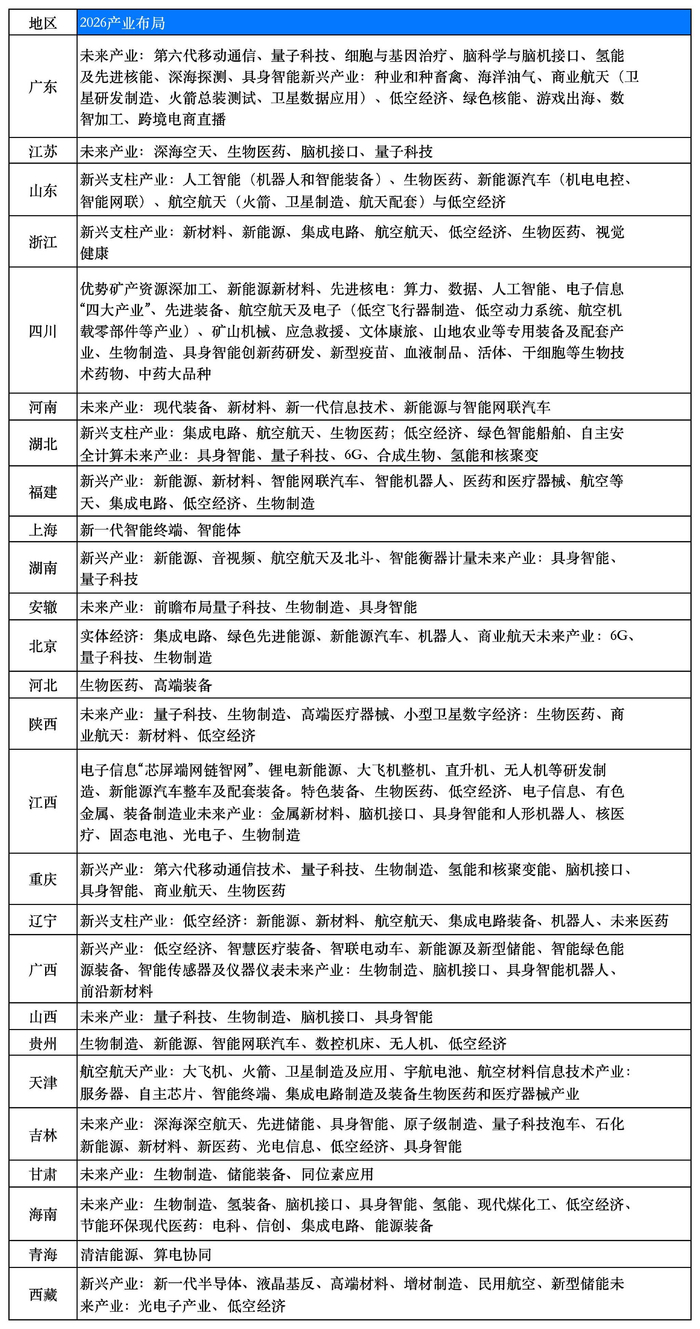
2026年31省“强产业”图景:传统、新兴、未来三维并进,推进智能化和绿色化
Xin Lang Cai Jing· 2026-02-09 03:24
Core Viewpoint - The "14th Five-Year Plan" emphasizes building a modern industrial system and strengthening the foundation of the real economy as a primary strategic task, with 2026 marking the beginning of this plan [1] Group 1: Industry Focus and Strategies - Local governments across 31 provinces are prioritizing "strong industries" with a focus on "new quality productivity," driven by technological innovation, while consolidating traditional industries and competing in AI and future industries [1] - Key emerging industries identified include artificial intelligence, biomedicine, commercial aerospace, robotics, and quantum technology, reflecting a commitment to the central government's directives [3][9] - Provinces are adopting a three-dimensional approach to industry development, focusing on upgrading traditional industries, nurturing emerging industries, and laying out future industries [3][4] Group 2: Technological Innovation and Investment - Technological innovation is seen as the primary driver for strong industries, with many provinces setting quantitative targets for R&D investment, such as Jiangsu aiming for a 7% annual increase in R&D spending [4][5] - Various provinces are investing significantly in core technology breakthroughs, with Beijing planning to invest over 1.5 billion yuan in high-tech industry technology research [7] - The establishment of innovation platforms and pilot zones is being prioritized to facilitate the transformation of technological achievements into production [7][9] Group 3: Differentiated Industrial Layout - Provinces are tailoring their industrial strategies based on local resources and advantages, with eastern coastal provinces focusing on global innovation hubs and western provinces targeting green energy and computing [11][12] - The northeastern provinces are revitalizing traditional industries and enhancing specialized equipment manufacturing, with specific initiatives to support local industrial clusters [12][13] Group 4: Talent and Policy Support - Local governments are launching new talent acquisition plans to attract high-level professionals, with Beijing implementing measures to support young innovators [13] - A comprehensive policy framework combining industrial planning, special policies, and financial support is essential for achieving the goal of strong industrial provinces [13]
华源证券:产业升级有望提振原奶需求 奶价拐点向上或助力头部乳企修复市场份额
Zhi Tong Cai Jing· 2026-02-09 03:07
Core Viewpoint - The report from Huayuan Securities indicates a positive outlook for leading dairy companies, expecting them to benefit from the recovery of market share during the rising milk price period and to enhance profitability through leading industry upgrades and entering high-margin deep processing products [1] Supply Side Summary - The supply-demand imbalance has driven low fluctuations in raw milk prices, but there is structural growth potential in per capita dairy consumption. The low milk prices are expected to create a window for industry upgrades, promoting domestic substitution of deep processing products [2] - Milk prices are anticipated to rise, directly benefiting the fundamentals of upstream dairy companies. The price of fresh milk in major production areas has declined for over four years, reaching 3.04 yuan/kg, a 30.6% drop from the 4.38 yuan/kg peak in 2021. The report predicts that the turning point for raw milk prices will arrive in 2026, significantly boosting the performance of upstream dairy companies [2][3] Demand Side Summary - There are structural opportunities in dairy product demand, with domestic substitution in deep processing potentially providing a new growth curve for dairy companies. The per capita dairy consumption in China is projected to be 40.6 kg in 2024, still below the 47 kg target set for 2030. The consumption structure is primarily focused on liquid milk, with a low proportion of dairy solids [3] - The report highlights the potential for growth in low-temperature milk and cheese products, driven by increasing health awareness. The experience from Japan shows that deep processing continues to develop even after liquid milk peaks. Additionally, the regulatory changes by the State Administration for Market Regulation are expected to benefit leading companies by clarifying standards for deep processing products [3] - The Ministry of Commerce's temporary anti-subsidy measures on imported dairy products from the EU, effective from December 2025, will increase import costs, enhancing the price-performance advantage of domestic deep processing products. This policy is expected to accelerate the domestic substitution process for high-value products like cheese and cream, helping to absorb excess raw milk and improve the supply-demand dynamics in the industry [3] Market Share Recovery - The anticipated turning point in milk prices is expected to help leading dairy companies recover market share. The maintenance or improvement of gross margins during the rising milk price period will depend on the actual recovery of market demand. As raw milk prices enter an upward cycle, previously recognized inventory and biological asset impairment losses may be reversed, potentially leading to a short-term recovery in net profit margins [4] - The report notes that many small brands have used low-price strategies to capture market share during the declining milk price period, which has increased sales expenses for leading companies. However, as the surplus of raw milk decreases during the rising price period, the competitive environment is expected to improve, benefiting leading companies in regaining market share [4] Investment Recommendations - The report recommends focusing on upstream farms such as Youran Dairy and China Shengmu, with a suggestion to pay attention to Modern Dairy. For dairy product companies, it recommends Yili Group (600887) and suggests monitoring Mengniu Dairy and New Hope Dairy (002946) [4]

科德宝:深度融入中国产业生态
Zhong Guo Hua Gong Bao· 2026-02-09 02:53
Core Insights - The Chinese petrochemical industry is expected to maintain steady growth due to strong demand, clear policy direction, and breakthroughs in high-end sectors [1][2] - Covestro Group aims to deepen localization in China as a strategic foundation, focusing on local R&D, production, and market expansion [1][3] Industry Overview - China, as the world's largest producer and consumer of petrochemical products, benefits from a modernization process supported by its 1.4 billion population, providing robust and sustained demand [2] - The country has a complete petrochemical industry chain, leading in production capacity across over 20 types of basic chemicals globally, while attracting significant foreign investment through high-level openness [2] - The industry faces challenges such as global economic changes, structural supply-demand imbalances, and the transition to green and low-carbon practices, with policies guiding the industry towards high-end and green development [2] Company Strategy - Covestro's long-term strategic goal includes balanced sales distribution across Europe, Asia, and the Americas, with China being a key market [3] - The company emphasizes deep localization by investing in advanced manufacturing facilities, local R&D, and talent to enhance operational capabilities and meet local customer needs [3] - Covestro aims to integrate its global core technology with the demands of emerging markets in areas like new energy, robotics, and AI, fostering innovation and value co-creation with local partners [3][4] Local Partnerships and Branding - Covestro has strengthened collaborations with local partners, marking a shift from being a single product supplier to an ecosystem partner and value co-creator [4] - The company launched a new Chinese brand identity at the China International Import Expo, enhancing its local brand recognition and influence [4] Focus Areas for 2025 - In the upcoming year, Covestro will focus on local R&D, production, and new market expansion, aligning with the core strategy of "In China, For China" [5] - The company plans to establish a humanoid robot co-creation center in Zhangjiang Robot Valley, which will serve as a platform for exploring future trends and business opportunities [5] - Covestro is expanding its localized production and supply chain resilience to respond more agilely to market demands, including the introduction of key products by its subsidiary, Eger Borgmann [6]
从外贸万亿大省看韧性与活力
Ren Min Ri Bao· 2026-02-09 02:17
Core Viewpoint - In 2025, China's total import and export value of goods reached 45.47 trillion yuan, a year-on-year increase of 3.8%, maintaining its position as the world's largest trading nation in goods [1] Group 1: Trade Performance and Contributions - Various provinces leveraged their geographical advantages and resource endowments to contribute to the steady development of China's imports and exports [1] - Guangdong province led the nation in import and export scale for 40 consecutive years, reaching 9.49 trillion yuan in 2025, with high-tech product exports surpassing 1 trillion yuan for the first time, totaling 1.14 trillion yuan [2] - In 2025, the combined import and export value of Guangdong, Jiangsu, Zhejiang, Shanghai, Shandong, Beijing, and Fujian reached 34.11 trillion yuan, contributing over half of China's foreign trade growth [3] Group 2: Market Diversification and New Opportunities - Chinese foreign trade enterprises are deepening cooperation in traditional markets while expanding into emerging markets, effectively diversifying market risks [4] - Guangdong's trade with ASEAN, the EU, and Hong Kong each exceeded 1 trillion yuan in 2025, while trade with Belt and Road countries reached 3.66 trillion yuan, growing by 5% [6] - Zhejiang's trade with ASEAN surpassed that with the EU for the first time, reaching 8690.7 billion yuan, a growth of 16.5% [6] Group 3: New Business Models and Innovations - The digital transformation and logistics upgrades have enabled more enterprises to participate in global competition, breaking traditional trade time and space limitations [8] - Shanghai's service trade reached over 250 billion USD in 2025, accounting for nearly 30% of the national total, with a focus on digital technology and knowledge-intensive services [8] - Jiangsu's cross-border e-commerce platform has driven a 35% increase in exports for small and medium-sized enterprises [8] Group 4: Systemic Changes in Foreign Trade - China's high-quality foreign trade development is characterized by systemic changes in industrial upgrades, market diversification, and business model innovations [9] - The "Guangdong Goods Go Global" initiative aims to assist foreign trade enterprises in expanding markets, strengthening industries, and building brands [9] - Experts emphasize the need to accelerate the development of new business models such as cross-border e-commerce and overseas warehouses to explore new trade spaces [9]
市场缩量调整,聚焦攻防均衡丨周度量化观察
申万宏源证券上海北京西路营业部· 2026-02-09 02:10
Market Overview - This week, the A-share market experienced a comprehensive pullback, with the Shanghai Composite Index down by 1.27%, the CSI 300 down by 1.33%, and the ChiNext Index down by 3.28%. The average daily trading volume in the Shanghai and Shenzhen markets significantly decreased to around 2.3 trillion yuan [2][11][15]. - In the bond market, the overall performance was strong, supported by a stable funding environment maintained by the central bank. The January PMI data fell below the growth line, which is favorable for the bond market [3][31]. Equity Market - The decline in A-shares was primarily driven by a shift in expectations regarding the Federal Reserve's policy, which triggered a significant pullback in precious metals and led to profit-taking in popular sectors ahead of the Spring Festival. The nomination of hawkish candidate Waller as Fed Chair strengthened the dollar, suppressing risk appetite and dragging down cyclical stocks [6][9]. - The investment strategy emphasizes a balanced approach, advocating for low buying and avoiding high chasing. Long-term trends in sectors such as defense, resources, finance, and supply chains are highlighted as areas of potential growth [6][9]. Bond Market - The market is expected to remain volatile in the short term, with favorable factors including the central bank's support for the funding environment. However, the anticipated supply of government bonds poses a challenge. The recommendation is to focus on medium to short-term bond strategies rather than excessive speculation on long-term bonds [7][31]. Commodity Market - The gold market experienced significant volatility, with COMEX gold prices dropping sharply by 8.92% due to a combination of factors, including hawkish expectations from the Fed, profit-taking by bulls, and a sharp decline in silver prices [4][36]. - The short-term outlook for gold suggests potential fluctuations within the current range, with a focus on upcoming U.S. non-farm payroll data and Fed officials' statements. Long-term gold investment remains solid as a core asset [8][40]. Overseas Market - The U.S. economy remains strong, with favorable credit cycle expectations. However, the market is at a relatively high level, and factors such as unclear policy outlooks and declining risk appetite may lead to increased volatility. The AI industry trend is still ongoing, and traditional cycles are expected to recover [9][39].