新型政策性金融工具

Search documents
国债期货日报-20251009
Nan Hua Qi Huo· 2025-10-09 12:04
Report Summary 1. Report Industry Investment Rating No relevant information provided. 2. Core View of the Report - The report suggests paying attention to the central bank's attitude. The short - term market may continue to fluctuate, and it is not advisable to chase high after the rebound. Partial profit - taking of long positions can be considered [1][3]. 3. Summary by Related Catalogs 3.1. Disk Review - On Thursday, treasury bond futures closed higher across the board. Trading volume of TF, T, and TL contracts decreased significantly. Cash bond trading was light, and yields declined across the board. The funding situation was loose, with DR001 around 1.33. Open - market reverse repurchase was 61.2 billion,买断式逆回购 was 110 billion, and the net withdrawal was 35.13 billion [1]. 3.2. Intraday News - The minutes of the Fed's September monetary policy meeting showed differences within the Fed regarding the subsequent rate - cut amplitude. The Ministry of Commerce announced the decision to implement export controls on relevant overseas rare - earth items [2]. 3.3. Market Analysis and Judgment - Treasury bond futures continued the pre - holiday rebound trend today, unaffected by the sharp rise in the stock market. Due to some investment managers and traders still on vacation, market trading was relatively light. The National Development and Reform Commission announced at a press conference before the holiday that it would work with relevant parties to promote new policy - based financial instruments with a scale of 500 billion yuan to supplement project capital. In the future, attention should be paid to the central bank's specific arrangements for this policy. In the short term, the central bank may still prefer to use structural tools to support the real economy and postpone the timing of reserve - requirement ratio cuts and interest - rate cuts [3]. 3.4. Treasury Bond Futures Daily Data | Contract | 2025 - 10 - 09 Price | 2025 - 09 - 30 Price | Today's Change | 2025 - 10 - 09 Position (Lots) | 2025 - 09 - 30 Position (Lots) | Position Change | | --- | --- | --- | --- | --- | --- | --- | | TS2512 | 102.41 | 102.374 | 0.036 | 75,441 | 74,895 | 546 | | TF2512 | 105.75 | 105.655 | 0.095 | 149,401 | 150,436 | - 1035 | | T2512 | 108.05 | 107.885 | 0.165 | 252,116 | 249,185 | 2931 | | TL2512 | 114.53 | 114 | 0.53 | 174,133 | 170,726 | 3407 | | TS Basis (CTD) | - 0.0372 | - 0.0131 | - 0.0241 | TS Main Contract Trading Volume (Lots) | 29,898 | 29,604 | 294 | | TF Basis (CTD) | - 0.034 | - 0.0013 | - 0.0327 | TF Main Contract Trading Volume (Lots) | 51,620 | 62,260 | - 10640 | | T Basis (CTD) | 0.0524 | 0.2077 | - 0.1553 | T Main Contract Trading Volume (Lots) | 73,515 | 91,682 | - 18167 | | TL Basis (CTD) | 0.319 | 0.3574 | - 0.0384 | TL Main Contract Trading Volume (Lots) | 97,276 | 135,369 | - 38093 | [4]

图说金融:新型政策性金融工具资金开始投放
Zhong Xin Qi Huo· 2025-10-09 11:34
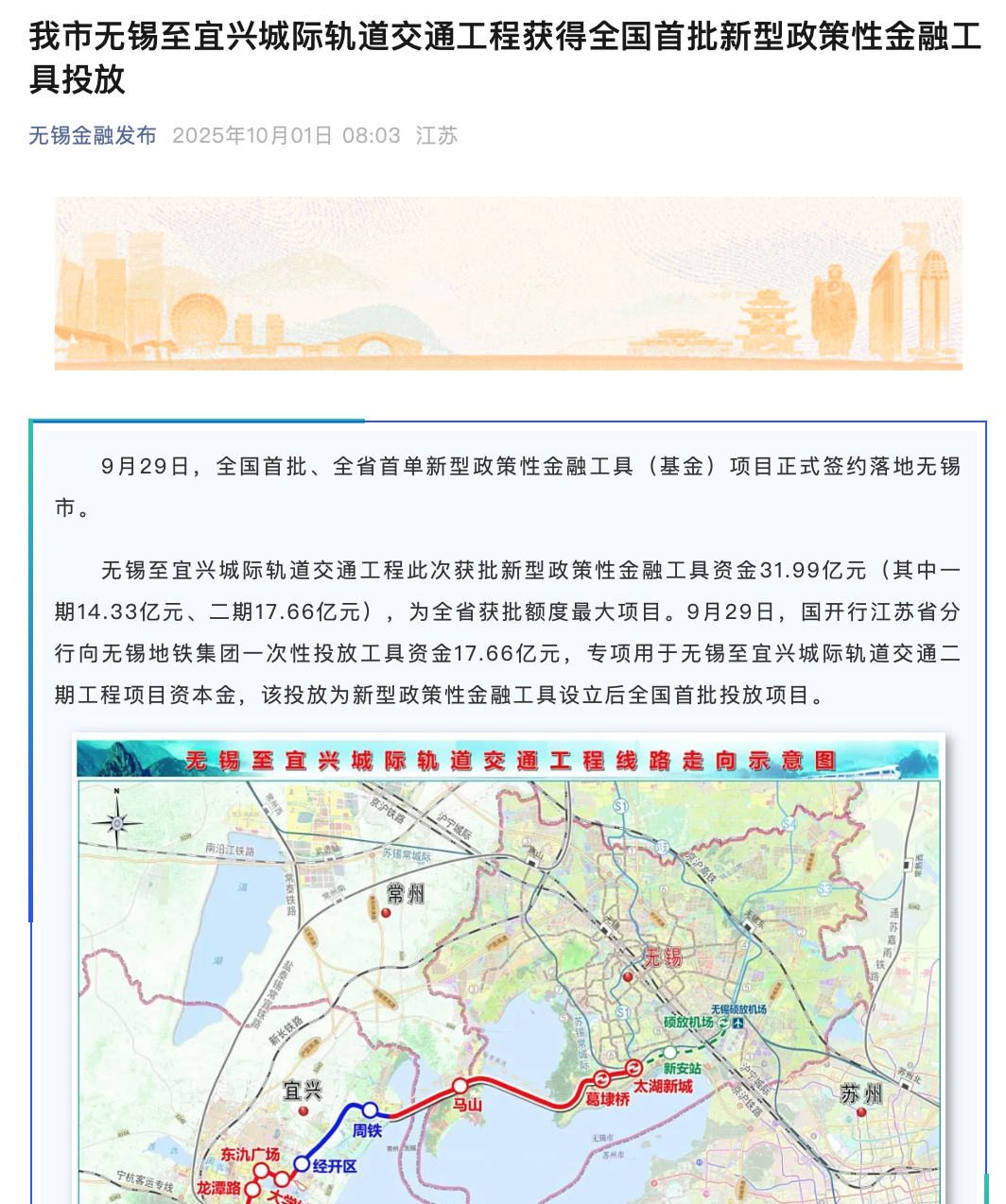
Report Summary 1. Report Industry Investment Rating - No information provided 2. Core View of the Report - On September 29, 2025, three new policy-based financial instrument companies were registered, and funds started to be disbursed on the same day. The funds have been disbursed in provinces and cities such as Jiangsu, Zhejiang, Guangdong, Hainan, Guangxi, Fujian, Anhui, Shandong, Sichuan, Chongqing, and Inner Mongolia [2]. 3. Summary by Relevant Catalog Features of the Instruments - Long - term: Some project financing terms are 20 years or 15 - 20 years [2]. - Low - interest rate: The capital interest rate of a project is lower than the current LPR, setting a new record for the lowest financing cost among all financing channels since the group's establishment [2]. Investment Fields - The disclosed project fields include infrastructure areas such as transportation and logistics, green - low - carbon transformation, municipal and industrial parks, as well as scientific and technological innovation fields such as artificial intelligence [3]. Proportion in Total Investment - In some projects, the amount obtained accounts for less than or equal to 10% of the total project investment (less than or equal to 50% of the project capital) [4]. Project Approval Rate - The project approval rate in some areas may be low. For example, in a certain place in Zhejiang, the approval rate from the city to the province is 40%, and from the province to the state is 13% [5]. Disbursement Situation as of October 8 - Multiple projects in various provinces and cities have received new policy - based financial instrument funds, with specific amounts and project details as shown in the table. For example, the Wuxi - Yixing Intercity Rail Transit Project in Wuxi, Jiangsu received 31.99 billion yuan; the Taicang Water Supply Co., Ltd. Expansion and Booster Station Project in Taicang, Jiangsu received 0.2076 billion yuan, accounting for 10% of the total project investment of 2.0766 billion yuan [6].
前三季度地方借钱约8.5万亿元,花哪儿了?
第一财经· 2025-10-09 06:56
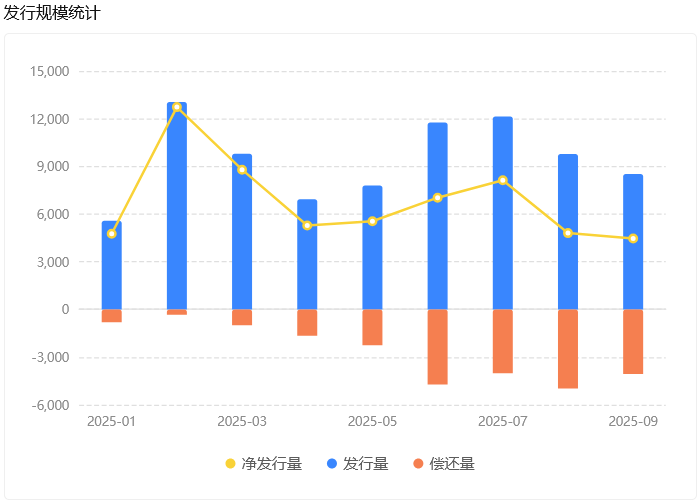
Core Viewpoint - Local governments are increasing their borrowing to stabilize investment and mitigate risks, with a record high in bond issuance this year, but the growth rate is gradually declining as the issuance approaches its limit [3][6]. Summary by Sections Local Government Bond Issuance - In the first three quarters of this year, local government bond issuance totaled approximately 8.54 trillion yuan, representing a year-on-year increase of about 27% [3][6]. - The broad fiscal revenue of local governments for the first eight months was around 10.75 trillion yuan, with borrowing accounting for about 72% of this revenue [6]. Use of Borrowed Funds - Approximately 60% of the funds raised are used for repaying old debts, while nearly 40% are directed towards major project construction [6][7]. - The issuance of refinancing bonds reached about 4.19 trillion yuan, a year-on-year increase of 69%, primarily aimed at repaying old debts [7][8]. Debt Management and Financial Health - The average interest cost of the debt has decreased by over 2.5 percentage points, saving more than 450 billion yuan in interest expenses [8]. - The refinancing efforts have improved the financial health of local governments and reduced financial risks significantly [8][10]. Infrastructure Investment - In the first eight months, infrastructure investment (excluding power, heat, gas, and water supply) grew by 2.0%, surpassing the overall fixed asset investment growth rate of 0.5% [10]. - Approximately 3.15 trillion yuan of the new local government bonds was allocated to major project construction, with significant portions directed towards municipal infrastructure, transportation, and social projects [10]. Future Outlook - The total issuance of local government bonds for the year is nearing its limit, with a cap of 5.2 trillion yuan set for new bonds, and 84% of this quota has already been utilized [10][11]. - Experts suggest the possibility of issuing an additional 1 trillion yuan in bonds to further alleviate the pressure of hidden debts [11].

前三季度地方借钱约8.5万亿元,花哪儿了?
Di Yi Cai Jing· 2025-10-09 06:13
Core Viewpoint - Local governments are increasingly relying on bond issuance to manage debt and finance projects, with over 60% of the funds raised used for debt repayment and nearly 40% allocated for project construction [1][4][5]. Group 1: Bond Issuance and Debt Management - In the first three quarters of this year, local government bond issuance reached approximately 8.54 trillion yuan, a year-on-year increase of about 27% [2]. - The issuance of refinancing bonds accounted for about 4.19 trillion yuan, representing a significant year-on-year growth of approximately 69% [4][5]. - The refinancing bonds are primarily used to repay old debts, including the principal of maturing government bonds and to replace hidden debts, thereby optimizing the debt structure and alleviating repayment pressure [4][6]. Group 2: Allocation of Funds - Approximately 63% of the total bond issuance, or about 5.39 trillion yuan, was effectively used for debt repayment [5]. - The remaining funds, around 3.15 trillion yuan, were directed towards major project construction, with about 2.5 trillion yuan specifically allocated to special project bonds [6]. - The special project bonds were primarily invested in municipal and industrial infrastructure (28%), transportation infrastructure (18%), land reserves (14%), and social projects such as healthcare and education (12%) [6]. Group 3: Economic Impact and Future Outlook - Infrastructure investment in the tertiary sector grew by 2.0% year-on-year in the first eight months, surpassing the overall fixed asset investment growth rate of 0.5% [8]. - The total bond issuance for the year is nearing its limit, with 84% of the annual quota already utilized, raising concerns about potential policy adjustments in the fourth quarter to increase issuance [8]. - Experts suggest that an additional 1 trillion yuan in bonds could be issued to further alleviate the pressure of hidden debts and improve local liquidity [9].
何谓新型政策性金融工具?|宏观经济
清华金融评论· 2025-10-08 09:52
文/国金宏观 宋雪涛 此 次新型政策性金融工具的出台更多为了长期目标,与2 0 2 2年相比,在 投向、资金来源和经济影响等方面并不相同。 9月29日,国家发改委在新闻发布会上表示:"推进新型政策性金融工具有关工作,规模共5000亿元,全部用于补充项目资本金"。新型政策性 金融工具最早于今年4月政治局会议提出,最终在基数较高、同比增速压力较大的四季度落地,符合此前市场预期。 早在2022年,央行曾支持国开行、农发行和进出口银行设立类似的政策性开发性金融工具,当时为了托底投资,主要投向交通水利能源等基 础设施和信息科技物流的产业升级,投放7399亿元,带动当年基建投资增速从上半年的9.3%提升至11.5%。对比2022年,这一次的政策性金 融工具有三个不同之处。 出台背景和投向不同 与2022年稳增长压力较大的背景相比,今年实现全年5%的 国内生产总值(GDP) 增长目标压力并不大,此次出台新型政策性金融工具更多 是为了支持扩大内需和科技创新的长远目标,这也符合"十五五"规划的两条主线。因此,新型政策性金融工具在支持项目方面,更加聚焦新 质生产力,重点支持数字经济、人工智能、低空经济、消费基础设施、绿色低碳、农 ...

更好服务实体经济 我国推出5000亿元新型政策性金融工具
Yang Shi Wang· 2025-10-07 00:04
Core Viewpoint - The establishment of new policy-based financial instruments aims to enhance financial services for the real economy and promote effective investment, with a total scale of 500 billion yuan allocated for project capital supplementation [1] Group 1 - The new policy-based financial instruments will focus on supporting technological innovation, promoting consumption, and stabilizing foreign trade [1] - The initiative is part of efforts to ensure stable and healthy economic development [1]
国庆假期不停工!重点工程建设“火力全开”
Zhong Guo Zheng Quan Bao· 2025-10-03 09:35
Group 1 - Central enterprises are actively promoting projects and investments during the National Day holiday to stabilize the economy, with significant engineering projects continuing without interruption [1] - The world's first "dual-tower one machine" solar thermal energy storage power station has entered full system trial operation, marking a breakthrough in tower solar power generation technology [2] - The successful installation of the last wind turbine in the 200,000-kilowatt wind-storage project in Hegang, Heilongjiang, signifies the completion of the main engineering work [3] Group 2 - The G228 Binhai section's Tauer River Bridge has been completed and opened to traffic, significantly reducing travel time between the two banks [4] - The construction of the Zhongsha Gule Ethylene project is progressing rapidly, with over 4,000 workers on-site, achieving 82.5% overall progress [5] - The world's highest high-proportion co-firing high-alkali coal 660 MW ultra-supercritical thermal power unit has been put into operation, expected to generate 8 billion kilowatt-hours annually [6] Group 3 - The first batch of dam sections for the highest hyperbolic arch dam under construction in the domestic plateau has been successfully poured to the top, marking a significant milestone [7] - The National Development and Reform Commission is accelerating fund disbursement for the fourth quarter, with a new policy financial tool scale of 500 billion yuan aimed at supplementing project capital [8]


投资、消费,两大利好来了
Shang Hai Zheng Quan Bao· 2025-10-01 06:51
Core Viewpoint - The National Development and Reform Commission (NDRC) has announced significant policy benefits ahead of the National Day holiday, including the introduction of 500 billion yuan in new policy financial instruments and the allocation of 69 billion yuan in special long-term bonds to support the consumption of old goods [1][6]. Group 1: New Policy Financial Instruments - The first batch of new policy financial instruments has been officially launched, with a total scale of 500 billion yuan, all designated for supplementing project capital [2][4]. - The first project funded by these instruments is the Wuxi to Yixing intercity rail transit project, which received 3.199 billion yuan, making it the largest project approved in the province [4]. - Other cities, including Guangzhou, Puyang, Xingtai, Huzhou, and Yibin, are also actively seeking to utilize these new financial instruments to expand effective investment [4][5]. Group 2: Special Long-term Bonds for Consumption - The NDRC, in collaboration with the Ministry of Finance, has allocated 69 billion yuan in special long-term bonds to support the consumption of old goods, completing the annual target of 300 billion yuan in central funding [6]. - From January to August, 330 million people have claimed subsidies for replacing old goods, leading to sales exceeding 2 trillion yuan [6]. - Retail sales of household appliances and related goods have seen significant year-on-year growth, with increases of 28.4%, 22.3%, 22.0%, and 21.1% in various categories [6].
2025年9月PMI数据点评:PMI边际回升:供给推动
Haitong Securities International· 2025-09-30 15:02
Group 1: Manufacturing Sector Insights - In September 2025, the Manufacturing PMI rose to 49.8%, an increase of 0.4 percentage points from the previous month[7] - The production index reached a six-month high at 51.9%, up 1.1 percentage points, indicating active manufacturing activities[13] - New orders index was at 49.7%, showing a slight increase of 0.2 percentage points but still in the contraction zone[13] Group 2: Raw Materials and Pricing - The main raw materials purchasing price index decreased slightly to 53.2%, down 0.1 percentage points, while the factory price index fell to 48.2%, down 0.9 percentage points[19] - The procurement volume index rose to 51.6%, an increase of 1.2 percentage points, indicating accelerated raw material purchases[21] Group 3: Non-Manufacturing Sector Performance - The services business activity index fell to 50.1%, a decrease of 0.4 percentage points, with notable sector differentiation[22] - The construction business activity index was at 49.3%, a marginal increase of 0.2 percentage points, but still below the critical point[26] Group 4: Economic Policy and Risks - The government announced a new policy financial tool worth 500 billion yuan to support project capital, aimed at boosting infrastructure activities[27] - Real estate demand remains weak, posing a risk to overall economic recovery[28]
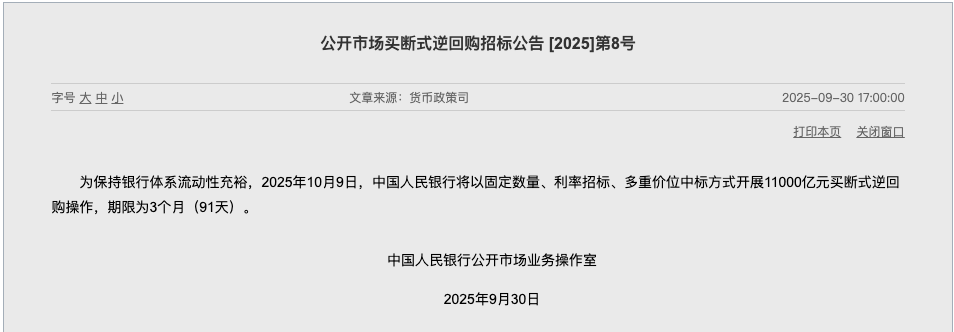
释放呵护流动性宽松信号,央行公告节后加量续作买断式逆回购
2 1 Shi Ji Jing Ji Bao Dao· 2025-09-30 10:56
Core Viewpoint - The People's Bank of China (PBOC) is set to conduct a 1.1 trillion yuan reverse repo operation on October 9, 2025, to maintain ample liquidity in the banking system, with a term of 3 months [1] Group 1: Reverse Repo Operations - In October, 800 billion yuan of 3-month reverse repos and 500 billion yuan of 6-month reverse repos are set to mature, leading to a net injection of 300 billion yuan after the PBOC's operation [4] - The PBOC's actions indicate a continuation of liquidity support, with expectations of further 6-month reverse repo operations to match the maturing amounts [4][5] - The central bank's strategy aims to counter potential liquidity tightening due to government bond issuances and seasonal cash demand increases [5] Group 2: Market Conditions and Expectations - The PBOC's liquidity measures are designed to stabilize the financial environment amid significant government bond issuances and a strong stock market [5] - Analysts predict that the central bank will utilize both reverse repos and Medium-term Lending Facility (MLF) tools to inject liquidity, although the scale of net liquidity injection may decrease from previous high levels [6] - There is an expectation of a new round of monetary easing, including a potential reserve requirement ratio (RRR) cut, to support economic growth and stabilize the real estate market [6]