
电动化

Search documents
产销连续3年保持3000万辆以上规模 汽车产业竞争力源自硬实力
Xin Hua Wang· 2026-01-14 23:37
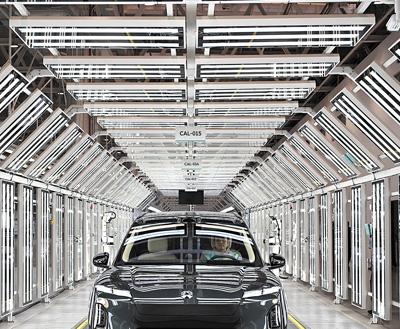
Core Insights - The continuous advancement of electrification technology and the rapid application of cutting-edge technologies have led to sustained growth in China's automotive production and sales, reflecting the resilience and dynamic momentum of the economy [1][7]. Group 1: Automotive Production and Sales - China's automotive production and sales have maintained a scale of over 30 million units for three consecutive years, ranking first globally for 17 years [7]. - In 2025, the production and sales of new energy vehicles (NEVs) are projected to reach 16.626 million and 16.49 million units, respectively, representing year-on-year growth of 29% and 28.2% [8]. Group 2: Technological Advancements - The average range of pure electric passenger vehicles in China is expected to approach 500 kilometers by 2025, with fast-charging technology allowing for 80% charge in 15 minutes [8]. - The integration of various technological routes, including electric, hydrogen fuel, and synthetic fuels, is advancing, with China's "super electric hybrid technology" becoming a successful example for reverse technology export to multinational automotive companies [8]. Group 3: Export Growth - In 2025, the export of NEVs is expected to reach 2.615 million units, doubling year-on-year, with passenger vehicle exports at 2.532 million units and commercial vehicle exports at 83,000 units, showing growth rates of 100% and 86.8%, respectively [9]. Group 4: Intelligent Manufacturing and Automation - BYD's factory demonstrates advanced manufacturing capabilities, achieving a vehicle production time of 51 seconds per unit, supported by nearly a thousand industrial robots and a fully automated welding rate of 100% [7]. - The market for L2-level assisted driving vehicles has surpassed 60% of new car sales, with the first L3-level conditional autonomous driving models receiving approval [10]. Group 5: Industry Transformation and Profitability - Measures to combat "involution" in the automotive industry, such as halting price wars and improving payment terms, have led to a profit growth of 4.4% in the automotive sector from January to October 2025, accelerating to 7.5% by November [11]. - High-quality supply and brand upgrades are being emphasized, with several flagship models gaining market recognition, including the Hongmeng Zhixing's Zun Jie S800 and the AITO series [11].

去年我国汽车产销双破3400万辆 连续17年居全球第一
Sou Hu Cai Jing· 2026-01-14 22:41
Group 1 - The core viewpoint of the articles highlights the robust growth forecast for China's automotive industry, with production and sales expected to reach 34.53 million and 34.40 million units respectively by 2025, marking year-on-year increases of 10.4% and 9.4% [1] - The production and sales of new energy vehicles (NEVs) are projected to reach 16.63 million and 16.49 million units by 2025, with year-on-year growth rates of 29% and 28.2%, maintaining China's position as the global leader for 11 consecutive years [1] - NEVs are expected to account for over 50% of new car sales in China, solidifying their status as the dominant force in the automotive market [1] - China's automotive exports are anticipated to exceed 7 million units in 2025, with new energy vehicle exports reaching 2.615 million units, representing a year-on-year increase of 100% [1] - The automotive industry in China has achieved significant breakthroughs during the 14th Five-Year Plan period, maintaining production and sales above 30 million units for three consecutive years and surpassing 10 trillion yuan in revenue [1] Group 2 - The recently released "Two New" policy for 2026 adjusts the vehicle replacement subsidy from a fixed amount to a percentage of the vehicle price, ensuring a smooth transition of policies [2] - A notification from the Ministry of Commerce and nine other departments regarding the implementation of green consumption initiatives is expected to accelerate the green transformation of development and consumption models, positively impacting market expectations and boosting automotive consumption [2]
再创新高,中国汽车产销突破3400万辆!
Xin Jing Bao· 2026-01-14 14:55
Core Insights - In 2025, China's automotive production and sales exceeded 34 million units, marking the third consecutive year above 30 million and maintaining its position as the world's largest automotive market for 17 years [1][3] - The automotive industry in China has achieved significant milestones, including a revenue surpassing 10 trillion yuan and becoming the world's largest exporter of vehicles, driven by high-quality transformation and the rise of domestic brands in the electric vehicle sector [1][5] - The forecast for 2026 suggests a stable automotive market with total sales expected to reach 34.75 million units, supported by favorable policies and consumer demand [1][13] Production and Sales Performance - In 2025, total automotive production reached 34.53 million units, with sales at 34.40 million units, reflecting year-on-year growth of 10.4% and 9.4% respectively [3] - Passenger vehicle production and sales surpassed 30 million units for the first time, reaching 30.27 million and 30.10 million units, with year-on-year increases of 10.2% and 9.2% [3][4] - The commercial vehicle market also rebounded, achieving over 4 million units in production and sales, with exports exceeding 1 million units for the first time [4] New Energy Vehicles (NEVs) - NEV production reached 16.62 million units in 2025, with sales at 16.49 million units, marking year-on-year growth of 29% and 28.2% respectively [5][8] - NEVs accounted for 47.9% of total new car sales, with domestic sales of NEV passenger vehicles reaching 54% [5] - The growth of NEVs is attributed to favorable policies, abundant supply, and improved infrastructure, alongside advancements in core technologies [8] Export Performance - In 2025, China's automotive exports reached 7.098 million units, a year-on-year increase of 21.1% [10] - NEV exports also saw significant growth, reaching 2.615 million units, doubling from the previous year [10] Future Outlook - The automotive market is expected to continue its positive trajectory in 2026, with total sales projected at 34.75 million units, a 1% increase from 2025 [13] - The passenger vehicle market is anticipated to grow by 0.5%, while the commercial vehicle market is expected to see a 4.7% increase [13] - The NEV market is forecasted to reach 19 million units in sales, reflecting a 15.2% growth [13] - The automotive industry is facing a competitive landscape, with a shift towards AI integration and smart driving technologies, indicating a potential consolidation among leading suppliers [14]
2025年我国汽车产销量再创新高
Zhong Guo Jing Ji Wang· 2026-01-14 13:56
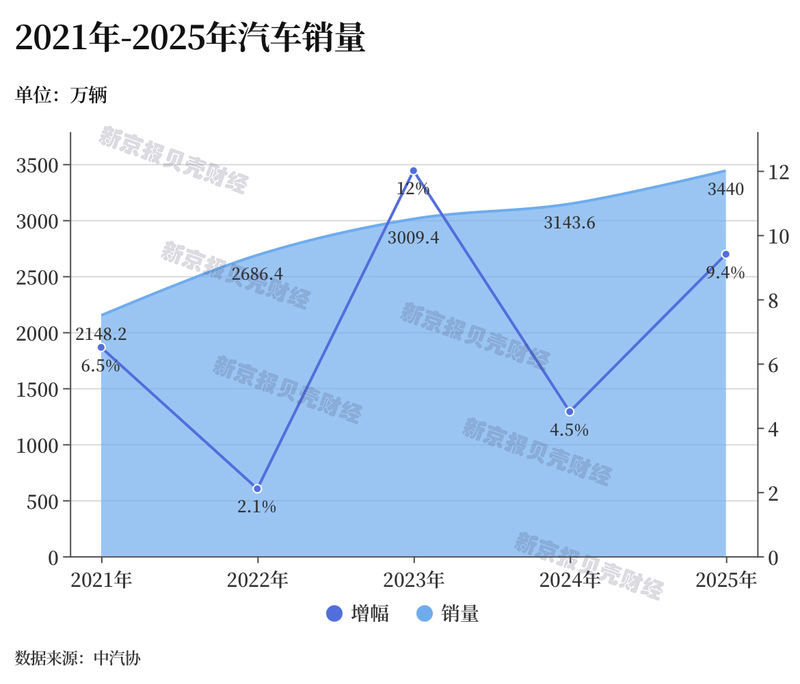
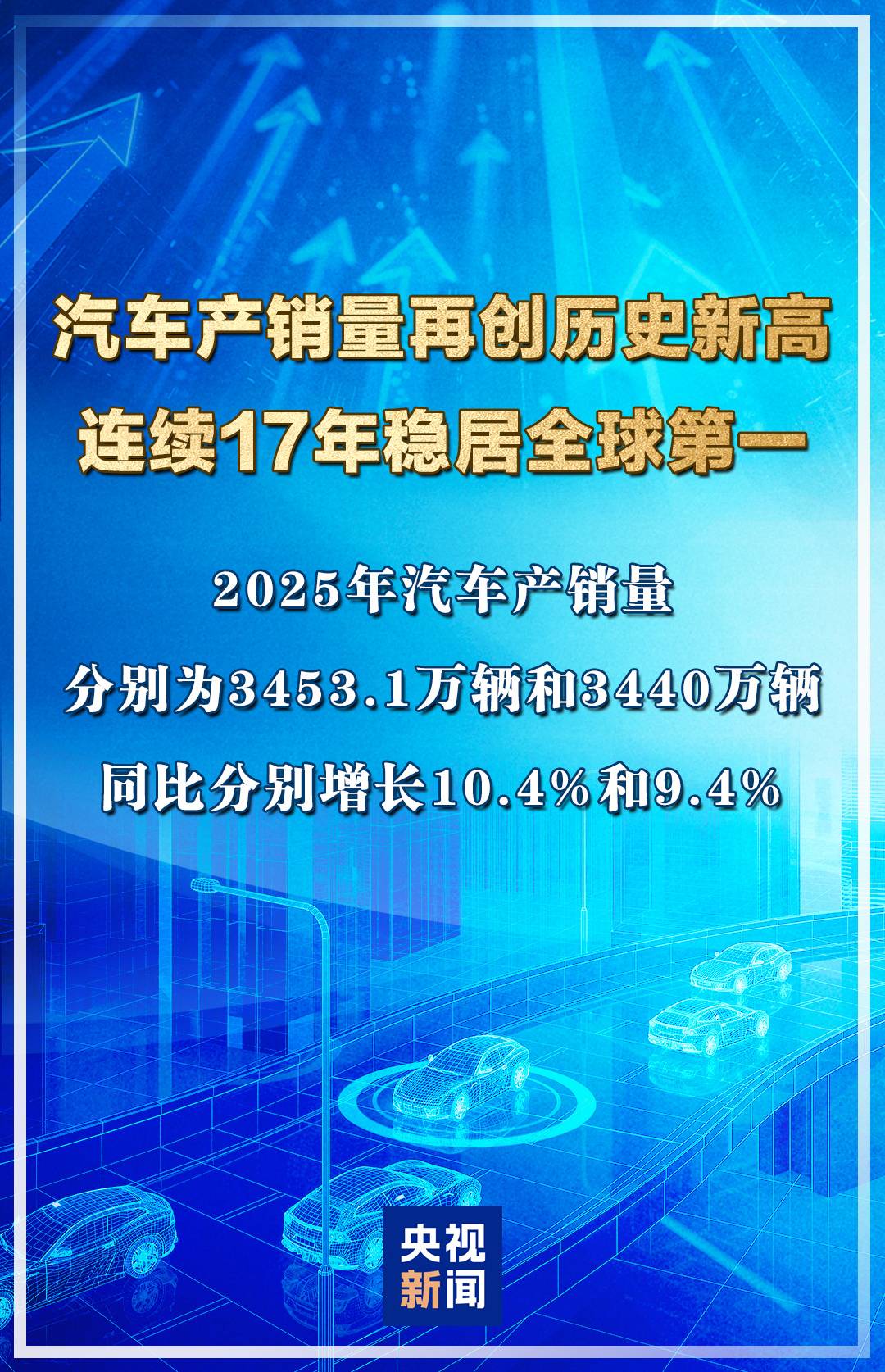
中国汽车工业协会发布最新数据显示,2025年,我国汽车产销量均突破3400万辆,再创历史新高。新能 源汽车产销量均超1600万辆,新能源汽车国内新车销量占比突破50%。 2025年,我国汽车产销量分别为3453.1万辆和3440万辆,同比分别增长10.4%和9.4%,连续17年稳居全 球第一。新动能加快释放,新能源汽车产销分别完成1662.6万辆和1649万辆,同比分别增长29%和 28.2%,连续11年位居全球第一。 "我国汽车行业继续展现出强大的发展韧性和活力,多项指标再创新高。"中国汽车工业协会副秘书长陈 士华表示,"十四五"期间,我国汽车行业取得多方面突破,产销量连续三年保持3000万辆以上规模,营 业收入突破10万亿元,电动化与智能化、网联化加速融合,形成产业领先优势。 2025年,我国"两新"政策加力扩围,企业新品密集上市,汽车市场终端需求持续释放,2025年汽车产销 量实现超预期增长。2026年,"两新"政策平稳有序衔接。近日9部门联合印发的《关于实施绿色消费推 进行动的通知》,将加快发展方式和消费模式绿色转型,提振汽车消费。陈士华表示,2026年,中国汽 车产业将持续推进高质量发展,整体市场保 ...
突破3400万辆!2025年我国汽车产销量再创历史新高
Yang Guang Wang· 2026-01-14 11:20
Core Insights - The Chinese automotive industry is projected to achieve record production and sales of over 34 million units in 2025, maintaining its position as the world's largest market for 17 consecutive years [1][2] - New energy vehicles (NEVs) are expected to account for over 50% of domestic new car sales, solidifying their status as the dominant force in the market [1][2] Industry Performance - In 2025, the total production and sales of automobiles reached 34.53 million and 34.40 million units respectively, marking a historical high [2] - The passenger vehicle market showed steady growth, while the commercial vehicle market rebounded with over 10% growth, surpassing 4 million units [2] - NEV production and sales exceeded 16 million units, with exports reaching over 7 million units, including 2.615 million NEVs [2] Globalization and Innovation - The Chinese automotive industry is experiencing a new phase of globalization, with increased export volumes and deeper international cooperation [2][3] - A German luxury car brand has established a research center in China and is collaborating with local tech companies to develop advanced in-car information systems [3] - China's automotive sector is becoming a hub for global automotive innovation, with NEVs contributing over one-third of export volumes [3][4] Technological Advancements - The industry has seen significant breakthroughs in technology, including the approval of L3 autonomous driving models and advancements in hydrogen vehicles and solid-state batteries [4] - The integration of artificial intelligence in driving automation and cabin intelligence is expected to deepen, with increased penetration of L2 and L3 driving assistance features [4] Market Dynamics and Policies - The automotive market's consumption vitality has been enhanced through policy guidance, with over 11.5 million vehicles traded in under the old-for-new program, generating over 1.6 trillion yuan in new car sales [4][5] - The potential for vehicle upgrades remains high, with over 47 million old passenger vehicles eligible for replacement, indicating significant market activation potential [5] - The automotive market is projected to reach total sales of 34.75 million units in 2026, with NEV sales expected to grow by 15.2% to 19 million units [5]
瑞银:2030年中国汽车品牌在西欧市场占有率有望达15%
Zhong Guo Xin Wen Wang· 2026-01-14 09:57
Core Viewpoint - UBS predicts that by 2030, the market share of Chinese automotive brands in Western Europe is expected to increase from the current 5% to 15% [1] Group 1: Market Growth - Five years ago, China's passenger car export volume was approximately 1 million units, projected to reach around 6 million units by 2025, indicating significant growth [1] - The average export price of Chinese passenger cars has risen from around 100,000 RMB to approximately 300,000 RMB, reflecting a shift from low-end to mid-to-high-end products [1] Group 2: Product Diversification - Chinese automotive companies are not only exporting passenger cars but also other categories such as motorcycles, heavy trucks, and buses [1] - The integration of electric vehicle advantages along with features like autonomous driving and driver assistance has made Chinese automotive products more competitive in terms of cost-performance compared to global counterparts [1] Group 3: Strategic Collaborations - Current efforts by Chinese automotive companies to strengthen partnerships with local European firms, along with the growth of direct export volumes and local production capacity, are expected to contribute to the steady increase in market share in Western Europe [1] - Globally, the market share of Chinese automotive brands is currently at 20%, with a forecasted increase to 25% by 2030 [1]
均突破3400万辆!2025年我国汽车产销量再创历史新高
中国基金报· 2026-01-14 07:18
来源:新闻联播 中国汽车工业协会今天( 1 4日)发布的最新数据显示, 2 025年,我国 汽车行业继续展现出 强大的发展韧性和活力,多项经济指标再创新高。 2025年,汽车产销量分别为3453.1万辆和3440万辆,同比分别增长10.4%和9.4%,产销量再 创历史新高,连续17年稳居全球第一 。其中,新动能加快释放,新能源汽车产销量超1600万 辆,其中国内新车销量占比超50%,成为我国汽车市场主导力量。在对外贸易方面,呈现出较强 韧性,汽车出口超700万辆,出口规模再上新台阶。其中, 新能源汽车出口261.5 万辆,同比 增长 1倍 。 中国汽车工业协会副秘书长 陈士华介绍,"十四五"期间,我国汽车行业取得多方面突破,产销 量连续三年保持3000万辆以上规模, 营业收入突破10万亿元,出口跻身世界第一 ,电动化与 智能化、网联化加速融合,形成产业领先优势。 2025年,我国"两新"政策加力扩围,企业新品密集上市,汽车市场终端需求持续释放,2 025 年汽车产销量实现超预期增长。值得注意的是, 2 025年, 中国品牌乘用车销量占比接近 70%,较去年同期上升4.3个百分点。2025年,在政策利好、供给丰 ...
连续17年,全球第一!
第一财经· 2026-01-14 06:45
中国汽车工业协会今天(14日)发布的最新数据显示,2025年,我国汽车行业继续展现出强大的发展 韧性和活力,多项经济指标再创新高。 2025年,汽车产销量分别为3453.1万辆和3440万辆,同比分别增长10.4%和9.4%,产销量再创历 史新高,连续17年稳居全球第一。 其中,新动能加快释放,新能源汽车产销量超1600万辆,其中国 内新车销量占比超50%,成为我国汽车市场主导力量。在对外贸易方面,呈现出较强韧性,汽车出口 超700万辆,出口规模再上新台阶。其中, 新能源汽车出口261.5万辆,同比增长1倍 。 中国汽车工业协会副秘书长陈士华介绍,"十四五"期间,我国汽车行业取得多方面突破,产销量连续 三年保持3000万辆以上规模, 营业收入突破10万亿元,出口跻身世界第一 ,电动化与智能化、网联 化加速融合,形成产业领先优势。 陈士华说,2026年,"两新"政策平稳有序衔接。包括9部门联合印发的《关于实施绿色消费推进行动 的通知》,将加快发展方式和消费模式绿色转型,这将稳定市场预期,提振汽车消费。2026年,中国 汽车产业将持续推进高质量发展,整体市场保持稳健运行。 来源|央视新闻 编辑 |瑜见 2025年 ...
2025年汽车产销量再创历史新高 连续17年稳居全球第一
Yang Shi Xin Wen· 2026-01-14 06:05
中国汽车工业协会今天(14日)发布的最新数据显示,2025年,我国汽车行业继续展现出强大的发展韧性和活力,多项经济指标再创新高。 中国汽车工业协会副秘书长 陈士华:2026年,"两新"政策平稳有序衔接。包括9部门联合印发的《关于实施绿色消费推进行动的通知》,将加快发展方式 和消费模式绿色转型,这将稳定市场预期,提振汽车消费。2026年,中国汽车产业将持续推进高质量发展,整体市场保持稳健运行。 (总台央视记者 朱江 罗宏进 制图 喻偌洢) 责编:刘安琪 | 审核:李震 | 监审:古筝 2025年,汽车产销量分别为3453.1万辆和3440万辆,同比分别增长10.4%和9.4%,产销量再创历史新高,连续17年稳居全球第一。新动能加快释放,新能 源汽车产销量超1600万辆,其中国内新车销量占比超50%,成为我国汽车市场主导力量。在对外贸易方面,呈现出较强韧性,汽车出口超700万辆,出口 规模再上新台阶。其中,新能源汽车出口261.5万辆,同比增长1倍。 中国汽车工业协会副秘书长 陈士华:"十四五"期间,我国汽车行业取得多方面突破,产销量连续三年保持3000万辆以上规模,营业收入突破10万亿元, 出口跻身世界第一,电 ...
奇瑞2026年挑战320万辆目标
Jing Ji Guan Cha Bao· 2026-01-14 00:44
Core Insights - Chery Group achieved a total vehicle sales of 2.8063 million units in 2025, marking a year-on-year increase of 7.8% and surpassing 18.53 million cumulative users [2] - The company aims to reach a sales target of 3.2 million units in 2026, representing a growth of 14.03% compared to 2025 [3] Sales Performance - In 2025, Chery's export volume reached 1.344 million units, reflecting a year-on-year growth of 17.4%, maintaining its position as the top Chinese brand in passenger car exports for 23 consecutive years [2] - The sales of new energy vehicles (NEVs) reached 903,800 units in 2025, with a significant year-on-year increase of 54.9%, positioning the company among the industry leaders in both scale and growth [2] Brand Strategy - Chery's brand portfolio includes five distinct brands: Chery, Exeed, Jetour, Zongheng, and iCAR, with over 90% of new products launched in 2025 being NEVs [2] - Specific brand performances in 2025 include: Chery brand with 1.7009 million units, Exeed with 120,300 units, Jetour with 622,500 units, iCAR with 96,900 units, and Zongheng with 8,327 units [2] Future Outlook - Chery Group completed its listing on the Hong Kong Stock Exchange in 2025, marking the beginning of its global capital expansion [3] - The company plans to launch 17 key models in 2026, focusing on accelerating its transition towards electrification and intelligence [3]