
太空算力

Search documents
“中方这一举动,要挑战马斯克”
Guan Cha Zhe Wang· 2026-01-30 00:55
【文/观察者网 柳白】将人工智能(AI)算力搬上太空,已逐步从概念走向现实,中国的行动尤为引人 关注。 路透社1月29日的报道注意到,中国计划在未来五年内发射天基人工智能数据中心,此举将直接挑战马 斯克麾下太空探索技术公司(SpaceX)向太空部署数据中心的雄心。 中国航天科技集团29日表示,"十五五"时期,将谋划推动太空旅游、太空数智基础设施、太空资源开 发、太空交通管理等新领域发展。 太空数智基础设施方面,将建设吉瓦级太空数智基础设施,创建云、边、端一体的新型太空体系架构, 实现算力、存力、运力等深度融合,赋能"天数天算""地数天算""天地同算"。 路透社注意到,该集团去年12月发布的一份政策文件也显示,中国计划将人工智能处理这一高耗能的工 作转移至轨道,利用"吉瓦级"太阳能枢纽,到2030年打造出具备产业规模的"太空云"体系。该文件明 确,将天基太阳能与人工智能计算相融合,是中国"十五五"规划的核心支柱之一。 去年5月,国星宇航"星算"计划实施首次发射,这也是之江实验室"三体计算星座"的首次发射。该"星 算"计划旨在构建一个由2800颗计算卫星组成的太空算力网络,预计2035年前完成全部组网;北京邮电 ...

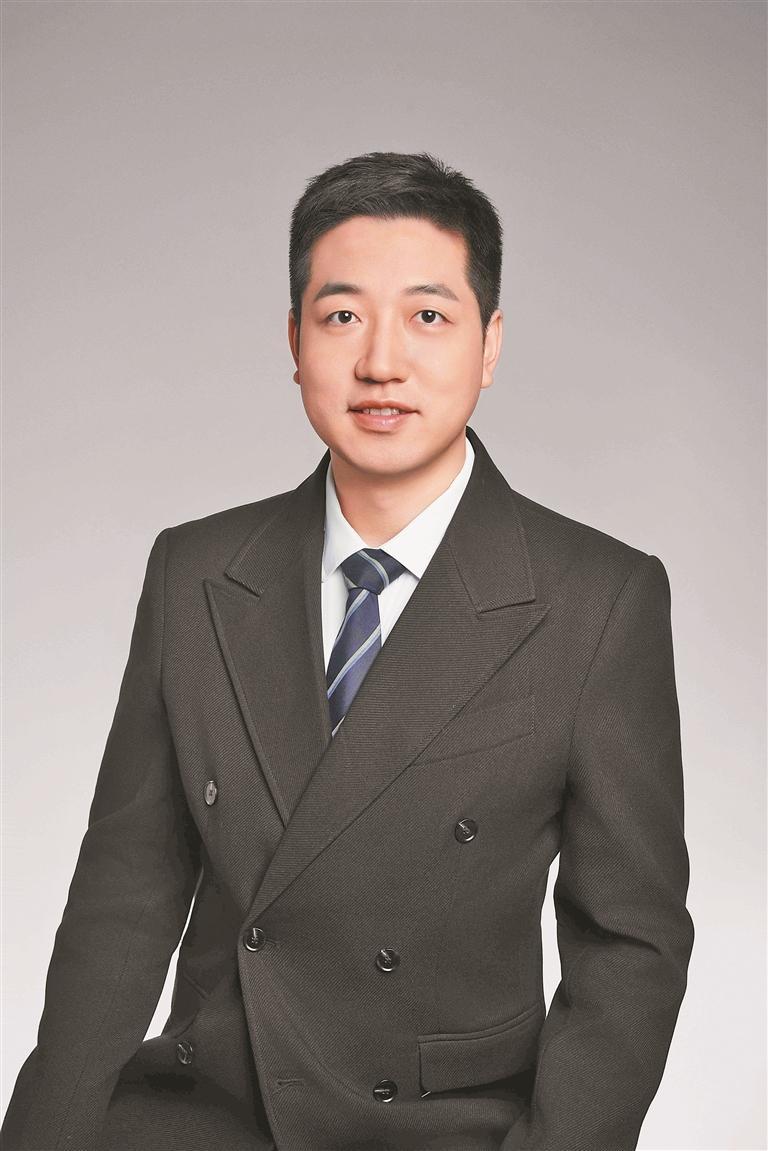
平安高端装备混合基金经理王修宝 国内商业航天进入黄金窗口期
Shen Zhen Shang Bao· 2026-01-29 17:40
最近两个月,商业航天成为资本市场关注的焦点,多只个股涨幅翻倍。平安高端装备混合基金经理王修宝近 日接受记者采访时指出,本轮商业航天行情较以往更具持续性,是产业拐点、政策支持、资本市场中美共振 的结果;2026年有望成为中国商业航天发展新起点。 三大因素助推商业航天强势表现 商业航天是以市场为主导、具有商业盈利模式的航天活动,涵盖卫星制造、火箭发射、卫星应用等领域。自 去年12月至今年1月28日,商业航天板块指数涨幅接近42%。王修宝管理的平安高端装备混合发起式基金 的"航程"也正好始于两个月前。"对于我们而言,一开始便幸运地站在了潮头,这既是时代的馈赠,也是我们 对产业脉搏一次果敢的把握。" 王修宝认为,商业航天更强调"商业"属性,其核心是引入社会资本,实现市场化运营与盈利闭环。他指出, 我国商业航天起步较晚,2014年~2015年政策破冰后,社会资本开始大规模进入该领域。经过10年发展,国 内商业航天市场规模颇为可观,已步入"收获季",逐步迈入规模化、商业化发展新阶段。 e a 9 o you got o 0 EPRADS ( :4 ( 19 60 7 (1) 王修宝 深圳商报记者詹钰叶 最近两个月,商业航 ...
十多家企业加速冲刺资本市场 商业航天或应IPO大年
Xin Hua Cai Jing· 2026-01-29 10:00
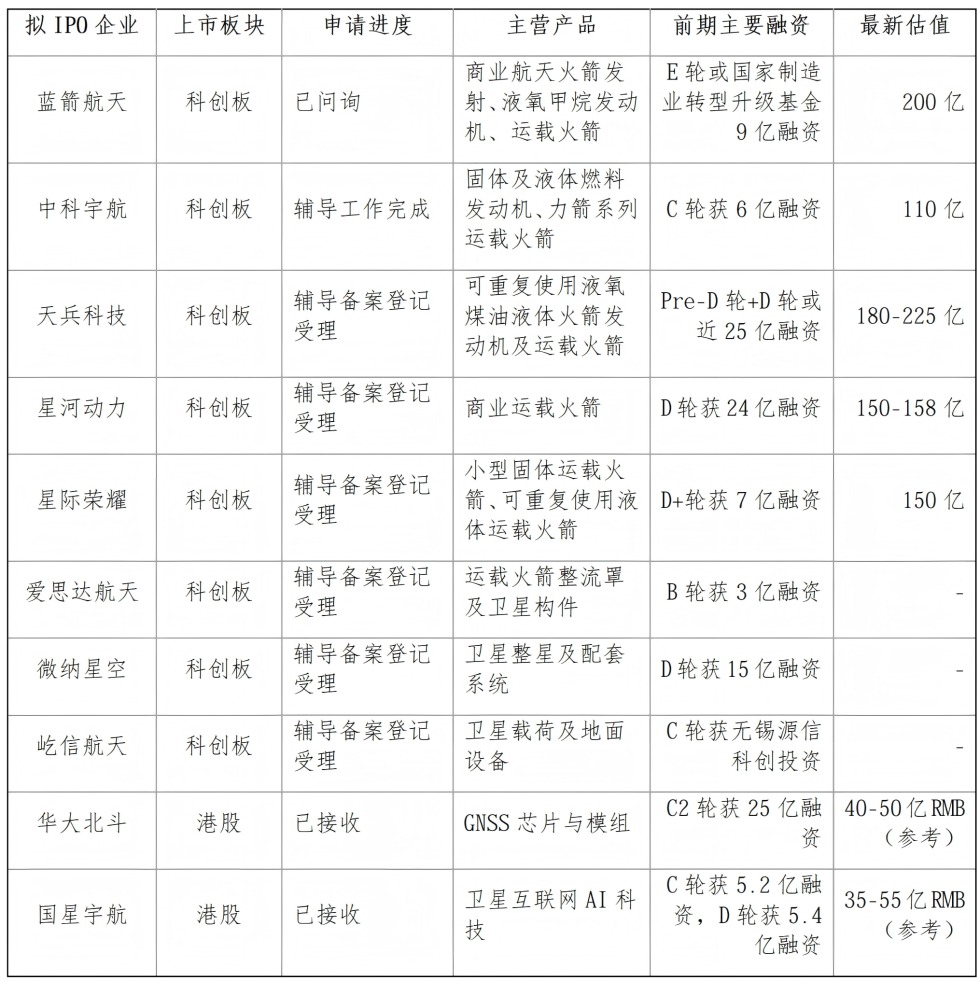
Core Insights - The report by Beijing Fourth Wave Technology Think Tank indicates that over a dozen companies are accelerating their efforts to enter the capital market, with a concentrated IPO boom expected in the commercial aerospace industry by 2026, potentially igniting a new wave of financing following the domestic GPU surge [1] - The commercial aerospace index saw a 13.8% increase in the first week of January 2026, with a cumulative rise of 23.4% over the first six trading days, driven by both policy and market factors [1] Policy and Market Drivers - The release of the "Action Plan for Promoting High-Quality and Safe Development of Commercial Aerospace (2025-2027)" by the National Space Administration in November 2025 outlines 22 key support measures [1] - The China Securities Regulatory Commission expanded the application scope of the fifth set of listing standards for the Sci-Tech Innovation Board to include commercial aerospace in June 2025, facilitating IPOs for quality commercial rocket companies [1] IPO Progress and Valuations - Companies such as Blue Arrow Aerospace and China Aerospace Science and Industry Corporation are making significant strides towards IPOs, with Blue Arrow Aerospace's valuation reaching 20 billion and Tianbing Technology's valuation between 18-22.5 billion [2][3] - The report lists several companies with their respective IPO progress, main products, and latest valuations, highlighting the competitive landscape in the commercial aerospace sector [3] Market Performance of Listed Companies - The report notes that listed companies like Tongyu Communication, China Satellite, and Aerospace Electronics have seen significant stock price increases of 187%, 148%, and 139% respectively, indicating strong market performance in the commercial aerospace sector [5] Financing Trends - In 2025, the total financing amount for commercial aerospace reached 18.6 billion, a 32% year-on-year increase, with 67 financing events primarily in rocket manufacturing and satellite applications [6] - The report predicts that the market will be dominated by 3-4 leading companies, with early entrants likely to establish stable supply chains with downstream satellite operators [6]
“太空市场”新年升温 民营企业抢抓机遇
Zhong Guo Xin Wen Wang· 2026-01-29 07:13
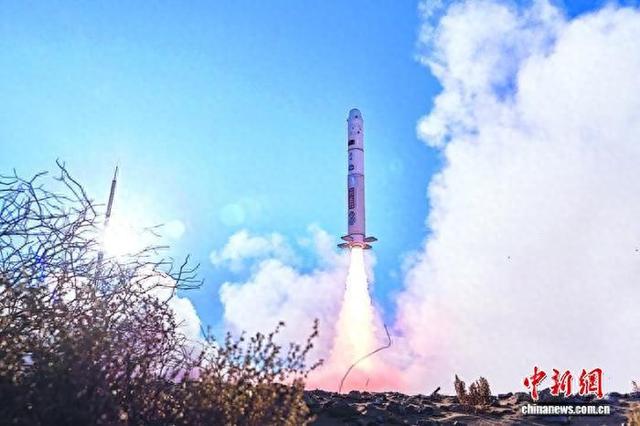
Group 1 - The Chinese commercial aerospace sector is experiencing significant growth, marked by successful launches and IPO preparations, indicating a strong start to the year [1][3] - Companies like Beijing Xinghe Power Aerospace Technology Co., Ltd. have completed multiple rocket launches and are actively seeking partnerships, showcasing the increasing interest from suppliers and investors [3][4] - The Tianjin Aisida Aerospace Technology Co., Ltd. is witnessing rapid growth in commercial aerospace orders, driven by a collaborative ecosystem in the Beijing-Tianjin-Hebei region [4] Group 2 - Safety concerns regarding space debris are becoming critical as the commercial aerospace industry expands, prompting companies like Suzhou Sanyuan Aerospace Technology Co., Ltd. to develop solutions for tracking and managing space debris [5] - Companies are focusing on enhancing their technological capabilities to meet future demands, with innovations in thermal management for space applications being a priority for Beijing Renshu Technology Co., Ltd. [5] - The satellite internet market is rapidly evolving, with companies like Galaxy Aerospace (Beijing) Network Technology Co., Ltd. pushing for the deployment of satellite communication technologies to meet growing consumer needs [6][5]
电科蓝天上市在即-太空能源观点更新
2026-01-29 02:43
Summary of Conference Call Records Industry Overview - The global commercial space industry is rapidly developing, with both China and the US focusing on reducing the barriers for reusable rockets, leading to an increase in launch frequency and a surge in satellite launches, particularly low Earth orbit (LEO) satellites, indicating a significant market scale [1][5] - The total number of low Earth orbit satellites applied for in China exceeds 280,000, including 200,000 from the Radio Innovation Institute, while overseas projects like Starlink B3 also indicate a large market potential [5] Key Insights and Arguments - The energy system plays a crucial role in satellite platforms, with the value split between payload and platform being roughly equal, and the energy system accounting for a significant portion of the satellite platform [1][5] - The demand for space computing has led to increased requirements for energy systems, with Musk's plan to launch 100GW of energy in space highlighting the scale of this demand compared to existing data center capacities in China and North America [2][4] - The development of flexible solar wings is becoming mainstream due to their higher packing efficiency and adaptability to larger arrays, which is essential for low Earth orbit launches [7][13] - SpaceX's Starlink 3 satellites opted for crystalline silicon batteries due to the high cost and scarcity of gallium, which makes gallium arsenide batteries impractical despite their higher efficiency [1][9] Emerging Trends - SpaceX plans to build 100GW of photovoltaic capacity for its satellite power systems and is actively researching Chinese photovoltaic equipment companies to meet its expansion needs [11][12] - The extension of the tariff exemption policy for Chinese photovoltaic equipment exports to the US is expected to accelerate order placements and equipment transportation [3][12] - The demand for space computing is expected to drive the development of the domestic photovoltaic industry, particularly in space applications, as the overall expansion plan of SpaceX significantly increases global photovoltaic installation demand [12] Additional Important Points - The importance of flexible packaging technology in space applications is emphasized, as it allows rockets to carry more thin substrates, enhancing payload capacity [13] - The energy consumption in future space computing scenarios will be substantial, necessitating advancements in energy systems, including battery technology iterations and the exploration of new materials like perovskite and silicon [4][7] - The current global scarcity of gallium affects the production of gallium arsenide batteries, limiting their power output and making crystalline silicon a more viable option for satellite energy systems [8][9]
未知机构:中银基金周斌太空光伏是较好的能拉动需求的点但兑现起来会相对较-20260129
未知机构· 2026-01-29 02:25
中银基金周斌: 太空光伏是较好的能拉动需求的点,但兑现起来会相对较慢。 从储能角度、全球缺电逻辑,从供需角度,传统锂电板块会相比光伏先走出来。 太空光伏的高景气度逻辑是认可的,但不希望参与仅有供给侧逻辑的板块,希望参与有真实需求拉动、有真实订 单的板块。 商业航天海外链space x很早就跑通了,在24年10月实现星舰可回收后逻辑就已通畅,可以以非常低成本的往太空 发射卫星。 但国内to c模式没有走通,国内成本很高,我们在全球的竞争力和马斯克相比较低,从通讯角度很难卷得过马斯 克。 光伏方面,反内卷已进行较长时间,但反应效果较一般,虽然硅料能把价格提上去,但下游传导是偏弱的。 太空光伏是短期爆点,中美目前格局下,马斯克需完成在卫星能源上的自主可控,太空算力是可行的,去弥补美 国数据中心缺电的瓶 中银基金周斌: 太空光伏是较好的能拉动需求的点,但兑现起来会相对较慢。 从储能角度、全球缺电逻辑,从供需角度,传统锂电板块会相比光伏先走出来。 光伏方面,反内卷已进行较长时间,但反应效果较一般,虽然硅料能把价格提上去,但下游传导是偏弱的。 太空光伏是短期爆点,中美目前格局下,马斯克需完成在卫星能源上的自主可控,太空算 ...
特斯拉Q4利润大降61%,马斯克用“科技宏图”撑起信仰:20亿美元押注xAI,太空算力与机器人掀起赛博狂欢
Sou Hu Cai Jing· 2026-01-29 01:01
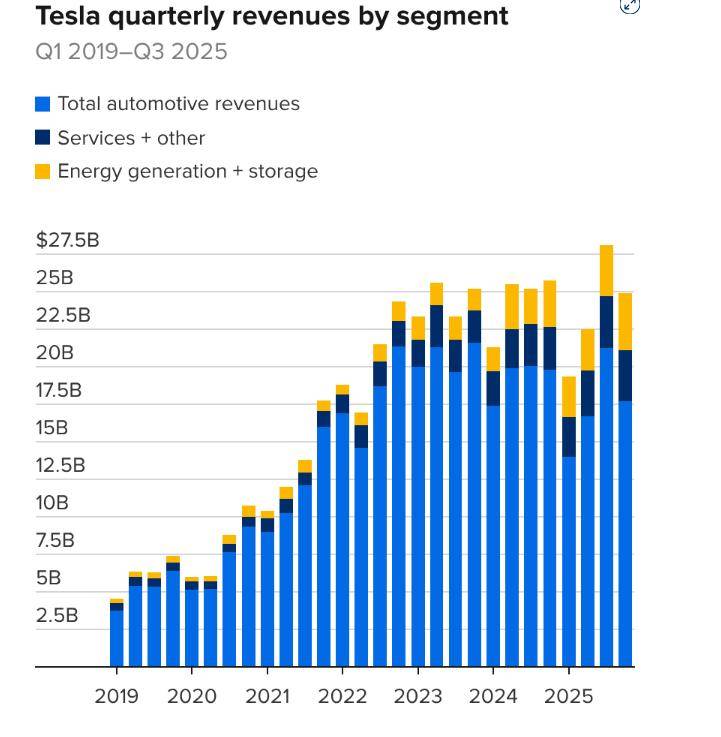
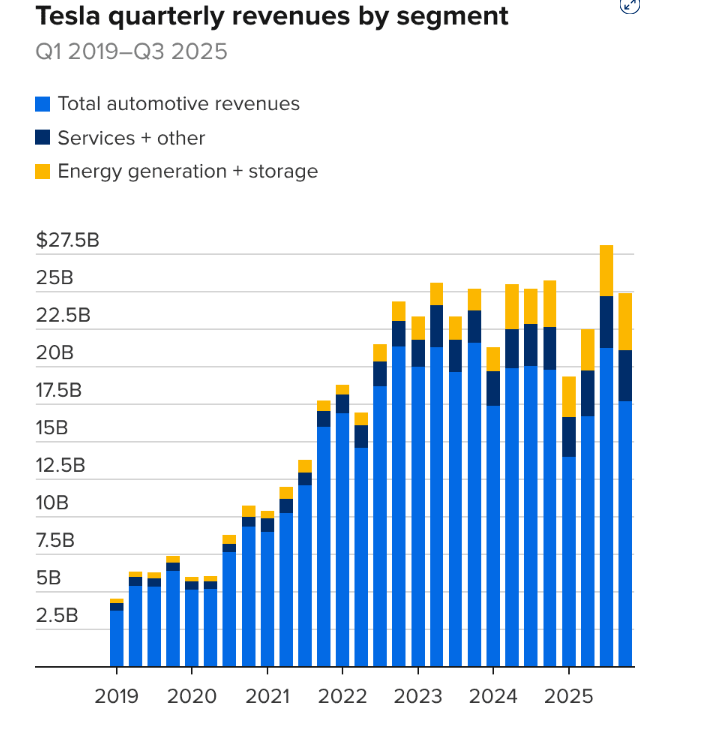
Core Viewpoint - Tesla reported better-than-expected Q4 earnings, with record energy deployment, but faced a 3% decline in annual revenue for the first time in its history, alongside a significant 61% drop in Q4 net profit [1][5][10]. Financial Performance - Tesla's total revenue for Q4 was approximately $24.9 billion, slightly above Wall Street's expectation of $24.79 billion, despite a year-over-year decline of about 3% [2][5]. - The automotive business, which is Tesla's core revenue source, saw a significant year-over-year decline of 11%, dropping from approximately $19.8 billion to $17.7 billion [5]. - Adjusted earnings per share for Q4 were about $0.50, exceeding analysts' expectations of $0.45 [2]. Market Response - Despite the disappointing annual revenue and Q4 profit, Tesla's stock price rose in after-hours trading, reflecting investor confidence in CEO Elon Musk's vision for a "Tesla super technology empire" [1][2]. - The stock has seen a significant increase of 50% since the second half of 2025, indicating strong market sentiment despite ongoing performance challenges [1]. Strategic Investments - Tesla announced a $2 billion investment in xAI, a competitor to OpenAI, aiming to enhance its capabilities in AI applications [1][15]. - The investment aligns with Tesla's broader strategy to integrate AI into its products and services, as outlined in its Master Plan Part IV [16]. Future Growth Initiatives - Tesla is focusing on advancements in AI, autonomous driving, Robotaxi services, and the Optimus humanoid robot, which are seen as key drivers for future growth [12][14]. - The company plans to convert its Fremont factory production line to mass-produce the Optimus robot, with a target to start production by the end of 2026 [14]. Competitive Landscape - Tesla faces increasing competition, particularly from BYD in the Chinese market, which has impacted its vehicle sales in recent quarters [2][10]. - The company reported a 16% decline in electric vehicle deliveries for Q4 and an 8.6% drop in annual deliveries [8]. Energy and Storage Business - Tesla's energy generation and storage business reported revenue of approximately $3.84 billion, reflecting a year-over-year growth of 25%, which partially offsets the decline in automotive revenue [12][14]. - The company emphasized the importance of its energy business as a "hard support" against the downturn in automotive sales [5]. SpaceX and Broader Ecosystem - Tesla's long-term growth narrative is closely tied to SpaceX, with investors viewing Tesla stock as a proxy for exposure to SpaceX's potential IPO and its ambitious projects [2][18]. - SpaceX's plans for solar energy production and AI capabilities are expected to synergize with Tesla's goals, enhancing the overall valuation narrative for both companies [19][21].


特斯拉(TSLA.US)Q4利润大降61% 马斯克用“科技宏图”撑起信仰:20亿美元押注xAI 太空算力与机器人掀起赛博狂欢
智通财经网· 2026-01-29 00:36
Core Insights - Tesla reported better-than-expected Q4 earnings, with record energy deployment, but faced a 3% decline in annual revenue for the first time in its history, and a significant 61% drop in Q4 net profit [1][5][12] - Despite the disappointing financials, CEO Elon Musk's optimistic outlook on AI, autonomous driving, and robotics has led to a post-earnings stock price increase of over 4% [2][13] - The company's automotive revenue fell by 11% year-over-year, while energy and storage revenue grew by 25%, indicating a shift in focus [5][15] Financial Performance - Q4 total revenue was approximately $24.9 billion, slightly above Wall Street's expectation of $24.79 billion, but down 3% year-over-year [2][5] - Adjusted earnings per share for Q4 were about $0.50, exceeding the expected $0.45 [2] - Tesla's gross margin for Q4 was approximately 20.1%, higher than the anticipated 17.1%, but net profit under GAAP standards saw a 61% year-over-year decline due to a 39% increase in operating expenses [5][12] Business Segments - The automotive segment, which has historically been the largest revenue contributor, saw a significant decline, dropping from approximately $19.8 billion to $17.7 billion year-over-year [5][12] - Energy generation and storage revenue reached about $3.84 billion, growing 25% year-over-year, which helped mitigate the decline in automotive revenue [15][18] - Tesla plans to invest $20 billion in xAI, a competitor to OpenAI, to enhance its AI capabilities [16][17] Strategic Initiatives - Tesla is transitioning its production lines to focus on the upcoming Optimus humanoid robot and plans to scale production significantly by 2026 [15][18] - The company is also expanding its Robotaxi service, with plans to roll out in several major U.S. cities [14][15] - Tesla's collaboration with SpaceX is expected to bolster its long-term growth narrative, as both companies are intertwined in Musk's broader vision for technology and infrastructure [19][20] Market Dynamics - Tesla faces increasing competition, particularly from BYD in the Chinese market, which has impacted its vehicle sales [2][9] - The decline in vehicle deliveries by 16% in Q4 and 8.6% for the year highlights ongoing challenges in the automotive sector [9][11] - Investors are increasingly viewing Tesla not just as an automotive company but as part of a larger ecosystem that includes SpaceX and AI technologies, which may support its valuation despite current struggles [2][19]
旋极信息(300324.SZ)及参控股子公司目前不涉及太空算力领域相关业务
Ge Long Hui· 2026-01-28 13:39
格隆汇1月28日丨旋极信息(300324.SZ)在互动平台表示,公司及参控股子公司目前不涉及太空算力领域 相关业务。 ...

【川股每日董秘问答】涉泸州老窖、四川双马、中密控股、金石亚药、厚普股份等公司
Xin Lang Cai Jing· 2026-01-28 10:12
Group 1: Company Performance and Revenue - Luzhou Laojiao's overseas revenue is approximately 186 million yuan, accounting for 0.60% of total revenue [1][14] - Sichuan Shuangma focuses on biomedicine and has established a portfolio of innovative drugs in various disease areas, with a strong global supply capability for peptide raw materials [2][15] - Sichuan Shuangma's peptide products are exported to countries including the USA, Brazil, India, and Spain, with a significant presence in the chronic disease treatment market [2][15] Group 2: Product Applications and Market Expansion - Sichuan Shuangma produces over a hundred types of beauty peptides, collaborating with leading global cosmetic brands to enhance product innovation [3][16] - Zhongmi Holdings has applied its high-speed mechanical seals in commercial aerospace, although this segment's revenue is relatively low compared to its traditional petrochemical market [4][17] - Zhongmi Holdings is monitoring the demand for sealing products in the large aircraft sector but has not identified significant market needs yet [5][18] Group 3: Technological Development and Future Prospects - Jinshi Yaya's vacuum coating technology is not currently applied in space photovoltaic equipment but the company is exploring potential collaborations in other fields [6][19] - Houpu Co. has experience in distributed energy projects in both natural gas and hydrogen applications [7][20] - Zhimin Da is developing a high-radiation-resistant computing platform for space applications, although this technology is still in the research phase [8][21] Group 4: Market Strategy and Competitive Position - Sichuan Jiuzhou has successfully entered the overseas market with its Wi-Fi routers, while focusing on domestic sales for its camera products [12][25] - Jiuzhou's subsidiary is actively pursuing opportunities in the low-altitude economy, with significant progress in technology and product development [12][25] - Kexin Mechanical and Electrical is concentrating on high-end process equipment in energy and chemical sectors, while exploring new growth points in intelligent manufacturing [10][24]


