慢牛

Search documents
私募仓位攀至年内最高主观策略强势回归
Zheng Quan Shi Bao· 2025-09-21 17:42
Group 1: Market Sentiment and Positioning - Private equity firms in China are showing increasing optimism, with stock private equity institutions' average positions rising to the highest level of the year at 78.04% as of September 12, up 2.96 percentage points from the previous week [1] - The proportion of private equity firms with heavy or full positions (over 80%) has significantly increased to 60.02%, a rise of 5.81 percentage points week-on-week, while the proportion of firms with no positions has decreased to 5.08%, down 0.77 percentage points [1] - Different scales of private equity firms are maintaining high positions, with those managing over 10 billion yuan averaging 78.22%, and those between 5 billion to 10 billion yuan averaging 86.49%, the highest among all categories [1] Group 2: Performance and Market Trends - The top 100 subjective private equity firms have achieved an average return of 37.43% year-to-date, while the top quantitative firms have an average return of 26.69% [2] - The "Dai Shui Quan Growth Phase I" product from the leading private equity firm Dai Shui Quan has reported a return exceeding 50% [2] - The market is exhibiting a "slow bull" characteristic, with investor risk appetite remaining high, driven by liquidity, fundamentals, and external factors [2] Group 3: Sector Performance and Strategy - There is a clear market stratification, with significant gains in sectors like telecommunications, electronics, and non-ferrous metals, while coal and steel sectors have seen minimal increases [3] - The firm "Jia Gu Capital" emphasizes the importance of understanding one's capability circle and leveraging comparative advantages in familiar areas to maximize returns [3] - The firm suggests using industry ETFs or other tools to adjust investment allocations in response to macroeconomic changes, rather than strictly focusing on bottom-up stock selection [3]
私募仓位攀至年内最高 主观策略强势回归
Zheng Quan Shi Bao· 2025-09-21 16:57
Group 1 - The overall sentiment among private equity institutions remains optimistic despite market fluctuations, with stock private equity institutions' average positions reaching a year-to-date high of 78.04% as of September 12 [1] - The proportion of private equity institutions with heavy or full positions (over 80%) has significantly increased to 60.02%, up by 5.81 percentage points from the previous week, while the proportion of those with no positions has decreased to 5.08% [1] - Different scales of private equity institutions show high average positions, with large-scale institutions (over 10 billion) averaging 78.22%, and those between 5 billion to 10 billion averaging 86.49%, indicating a general trend of maintaining high positions across various sizes [1] Group 2 - The top 100 subjective private equity firms have achieved an average return of 37.43% year-to-date, while the top quantitative private equity firms have an average return of 26.69% [2] - The market is exhibiting a "slow bull" characteristic, with investor risk appetite remaining high, driven by liquidity, fundamentals, and external factors, leading to a shift from "certainty priority" to "growth priority" [2] - Emerging growth opportunities, such as new consumption, innovative pharmaceuticals, robotics, and AI hardware, are becoming significant market drivers, reflecting a renewed focus on fundamental growth rather than just certainty [2] Group 3 - Large private equity institutions, such as Jiangju Capital, observe a clear market stratification, with significant gains in sectors like telecommunications and electronics, while coal and steel sectors show minimal increases [3] - Jiangju Capital emphasizes the importance of understanding one's capability circle and leveraging comparative advantages in familiar areas to maximize expected returns [3] - The firm suggests using industry ETFs or other tools to adjust investment allocations in response to macroeconomic changes, rather than strictly adhering to bottom-up stock selection [3]
两件大事刷屏!“924行情”即将一周年 下周市场会修复吗?
Mei Ri Jing Ji Xin Wen· 2025-09-21 05:01
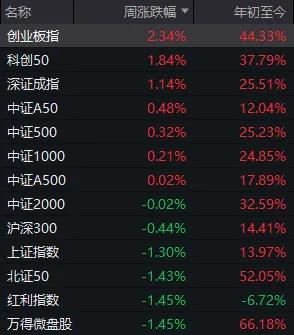
Market Overview - The A-share market experienced significant volatility during the trading week from September 15 to 19, indicating that a slow bull market does not equate to easy profits for investors [1] - Major stock indices showed mixed performance, with the ChiNext Index posting a notable increase, while core assets and micro-cap stocks performed poorly [2][3] Index Performance - The weekly performance of major indices is as follows: - ChiNext Index: +2.35% (YTD: +44.34%) - CSI 200: +1.84% (YTD: +37.79%) - Shenzhen Component Index: +1.14% (YTD: +25.51%) - CSI 300: -0.44% (YTD: +14.41%) - Shanghai Composite Index: -1.30% (YTD: +13.97%) [3] Individual Stock Performance - Only 1,754 stocks rose during the week, marking the worst performance in September, with a significant drop from previous weeks [4] - The number of rising stocks decreased from 3,467 on September 12 to 1,754 on September 19 [4] Sector Performance - The technology sector remained strong throughout the week, while tourism and engineering machinery sectors saw notable gains on Friday [5] - Top-performing sectors included: - Lithography Machines: +7.16% (YTD: +64.07%) - Tourism and Hotels: +4.75% (YTD: +26.75%) - EDR Concept: +4.43% (YTD: +39.44%) [6] Financial Sector Analysis - The banking sector has been underperforming, with the CSI Bank Index nearly erasing its gains for the year [11] - The brokerage sector faced significant selling pressure, leading to a breach of the 60-day moving average [13] Market Sentiment and Future Outlook - Analysts suggest that the market may continue to experience fluctuations in the short term, but the long-term "slow bull" trend remains intact [15] - Positive signals from recent U.S.-China communications may bolster market sentiment and repair expectations for the upcoming week [18][21] Upcoming Events - Key upcoming events include a press conference on the achievements of the "14th Five-Year Plan" and the release of various economic indicators, which may influence market sentiment [24] - A total of 50 companies will have lock-up shares released next week, amounting to 2.894 billion shares with a total market value of approximately 61.907 billion yuan [25]

降息之后,哪些资产会遭殃?
大胡子说房· 2025-09-20 05:49
昨晚,大锤终于落地。 美联储正式宣布降息25个基点, 联邦基金利率目标区间从4.25%-4.5%降至4.00%-4.25%。 这是本年度美联储第一次降息,符合市场的预期。 既没有超预期的降息50个基点,也没有低于预期的不降息。 宣布降息之后,市场反应很迅速,美元指数短线一度大幅下探到96.4,离岸人民币兑美元短期升破7.09,美股同时也短线拉升。 但很快,市场就来了一波过山车,从"激情澎湃"迅速回归稳定, 收盘的时候,美股是微跌的,美元指数也回到了97。 市场整体的反应,并不是很强烈。 说明老美那边的资本市场已经 提前消化了降息25个基点的预期。 所以尘埃落定之后,欧美那边的市场变化反而没有预期中那么大。 欧美市场的冷静,明显影响了东大这边的市场情绪。 所以东大这边,也来了一波过山车。 早上的时候,港股恒生指数和大A盘中大涨,大A一度接近3900点。 但下午马上风向转变,指数全部转头向下。 最后大A收盘的时候,下调了1.13%。 为什么会出现这种过山车的情况? 主要原因有两个: 第一,大A部分板块已经提前消化了降息的利好。 降息前几天,科技板块以及科技概念的票子,都已经大涨过一波了。 市场上几个最出圈的票,都 ...

牛市还在?
Sou Hu Cai Jing· 2025-09-19 10:00
Group 1 - The recent adjustment in A-shares has led to renewed skepticism about the bull market, with the current market dynamics differing significantly from the 2014-2015 period, where widespread surges were common [2] - The rapid increase in IPOs over the past decade has resulted in a larger number of stocks in the A-share market, leading to a potential concentration of trading volume in high-quality companies, similar to trends seen in the Hong Kong stock market [2] - The current market environment suggests that a broad-based rally is unlikely due to limited capital to support such movements, indicating that the bull market may only apply to select stocks [2] Group 2 - The recent drop in A-shares following the Federal Reserve's interest rate cut is attributed to the need for the market to digest previous short-term gains in certain stocks, rather than a direct negative reaction to the rate cut itself [3] - The upcoming LPR adjustment will be a key factor in determining the short-term outlook for A-shares, with the possibility of future rate cuts still holding potential for positive market sentiment [3] - The focus should shift from questioning the existence of a bull market to researching specific sectors and companies, as understanding these elements may yield greater insights and opportunities [3]

越来越确定,A股这一次就是慢牛!
Sou Hu Cai Jing· 2025-09-19 03:02
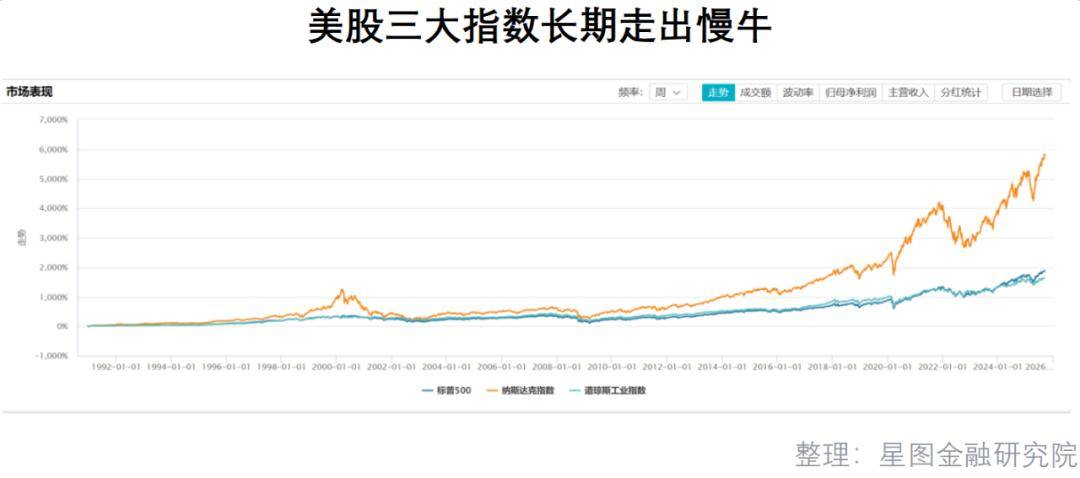
Group 1 - The A-share market is experiencing a cooling period, showing a trend of oscillation and upward movement, which raises concerns among investors about the sustainability of the current market momentum [1] - The article aims to analyze the causes of the 40-year slow bull market in the US stock market and compare it with the current situation of the A-share market to help investors seize investment opportunities [1] - Since the 1980s, the US stock market has entered a slow bull phase, characterized by a structural long-term bull market lasting over 40 years, with annualized returns of 8%-10% for equity investments [1][7] Group 2 - The period from 1982 to 1987 was marked by a consumer-driven bull market, where high interest rates initially controlled inflation, leading to economic recovery and stock market growth [3] - From 1988 to 1994, the US economy experienced a transition with a focus on consumer and pharmaceutical sectors, benefiting from globalization and technological advancements [4] - The late 1990s saw the rise of the internet economy, with significant capital inflow into tech companies, although this period also led to the formation of market bubbles [5] Group 3 - The decade from 2000 to 2009 was characterized by a crisis period, where the bursting of the internet bubble and subsequent financial scandals led to a significant downturn in the stock market [6] - Since 2010, the dominance of technology giants has shaped the market, supported by low interest rates and quantitative easing, which have provided ample liquidity [6][9] - The long-term economic fundamentals of high growth and low inflation have been crucial for the sustained slow bull market in the US [7] Group 4 - The A-share market is beginning to show signs of a slow bull pattern, with improvements in macroeconomic conditions, corporate earnings, and institutional reforms [14] - A decline in risk-free interest rates has provided ample liquidity for the A-share market, similar to the low interest rate environment in the US [14][17] - The improvement in corporate earnings, driven by domestic demand and emerging industries, is a key foundation for the A-share slow bull market [17] Group 5 - Continuous capital market reforms and the acceleration of long-term funds entering the market are optimizing the investment ecosystem in the A-share market [21] - The introduction of various ETF products has provided investors with diverse and low-cost investment options, enhancing market stability [21][22] - The article concludes that understanding the underlying logic of a slow bull market is essential for investors to navigate the capital market effectively [22]
A股调整还是来了,老问题:见顶了吗?
Sou Hu Cai Jing· 2025-09-18 13:21
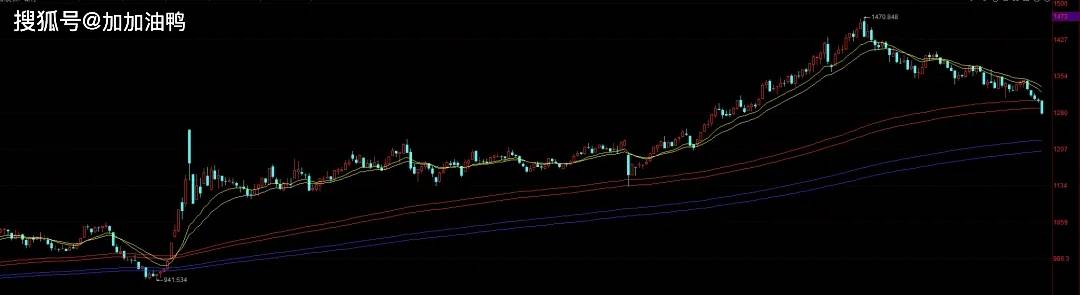
Group 1 - The A-share market is experiencing a decline, raising questions about whether it has reached a temporary peak, especially given the high trading volume and prices [1] - The recent drop is influenced by several factors, including the Federal Reserve's interest rate decision, which was in line with market expectations, and the subsequent hawkish comments from Powell [1] - There are reports of banks being guided to reduce positions, which has led to a significant decline in the banking sector [1] Group 2 - The market has seen a substantial increase in trading volume since June 23, primarily driven by large technology stocks, but this volume has recently decreased from 3 trillion to 2.4 trillion [6] - The leverage in the market is approaching 2.4 trillion, with an increase of over 70 billion in the past three trading days, indicating a potential risk as leverage can be a double-edged sword [6][8] - There has been a notable increase in share reductions by major shareholders across various sectors, with semiconductor and machinery sectors showing particularly high reduction rates [9] Group 3 - The market is facing a slowdown in new capital inflows, as indicated by the reduced speed of private equity fundraising and the slowing down of deposit transfers [9] - The current market dynamics suggest that the anticipated adjustments in a bull market may lead to uncertainty among retail investors, questioning their confidence in buying during corrections [10] - Technical analysis indicates that the Shenzhen Composite Index has formed a potential top structure, which could signal further adjustments in the market [12]
【笔记20250918— 最高3899,最低3801】
债券笔记· 2025-09-18 11:41
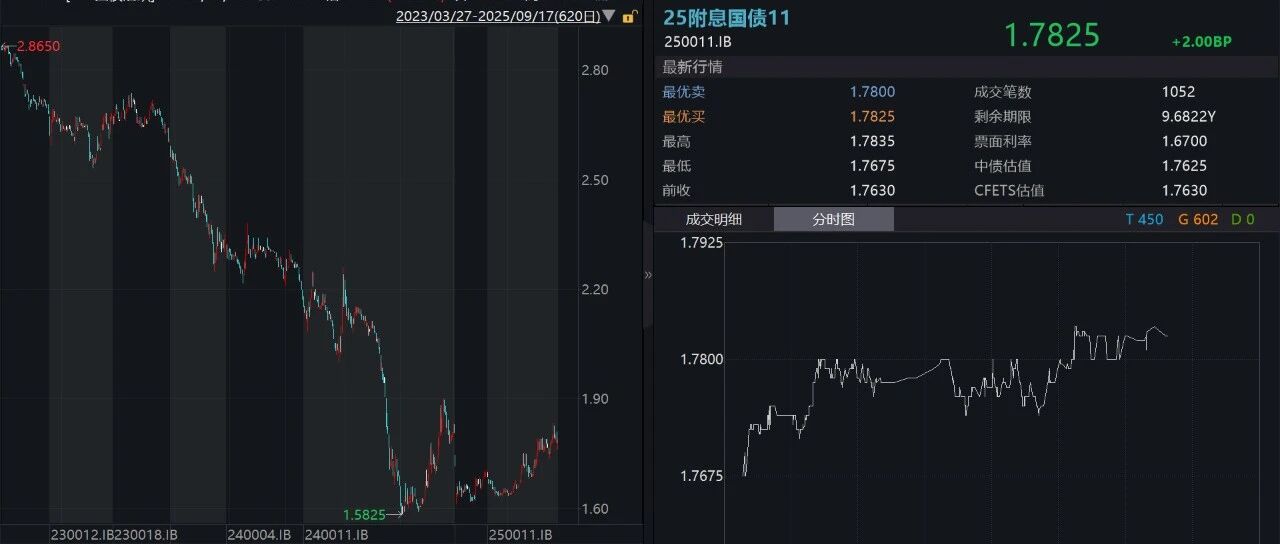
Core Viewpoint - The market's fluctuations are driven by human nature, which remains constant and predictable, leading to similar outcomes despite different narratives in each cycle [1]. Group 1: Market Conditions - The expectation of a 50 basis points (BP) rate cut by the Federal Reserve did not materialize, resulting in a market pullback after reaching a high of 3899 points [5]. - The central bank conducted a 4870 billion yuan reverse repurchase operation, with a net injection of 1950 billion yuan after 2920 billion yuan matured [3]. - The interbank funding environment shifted from tight to loose, with the overnight repurchase rate (DR001) around 1.51% and the 7-day rate (DR007) at approximately 1.56% [3]. Group 2: Bond Market Dynamics - Long-term bond yields have risen significantly, with the 10-year government bond yield increasing from 1.7675% to 1.7825% during the trading day [5]. - The bond market exhibited a cautious sentiment in the morning, with a slight uptick in yields, while the stock market initially rose before experiencing a sharp decline in the afternoon [5]. - The trading volume in the interbank market showed a total of 71609.98 million yuan, with a slight increase in the overall transaction volume [4]. Group 3: Stock Market Performance - The Shanghai Composite Index closed at 3831.66, down 44.68 points or 1.15%, with a total trading volume of 1.37 trillion yuan [6]. - The market experienced a transition from attempting to breach the 3900-point mark to defending the 3800-point level, indicating volatility and uncertainty among investors [6]. - The stock market's decline was perceived differently by various market participants, with some viewing it as a stabilization of a slow bull market while others feared a shift towards a bear market [6].
降息靴子落地,但风险却开始出现了?
大胡子说房· 2025-09-18 11:15
Core Viewpoint - The Federal Reserve officially announced a 25 basis point interest rate cut, lowering the target range from 4.25%-4.5% to 4.00%-4.25%, marking the first rate cut of the year and aligning with market expectations [1] Market Reaction - Following the announcement, the market reacted quickly with the dollar index dropping to 96.4 and offshore RMB briefly surpassing 7.09 against the dollar, while U.S. stocks initially rose before closing slightly down [1] - The overall market response was muted, indicating that the capital markets had already priced in the 25 basis point cut [1] A-share Market Dynamics - The A-share market experienced volatility, with the Hang Seng Index and A-shares initially rising before reversing to close down 1.13% [1] - Two main reasons for this volatility were identified: 1. Certain sectors, particularly technology, had already priced in the benefits of the rate cut prior to the announcement, leading to profit-taking [1][4] 2. The "Wang Wang Team" exerted precise control over the market, particularly affecting banks, brokerages, and financial sectors [1][4] Future Rate Cuts and Market Outlook - The focus now shifts to potential future rate cuts in October and December, with the most significant information being the Fed's dot plot, which reflects the committee's outlook on future rate changes [6][10] - The dot plot indicated that a majority of Fed officials expect two more rate cuts this year, with the most conservative approach being a gradual reduction of 25 basis points at a time [7][8] Long-term Trends - A sustained period of rate cuts is expected to release global liquidity, potentially leading to a decline in the dollar's asset advantage and an upward trend for non-dollar assets [11] - However, short-term fluctuations may occur due to various factors, including rate cut timing and geopolitical events [11] Investment Strategy - The current market environment suggests that while long-term bullish trends are anticipated, short-term volatility may present buying opportunities, provided that the right assets are selected and risks are managed [11]

A股放量下跌,超4300只个股下挫,接下去还能涨吗?
Sou Hu Cai Jing· 2025-09-18 09:08
Market Overview - On September 18, A-shares experienced a significant decline, with all three major indices dropping over 1%, specifically the ChiNext Index down 1.64%, Shanghai Composite Index down 1.15%, and Shenzhen Component Index down 1.06% [1] - The total trading volume in the A-share market reached 3.17 trillion yuan, an increase of 763.7 billion yuan compared to the previous day [1] - Over 4,300 stocks in the market fell, while the robotics sector continued to perform strongly, with Shoukai Co. hitting the daily limit for the 11th time in 12 days [1] Federal Reserve Rate Cut - The Federal Reserve's decision to cut interest rates by 25 basis points was in line with market expectations, with Chairman Powell indicating no broad support for a larger cut [2] - Following the rate cut, global commodity prices, including gold, saw a significant decline, with spot gold dropping from a historical high of $3,700 per ounce to around $3,650 per ounce [2] Banking Sector Performance - The banking sector faced a comprehensive downturn on September 18, with major banks like Changshu Bank and Agricultural Bank of China seeing declines of over 2% [3] - Since reaching a historical high on July 11, the banking sector indices have fallen over 13%, breaking below the 120-day moving average for the first time in a year [3] Shareholder Actions - Despite the downturn in the banking sector, several listed banks have seen shareholder increases, indicating confidence in their future prospects [4][5] - For instance, Everbright Bank's major shareholder has increased its stake by 0.02%, while Nanjing Bank's major shareholder raised its stake from 12.56% to 13.02% [5] Future Market Outlook - Analysts suggest that the recent market decline may be a temporary adjustment, with expectations of a potential upward trend resuming after the correction [8] - Historical patterns indicate that if the market is in a slow bull phase, significant increases may not occur in the next six months, while a fast bull phase could lead to a shorter adjustment period [8] - The possibility of a global central bank rate cut following the Fed's decision could provide further support for the A-share market, potentially leading to a second wave of upward movement [8]