食品安全

Search documents
《公司舆情哨》2025盘点:十大事件、四类危机、四种趋势!
Sou Hu Cai Jing· 2026-01-09 05:48
Core Insights - The article discusses the significant public relations challenges faced by major brands in 2025, highlighting the crisis management issues and the evolving consumer expectations in various industries [1][2][5] Group 1: Key Events and Trends - In 2025, over 20 well-known brands were monitored for public sentiment, with Sam's Club and Moutai being among the most frequently mentioned due to crises such as trust issues and leadership changes [2][4] - Major public sentiment events included Sam's Club's trust crisis, Moutai's leadership change, and controversies surrounding brands like Nestlé and West Bay [2][4] - The food, new tea drinks, and dairy industries were particularly scrutinized, reflecting their close ties to consumer daily life [2][4] Group 2: Types of Crises - The public relations crises identified can be categorized into four main types: food safety issues, marketing and advertising controversies, personnel changes and strategic adjustments, and incidents related to live streaming and new media [4][6][10] - Food safety issues were the most significant, with incidents like a food poisoning case involving Yunhai Yao leading to severe penalties [6][8] - Marketing controversies included misleading advertising practices, such as the "half bag" marketing by White Elephant, which misled consumers about product quantity [11][12] Group 3: Leadership Changes - 2025 saw numerous leadership changes in major consumer brands, particularly in the alcohol and dairy sectors, reflecting pressures for strategic transformation and performance improvement [15][17] - Notable changes included Moutai's leadership transition and significant shifts within Nestlé's executive team, which could impact existing strategies [18][19] Group 4: New Media and Crisis Management - The rise of live streaming and short videos has led to an increase in real-time public relations crises, exemplified by the incident involving Pop Mart during a live stream [20][21] - Companies are urged to adapt their crisis management strategies to address the rapid dissemination of information and the emotional responses of consumers [22][23] Group 5: Evolving Consumer Expectations - Consumer scrutiny has shifted from product safety to emotional and value-based considerations, indicating a deeper examination of brand integrity and marketing practices [24][25] - Companies are encouraged to embrace constructive criticism as an opportunity for improvement rather than adopting a victim mentality [30][31] Group 6: Future Challenges - The consumer goods industry is expected to remain a hotspot for public relations challenges, with increasing demands for product safety, marketing honesty, and price transparency [28][29] - The integration of AI technology in reputation management presents both opportunities and risks, necessitating a balance between efficiency and ethical considerations [32]


观影敲警钟,培训强技能—崇义市场监管局拧紧岁末年初食品安全“责任阀”
Zhong Guo Shi Pin Wang· 2026-01-09 05:15
Core Viewpoint - The article emphasizes the importance of food safety during the peak consumption season at the end of the year, highlighting the proactive measures taken by the Chongyi County Market Supervision Administration to ensure food safety in the catering industry [1][2][3] Group 1: Meeting and Training - A food safety warning and training meeting was organized on January 8, 2026, involving over 50 catering service units and rural banquet organizers to strengthen food safety responsibilities [1] - The meeting included a screening of an educational film that showcased real cases of food poisoning due to illegal practices, reinforcing the concept of "safety first, responsibility above all" among participants [1][2] Group 2: Training Content - The training focused on high-risk points during the festive season, covering the latest revisions of the Food Safety Law, food procurement standards, and key control points for storage and processing [2] - Specific issues such as labeling of bulk foods, cold chain food traceability, and measures against food waste were addressed through detailed explanations and case studies to enhance the risk management capabilities of the attendees [2] Group 3: Regulatory Measures - The Market Supervision Administration reported recent findings from special inspections, clarifying the legal responsibilities of food operators and outlining three key requirements for compliance [2] - Future actions include increased regulatory efforts through regular inspections and a complaint reporting channel to ensure a safe and reassuring food consumption environment during the festive season [3]
“无菌蛋”靠谱吗?专家:很难达到绝对无菌,营养与普通鸡蛋无异
Yang Shi Xin Wen· 2026-01-09 03:18
Group 1: Food Safety and Quality - The increasing consumer focus on food safety highlights the importance of eggs as a key protein source in Chinese households, with "sterile eggs" being marketed as "safer," "more nutritious," and "healthier" [1] - Professor Liu Jingbo from Jilin University states that achieving absolute sterility in eggs is difficult, and the term "sterile eggs" should more accurately be referred to as "edible raw eggs," which can meet safety standards for consumption [1] - There are currently no national or industry standards for edible raw eggs in China, although group standards have been established to regulate them [1] Group 2: Food Additives and Regulations - The excessive use of food additives, particularly composite phosphates in shrimp products, has raised public concern, as highlighted by the "water-retaining shrimp" incident [2] - The national standard GB 2760-2024 specifies that water-retaining agents can be used in frozen aquatic products, with a maximum limit of 5 grams per kilogram [2] - Experts emphasize the need for companies to adhere to food safety responsibilities and to innovate in technology to enhance the quality of frozen aquatic products [2] Group 3: Supply Chain and Traceability - There is a call for stricter regulation of the shelf life and cold chain transport conditions for key raw materials like frozen meat and seafood [3] - Increased sampling inspections of food supply materials and the use of new technologies to improve inspection levels are recommended [3] - A transparent regulatory network involving multiple stakeholders is essential for public trust in food safety [3] Group 4: Salmonella Prevention in Egg Production - In the breeding phase, it is crucial to ensure that eggs are free from Salmonella, requiring monthly testing of feed, water, and the environment [4] - Edible raw eggs must be transported and stored under cold chain conditions, with specific temperature and humidity requirements [4] - The recommended consumption period for raw eggs is within 15 days of production, and vulnerable populations should avoid consuming raw eggs [4]
湖北沙洋通报“未经检疫牛肉流入沙市区”:已启动专项整治行动
Zhong Guo Xin Wen Wang· 2026-01-08 23:37
Core Viewpoint - Hubei Province's Shayang County has initiated a special rectification action in response to reports of "unquarantined beef entering Shashi District" [1] Group 1: Regulatory Actions - Shayang County has formed a task force comprising food safety, market regulation, agriculture, and public security departments to conduct a comprehensive inspection of the livestock slaughtering industry [1] - The county is accelerating the investigation of related cases and will impose strict penalties on the involved enterprises, with updates to be communicated to the public [1] - Individuals responsible for inadequate supervision or dereliction of duty during inspections will face serious consequences in accordance with regulations [1] Group 2: Future Measures - Shayang County plans to establish a regular supervision mechanism, ensuring that official veterinarians are present 24/7 at slaughtering sites [1] - The county will enhance daily inspections and random sampling, along with regular training on industry standards to ensure food safety from the source [1]
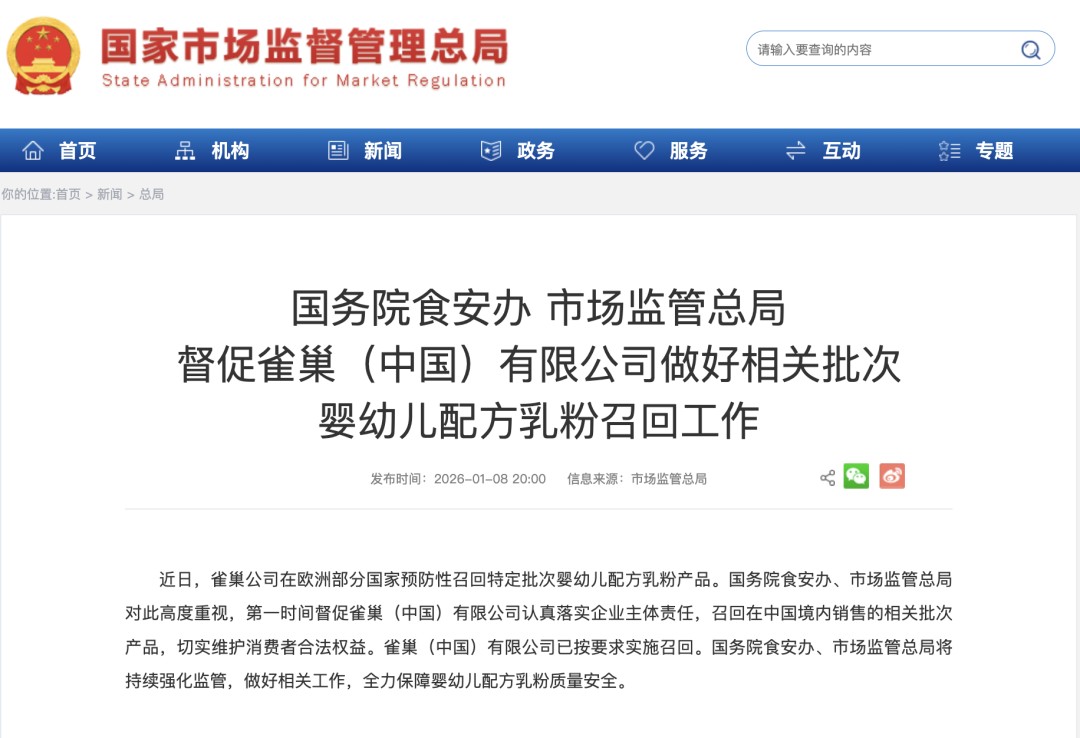
71批次!雀巢奶粉全球召回 多家乳企紧急自查→
Guo Ji Jin Rong Bao· 2026-01-08 14:18
Group 1 - Nestlé has initiated a global recall of infant formula products in 31 countries due to quality issues with a supplier's ARA oil ingredient, which may contain a harmful toxin [2][3] - In China, Nestlé announced a preventive recall of 71 batches of infant formula, including products from brands such as "Nestlé BEBA Supreme" and "Wyeth" [2][3] - The affected brands include four in total: Lait D'or, Platinum Enfamil, Comfort Enfamil, and Wyeth [2] Group 2 - The Chinese government, through the State Administration for Market Regulation, is closely monitoring the situation and has urged Nestlé China to fulfill its corporate responsibilities regarding the recall [3][4] - Other companies in the industry, such as DSM and Runke Bio, have publicly distanced themselves from the issue, asserting that they do not supply the problematic ARA ingredient [5][6] - Domestic dairy companies like Danone, Junlebao, and China Feihe have confirmed that their products do not use the implicated ARA ingredient and have maintained high safety standards [8][9][10] Group 3 - Nestlé's global sales for the first nine months of 2025 reached 65.869 billion Swiss francs, reflecting a 1.9% decline year-on-year, with an organic growth rate of 3.3% after excluding currency effects [10] - The Greater China region, now integrated into the Asia, Oceania, and Africa region, reported a significant decline in organic growth rate of -6.1% for the same period [10]


71批次!雀巢奶粉全球召回,多家乳企紧急自查→
Guo Ji Jin Rong Bao· 2026-01-08 14:11
Group 1 - Nestlé has announced a global recall of infant formula products in 31 countries due to quality issues with a supplier's ARA oil ingredient, which may contain a harmful toxin [1][4] - In China, Nestlé is recalling 71 batches of affected products, including those sold through cross-border e-commerce channels [1][2] - The recall affects four brands: Lait D'or, Platinum Enfamil, Comfort Enfamil, and Wyeth [1] Group 2 - The ARA ingredient is an Omega-6 polyunsaturated fatty acid commonly used in infant formula and dietary supplements, with major producers including DSM, Cabot, and Runke [4] - Other companies, such as Danone and Junlebao, have confirmed that their ARA sources are not related to the recalled products [8] - Nestlé emphasized that the detected toxin levels were very low, but a precautionary recall was implemented to maintain quality control [8] Group 3 - Nestlé's global sales for the first nine months of 2025 were CHF 65.869 billion, a 1.9% decline year-on-year, with an organic growth rate of 3.3% [9] - The Greater China region, now merged into the Asia, Oceania, and Africa (AOA) region, reported a significant decline with an organic growth rate of -6.1% [9] - The AOA region recorded sales of CHF 15.263 billion, a 2.7% increase year-on-year [9]
71批次!雀巢奶粉全球召回,多家乳企紧急自查
Guo Ji Jin Rong Bao· 2026-01-08 14:11
Group 1 - Nestlé has announced a global recall of certain batches of infant formula products in 31 countries due to quality issues with a supplier's ingredient that may contain a harmful toxin [1][3] - In China, Nestlé is recalling 71 batches of infant formula, including products from four brands: Lait Dujardin, Platinum Enfamil, Comfort Enfamil, and Wyeth [3][4] - The recall was prompted by the detection of a quality issue with an oil ingredient rich in arachidonic acid (ARA), which could potentially contain cereulide, a toxin that can cause gastrointestinal issues [3][6] Group 2 - The Chinese government has emphasized the importance of consumer safety and has urged Nestlé to take responsibility for the recall [4] - Other companies in the industry, such as Danone and Junlebao, have stated that their products do not use the implicated ARA ingredient and have implemented rigorous testing standards [9] - Nestlé has clarified that the toxin levels detected are very low, but they are proceeding with a precautionary recall to maintain quality control [9] Group 3 - Nestlé's global sales for the first nine months of 2025 reached 65.869 billion Swiss francs, a decline of 1.9% year-on-year, with an organic growth rate of 3.3% after excluding currency effects [10] - The Greater China region, which is now integrated into the Asia, Oceania, and Africa (AOA) region, has faced significant performance challenges, reporting an organic growth rate of -6.1% [10]
保水虾仁、无菌蛋、长保食品…… 热议食品安全,你敢吃吗?
2 1 Shi Ji Jing Ji Bao Dao· 2026-01-08 09:25
Group 1: Food Safety Concerns - The excessive use of additives, such as water-retaining agents in shrimp products, has raised significant safety concerns, with one company exceeding the legal limit of phosphate by 145% [2] - Microbial contamination, particularly from botulinum toxin, remains a major risk in food safety, necessitating strict control measures from production to storage [3] - Experts emphasize that the safety of long shelf-life foods does not correlate directly with their nutritional value, and modern processing techniques can ensure both safety and nutrition [3] Group 2: Industry Trends and Innovations - The demand for "suitable elderly food" is increasing, with a significant gap in the market for scientifically defined products that cater to the nutritional needs of older adults [5] - The approval of D-alloheptulose as a new food ingredient marks a significant advancement in synthetic biology applications within the food industry, indicating a mature technological and policy framework [5] - The introduction of new food safety standards, including updated labeling regulations, aims to enhance consumer awareness and safety, addressing long-standing industry concerns [6][7] Group 3: Regulatory Developments - The release of 50 new national food safety standards, including those for prepackaged food labeling, represents a significant upgrade in food labeling management [6] - The new regulations require clear labeling of expiration dates and allergenic substances, aiming to reduce food allergy risks and improve consumer information [6] - The implementation of comprehensive food safety regulations across the entire supply chain reflects a shift towards proactive risk management and consumer safety [7]
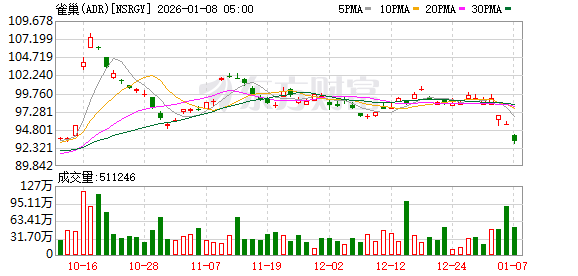
雀巢奶粉召回事件波及扩大,多品牌紧急回应,嘉必优股价大跌
Bei Ke Cai Jing· 2026-01-08 05:40
Core Viewpoint - The Nestlé infant formula recall has led to significant market disruptions, affecting not only Nestlé but also other brands and suppliers in the industry, with potential long-term impacts on consumer trust and sales performance [1][2][3]. Group 1: Recall Details - On January 6, Nestlé announced a recall of certain batches of infant formula across 31 countries due to quality issues with ARA (arachidonic acid) oil, which may contain harmful bacteria [2][3]. - The recall involves 71 batches of products from Nestlé and Wyeth, affecting at least 15 series of infant formula and one series of children's growth formula [3][4]. - Nestlé's assessment indicates that the affected batches represent less than 0.5% of the group's annual sales, suggesting limited financial impact on the company [4]. Group 2: Market Reactions - Following the recall announcement, there has been a surge in irrational returns from customers, with some retailers reporting significant increases in return requests, regardless of whether the products were part of the affected batches [1][5]. - The recall has led to a decline in confidence among distributors, particularly affecting Nestlé's high-end infant formula "Platinum Enfamil," which may face severe market challenges [1][5]. Group 3: Impact on Competitors and Suppliers - Other infant formula brands and suppliers, including Danone and HiPP, have clarified that they do not use the implicated ARA supplier, distancing themselves from the recall [8][9]. - The largest ARA supplier, DSM-Firmenich, confirmed that the problematic ARA was not produced by them and noted an increase in market demand for their ARA products due to the recall [10][18]. - The A-share listed company, Jia Bi You Biotechnology, is under scrutiny as it is suspected to be the supplier of the problematic ARA, leading to a significant drop in its stock price [1][17]. Group 4: Financial Performance and Market Share - In 2024, despite a market share increase in the infant nutrition sector, Nestlé's overall performance in the Greater China region is projected to show negative growth, with a reported organic growth rate of -6.1% for the first three quarters of 2025 [7]. - Market data indicates that Nestlé and Wyeth hold approximately 4.9% and 4.4% market shares, respectively, in the Chinese infant formula market, trailing behind competitors like Feihe and Danone [7].
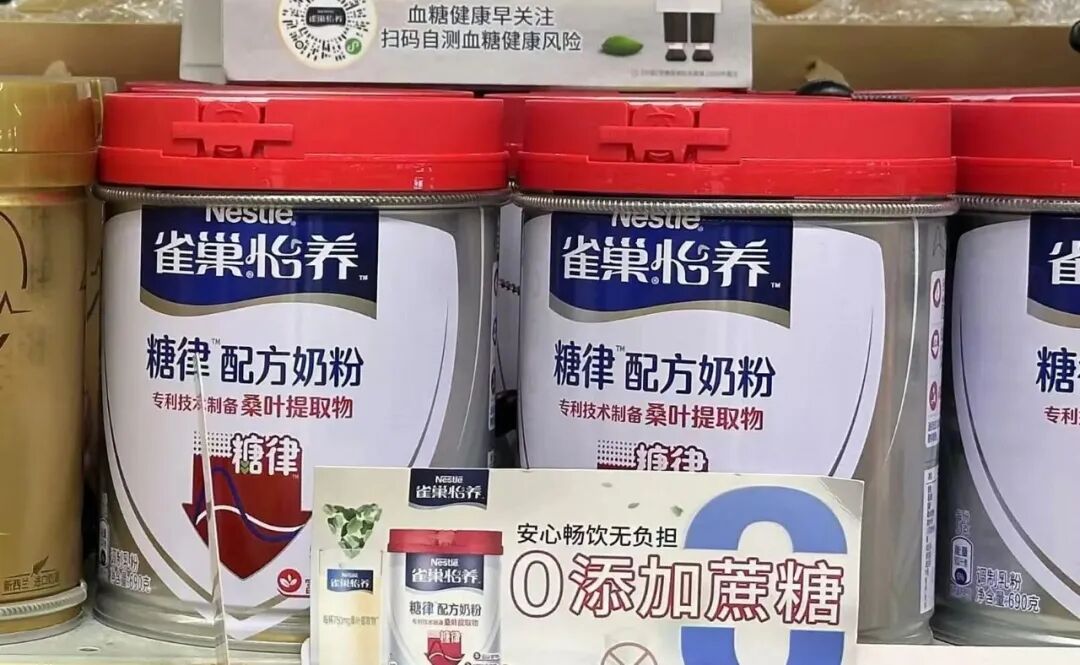
雀巢奶粉召回范围扩大至31个国家和地区 雀巢中国召回部分特定批次婴幼儿奶粉
Xin Lang Cai Jing· 2026-01-08 04:34
Group 1 - Nestlé has expanded its recall of infant formula to 31 countries and regions, including China, due to safety concerns [2][3] - The recall involves specific batches of products such as Lactogen, Althéra, and Wyeth, with a focus on those imported from Europe and sold through cross-border e-commerce channels in China [2] - The Hong Kong Food Safety Center has also released a list of affected batches, including 21 batches of Nestlé and Wyeth products [2] Group 2 - The issue originated from a self-monitoring test at a Nestlé factory in the Netherlands, where a supplier's raw material was found to contain Bacillus cereus toxin [3] - The toxin detected in the ARA oil used in production is heat-resistant and may cause acute gastrointestinal symptoms [3] - Nestlé China has stated that there have been no reports of adverse effects related to the affected products so far [3]