碳市场

Search documents
价跌量缩后,全国碳市场后市如何走?
Zheng Quan Shi Bao Wang· 2025-08-05 05:03
Group 1 - The national carbon market closed at 72.43 yuan/ton on August 1, showing a slight decrease of 0.07% from the previous day, and a decline of 3.39% from the end of June [1] - In July, the total trading volume of carbon emission allowances (CEA) was 11.6642 million tons, representing a significant decrease of 26.57% month-on-month, with the average daily trading volume dropping by 35.75% compared to June [1] - The Fudan University Sustainable Development Research Center noted that the carbon price fluctuated downwards in July, narrowing the price range from 74.28 yuan/ton at the beginning of the month to 72.33 yuan/ton by the end [1] Group 2 - The Fudan Carbon Price Index forecasts that by August 2025, the expected buying price for CEA will be 71.25 yuan/ton, while the selling price is expected to be 76.04 yuan/ton, with a midpoint of 73.65 yuan/ton [2] - As of July, the national carbon market has cumulatively traded 6.811 billion tons, with a total transaction value of 46.823 billion yuan [2] - The carbon market is set to expand in 2025 to include industries such as steel, cement, and aluminum smelting, with new trading methods introduced [2] Group 3 - The Chairman of the Shanghai Environment and Energy Exchange stated that efforts will continue to enhance the development and improvement of the national carbon emission trading market mechanisms [3]
钢铁业超低排放改造交出亮眼答卷
Jing Ji Ri Bao· 2025-08-05 02:52
Core Viewpoint - The steel industry is in its final year of ultra-low emission transformation, with significant progress made in reducing carbon emissions and enhancing environmental standards across the sector [1][2]. Group 1: Ultra-Low Emission Transformation - As of July this year, 197 steel enterprises have completed ultra-low emission transformations, with 600 million tons of crude steel capacity achieving full-process ultra-low emissions, and 350 million tons undergoing key engineering modifications, representing over 80% of the national total capacity [1]. - The investment for ultra-low emission transformation per ton of steel is approximately 474.35 yuan, with an average environmental operating cost of about 218.43 yuan per ton [1]. - An additional investment of around 200 billion yuan is needed to achieve the target of over 80% capacity completion by the end of this year [1]. Group 2: Industry Challenges and Strategies - The steel industry faces structural contradictions, including excess low-end products and insufficient high-end offerings, indicating a need for continuous optimization of product structure and energy-saving transformations [3]. - The industry is encouraged to adopt advanced technologies and management practices to balance production efficiency and environmental protection, ensuring fair competition among enterprises [2][3]. - The long-process steel enterprises are the primary source of carbon emissions, accounting for about 98% of total emissions in the sector, necessitating focused management and improvement in carbon emission reduction capabilities [4]. Group 3: Carbon Market and Future Directions - The national carbon market now includes the steel, cement, and aluminum industries, covering over 8 billion tons of emissions from approximately 3,700 key emitting units, making it the largest carbon market globally [3]. - The steel industry is advised to actively participate in voluntary carbon markets to reduce compliance costs and enhance carbon asset management [5]. - A flexible and sustainable management system is recommended to ensure long-term maintenance of emission reduction achievements and to provide tangible benefits for companies that excel in emissions reduction [2][4].
逾八成粗钢产能完成全流程或部分环节超低排放改造—— 钢铁业超低排放改造交出亮眼答卷
Jing Ji Ri Bao· 2025-08-04 22:10
Core Viewpoint - The steel industry is in its final year of ultra-low emission transformation, with significant progress made in reducing carbon emissions and enhancing green development [1][2][3] Group 1: Ultra-Low Emission Transformation - As of July this year, 197 steel enterprises have completed ultra-low emission transformations, with 600 million tons of crude steel capacity achieving full-process ultra-low emissions, and 350 million tons undergoing key engineering modifications, representing over 80% of the national total capacity [1] - The investment for ultra-low emission transformation per ton of steel is approximately 474.35 yuan, with an average environmental operating cost of about 218.43 yuan per ton [1] - An estimated additional investment of around 200 billion yuan is required to achieve the target of over 80% capacity completion by the end of this year [1] Group 2: Industry Challenges and Strategies - The steel industry faces structural contradictions, including excess low-end products and insufficient high-end products, indicating a need for continuous optimization of product structure and energy-saving transformations [3] - The long-process steel enterprises are the main source of carbon dioxide emissions, accounting for about 98% of total emissions in the steel production sector [4] - There are challenges in data management, carbon emission management capabilities, and balancing emission reductions with growth, necessitating a phased and organized approach to market entry and quota control [4] Group 3: Carbon Market and Future Directions - The national carbon market now includes the steel, cement, and aluminum industries, covering over 8 billion tons of emissions from approximately 3,700 key emitting units, making it the largest carbon market globally [3] - The steel industry is encouraged to actively participate in the voluntary carbon market to effectively reduce compliance costs and enhance green development momentum [5]
化工行业周报(20250728-20250803):本周TDI、环氧氯丙烷、氢氧化锂、甲酸、磷酸等产品涨幅居前-20250804
Minsheng Securities· 2025-08-04 14:43
Investment Rating - The report maintains a "Buy" rating for key companies in the chemical industry, specifically recommending Shengquan Group, Hailide, and Zhuoyue New Energy [4]. Core Insights - The report emphasizes the importance of identifying companies with strong performance in the first half of the year, particularly those expected to exceed earnings forecasts in Q2 2025. It highlights Shengquan Group's role as a major domestic supplier of electronic resins for AI servers, benefiting from increasing server shipments. Hailide is noted for its leadership in the polyester industrial yarn sector, which is expected to benefit from U.S. tariff conflicts. Zhuoyue New Energy is recognized for its capacity growth and new product launches, which are anticipated to elevate its performance [1][2][4]. Summary by Sections Chemical Industry Overview - The chemical industry index closed at 3727.14 points, down 1.46% from the previous week, outperforming the CSI 300 index by 0.29% [10]. - Key chemical products such as TDI, epoxy chloropropane, lithium hydroxide, formic acid, and phosphoric acid saw significant price increases [21]. Key Sub-Industry Tracking - **Phosphate Fertilizers**: The report indicates a peak export window for phosphate fertilizers, with exports expected to alleviate domestic overcapacity and maintain profitability for large phosphate chemical companies like Yuntianhua [2]. - **Pesticides**: Following a chemical safety incident, the report anticipates a nationwide safety inspection that may lead to the elimination of non-compliant production capacities, potentially boosting the pesticide industry's outlook [3]. - **Polyester Filament**: The report notes a slight increase in polyester filament prices, driven by rising production costs and a modest uptick in demand, although overall market conditions remain weak [24][25]. Company Performance Forecasts - Shengquan Group is projected to have an EPS of 1.03 in 2024, with a PE ratio of 31, while Hailide's EPS is expected to be 0.35 with a PE of 16. Zhuoyue New Energy is forecasted to achieve an EPS of 1.24 with a PE of 35 [4].


价跌量缩后 全国碳市场后市如何走?
Zheng Quan Shi Bao Wang· 2025-08-02 09:47
Group 1 - The national carbon market closed at 72.43 yuan/ton on August 1, down 0.07% from the previous day, with a 3.39% decline from the end of June [1] - In July, the national carbon market saw a total trading volume of 11.6642 million tons, a decrease of 26.57% month-on-month, ending a four-month growth trend [1] - The average daily trading volume in July was 510,300 tons, down 35.75% from June's 794,200 tons [1] Group 2 - The Fudan Carbon Price Index forecasts a buying price of 71.25 yuan/ton and a selling price of 76.04 yuan/ton for carbon emission allowances (CEA) by August 2025 [2] - As of July, the national carbon market has cumulatively traded 6.811 billion tons, with a total transaction value of 46.823 billion yuan [2] - The carbon trading management regulations will take effect on May 1, 2024, marking a significant step in the development of the carbon market [2] Group 3 - The chairman of Shanghai Environment Energy Exchange stated that efforts will continue to enhance the mechanisms of the national carbon trading market [3]
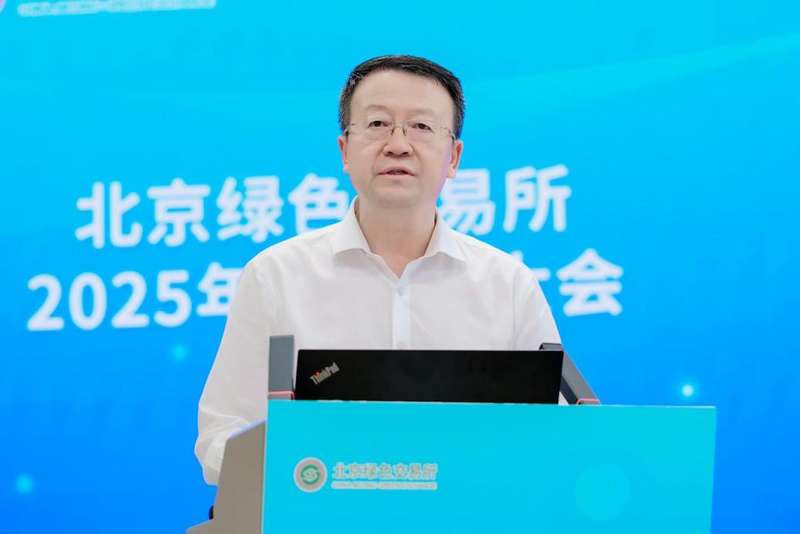
北京绿色交易所:全国自愿碳市场累计成交额突破2亿元
Xin Jing Bao· 2025-07-30 15:03
Group 1 - The core viewpoint of the news is the significant progress made in China's voluntary carbon market, with a total trading volume nearing 2.4 million tons and a transaction value exceeding 200 million yuan as of July 28 [1] - The establishment of the National Green Technology Trading Center under the Beijing Green Exchange has been officially approved by the National Development and Reform Commission, aiming to promote green technology and accelerate its transformation [1][3] - The Beijing Green Exchange is focusing on addressing challenges in green technology trading and is conducting foundational research on business models, evaluation standards, and the establishment of a technology broker system [3] Group 2 - The Beijing Green Exchange aims to maintain its primary role in voluntary greenhouse gas reduction trading while supporting the stable and efficient operation of the market [4] - Future services will include five categories: local carbon market trading, corporate green low-carbon development services, green technology trading services, ESG comprehensive services, and green bond issuance and trading [4] - The exchange is committed to enhancing internationalization and high-energy development to better support the dual carbon industry [4]

复旦碳价指数:2025年8月GEC价格指数走势分化
Cai Fu Zai Xian· 2025-07-29 03:28
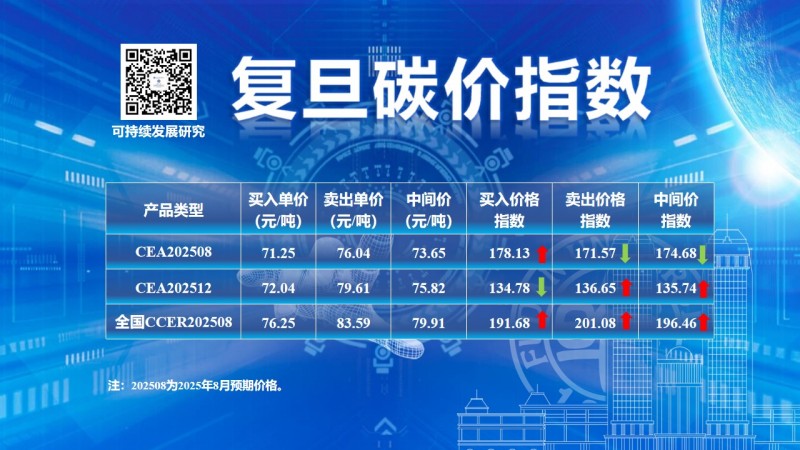
Core Insights - The Fudan University Sustainable Development Research Center released the carbon price index for August 2025, including national carbon emission allowance (CEA) prices, CCER prices, and GEC prices [1][2]. Carbon Emission Allowance (CEA) Prices - The expected buy price for the CEA in August 2025 is 71.25 CNY/ton, with a sell price of 76.04 CNY/ton, resulting in a midpoint price of 73.65 CNY/ton. The buy price index increased by 0.83% to 178.13, while the sell price index decreased by 0.82% to 171.57 [2][3]. - For December 2025, the expected buy price is 72.04 CNY/ton, sell price is 79.61 CNY/ton, and midpoint price is 75.82 CNY/ton. The buy price index is 134.78, and the sell price index is 136.65 [2][3]. Certified Emission Reduction (CCER) Prices - The expected buy price for CCER in August 2025 is 76.25 CNY/ton, with a sell price of 83.59 CNY/ton, leading to a midpoint price of 79.91 CNY/ton. The buy price index rose by 2.49% to 191.68, and the sell price index increased by 3.45% to 201.08 [2][3]. Green Electricity Certificate (GEC) Prices - The expected prices for GECs in August 2025 show a divergence in trends. For 2024 production, centralized project GECs are priced at 3.50 CNY/unit, distributed project GECs at 3.36 CNY/unit, and biomass power generation GECs at 3.66 CNY/unit. For 2025 production, prices are 7.82 CNY/unit for centralized projects, 6.94 CNY/unit for distributed projects, and 6.77 CNY/unit for biomass [4][5]. Market Trends - In July, the average closing price for CEA was 73.64 CNY/ton, up approximately 3% from June's average of 71.51 CNY/ton. However, the trading volume decreased by 35.75% to an average of 51.03 million tons compared to June [6]. - The global carbon market showed mixed trends, with the EU carbon market's average price rising slightly, while the UK market saw a significant drop in trading volume [9].
全国碳市场行情简报(2025年第124期)-20250728
Guo Tai Jun An Qi Huo· 2025-07-28 11:52
Report Overview - Report Title: National Carbon Market Market Briefing (Issue 124, 2025) [1] - Publisher: Guotai Junan Futures [2] - Release Date: July 25, 2025 [3] Investment Rating - No investment rating provided in the report. Core Views - The average daily trading volume within the week was over 600,000 tons, and the CEA price fluctuated downward. The CEA main contract continued its weakness, with 288,000 tons listed and 0 tons in bulk transactions. The CCER listed agreement trading volume was 2,600 tons, with an average transaction price of 81.97 yuan/ton (0.04% change) [4]. - It is recommended that enterprises with a quota gap make batch purchases at low prices before the end of August [4]. - The depletion of mandatory circulation quotas may support a carbon price reversal. It is expected that the mandatory circulation quotas will be exhausted by mid - October. Anticipatory trading may occur, and signs of a carbon price reversal may be seen in Q3. Before August, the carbon price may remain volatile due to slow release of mandatory circulation quotas and low trading willingness. From September, as compliance pressure emerges, the upward momentum may be released, and the price may rise [6]. Summary by Directory Market Conditions - CEA: The closing prices of CEA19 - 20, CEA21, CEA22, CEA23, and CEA24 were 71.34 yuan/ton, 74.40 yuan/ton, 74.50 yuan/ton, 74.20 yuan/ton, and 74.04 yuan/ton respectively. The price changes were 0.00%, 0.00%, 0.00%, - 0.32%, and - 0.63% respectively. The total trading volumes were 0.00 tons, 0.00 tons, 1.00 ton, 7.15 tons, and 20.69 tons respectively [8]. - CCER: The trading volume was 2,600 tons, with an average transaction price of 81.97 yuan/ton (0.04% change), and the transaction amount was 211,500 yuan. The cumulative trading volume was 239,320 tons [10]. Strategy - It is recommended that enterprises with a quota gap make batch purchases at low prices before the end of August [4]. Core Logic - The depletion of mandatory circulation quotas may support a carbon price reversal. It is expected that the mandatory circulation quotas will be exhausted by mid - October. Anticipatory trading may occur, and signs of a carbon price reversal may be seen in Q3. Before August, the carbon price may remain volatile due to slow release of mandatory circulation quotas and low trading willingness. From September, as compliance pressure emerges, the upward momentum may be released, and the price may rise [6]
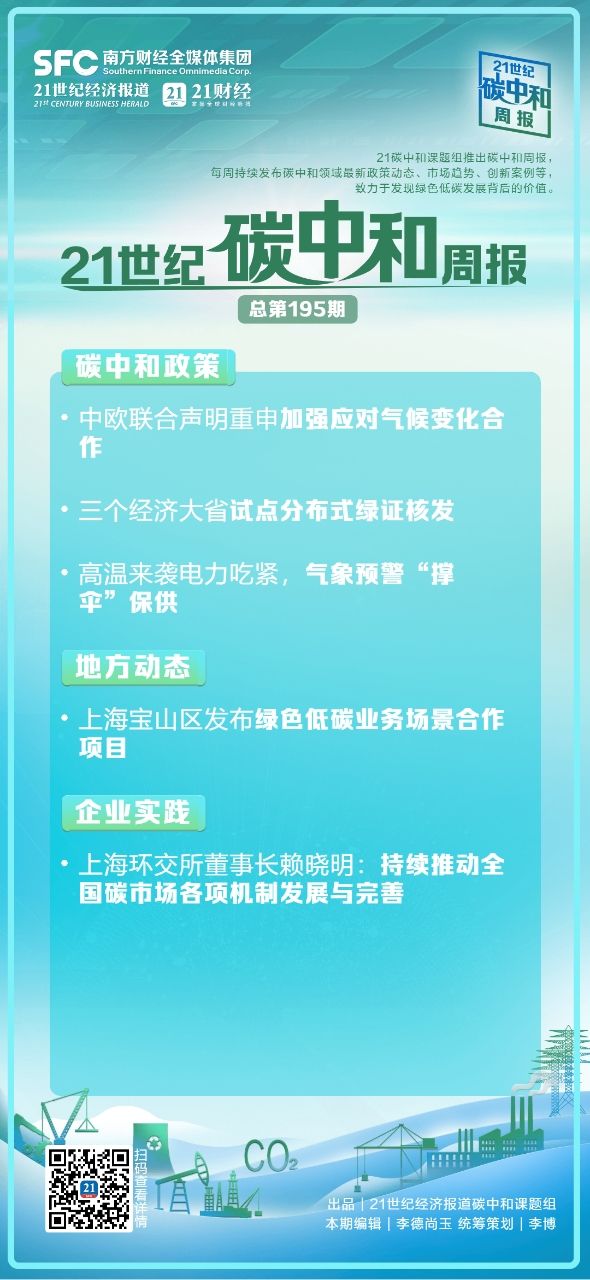
中欧加强应对气候变化合作;三省试点分布式绿证核发
2 1 Shi Ji Jing Ji Bao Dao· 2025-07-28 08:51
Policy Insights - China and the EU reaffirmed their commitment to strengthen cooperation on climate change, emphasizing the importance of the Paris Agreement and the principle of "common but differentiated responsibilities" [4] - The joint statement outlines seven cooperation directions, including the implementation of climate agreement goals, support for the 2025 COP30 conference, and acceleration of renewable energy deployment [4] Local Developments - Three major provinces in China (Zhejiang, Henan, Guangdong) are piloting the issuance of green certificates for distributed renewable energy projects, aiming to establish a framework for nationwide implementation [5] - The pilot program focuses on project registration, measurement management, and data collection, which are crucial for enhancing the green value of renewable energy enterprises [5] Industry Practices - The national carbon market in China has been operational for four years, with a cumulative trading volume exceeding 670 million tons and a transaction value of 46 billion yuan, indicating a healthy and orderly market development [7] - The market is set to expand in 2025 to include high-carbon industries such as steel, cement, and aluminum, which are also affected by the EU's carbon border adjustment mechanism [7][8] - Companies are urged to enhance green electricity applications and conduct comprehensive carbon footprint assessments to improve competitiveness in response to international trade rules [8]

火力发电项目可行性研究报告-市场全景调研分析及投资可行性研究预测 (商业计划书)
Sou Hu Cai Jing· 2025-07-28 08:21
Industry Overview - Thermal power generation refers to the process of generating electricity by burning fuels such as oil, coal, and natural gas to produce heat, which is then used to convert water into high-temperature, high-pressure steam that drives generators. Despite the rapid development of renewable energy, thermal power will remain a significant component of electricity supply in the short term. Innovations in materials and manufacturing processes will drive the industry towards higher performance and more environmentally friendly solutions [1]. Development History - The thermal power generation industry in China has developed over more than 70 years, forming a complete industrial system dominated by coal power and supplemented by gas power. As of the end of December 2024, the total installed power generation capacity in the country is approximately 3.35 billion kilowatts, a year-on-year increase of 14.6%. Among this, thermal power capacity is about 1.45 billion kilowatts, up 3.8%; solar power capacity is approximately 890 million kilowatts, up 45.2%; and wind power capacity is about 520 million kilowatts, up 18.0% [2]. Market Competition Status - The national thermal power market has formed a diversified competitive landscape led by five major central enterprises and supplemented by local state-owned enterprises and private capital. Major companies like the State Energy Group and Huaneng leverage their advantages in the industrial chain to stabilize fuel price fluctuations. Provincial energy groups maintain strong influence in local markets due to favorable policies. As the electricity spot market trial progresses, competition among power generation groups is shifting from installed capacity to cost control per kilowatt-hour, with some companies enhancing marginal profits through digital fuel management systems and optimized unit scheduling strategies. The market competition is expected to show three significant trends: leading companies will enhance industry concentration through mergers and acquisitions, specialized operators will capture the frequency regulation service market relying on technological advantages, and cross-industry competitors will enter the comprehensive energy service field with new models. Market players need to prepare strategically by establishing flexible asset portfolios to cope with policy fluctuations, cultivating carbon asset management capabilities to seize market opportunities, and building digital infrastructure to improve operational efficiency. Ultimately, the companies that succeed will be those that can ensure energy security while proactively positioning themselves for a zero-carbon transition [5][7]. Development Trends - The next decade will be a critical phase for the transformation of China's thermal power generation industry. From the perspective of energy security, the dominant position of coal as a primary energy source will not change in the short term, but the role of thermal power will inevitably shift from a base-load power source to a regulating power source, requiring companies to reassess asset values. Technological advancements such as 700℃ ultra-supercritical and IGCC will enhance industry efficiency, while artificial intelligence-enabled smart operations may become a new breakthrough for cost reduction and efficiency improvement. The policy environment will reshape the industry's profit model through improved capacity compensation mechanisms and expanded carbon market coverage. The future of the thermal power industry lies not in repeating past scale expansions but in innovatively defining its new role in the new power system. In this process, technological iteration serves as the oar, market mechanisms as the rudder, and the concept of sustainable development should be the ever-burning lighthouse guiding the way. The Chinese thermal power industry is writing its own transformation chapter in the grand narrative of the energy revolution [8].