稳增长政策

Search documents
【广发宏观郭磊】经济数据延续放缓,政策加力概率上升
郭磊宏观茶座· 2025-09-15 08:13
Economic Overview - August economic data shows continued slowdown, with six major indicators (exports, industrial output, services, retail sales, investment, and real estate sales) all below previous values. GDP estimates based on production and expenditure methods are approximately 4.67%, lower than July's 4.91% [1][7][8] Industrial Performance - Industrial added value in August grew by 5.2%, down from 5.7% in the previous month. The slowdown in export delivery value, which saw a year-on-year decline of 0.4%, is a significant drag on industrial performance [2][12] - High-tech industries continue to show resilience, with added value increasing by 9.3%. Key products like new energy vehicles and solar cells maintain high growth rates [2][13] Retail Sales - Retail sales growth in August was 3.4%, a decrease from 3.7% in July. Notable trends include accelerated rural consumption and a slowdown in urban consumption [3][14] - Categories with relatively high growth include sports and entertainment, jewelry, and home appliances, driven by service consumption trends and policy benefits [3][15] Fixed Asset Investment - Fixed asset investment saw a significant decline, with cumulative year-on-year growth dropping from 1.6% to 0.5%, and a monthly decline of 6.3%, worsening from -5.2% previously. Real estate, manufacturing, and infrastructure investments are all contributing to this downturn [4][16] - Manufacturing investment showed a year-on-year decline of 1.3%, indicating a slowdown in equipment updates [4][16] Real Estate Market - The real estate sector is experiencing a downward trend, with sales area, new starts, construction, and investment all showing increased year-on-year declines. The new housing price index in 70 major cities fell by 0.3% month-on-month, consistent with previous values [5][20][21] - Real estate investment in August saw a year-on-year decline of 19.4%, with new construction area down by 20.3% [5][20] Economic Phases - The economic rhythm of this year can be divided into three phases: strong growth in Q1 driven by exports and real estate, a resilient Q2 despite external disturbances, and a noticeable slowdown in July and August [5][22] - If Q3 GDP is estimated at 4.8%, achieving the annual target of 5.0% will require a Q4 growth rate of approximately 4.64% [5][22] Policy Outlook - Current macroeconomic policy is in the second phase, focusing on stabilizing cash flow and profit statements. The government is expected to continue its counter-cyclical adjustments following the release of August economic data [6][23]


债市定价围绕风险偏好及机构行为展开
Qi Huo Ri Bao· 2025-09-12 22:28
Group 1 - The bond market has accelerated its correction since early September, with 10-year and 30-year treasury yields falling below 1.80% and 2.10% respectively as of September 10 [1] - Short-term treasury yields have seen a marginal increase of around 1 basis point, supported by a slight easing in the funding environment [1] - The yield curve for treasury bonds exhibits a pronounced bear steepening characteristic [1] Group 2 - The China Securities Regulatory Commission (CSRC) has released a draft regulation on the management of public fund sales fees, aiming to lower investment costs and encourage long-term value investing [2] - The new regulation increases the punitive redemption fee rates for bond funds, leading some institutions to sell bonds as a precautionary measure [2][3] - The existing redemption fee structure for bond funds is being simplified, with new minimum rates set for different holding periods, requiring investors to hold for at least six months to avoid high fees [2] Group 3 - Recent economic data shows a marginal improvement in fundamentals, with August CPI down 0.4% year-on-year and PPI down 2.9%, but the decline in PPI has narrowed [4] - The central bank is expected to maintain a relatively stable funding environment, with a focus on protecting liquidity [5] - The bond market sentiment remains cautious, with yields breaking through key levels, and further declines in yields will require more positive developments such as new monetary policies or resumption of central bank bond transactions [5]
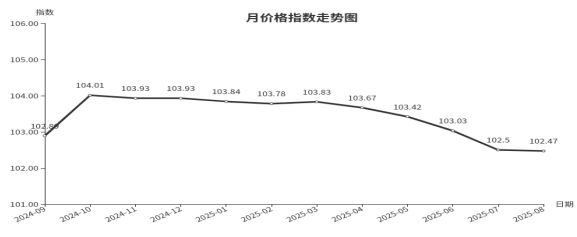
8月临沂商城月价格总指数为102.47点,环比下跌0.03点
Zhong Guo Fa Zhan Wang· 2025-09-12 08:04
Core Insights - The overall price index for Linyi Mall in the current month is 102.47 points, reflecting a slight decrease of 0.03 points month-on-month and a year-on-year decline of 0.74 points [1] Price Index Summary - Among 14 categories of goods, 5 categories saw price increases, 3 remained stable, and 6 experienced price declines. The top two categories with price increases are steel and lighting, while the top two categories with price declines are clothing and board materials [3] Steel Category - The steel category's price index reached 97.66 points, with a month-on-month increase of 0.34 points. Subcategories such as profiles, pipes, and boards saw increases of 0.51 points, 0.40 points, and 0.26 points respectively, while construction steel experienced a decrease of 0.07 points. The rise in prices is attributed to national growth policies and the acceleration of major infrastructure projects, which boosted market confidence. The increase in profile prices is mainly due to rising billet prices and production cuts from some steel mills due to equipment maintenance and environmental restrictions [5] Lighting Category - The lighting category's price index is 104.41 points, with a month-on-month increase of 0.10 points. Subcategories such as lighting accessories and commercial lighting saw increases of 0.55 points and 0.12 points respectively, while outdoor lighting slightly increased by 0.01 points and home lighting slightly decreased by 0.02 points. The overall market for lighting is performing well, with sales of high-end products increasing [8] Clothing and Accessories Category - The clothing and accessories category's price index is 103.57 points, reflecting a month-on-month decrease of 0.34 points. The accessories subcategory saw a decline of 0.49 points, while the clothing subcategory remained stable. The market is currently in a traditional off-season, leading to reduced retail demand and a shift towards wholesale business [11] Board Materials Category - The board materials category's price index is 95.85 points, with a month-on-month decrease of 0.25 points. The market is experiencing weak demand, particularly from the construction industry, which is affected by a sluggish real estate market. The overall sales volume is declining, and prices for some products are being adjusted downward due to fluctuations in raw material prices [13]
ETF总规模近一个月增长近10%
Zheng Quan Ri Bao· 2025-09-11 16:15
Core Insights - The total scale of ETFs increased by 458.8 billion yuan in the past month, reaching 5.13 trillion yuan, marking a nearly 10% growth [1] - The number of ETF shares rose by 115.4 billion, totaling 2.9 trillion shares, with 16 new products launched, bringing the total to 1,288 [1] - The financial sector saw the largest increase in shares, followed by the sub-segment of the chemical industry and the Hong Kong internet sector [1][2] ETF Performance - Ten products experienced a scale increase of over 10 billion yuan, with several broad-based products growing by over 20 billion yuan, such as Huatai-PB CSI 300 ETF and CSI 300 ETF E-Fund, which grew by 24.3 billion yuan and 21.6 billion yuan respectively [1] - The top-performing thematic ETFs included Guotai Securities ETF and E-Fund ChiNext ETF, both exceeding 10 billion yuan in growth [2] Thematic and Cross-Border ETFs - The chemical industry and artificial intelligence sectors are attracting significant investment, with the Penghua Chemical ETF growing by over 14 billion yuan and the E-Fund AI ETF increasing by 5.6 billion yuan [2] - Cross-border ETFs are becoming a key channel for investing in Hong Kong stocks, with the Fuguo Hong Kong Internet ETF growing by 19.8 billion yuan and the Huatai-PB Hang Seng Technology ETF increasing by 8.2 billion yuan [3] Market Trends - The current low valuation of A-shares and ongoing domestic growth policies are driving demand for broad-based ETFs, which are seen as a risk-diversifying investment option [2] - The demand for cross-border ETFs is rising due to improved valuation expectations in Hong Kong and the attractiveness of technology and financial sectors [3]
光大期货有色商品日报-20250911
Guang Da Qi Huo· 2025-09-11 05:17
Group 1: Report Industry Investment Rating - No relevant content found Group 2: Core Views of the Report - Copper prices are expected to continue a moderate recovery. The market has digested concerns about the US recession and shifted to expectations of Fed rate - cuts. Domestic CPI performance also spurs expectations of domestic growth - stabilizing policies, and the expected improvement in fundamentals during the "Golden September and Silver October" period will support copper prices [1]. - Aluminum prices are generally strong. Alumina,沪铝, and aluminum alloy are all showing a bullish trend. Although there is an oversupply situation in alumina, the overall aluminum market is in a macro - micro resonance mode, and the end of tax rebates for recycled aluminum restricts supply, making aluminum alloy relatively more resilient [1][2]. - Nickel prices may continue to be strong. With marginal improvements in nickel - iron and the new energy sectors, there are opportunities for long - positions at low prices. The cost support for stainless steel is strengthening, and the new energy raw material prices may remain strong due to tight supply [2]. Group 3: Summary by Relevant Catalogs 1. Research Views Copper - Macro: US August PPI inflation unexpectedly declined, providing grounds for Fed rate - cuts. In China, the CPI turned negative year - on - year in August, and the PPI decline narrowed. The finance minister emphasized strengthening the domestic market and implementing more proactive macro - policies [1]. - Inventory: LME copper inventory decreased by 225 tons to 155,050 tons; Comex copper inventory increased by 916 tons to 280,056 tons; SHFE copper warehouse receipts increased by 45 tons to 19,126 tons; BC copper remained at 4,418 tons [1]. - Demand: As the peak season approaches, high copper prices have led to weak downstream procurement [1]. Aluminum - Price: Alumina,沪铝, and aluminum alloy all showed a bullish trend. AO2601 closed at 2,944 yuan/ton, up 0.75%; AL2510 closed at 20,830 yuan/ton, up 0.22%; AD2511 closed at 20,390 yuan/ton, up 0.2% [1]. - Inventory: The overall situation is complex, with changes in different varieties and trading venues [1][2]. - Market: Environmental protection restrictions in some areas have affected downstream start - up, and the inventory inflection point for aluminum ingots has been postponed [2]. Nickel - Price: LME nickel rose 0.43% to 15,170 US dollars/ton, and沪镍 rose 0.24% to 120,780 yuan/ton [2]. - Inventory: LME nickel inventory increased by 3,024 tons to 221,094 tons; domestic SHFE warehouse receipts decreased by 295 tons to 22,304 tons [2]. - Market: Nickel - iron and new energy sectors are showing marginal improvements, and stainless steel cost support is strengthening [2]. 2. Daily Data Monitoring Copper - Price: The price of flat - water copper increased by 40 yuan/ton to 79,840 yuan/ton; the premium of flat - water copper decreased by 20 yuan/ton [3]. - Inventory: LME registered + cancelled inventory decreased by 550 tons; SHFE warehouse receipts increased by 155 tons; COMEX inventory increased by 1,739 tons; social inventory increased by 0.7 million tons [3]. Aluminum - Price: Wuxi and Nanhai aluminum prices increased; the price of Shandong alumina decreased by 30 yuan/ton; the price of ADC12 aluminum alloy in South China increased by 100 yuan/ton [5]. - Inventory: LME registered + cancelled inventory remained unchanged; SHFE warehouse receipts decreased by 74 tons; total inventory decreased by 1,518 tons; alumina social inventory increased by 2.1 million tons [5]. Nickel - Price: The price of Jinchuan nickel decreased by 600 yuan/ton; the price of nickel - iron remained stable; the price of some stainless steel products increased [5]. - Inventory: LME registered + cancelled inventory increased by 456 tons; SHFE nickel warehouse receipts decreased by 173 tons; nickel social inventory increased by 460 tons [5]. Zinc - Price: The main settlement price decreased by 0.2%; SMM 0 and 1 spot prices increased by 50 yuan/ton; the prices of zinc alloy and zinc oxide also changed to varying degrees [7]. - Inventory: SHFE inventory increased by 793 tons; LME inventory remained unchanged; social inventory increased by 0.14 million tons [7]. Tin - Price: The main settlement price decreased by 0.5%; LME S3 price decreased by 2.1%; SMM spot price increased by 900 yuan/ton [7]. - Inventory: SHFE inventory increased by 207 tons; LME inventory remained unchanged [7]. 3. Chart Analysis - **Spot Premium**: Charts show the spot premium trends of copper, aluminum, nickel, zinc, lead, and tin from 2019 - 2025 [9][11][12]. - **SHFE Near - Far Month Spread**: Charts display the near - far month spread trends of copper, aluminum, nickel, zinc, lead, and tin from 2020 - 2025 [16][21]. - **LME Inventory**: Charts present the LME inventory trends of copper, aluminum, nickel, zinc, lead, and tin from 2019 - 2025 [25][27][29]. - **SHFE Inventory**: Charts show the SHFE inventory trends of copper, aluminum, nickel, zinc, lead, and tin from 2019 - 2025 [32][34][36]. - **Social Inventory**: Charts display the social inventory trends of copper, aluminum, nickel, zinc, stainless steel, and 300 - series stainless steel from 2019 - 2025 [38][40][42]. - **Smelting Profit**: Charts show the trends of copper concentrate index, rough copper processing fee, aluminum smelting profit, nickel - iron smelting cost, zinc smelting profit, and stainless steel 304 smelting profit margin from 2019 - 2025 [45][47][49]. 4. Non - ferrous Metals Team Introduction - Zhan Dapeng, a master of science, is the director of non - ferrous research at Everbright Futures Research Institute, with extensive experience in commodity research and many awards [52]. - Wang Heng, a master of finance from the University of Adelaide, Australia, is a non - ferrous researcher at Everbright Futures, focusing on aluminum and silicon research [52]. - Zhu Xi, a master of science from the University of Warwick, UK, is a non - ferrous researcher at Everbright Futures, focusing on lithium and nickel research [53].
核心CPI涨幅连续第4个月扩大,专家认为扩内需政策持续显效
Jing Ji Ri Bao· 2025-09-11 01:37
Group 1 - The consumer market in August showed overall stability, with the Consumer Price Index (CPI) remaining flat month-on-month and decreasing by 0.4% year-on-year, while the core CPI, excluding food and energy, increased by 0.9% year-on-year, marking the fourth consecutive month of growth [1] - The Producer Price Index (PPI) month-on-month ended an eight-month decline, stabilizing after a 0.2% drop in the previous month, with a year-on-year decrease of 2.9%, which is a narrowing of 0.7 percentage points from the previous month [2][3] - The improvement in supply-demand relationships in certain industries has contributed to the stabilization of PPI, with energy and raw material prices showing signs of recovery [2][3] Group 2 - The "old-for-new" consumption policy has been expanded, providing significant support for prices of covered goods, with transportation tool prices stabilizing month-on-month and the year-on-year decline narrowing from 2.1% to 1.9% [2] - Service prices have shown a continuous upward trend since March, with a year-on-year increase of 0.6% in August, indicating the release of service consumption potential [2] - The overall low price level since the beginning of the year is expected to continue, providing ample space for future growth-stabilizing policies [3][4]
持续调整!年内上千只债基负收益
Zheng Quan Shi Bao· 2025-09-10 10:29
Core Viewpoint - The bond market has experienced significant adjustments since July, leading to negative returns for over a thousand bond funds, while the equity market has seen a rise in investor confidence due to supportive policies [1][4]. Group 1: Bond Market Performance - Since early July, the 30-year government bond futures have retraced over 5%, with other maturities also showing declines, indicating a broad adjustment in the bond market [2][3]. - As of September 9, the yields for various government bonds have increased, with the 30-year yield nearing 2.10%, reflecting a shift in market expectations and risk appetite [2][3]. Group 2: Fund Performance - Over a thousand bond funds have reported negative returns this year, with 50 funds showing returns below -2% and 181 funds below -1% [4]. - In contrast, convertible bond funds and mixed equity-bond funds have performed relatively well, with some convertible bond funds exceeding 20% returns [4]. Group 3: Market Dynamics - The adjustments in the bond market are attributed to a shift in expectations driven by macroeconomic policies aimed at stabilizing growth, leading to a stronger equity market and a "stock-bond seesaw" effect [3][6]. - The recent regulatory changes regarding fund fees may influence investor behavior, potentially increasing the attractiveness of bond funds despite current market challenges [5]. Group 4: Future Outlook - Analysts suggest that while the bond market faces short-term pressures from rising equity markets, there remains fundamental support for bonds, and a potential stabilization could occur if negative sentiment dissipates [6]. - The ongoing dynamics between equity and bond markets will continue to be a focal point, with the possibility of structural opportunities arising as the market adjusts [6].
长信改革红利混合:2025年上半年末换手率达823.77%
Sou Hu Cai Jing· 2025-09-05 05:03
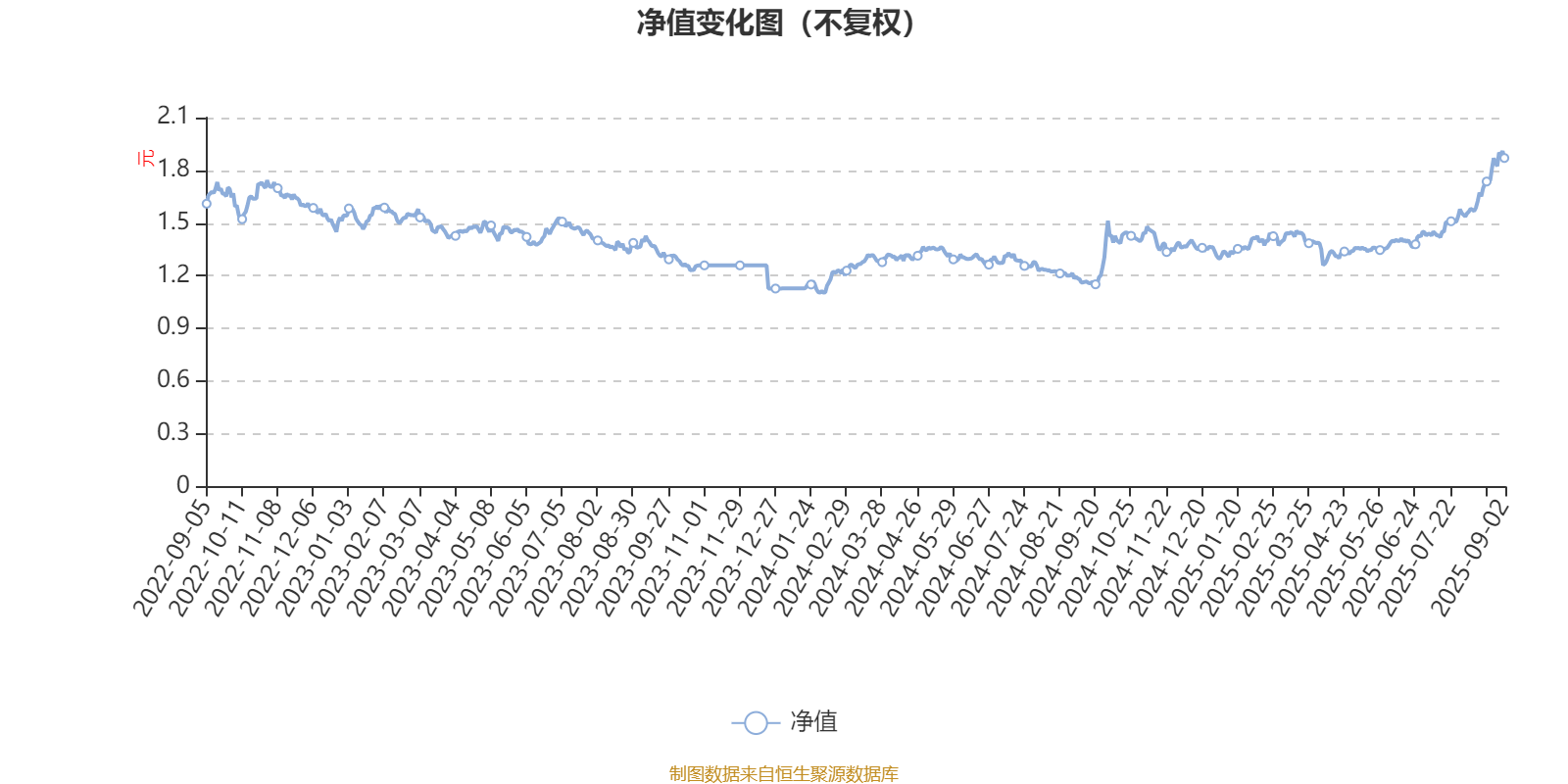
Core Viewpoint - The AI Fund Changxin Reform Dividend Mixed Fund (519971) reported a profit of 781,500 yuan for the first half of 2025, with a weighted average profit per fund share of 0.1123 yuan, and a net value growth rate of 8.21% during the reporting period [3][32]. Fund Performance - As of September 2, the fund's unit net value was 1.87 yuan, with a one-year cumulative net value growth rate of 54.94%, the highest among the three funds managed by the fund manager Zhang Ziqiao [3]. - The fund's performance over different time frames includes a three-month net value growth rate of 37.70%, a six-month growth rate of 36.20%, and a one-year growth rate of 57.80%, ranking 90/880, 81/880, and 194/880 respectively among comparable funds [5]. Fund Management Insights - The fund management indicated a focus on domestic demand and the political bureau's growth stabilization policies, as well as cyclical sectors and technology growth opportunities for the second half of the year [3]. - The management plans to maintain allocations in high-growth sectors such as overseas computing power, military industry, and domestic computing power, while also monitoring supply-side reform opportunities due to anticipated "anti-involution" policies [3]. Valuation Metrics - As of June 30, 2025, the fund's weighted average price-to-earnings (P/E) ratio was approximately 30.16 times, significantly higher than the industry average of 15.75 times [10]. - The fund's weighted average price-to-book (P/B) ratio was about 3.46 times, compared to the industry average of 2.52 times, and the weighted average price-to-sales (P/S) ratio was 2.76 times, against an industry average of 2.16 times [10]. Growth Metrics - For the first half of 2025, the fund's weighted average revenue growth rate was 0.08%, and the weighted average net profit growth rate was 0.4%, with a weighted annualized return on equity of 0.11% [19]. Risk and Return Metrics - The fund's three-year Sharpe ratio was 0.2644, ranking 185/875 among comparable funds [26]. - The maximum drawdown over the past three years was 29.42%, with the highest quarterly drawdown occurring in Q2 2022 at 19.05% [28]. Fund Composition - As of June 30, 2025, the fund had a total of 722 holders, with a total of 6.6512 million shares held, where management employees held 424,000 shares (6.44%), institutions held 37.48%, and individual investors held 62.52% [35]. - The fund's top ten holdings included companies such as Shenghong Technology, Xiaoshangpin City, and Zhimingda [40].
8月PMI点评:需求偏弱VS生产增强
Great Wall Securities· 2025-09-02 06:45
Group 1: Manufacturing Sector Insights - In August 2025, the manufacturing PMI increased by 0.1 percentage points to 49.4%, remaining below the expansion threshold, with a growth rate slightly lower than the average of 0.2% from 2016 to 2019[1] - The new orders index rose by 0.1 percentage points to 49.5%, contributing 0.03 percentage points to the PMI change[5] - The production index increased by 0.3 percentage points to 50.8%, marking the fourth consecutive month above the critical point[5] Group 2: Non-Manufacturing Sector Insights - The non-manufacturing PMI rose by 0.2 percentage points to 50.3%, indicating expansion, with the services index increasing by 0.5 percentage points to 50.5%[1] - The construction index fell by 1.5 percentage points to 49.1%, dropping into the contraction zone due to adverse weather conditions[1] - The business activity expectation index for services rose to 57.0%, indicating optimism among service sector enterprises[18] Group 3: Employment and Labor Market - The manufacturing employment index decreased by 0.1 percentage points to 47.9%, indicating a decline in employment conditions in the manufacturing sector[1] - The non-manufacturing employment index remained at 45.6%, with the services employment index dropping by 0.5 percentage points to 45.9%[23] - The construction employment index increased by 2.7 percentage points to 43.6%, supported by ongoing major infrastructure projects[23] Group 4: Risks and Economic Outlook - Risks include potential underperformance of domestic macroeconomic policies, delayed data extraction, and concentrated credit events[26] - The overall market demand remains weak, with external demand pressures still significant, indicating that the economic recovery foundation needs to be solidified[5]
早盘直击 | 今日行情关注
申万宏源证券上海北京西路营业部· 2025-09-02 02:52
Group 1 - The core viewpoint of the article indicates that the expectation of a performance turning point for listed companies has strengthened following the disclosure of the 2025 mid-year reports, with a rebound in net profit growth rate observed in Q1 2025 at 6.8%, despite a decline to 2.9% in Q2 2025 [1] - Domestic measures to stabilize growth are accelerating, with policies such as "anti-involution," infrastructure projects in the western regions, and childbirth subsidies being implemented, creating a dual focus on supply and demand [1] - The stock market is increasingly anticipating a turning point from negative to positive profit growth for listed companies, which is a significant factor influencing the medium-term market trend [1] Group 2 - The market is experiencing a volatile upward trend, with the Shanghai Composite Index recovering losses from the previous week, closing above the five-day moving average, and the Shenzhen Component Index showing accelerated gains [2] - The trading volume reached 2.7 trillion yuan, consistent with the previous week, and the market saw more stocks rising than falling, with over a hundred stocks hitting the daily limit [1][2] - Market hotspots are primarily concentrated in the TMT (Technology, Media, and Telecommunications) and non-ferrous metals sectors, with small-cap and technology stocks leading in gains [1]