
第二增长曲线

Search documents
激光雷达企业积极发展第二增长曲线
Zhong Guo Zheng Quan Bao· 2025-09-18 20:24
Core Viewpoint - Hesai Technology officially listed on the Hong Kong Stock Exchange on September 16, with an initial price of HKD 212.80 per share, reaching a peak of HKD 244 on the first day and closing at HKD 231 on September 18. The company turned a profit in Q2 2023, indicating a promising development outlook [1]. Business Performance - As of March 31, 2025, Hesai Technology has secured production contracts for 120 models from 22 global OEMs, including major manufacturers like Li Auto and Zeekr [2]. - In Q2 2025, the company reported a net income of CNY 706 million, a year-on-year increase of over 50%, and a net profit of CNY 44.1 million, marking a turnaround from losses [2]. - Competitors in the lidar industry, such as Suteng Juchuang and Tudatong, also showed positive performance, with Suteng Juchuang achieving a revenue of CNY 783 million in H1 2025, a 7.7% increase year-on-year [2]. Market Trends - The lidar industry is experiencing a "golden period" of simultaneous growth in volume and price, driven by increased demand for smart driving features and the integration of lidar as a standard safety product in vehicles [1]. - The penetration rate of lidar in new energy passenger vehicles reached 17% in June 2025, indicating that the technology has entered the mainstream market [3]. Strategic Shifts - Companies are increasingly targeting the robotics sector to achieve higher profit margins and explore new growth avenues, with lidar revenue in the robotics market projected to grow from USD 200 million in 2020 to USD 6 billion by 2024, at a CAGR of 29.4% [4]. - Suteng Juchuang's robotics and other sectors contributed significantly to its growth, with revenue from this area reaching CNY 221 million in H1 2025, a 420.2% year-on-year increase [4]. Product Development - Hesai Technology's miniaturized 3D lidar, the JT series, has delivered over 100,000 units within five months of launch, setting a company record [5]. - The company has secured a lidar order worth over USD 40 million from a leading US autonomous taxi company, with delivery planned by the end of 2026 [5].
研报掘金丨浙商证券:维持先导智能“买入”评级,有望开启强劲的第二增长曲线
Ge Long Hui· 2025-09-18 07:21
Core Insights - The company reported a significant increase in net profit for the first half of the year, reaching 740 million yuan, a year-on-year growth of 61.19% [1] - In Q2, the net profit was 375 million yuan, showing a remarkable year-on-year increase of 456.29% and a quarter-on-quarter increase of 2.67% [1] - The strong performance is attributed to the reversal of credit impairment losses amounting to 234 million yuan [1] Financial Performance - The operating cash flow showed a substantial improvement, with a net inflow of 2.353 billion yuan, marking a year-on-year increase of 231.33% [1] - The gross profit margin reached 40.27%, indicating enhanced profitability [1] Business Development - The company is positioned as an industry leader, with a clear performance inflection point [1] - By the first half of 2025, overseas revenue is expected to account for over 17% of total revenue [1] - The photovoltaic intelligent equipment business benefited from new technology iterations, generating 531 million yuan in revenue for the first half of 2025, a year-on-year growth of 32.04% [1] Strategic Partnerships - The company has established deep ties with globally recognized firms such as Volkswagen, BMW, LG, and SK, which is expected to enhance overall profitability as overseas revenue increases [1] Future Outlook - As a leader in solid-state battery production lines, the company is anticipated to initiate a strong second growth curve [1] - The diversification into non-lithium battery businesses, including 3C intelligent equipment and intelligent logistics systems, is effectively smoothing out the cyclical fluctuations of a single industry [1]


两年关店上万家,加盟模式大败退,这个行业的苦日子刚刚开始?
3 6 Ke· 2025-09-18 02:30
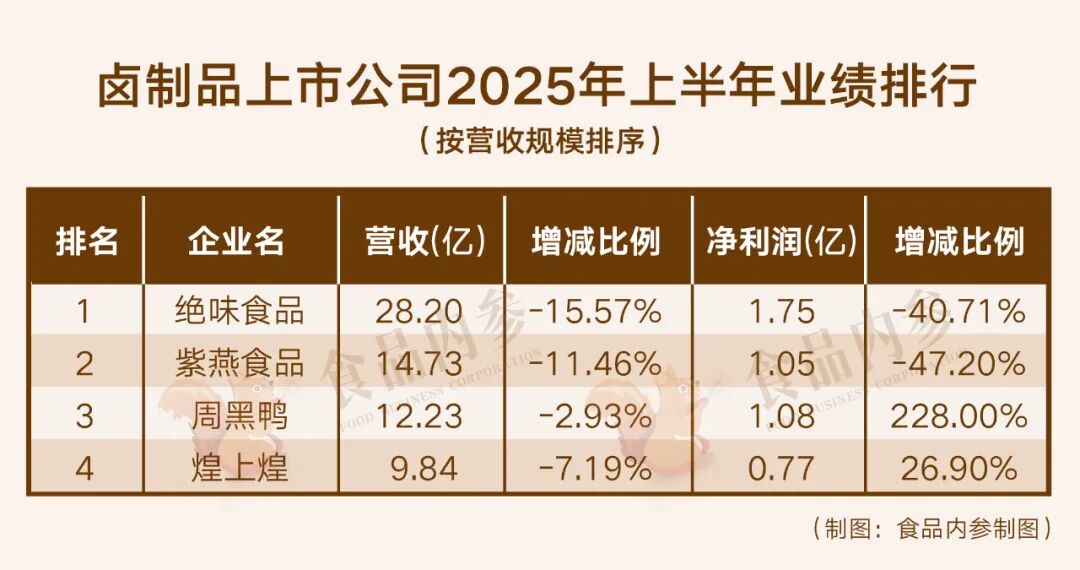
Core Viewpoint - The prepared food industry, particularly the marinated products sector, is facing significant structural challenges, leading to declining revenues and profits for several listed companies since 2024. The traditional growth model has failed, and mere promotional efforts or new product launches are insufficient to address these issues [1]. Structural Challenges - The four listed companies in the marinated products sector—Juewei, Zhou Hei Ya, Huang Shang Huang, and Ziyan Food—have all experienced a collective decline in performance in the first half of the year. Their combined revenue was 6.507 billion, down 11.25% from 7.332 billion in the same period last year, while net profit fell by 20.78% to 465 million from 587 million [2]. - Juewei, the largest player, saw the most significant decline, with revenue dropping 15.57% to 2.82 billion and net profit plummeting 40.71% to 175 million. Ziyan Food's net profit nearly halved to 105 million, with revenue shrinking to 1.146 billion [3]. Performance Data | Rank | Company Name | Revenue (Billion) | Change (%) | Net Profit (Billion) | Change (%) | | --- | --- | --- | --- | --- | --- | | 1 | Juewei | 2.82 | -15.57% | 0.175 | -40.71% | | 2 | Ziyan Food | 1.473 | -11.46% | 0.105 | -47.20% | | 3 | Zhou Hei Ya | 1.223 | -2.93% | 0.108 | 228.00% | | 4 | Huang Shang Huang | 0.984 | -7.19% | 0.077 | 26.90% | - Zhou Hei Ya and Huang Shang Huang performed relatively better, with Zhou Hei Ya's net profit increasing by 228% to 108 million, although it remains at half the level of 230 million from mid-2021 [3]. Historical Context - Juewei's peak profit was in 2021 at 981 million, but profits fell to 233 million and 344 million in 2022 and 2023, respectively, despite revenue reaching a high of 7.261 billion in 2023. In 2024, Juewei's revenue dropped 13.84% to 6.257 billion, with net profit declining over 30% [4]. - The overall trend shows that from 2021 to 2024, these companies have experienced a significant decline in performance after reaching their highs around 2021 [6]. Market Dynamics - The decline in performance is attributed to intensified competition, consumer perception of value, and the inability to meet consumer expectations regarding price and quality. Consumers have expressed dissatisfaction with high prices, leading to reduced purchasing behavior [8]. - Companies have resorted to frequent discounts and promotions, which have not effectively changed consumer perceptions of high prices and have negatively impacted net profits [8]. Old Growth Model Failure - The previous growth model, which relied heavily on store expansion, is no longer effective. Juewei's franchise model was once a significant growth driver, but recent trends indicate that the closure of stores is directly linked to declining revenues [9]. - Juewei's revenue from franchise stores accounted for 73.5% of total revenue in 2024, down from 54.17 billion in 2023, indicating a 15% decline [9]. Store Closure Trends - The total number of operating stores for the four listed companies has decreased by over 8,700 since 2023, with significant closures also occurring among regional brands [13]. - Juewei's store count dropped from 15,950 at the end of 2023 to 10,725 by September 2024, while Zhou Hei Ya's stores decreased from 3,816 to 2,864 [10][12]. Future Outlook - The marinated products sector is at a crossroads, needing to identify new growth models or second growth curves. Current efforts, such as Juewei's new store format and Zhou Hei Ya's brand upgrades, have yet to show significant results [14]. - The industry requires a deep restructuring around channels, products, and organization to adapt to the changing market dynamics and consumer preferences [14].


中集环科(301559) - 2025年9月17日投资者关系活动记录表
2025-09-17 09:10
Group 1: Tank Container Business - The tank container business maintained resilience in H1 2025, with revenue of CNY 924.25 million, holding the top market share [1] - The current tank container business is considered to be at a historical low, presenting a market restructuring opportunity [1] - The company is enhancing its manufacturing capacity and order delivery speed while actively expanding its acquisition team to explore high-end equipment and emerging fields [1] Group 2: Profit Margin and Market Conditions - The change in gross profit margin for tank container products in H1 2025 was primarily due to pressure in the chemical industry, intensified market competition, and declining market demand [2] Group 3: Competitive Advantages - The company possesses scale, brand, scope, and synergy advantages, enabling timely equipment investment, product upgrades, and cost control [2] - With over 20 years of high-quality development, the company has established a robust supply chain and cultivated the domestic application market for tank containers [2] - The company offers a comprehensive one-stop solution for the entire lifecycle of tank containers, with a diverse product line including standard, special, gas, and powder tank containers in various sizes [2] Group 4: Medical Equipment Business - The high-end medical imaging equipment component business has seen continuous growth, with a 12.88% increase in 2024 and a 16.12% increase in H1 2025 [3] Group 5: Aftermarket Business - The aftermarket business, which includes cleaning, maintenance, refurbishment, and parts sales for tank containers, generated revenue of CNY 74.92 million in H1 2025, a 0.95% year-on-year increase [3] Group 6: Future Development Directions - The company aims to achieve sustainable growth and enhance risk resistance through diversification, focusing on high-end equipment and related fields [4] - Plans include expanding high-end medical equipment business and intelligent equipment capabilities, responding to national policies through mergers and investments [5] - The goal is to transition from a global leader in tank containers to a core technology platform for high-end equipment within three to five years [5]
纷纷赴港 智能座舱企业集体IPO为哪般?
Huan Qiu Wang· 2025-09-17 07:00
Core Viewpoint - The IPO wave for intelligent cockpit companies is surging, following the trend set by autonomous driving companies, with several firms preparing for listings in Hong Kong to alleviate financial pressures and enhance market competitiveness [1][2][3]. Group 1: Market Dynamics - Intelligent cockpit technology companies are increasingly viewing IPO financing as a critical strategy for survival and expansion in a highly competitive market [1][3]. - The market for intelligent cockpits is rapidly evolving, with companies like Zhibo Zhixing and Siwei Zhili experiencing significant growth in their solution deployment, yet still facing substantial financial losses due to high R&D costs [2][3]. Group 2: Financial Performance - Zhibo Zhixing reported a compound annual growth rate (CAGR) of 67.2% in its intelligent cockpit solution deployment, increasing from 835,000 units in 2022 to 2,334,000 units in 2024, but still incurred losses of 878 million yuan, 876 million yuan, and 847 million yuan from 2022 to 2024 [2]. - Siwei Zhili, with a seven-year history, also faced losses of 13.59 million yuan, 59.81 million yuan, and 133 million yuan from 2022 to 2024, despite being selected by major automakers [2]. Group 3: Technological and Ecological Factors - Companies are focusing on their core technologies and ecosystem collaboration to attract capital, with Zhibo Zhixing leveraging partnerships with Alibaba and SAIC to create a competitive edge [4][6]. - The ability to develop comprehensive self-research capabilities is a common trait among the recently listed intelligent cockpit companies, enhancing their market position [5][6]. Group 4: Future Challenges and Strategies - The competitive landscape is intensifying, with both tech and automotive companies entering the intelligent cockpit space, making it crucial for these firms to maintain market position and investor confidence [7]. - Companies are encouraged to diversify their customer base to mitigate risks associated with high customer concentration, which is a significant concern for investors [8].
百润股份实控人转让6%股份套现14.7亿:预调鸡尾酒销量不断下滑 威士忌业务潜力有待检验
Xin Lang Cai Jing· 2025-09-17 04:06
Core Viewpoint - Liu Xiaodong, the controlling shareholder of Bairun Co., has transferred 6.01% of his shares to Liu Jianguo for 1.47 billion yuan, marking his first significant reduction since 2019 amid declining sales in the pre-mixed cocktail segment and the nascent whiskey business [1][2][4]. Group 1: Share Transfer Details - Liu Xiaodong transferred 63 million shares, representing 6.01% of the total share capital, to Liu Jianguo at a price of 23.337 yuan per share, which is a 7.54% discount to the closing price of 25.24 yuan on September 10 [1][2]. - Following the transfer, Liu Xiaodong retains a 34.58% stake in Bairun Co., while Liu Jianguo becomes a significant shareholder with 6.01% [1][2]. - Liu Jianguo's acquisition is characterized as a long-term financial investment, with no intention to participate in company management or appoint board members [2]. Group 2: Business Performance and Challenges - Bairun Co. has experienced a continuous decline in its main business, with a 6.61% revenue drop in 2024 and an 8.56% decline in the first half of the year [4][5]. - The revenue from pre-mixed cocktails, including sparkling water, was 2.677 billion yuan in 2024, down 7.18% year-on-year, with sales volume decreasing by 8.81% [4][5]. - The company faces significant challenges in sales channels, primarily relying on offline sales, which have been impacted by reduced foot traffic in supermarkets [5]. Group 3: Whiskey Business Potential - Bairun Co. is expanding its whiskey production capacity, having raised funds for whiskey aging projects, with an expected increase of 33,800 kiloliters in whiskey raw material capacity [6][7]. - The company plans to launch two whiskey products in November 2024, with additional products scheduled for release in 2025, indicating a potential shift in focus to whiskey as a second growth curve [7][8]. - The domestic whiskey market is highly competitive, with foreign brands dominating and a growing number of local companies entering the market [7][8].

“十五五”怎么干?央企控股上市公司新增长极轮廓显现
Shang Hai Zheng Quan Bao· 2025-09-16 18:45
Group 1 - Central enterprises are accelerating the preparation of the "14th Five-Year" plan, with many companies revealing their latest progress and focus areas during recent performance briefings [1][2] - The "14th Five-Year" period will emphasize the development of strategic emerging industries and future industries as key directions for creating a second growth curve [4][5] - Companies like Taigang Stainless Steel are focusing on high-end, green, and intelligent manufacturing, avoiding large-scale capacity investments in a saturated market [2][3] Group 2 - Hubei Energy has initiated its "14th Five-Year" planning work, aiming to enhance its energy sector through a multi-sector collaborative development strategy [2][3] - Companies are expected to submit their finalized "14th Five-Year" plans to the State-owned Assets Supervision and Administration Commission by June 30 of the first year of the planning period [3] - The focus on digital transformation is evident, with companies like China Merchants Highway planning to expand into smart transportation and related industries [6] Group 3 - New material sectors are being prioritized, with companies like CNOOC Development expanding their production capacity for chemical new materials [5] - The emphasis on new energy storage technologies is growing among energy central enterprises, with companies like Zhonglv Electric focusing on enhancing green electricity usage efficiency [7][8] - Some enterprises are planning to extend their operations upstream and downstream within their industry chains, such as China Nuclear Technology's move into valve industry services [8]
“十五五”怎么干? 央企控股上市公司新增长极轮廓显现
Shang Hai Zheng Quan Bao· 2025-09-16 18:32
Group 1 - Strategic emerging industries and future industries will be key directions for central enterprises to cultivate a second growth curve during the 14th Five-Year Plan period [2] - Chengfei Integration has identified drone fuselage manufacturing as an important new development direction, included in the company's 14th Five-Year Plan [2] - Some central enterprises have set specific growth targets, with Zhenhua Technology aiming to increase the proportion of civil business to 30% by the end of the 14th Five-Year Plan [2] Group 2 - CNOOC Development is accelerating its layout in chemical new materials, expanding production capacity for DPC catalysts and functional membrane materials [3] - Digital transformation is a crucial path for central enterprises to cultivate new growth points, with China Merchants Highway planning to promote smart and green development in the toll road operation industry chain [3] - The focus on high-end resin and polyether polyol products by Shenyang Chemical aims to serve high-growth markets such as automotive seats and medical gloves [3] Group 3 - China National Materials International acknowledges challenges in integration and business transformation, aiming to enhance performance and structure during the 14th Five-Year Plan [4] - New energy storage has become a key focus for several energy central enterprises, with Zhonglv Electric prioritizing the development of new energy storage projects [4] - Hubei Energy plans to develop new businesses in inspection and testing, new energy storage technology, and hydrogen energy [4] Group 4 - Hong Sifang, a fertilizer production central enterprise under China Salt Group, will prioritize industry transformation and the cultivation of strategic emerging industries during the 14th Five-Year Plan [5] - Jiangnan Chemical is focusing on the transformation of the civil explosives industry and aims to promote cross-regional and cross-ownership restructuring [5] - Zhongke Technology plans to extend its operations into the valve industry and maintenance services to achieve industrial breakthroughs [5]
港股IPO破局,2900亿医疗器械龙头迈瑞,预计三季度业绩回正
3 6 Ke· 2025-09-16 02:10
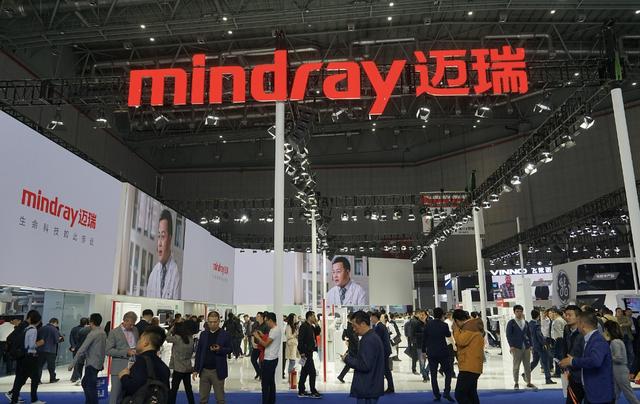
Core Viewpoint - The innovative pharmaceutical industry is experiencing a "BD moment," while the medical device sector, particularly represented by Mindray Medical, is facing significant challenges due to valuation corrections and market dynamics [1][5]. Group 1: Company Performance - Mindray Medical's revenue grew from 9.032 billion yuan in 2016 to 34.932 billion yuan in 2023, maintaining a double-digit annual growth rate [1]. - The company's net profit also saw substantial growth, increasing from 1.6 billion yuan to 11.582 billion yuan during the same period, with a consistent growth rate above 20% [1]. - However, starting in 2024, Mindray's revenue growth has dropped to less than 1%, with net profit showing nearly zero growth [3]. - In Q1 2025, Mindray reported a revenue of 8.237 billion yuan, a year-on-year decline of 12.12%, and a net profit of 2.629 billion yuan, down 16.81% [5]. - By Q2 2025, revenue further declined to 8.506 billion yuan, a drop of 23.77%, and net profit fell to 2.440 billion yuan, down 44.55% [5]. Group 2: Market Reaction and Valuation - Following the release of disappointing financial results, Mindray's stock price did not experience a significant drop, indicating that the market had already adjusted to the negative expectations [8]. - Despite the challenges, Mindray's stock has shown resilience compared to peers, although it has nearly halved from its peak [3]. Group 3: Industry Context - The difficulties faced by Mindray reflect broader challenges in the medical device industry, exacerbated by centralized procurement policies affecting revenue growth [5]. - The medical device market in China is expected to recover, with projections indicating a 20.9% year-on-year growth in the bidding market by Q4 2024 [8]. Group 4: Strategic Direction - Mindray aims to increase its international revenue share to over 70%, recognizing the overseas market's potential, which is five times larger than the domestic market [12]. - The company is considering a Hong Kong IPO to raise at least $1 billion, which would facilitate its global expansion strategy [12]. - Mindray's revenue from in vitro diagnostics (IVD) has reached 6.424 billion yuan, making it the largest revenue segment, and the company plans to focus on this area for future growth [14][15]. Group 5: Leadership and Future Outlook - Mindray's founder, Li Xiting, is 74 years old, and succession planning has become a point of interest for investors [10]. - Li has expressed optimism about the company's future, aiming to position Mindray among the top 10 global medical device companies by 2030 [10]. - The company has made significant investments in R&D, with 1.78 billion yuan allocated in H1 2025, representing 10.6% of revenue, to enhance its product offerings and market position [17].

金洲管道:公司始终坚持以价值创造为核心
Zheng Quan Ri Bao Wang· 2025-09-15 13:45
证券日报网讯 金洲管道(002443)9月15日在互动平台回答投资者提问时表示,公司始终坚持以价值创 造为核心,专注发展当前主业,并积极寻找合适的投资机会,以开拓新的增长点,构建第二增长曲线。 目前,公司已组建专项团队,就第二主业的发展规划开展深入研究,正在进一步完善相关规划纲要。待 方案成熟后,公司将及时提交董事会审议,并严格按照规定履行信息披露义务。 ...
