
量化紧缩

Search documents
金荣中国:现货黄金等待指引,目前暂交投于3927美元附近
Sou Hu Cai Jing· 2025-10-30 07:16
Fundamental Analysis - Gold prices experienced significant volatility, initially rising nearly 2% to reach a high of $4029.90 per ounce before dropping to a low of $3916.56, closing around $3930, marking a daily decline of approximately 0.57% [1] - The U.S. dollar index surged by 0.42% to close at 99.13, with an intraday high of 99.35, the highest since October 15 [3] - The yield on the 10-year Treasury note rose by 8.6 basis points to 4.081%, the largest single-day increase since June 6, while the 2-year yield increased by 10.8 basis points to 3.602%, reaching a one-month high [3] - The Federal Reserve lowered interest rates by 25 basis points to a target range of 3.75%-4.00%, but Chairman Powell's hawkish comments led to market disappointment, with the implied probability of a December rate cut dropping from 95% to 67.9% [4] Technical Analysis - The daily chart indicates that gold prices are under pressure, potentially challenging the $3900 level again, with a focus on testing the previous low of $3886 [8] - Short-term trading strategies suggest considering short positions near $3970 with a stop loss at $3980 and targets around $3930/3900, while aggressive long positions could be attempted near $3895 with a stop loss at $3886 and targets at $3945/3975 [9] Market Sentiment - The combination of a hawkish shift from the Federal Reserve, a strengthening dollar, and rising Treasury yields has increased the opportunity cost of holding gold, putting downward pressure on its price [5] - Investors are advised to closely monitor future statements from Federal Reserve officials, developments in U.S.-China negotiations, and decisions from central banks in Japan and Europe [5]


金银反弹受黄金带动 美联储决议后市场静待新指引
Jin Tou Wang· 2025-10-30 07:16
Core Viewpoint - The recent rise in silver prices is primarily driven by the rebound in gold prices, rather than fundamental factors specific to silver [1][2] Group 1: Market Dynamics - Spot gold rebounded nearly 2% after hitting a three-week low of $3886.46, driven by bargain buying, short covering, and expectations of central banks re-entering the market [1][2] - Traders increased long positions in gold as prices significantly corrected, pushing gold towards the critical $4000 mark [1][2] - Silver prices rose above $48.00 per ounce, with platinum demand also increasing by 1%, indicating a general uptick in the precious metals sector [1] Group 2: Federal Reserve Impact - Traders are adjusting positions ahead of the Federal Reserve's interest rate decision, with a 25 basis point rate cut largely priced in [2] - The market's direction will be influenced by Fed Chair Powell's press conference, particularly if he hints at reducing the scale of quantitative tightening (QT) or adopts a more dovish tone [2] - Both Bank of America and Deutsche Bank suggest that the Fed may end QT this month, which would bolster demand for non-yielding assets like gold and silver [2] Group 3: Technical Analysis - For spot gold, the recent 25 basis point rate cut did not lead to a significant price increase, indicating that many long positions were liquidated [3] - The current outlook for gold remains bearish unless it breaks above the mid-band resistance level [3] - Spot silver has potential upward movement towards the resistance level of $51.07, with a subsequent target of $54.49 if this level is breached [4]
美联储内部“鸽鹰”之争:降息50基点VS不降息!下一任主席人选或年底出炉,“伯恩斯时代”恐重演,独立性危机将助推金价?
Mei Ri Jing Ji Xin Wen· 2025-10-30 06:41
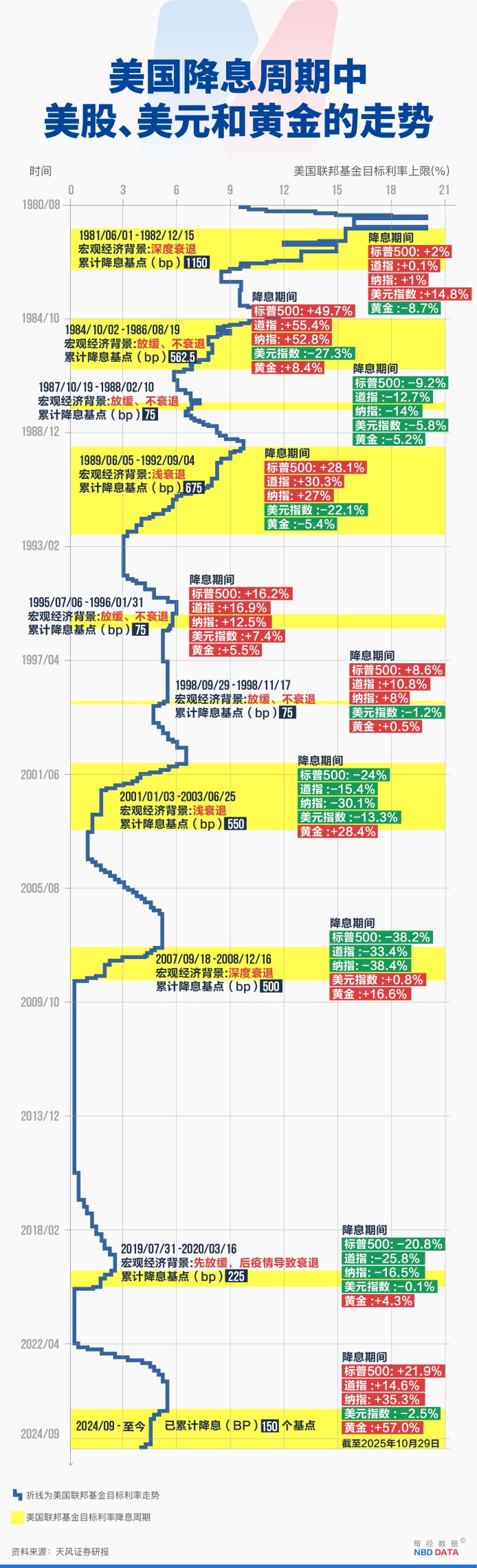
当地时间10月29日,美国联邦公开市场委员会(FOMC)宣布将联邦基金利率目标区间再次下调25个基 点到3.75%至4.00%之间。这是美联储继9月17日降息25个基点后再次降息,也是自2024年9月以来第五 次降息。 最新利率决议显示,两位委员投下了反对票,凸显出美联储内部的分歧。其中,被视为"外部人"的斯蒂 芬·米兰(Stephen Miran)主张大幅降息50个基点,而堪萨斯城联储主席施密德(Jeffrey Schmid)则倾 向于维持利率不变。 值得注意的是,特朗普近日表示,或将在年底前公布接替现任美联储主席鲍威尔的人选。 在特朗普政府目前圈定的五位候选人中,也有两位是完全没有美联储工作经验的。一旦更多"外部人"加 入,美联储的独立性将受到更大的挑战,成为全球金融市场最大的风险敞口。回顾上世纪伯恩斯时代的 历史,美联储独立性信任的崩塌,往往是黄金牛市的序曲。 图片来源:新华社记者 胡友松摄 鲍威尔释放"鹰派"信号,黄金先涨后降至4000美元以下 本次会议是美联储史上首次在缺失联邦就业数据的情况下召开的。由于国会预算僵局,美国联邦政府自 10月1日起停摆,大量常规经济数据发布被迫中断。尽管2018年12 ...

美联储“内讧”:降息50基点VS不降息!下一任主席人选或年底出炉 “伯恩斯时代”恐重演 独立性危机将助推金价?
Mei Ri Jing Ji Xin Wen· 2025-10-30 06:17
当地时间10月29日,美国联邦公开市场委员会(FOMC)宣布将联邦基金利率目标区间再次下调25个基点到3.75%至4.00%之间。这是美联储继 9月17日降息25个基点后再次降息,也是自2024年9月以来第五次降息。 最新利率决议显示,两位委员投下了反对票,凸显出美联储内部的分歧。其中,被视为"外部人"的斯蒂芬·米兰(Stephen Miran)主张大幅降息 50个基点,而堪萨斯城联储主席施密德(Jeffrey Schmid)则倾向于维持利率不变。 值得注意的是,特朗普近日表示,或将在年底前公布接替现任美联储主席鲍威尔的人选。 在特朗普政府目前圈定的五位候选人中,也有两位是完全没有美联储工作经验的。一旦更多"外部人"加入,美联储的独立性将受到更大的挑 战,成为全球金融市场最大的风险敞口。回顾上世纪伯恩斯时代的历史,美联储独立性信任的崩塌,往往是黄金牛市的序曲。 鲍威尔释放"鹰派"信号,黄金先涨后降至4000美元以下 纽约州立大学布法罗分校政治学系助理教授科林·安德森(Collin Anderson)对每经记者分析称,"我认为美联储之后将采取两种截然不同的策 略。一种是维持现状,不作任何剧烈的调整,只是小幅地调 ...
美联储如期降息25基点 金价从低点反弹
Jin Tou Wang· 2025-10-30 06:03
Group 1 - Gold prices are currently trading above $3967, with a recent report showing a price of $3971.87 per ounce, reflecting a 1.10% increase, while the highest price reached was $3981.64 and the lowest was $3914.92 [1] - The Federal Reserve's recent decision to lower the benchmark interest rate by 25 basis points to a range of 3.75%-4% has created a mixed sentiment in the market, with some members advocating for a more aggressive cut of 50 basis points [1][2] - The employment market is showing signs of cooling, with job growth slowing and unemployment rates rising, although still at low levels, indicating potential risks to economic activity [2] Group 2 - The Federal Reserve plans to halt balance sheet reduction starting December 1, with maturing agency debt being reinvested into Treasury securities, which may influence market liquidity [1] - Analysts suggest that the gold market is at a crossroads, with a potential decline in prices if the upcoming U.S.-China-Korea summit does not yield positive results and if expectations for a December rate cut continue to diminish [3] - The recent CPI data indicates that inflation remains relatively high, with core PCE potentially hovering around 2.3% to 2.4%, suggesting that inflationary pressures are still a concern for the Federal Reserve [2]
金价亚盘短期承压下跌,关注下方支撑位多单布局
Sou Hu Cai Jing· 2025-10-30 05:55
Group 1 - The core focus of the news is the cautious trading in the gold market, influenced by the upcoming US-China summit in Seoul and the potential impact on gold prices depending on the outcomes of trade negotiations [1] - If the trade talks do not yield significant progress, gold prices may find short-term support due to safe-haven demand; conversely, optimistic developments could lead to downward pressure on gold prices [1] - The market is currently at a crossroads, with factors such as a hawkish shift from Powell, strengthening of the dollar and US Treasury yields, and the end of quantitative tightening overshadowing any potential benefits for gold [1] Group 2 - Gold experienced significant volatility, initially rising nearly 2% to surpass the $4000 mark, reaching a high of $4029.90 per ounce, before reversing course following a hawkish statement from Fed Chair Powell [3] - The Fed's decision to lower rates by 25 basis points did not prevent gold from declining, as Powell's comments led to a drop to a low of $3916.56 per ounce, closing around $3930, reflecting a daily decline of approximately 0.57% [3] - The Fed's stabilization of bond holdings and potential resumption of balance sheet expansion in 2026 may support bond prices and lower yields, but the immediate impact of Powell's hawkish remarks has overshadowed these factors [3]

美联储系列二十八:美联储十月降息落地,缩表止步
Hua Tai Qi Huo· 2025-10-30 05:24
Report Summary 1. Report Industry Investment Rating No information provided. 2. Core View of the Report - The FOMC meeting cut the federal funds rate target range by 25bp to 3.75%-4.00% as expected and ended the balance - sheet reduction plan in December, marking the end of the quantitative tightening phase. The policy has entered a new transition stage of "stop easing → observe and evaluate", with the future interest - rate path becoming more uncertain [2][3]. - After the resolution, the market re - priced interest rates, exchange rates, and risk assets due to Powell's hawkish remarks. The market focused on the uncertainty of future interest - rate cuts behind the end of balance - sheet reduction. If macro data does not deteriorate significantly before December, the market's trading logic for interest - rate cuts will be more cautious [4]. 3. Section Summaries FOMC Meeting Results - The FOMC meeting cut the federal funds rate by 25bp to 3.75% - 4.00% and will end the balance - sheet reduction plan in December, with internal differences on interest - rate decisions, indicating increased uncertainty about the future interest - rate path [2][3]. - Powell emphasized that whether to cut interest rates in December depends on data, and the policy orientation has shifted to stronger data dependence. There are upward short - term inflation disturbances from tariffs, but they are expected to be temporary [3]. - The Fed has not determined the details of the balance - sheet duration structure adjustment but will gradually tilt towards short - duration allocation [3]. Market Reaction - After the Fed's decision, the market initially had a mild reaction, but then quickly re - priced due to Powell's hawkish remarks. The 10 - year U.S. Treasury yield rose by over 7bp to 4.06%, the 2 - year yield rose by over 10bp, U.S. stocks fell, gold declined, emerging - market currencies were under pressure, and Bitcoin significantly corrected [4]. - The market focused on the uncertainty of future interest - rate cuts, and if macro data does not deteriorate significantly before December, the trading logic for interest - rate cuts will be more cautious, and interest - rate fluctuations and cross - asset misalignment will remain highly elastic [4]. Economic Data Forecast (SEP Outlook) - Forecasts for real GDP, unemployment rate, PCE, core PCE, and interest rates from 2025 - 2028 are provided, and compared with June's predictions, showing changes in economic data expectations [30].
10月FOMC点评:美联储转鹰增加变数
HTSC· 2025-10-30 05:20
Group 1: Overall Information - The report is titled "Fed Turns Hawkish, Adding Uncertainty - October FOMC Review" and is published by Huatai Research on October 30, 2025 [1] Group 2: FOMC Meeting Summary - The Fed cut the benchmark interest rate by 25 basis points to 3.75%-4.00% at the October FOMC meeting and will stop quantitative tightening on December 1. Two members voted against the decision, showing internal disagreement [2] - Economic activity is expanding at a moderate pace. Employment growth has slowed this year, and the unemployment rate has risen slightly but remains low as of August. Inflation is still relatively high [2] Group 3: Powell's Press Conference - Powell stated that a December rate cut is not a given. The committee has not decided on December's policy and will make a judgment based on data, economic outlook, and risk balance. There are significant differences among members due to inflation risks and employment risks [3] - The Fed decided to end QT on December 1 because the money market pressure has reached the target level, with rising repo rates and the federal funds rate [3] - AI investment is insensitive to interest rates and is based on long - term judgments. The Fed is monitoring the rise in sub - prime auto loan defaults but has not found it to be a widespread credit problem [4] - The K - shaped economy has been included in the economic assessment. There is a certain correlation between the stock market and consumption, but a stock market decline may not lead to an equal - dollar decline in consumption [4][5] Group 4: Market Performance - After the hawkish remarks, interest - sensitive assets generally adjusted. US Treasury yields rose significantly, and technology stocks and copper performed relatively strongly. The US dollar index rose, and non - US currencies mostly fell [6] - As of the close on the day, the 2 - year US Treasury yield rose 11 basis points to 3.60%, and the 10 - year yield rose 10 basis points to 4.08%. US stocks closed mixed, with the Nasdaq up 0.55%, the S&P 500 flat, and the Dow down 0.16%. The Russell 2000 index fell 0.87% [6] - As of October 30, the OIS market priced in a further 17.2bp rate cut this year, and the probability of a December rate cut dropped to 68.6% [6] Group 5: Future Policy Outlook - The Fed's rate - cut logic has shifted from risk management to data - driven. The threshold for a December rate cut has increased significantly, and a further weakening of the job market may be a necessary condition [7] - Stopping quantitative tightening is expected to ease short - term liquidity tensions. After the government shutdown ends, the TGA account funds may flow back to the market, injecting more liquidity [8] - The new Fed chair nominee may be announced this year. If Kevin Hassett is nominated, it may increase concerns about the Fed's independence and benefit gold. If Christopher Waller is nominated, it may trigger reverse trading [8] Group 6: Asset Allocation Outlook - For US Treasuries, short - term government shutdowns may cause fundamental pressure and increase yield volatility. The Fed's more cautious stance drives the yield curve to bear - flatten. In the long run, monetary policy may be "tight first and then loose" [9] - For US stocks, the Fed's hawkish turn has affected some interest - sensitive sectors, but AI remains the main line. In the medium term, the macro - environment is still favorable, but long - term risks such as central bank tightening and over - capacity need attention [10] - For other assets, before US employment data shows further weakness, most assets may face pressure on the denominator. The recent strength of the RMB exchange rate may limit the impact of rising US Treasury yields [10]
美联储再次降息25个基点 国际金价震荡下行
Zhong Guo Jing Ying Bao· 2025-10-30 04:49
Core Points - The Federal Reserve announced a 25 basis point interest rate cut, lowering the federal funds rate target range to 3.75% to 4%, which aligns with market expectations [1] - Following the announcement, spot gold prices briefly fell below $3930 per ounce, despite reaching a high of $3965.84 per ounce earlier [1] - The Fed will end its quantitative tightening on December 1, but Chairman Powell expressed skepticism about further rate cuts in December, leading to reduced market expectations for additional monetary easing [1]
年内“二连降”,鲍威尔一句话“掀翻”市场,美联储10月决议要点速览15条
Sou Hu Cai Jing· 2025-10-30 04:33
2. 美联储货币政策委员会大多数成员投票支持降息25个基点,仅2人反对:斯蒂芬·米兰投票降息50个基 点,杰弗里·施密德投票不降息。 3. 10月降息与9月降息具有相同的风险管理逻辑,不存在零风险的政策路径。 4. 美联储已经累计降息150个基点,利率现已处于许多中性利率估计的范围内;当前货币政策仍然适度 具有限制性,若排除关税影响,当前通胀水平实际上已与2%的目标相去不远,可能只高出0.5%到 0.6%。 5. 委员会内部分歧较大,12月进一步降息并非板上钉钉。美联储将继续根据最新数据、不断变化的经济 前景以及风险平衡来确定适当的货币政策立场。 6. 政府停摆可能会影响12月的议息会议,在缺乏数据的情况下,可能有必要更加谨慎,经济数据缺失可 能构成暂停利率调整的理由。 7. 美联储决定于12月1日结束量化紧缩,届时,抵押贷款支持证券的赎回本金将被再投资于短期国债。 钛媒体App 10月30日消息,当地时间29日,美联储宣布年内第二次降息25个基点,并决定从12月1日起 结束缩表。主席鲍威尔随后表态12月再次降息并非板上钉钉,给美联储后续的政策前景增添了巨大的不 确定性。受此影响,交易员下调了对美联储12月降 ...