马太效应

Search documents
全球资管500强最新发布!57家中国机构现身,这家挺进30强
券商中国· 2025-06-18 05:02
57家中国资管机构进入榜单 2025年共有57家中国资产管理机构进入IPE"2025全球资管500强",2024年进入榜单的中国资管机构为52家。 对于中国资管公司在最新榜单的排名情况, IPE在中国的独家合作机构 爱鹏(北京)信息科技有限公司创始人胡砚表示,中国资管机构2024年经历了质的飞跃,表 现亮眼。 胡砚介绍,最新进入榜单的57家机构包括:22家基金管理公司、17家银行理财子公司、12家保险资产管理公司、5家证券公司和1家养老金保险公司。相较上一年入 围机构有一定变化,其中,有9家机构为首次入榜,48家为连续两年(2023—2024年)参评机构。 截至2024年底,这57家机构的总资产管理规模达约85.8万亿元,整体格局实现重大突破。实现近15%的强劲增长;平均排名较上年提升7位,呈现出集群式整体跃升 态势;其中37家机构排名上升,2家持平,仅9家下滑。 据悉,IPE全球排名依据以欧元计的上年末资产管理规模排序,排名结果可能受汇率变动影响。中国资产管理机构的管理规模数据来源于机构或其母公司公开披露 的信息、年度报告,以及机构向IPE或爱鹏提交的数据。 6月17日,欧洲出版集团"欧洲投资与养老金"(I ...





瑞承:教育AI化,结果是普惠还是分化
Jin Tou Wang· 2025-06-17 01:28
Group 1 - The core issue of the "third digital divide" is emerging in education, where affluent families leverage AI tools to reinforce their advantages, while ordinary families face marginalization due to limited resources and understanding [1] - The Stanford AI Index report reveals that 86% of students globally have accessed AI tools, but the distribution of educational resources is uneven, leading to a "Matthew effect" in technology benefits [1] - In the K12 education sector, the rate of computer science (CS) course offerings in U.S. high schools increased from 35% in 2017 to 60% in 2023, but disparities exist between schools, with elite schools offering CS courses at a rate of 91% compared to only 50.03% in schools serving over 75% low-income families [1] Group 2 - The transition to AI education is more flexible in high school to university stages, with AP Computer Science exam participation increasing 12-fold over 16 years, but participation rates vary significantly among different demographics [2] - From 2021 to 2023, the number of U.S. colleges offering AI bachelor's degrees rose from 9 to 19, yet only 104 graduates were produced in 2023, while master's programs saw a dramatic increase in institutions and graduates [2] - International students constitute a significant portion of AI graduate education, making up 67% of master's and 60% of doctoral students in 2023, with over half from China and India [2] Group 3 - McKinsey predicts that by 2030, about 30% of jobs in Europe and the U.S. will be replaced by AI, but the current education system is not producing talent with interdisciplinary thinking and ethical awareness [3] - The Stanford report emphasizes that AI education should integrate programming with statistics, cognitive science, and ethical philosophy, highlighting the need for a holistic approach to talent development [3] - The "AI cold door" phenomenon is evolving from individual anxiety to a systemic crisis due to uneven resource distribution, teacher capability gaps, and an outdated education system, making equitable access to technology benefits a pressing global educational reform issue [3]
AI 正在加剧职场“内卷”
Hu Xiu· 2025-06-16 01:57
Core Insights - The article draws a parallel between the impact of AI on the modern workforce and the themes presented in Charlie Chaplin's film "Modern Times," highlighting how both eras reflect the struggle of individuals against mechanization and efficiency-driven systems [1][3][20]. Group 1: AI's Impact on the Workforce - AI has become a symbol of the new industrial civilization, reshaping the nature of work and individual value at an unprecedented pace [4][5]. - Over 90% of Generation Z rely on AI for work and study, with 55.4% using it frequently, indicating a significant integration of AI into daily tasks [5]. - Despite the optimistic view that AI would liberate human labor, it has instead intensified workplace competition and redefined what constitutes an "excellent employee" [5][12]. Group 2: Employment Barriers and Competition - AI has not lowered the barriers to entry in the job market; rather, it has raised the standards for employment, making proficiency in AI a necessary skill [6][7]. - Many new employees find their capabilities comparable to that of an intern augmented by AI, which diminishes their unique value in the workplace [8][10]. - The reliance on AI tools has led to a situation where individuals who lack independent thinking and judgment may find their roles increasingly interchangeable with AI [10][11]. Group 3: Work Hours and Job Satisfaction - The use of AI has not reduced work hours; instead, it has led to an increase in weekly working hours, with a reported average increase of 3.15 hours for those who have significantly adopted generative AI [15][16]. - As AI raises efficiency standards, the pressure to produce higher quality work has intensified, leading to longer hours and decreased leisure time [16][17]. - Workers often do not benefit from the productivity gains brought by AI, as companies may reduce headcount while increasing individual workloads [18][19]. Group 4: Societal Transformation - The arrival of AI represents a subtle transformation rather than a dramatic upheaval, gradually altering perceptions of work and value without overt job displacement [20][21]. - As efficiency becomes commonplace, the challenge lies in redefining effort and reward in a landscape where speed is prioritized [22]. - Future value may increasingly depend on uniquely human capabilities such as understanding, judgment, and creativity, rather than mere technical proficiency with AI [23][24]. Group 5: Balancing Technology and Humanity - The integration of technology should not overshadow individual effort; meaningful contributions still hold significant value in a high-efficiency environment [24][25]. - It is essential for individuals to find their own rhythm amidst rapid technological changes, balancing the use of tools with maintaining boundaries between work and life [25][26].
5家保险资管机构一季度合计实现净利润超10亿元
Zheng Quan Ri Bao· 2025-06-11 16:56
Core Insights - The insurance asset management industry has shown positive performance in Q1, with five major institutions reporting a total revenue of 2.627 billion yuan, a year-on-year increase of 7.8%, and a net profit of 1.07 billion yuan, up 23% year-on-year [1][2] Group 1: Performance Overview - All five insurance asset management institutions reported profitability in Q1, with a total revenue of 2.627 billion yuan, a 7.8% increase year-on-year [2] - Among these, Taikang Asset led with a revenue of 1.471 billion yuan, a 7.0% increase, while Allianz Asset Management achieved the highest growth rate at 38.7%, with a revenue of 67 million yuan [2] - The total net profit for these institutions was 1.07 billion yuan, reflecting a 23% year-on-year growth, with Taikang Asset again leading at 612 million yuan, a 22.9% increase [2] Group 2: Market Trends and Expert Opinions - The overall performance of insurance asset management companies is significantly influenced by the performance of their parent insurance businesses, as internal funds dominate their operations [3] - The "Matthew Effect" is evident in the industry, with a clear performance divide between leading and smaller institutions, where the top three firms accounted for 50% of the total net profit of 34 firms [4] - Experts suggest that smaller firms can enhance competitiveness by focusing on niche markets, fostering collaborations, and investing in talent development [4] Group 3: Future Outlook - The insurance asset management industry is expected to experience four major trends: increased scale and concentration due to market competition and regulatory guidance, diversification and specialization of business operations, greater investment in financial technology, and expansion into international markets and cross-border collaborations [5]
2025年第23周:酒行业周度市场观察
艾瑞咨询· 2025-06-11 09:11
Core Insights - The article discusses the current trends and dynamics in the liquor industry, focusing on the rise of craft beer, the competition among major liquor brands in Hong Kong, and the strategies employed by companies during the off-season to engage consumers [1]. Industry Environment - The craft beer market is experiencing significant growth, driven by instant retail, with some retailers reporting sales increases of 20%-35%. However, traditional liquor distributors remain cautious due to short shelf life and supply chain challenges [2]. - The light bottle liquor market is projected to reach 150 billion by 2024, with potential to exceed 200 billion in the next decade. The "Bashi" brand from Sichuan Chunquan Group is gaining traction in Jiangsu, targeting the 30-60 yuan price range [3]. - Major Chinese liquor brands are rapidly expanding into the Hong Kong market, leveraging tax reductions and differentiated strategies to attract mid-to-high-end consumers, despite facing competition from foreign spirits [5]. - The liquor industry is shifting focus from channel-driven strategies to consumer-driven approaches, with companies like Moutai and Xijiu enhancing brand engagement through immersive experiences [6]. Future Predictions - The liquor industry is expected to undergo three major changes in the next decade: a shift towards smoother flavors to appeal to younger consumers, increased concentration among leading brands, and accelerated integration across different liquor categories [7]. Brand Dynamics - Yanjing Beer has successfully transitioned from single-point marketing to a comprehensive ecosystem approach, significantly increasing its revenue and profitability through high-end product offerings [11][12]. - Kuaizi Jiu is establishing a cultural benchmark with the opening of the largest brewing heritage exhibition hall in China, enhancing its brand's historical significance and supporting its high-end strategy [13]. - The "Shancheng Beer" trademark dispute highlights the challenges foreign brands face in local markets, with Carlsberg's strategy facing scrutiny due to declining brand value [14]. - Wuliangye's "He Mei" wedding event exemplifies the integration of traditional culture and modern marketing, promoting brand engagement through experiential marketing [15]. - China Resources Beer’s dual empowerment strategy for beer and liquor is underperforming, with its liquor segment failing to meet growth targets [17]. - Yanjing Beer is struggling with high-end positioning amidst a competitive landscape, facing challenges in revenue growth and market strategy [18]. - Guojiao 1573 is innovating through cultural narratives, collaborating with intangible cultural heritage artisans to enhance brand identity and consumer connection [19]. - Shacheng Laojiao has achieved remarkable growth, with projected revenue of 1.4 billion in 2024, driven by strategic market focus and product offerings [20]. - Water Well Square is promoting cultural values through its collaboration with artist Zhu Bingren, enhancing brand visibility during the Dragon Boat Festival [21]. - Liu Ling Zui Jiu is leveraging cultural heritage to establish a strong market presence, focusing on product diversity and consumer experience [23]. - Hongxing Erguotou has been recognized as a leading consumer brand in Beijing, emphasizing quality and cultural heritage in its production processes [24].




全球top21仪器巨头净利润“缩水”近30亿,2家降幅超7成
仪器信息网· 2025-06-11 07:48
Core Insights - The global scientific instrument industry reported a total net profit of 19.8 billion yuan from 21 listed companies in 2024, showing a slight decline year-on-year, with the average net profit margin dropping to 11.6% from 15.7% in 2023, indicating a slowdown in industry growth and increasing strategic differentiation among companies [1][2]. Group 1: Financial Performance - The top three companies maintained their positions, with Thermo Fisher leading with a net profit of 6.33 billion USD, a profit margin of 14.8%, driven by a decrease in sales costs and an increase in gross profit margin [5]. - Danaher and Merck, while retaining their second and third positions, faced challenges with Danaher's net profit declining for two consecutive years due to a drop in the biotechnology segment, while Merck managed a slight profit decrease of 1.7% through market expansion in emerging regions [5][6]. - Among the 21 companies, 10 had net profit margins significantly above the industry average of 11.6%, highlighting the profitability efficiency of leading firms [8]. Group 2: Strategic Adjustments - Companies like SIBAT and Sartorius showed remarkable performance, with SIBAT achieving a 60.79% increase in net profit despite a 10% revenue decline, demonstrating effective cost control strategies [6]. - Sartorius experienced a 46.1% increase in net profit, attributed to a 16% revenue growth in the North American market and strategic focus on energy measurement [6]. - Agilent, despite a slight revenue decline, successfully implemented cost reduction strategies, resulting in a record high net profit and an improved global ranking [6]. Group 3: Challenges and Market Dynamics - Nine companies, including Zeiss and Veralto, faced profit declines despite revenue growth due to factors like currency fluctuations and rising costs [9]. - Companies such as Illumina and Bio-Rad encountered dual declines in revenue and profit, with Illumina suffering from goodwill impairment and Bio-Rad facing increased restructuring costs [9]. - The industry is experiencing structural adjustments, with emerging markets like Latin America and the Middle East driving growth for some companies, while the Chinese market presents challenges [10]. Group 4: Future Outlook - The ability of Thermo Fisher to return to peak profitability, the effectiveness of Danaher's cost-saving initiatives, and Sartorius's growth potential in energy measurement will be key indicators for the industry's direction [10]. - Companies must address the challenge of achieving sustainable growth through technological innovation, market rebalancing, and operational efficiency amidst overall profit margin pressures [10].

消费金融新知|业绩分化市场重塑,万亿消费金融市场的新路径
Nan Fang Du Shi Bao· 2025-06-11 07:12
Group 1 - The consumption finance industry is experiencing a significant transformation, with favorable policies being released to stimulate consumption and a focus on compliance and innovation [2][3] - In 2024, among 31 licensed consumer finance institutions, the top four institutions (Ant Group, Zhaolian Consumer Finance, Xingye Consumer Finance, and Bank of China Consumer Finance) hold nearly 46% of the total assets, which amount to approximately 6,388 billion [3][4] - The revenue of 24 disclosed consumer finance institutions reached 1,138.6 billion, with the top four institutions accounting for half of this total [3][4] Group 2 - The "Matthew Effect" is evident in the consumer finance industry, where leading institutions are increasingly outperforming smaller ones, leading to a widening gap [4][5] - The pressure for capital replenishment is intensifying, with weakened internal capital generation capabilities and reduced shareholder investment, resulting in slower growth of shareholder equity [4] - AI technology is being widely adopted by leading consumer finance institutions to enhance efficiency and extend service scenarios, with applications in smart credit, wealth management, and remote banking [5][7] Group 3 - The introduction of the "Assisted Loan New Regulations" in April 2025 marks a significant turning point for the industry, emphasizing compliance and transparency in partnerships between banks and non-bank financial institutions [9][10] - The new regulations include a "white list" mechanism, which will likely accelerate the elimination of smaller assisted loan platforms and favor compliant leading institutions [9][10] - The implementation of the white list management is expected to intensify industry differentiation and reshuffling, benefiting compliant and capital-rich leading platforms [10][11] Group 4 - Consumer finance companies are advised to focus on high-frequency consumption scenarios and collaborate with various industries to create a "scene + finance" ecosystem [11][12] - There is a need for product innovation and diversification to meet the demands of new consumer segments, including new urban residents and employees of emerging productivity enterprises [11][12] - The industry faces the challenge of balancing compliance with innovation while ensuring consumer protection and transparent pricing [12][13]

民商基金遭遇密集解约,公募代销渠道面临重塑
Di Yi Cai Jing· 2025-06-10 11:30
Group 1 - The core viewpoint is that public fund managers are restructuring their channel cooperation strategies, with the cost-effectiveness of channels becoming a key consideration amid a transformation period in the public fund distribution industry [1][3] - As of June 10, multiple public funds, including Changcheng Fund, Furong Fund, and Puyin Ansheng Fund, announced the termination of their sales cooperation with Minshang Fund, reflecting a broader trend where nearly 40 institutions have ended partnerships with Minshang Fund since late May [2][3] - The number of fund distribution companies has decreased to 41, indicating a significant contraction in the market, with at least eight distribution institutions having terminated sales cooperation with public funds this year [2][4] Group 2 - The phenomenon of independent fund distribution institutions facing a wave of contract terminations highlights a deep transformation in the public fund distribution industry, driven by both industry-level changes and stricter regulatory requirements [3][5] - The "Matthew Effect" in the fund distribution industry is becoming more pronounced, with larger institutions dominating the market, as evidenced by the top ten independent sales institutions holding a significant share of the total fund distribution [4][5] - Many independent sales institutions are choosing to exit the market voluntarily, which may lead to a healthier market structure and a shift in investor selection criteria towards evaluating compliance qualifications, research capabilities, and service systems of public fund distribution institutions [5]
重磅发布 | 商祺管理咨询与读创客户端联合发布“2024年深圳上市企业费效比数据排行榜”
Sou Hu Cai Jing· 2025-06-10 10:14
Core Insights - The report highlights the "Cost-Effectiveness Ratio" (费效比) as a key metric for evaluating management efficiency, indicating the profit generated per unit of labor cost [3][29] - Shenzhen's listed companies demonstrated a revenue growth of 5.73%, reaching a total revenue of 83,765 billion yuan, while labor costs increased by 8.86%, outpacing net profit growth of 3.7% [5][8] - The report categorizes Shenzhen's listed companies into three tiers based on their performance: leading companies show strong momentum, mid-tier companies are stabilizing, and long-tail companies have potential for improvement [19][20] Overview of Shenzhen Listed Companies - A total of 549 companies are listed in Shenzhen, with 423 on A-shares and 126 on H-shares, where private enterprises constitute 61.93% of the total [6][8] - The average revenue per company in Shenzhen is 152.58 million yuan, with an average net profit of 12.53 million yuan [5][6] Human Capital Investment - The increase in labor costs exceeding revenue growth by 3.13 percentage points indicates a belief among Shenzhen companies that investing in human capital will accelerate value release [8][19] - The 90th percentile cost-effectiveness ratio is 1.15, significantly higher than the industry median of 0.19, highlighting the impact of human resource management on net profit [12][19] Revenue and Profit Distribution - Shenzhen's listed companies achieved a total revenue of over 8.3 trillion yuan, with private enterprises contributing 42.3% [22][24] - Private enterprises also accounted for 42.7% of the total net profit, demonstrating their significant role in the local economy [24][27] Cost-Effectiveness Rankings - The top companies in terms of cost-effectiveness include Ping An Bank with a ratio of 2.33 and BYD with a strong focus on labor efficiency [28][73] - The report emphasizes the importance of measuring cost-effectiveness to ensure that contributions exceed costs, which is crucial for business incentives [29][31] Sector-Specific Insights - The report identifies leading companies in various sectors, such as Tencent and BYD, showcasing their ability to leverage high salaries for high returns [31][85] - The analysis reveals that companies with high labor costs can still achieve high efficiency through strategic investments in talent and technology [31][70] Future Outlook - The report suggests that Shenzhen's listed companies are well-positioned for future growth, with potential for enhanced efficiency through digital transformation and organizational restructuring [19][70] - The emphasis on human capital and strategic management practices indicates a robust framework for sustaining competitive advantages in a complex economic environment [19][31]





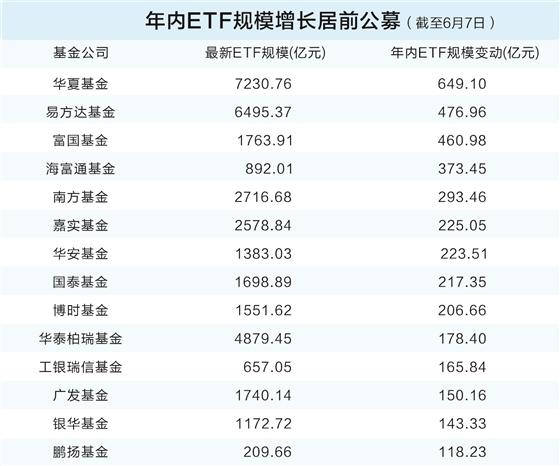
公募ETF强者恒强 中小公司错位谋变
Zheng Quan Shi Bao· 2025-06-08 18:48
Core Insights - The ETF market in China is experiencing a "Matthew Effect," where larger fund companies dominate while smaller firms seek niche opportunities for growth [2][5][8] - As of June 7, 2023, the total market size of ETFs reached 4.16 trillion yuan, with the top three fund companies managing 1.86 trillion yuan [3][4] - 14 fund companies have seen their ETF sizes grow by over 10 billion yuan this year, indicating a significant inflow of capital into these products [3][6] Group 1: Market Dynamics - The top three fund companies, namely Huaxia Fund, E Fund, and Huatai-PB Fund, have a combined management scale of 1.86 trillion yuan, creating a formidable scale barrier [2][3] - Smaller fund companies like Haifutong Fund and Pengyang Fund have achieved significant growth by focusing on specialized products such as bond ETFs and gold ETFs [2][7] - The competition among ETF providers has intensified, with product innovation and cost control becoming critical for survival [2][8] Group 2: Challenges for Small Fund Companies - Many small fund companies are avoiding direct competition in the ETF market and are instead focusing on off-market index funds due to resource constraints [5][6] - Small firms face challenges in product differentiation, as many ETFs track the same indices, leading to high levels of product homogeneity [6][8] - The operational costs associated with launching and maintaining ETFs can be prohibitive for smaller firms, impacting their ability to compete effectively [7][9] Group 3: Strategies for Growth - Small fund companies are encouraged to focus on niche markets, such as thematic or cross-border ETFs, to carve out a competitive edge [8][9] - Developing innovative products, such as ESG index funds or index-enhanced products, can help smaller firms attract investor interest [9] - Collaborating with other firms or institutions to share research and development costs may provide a pathway for smaller companies to enhance their product offerings [9]