
AGI

Search documents
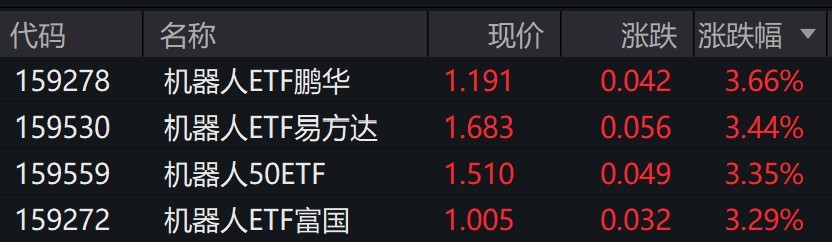
机器人概念股走强,相关ETF涨超3%
Mei Ri Jing Ji Xin Wen· 2026-01-16 05:43
Group 1 - The core viewpoint of the articles highlights a strong performance in the robotics sector, with notable gains in stocks such as Greentec Harmonics rising over 10% and Mingzhi Electric increasing by over 4% [1] - Robotics-related ETFs also saw significant increases, with the Penghua Robotics ETF up by 3.66%, the E Fund Robotics ETF up by 3.44%, and the 50 Robotics ETF up by 3.35% [2] - Analysts noted that humanoid robots showcased impressive advancements at a recent international consumer electronics exhibition, indicating a rapidly developing domestic industry with strong competitiveness [2] Group 2 - Looking ahead, the marginal impact of mass production of simple robots on investments is expected to weaken, while the narrative surrounding AGI (Artificial General Intelligence) is anticipated to strengthen [2] - Companies that are capable of building advanced AI systems, including those in Tesla's core supply chain and companies with vertical applications, are viewed positively for future growth [2]


我所知道的闫俊杰
雷峰网· 2026-01-15 10:43
Core Viewpoint - MiniMax is positioned to be the first among the "Six Little Dragons" to go public, driven by a genuine commitment to AI rather than treating it merely as a business opportunity [1][41]. Group 1: Company Background and Leadership - Yan Junjie, the leader of MiniMax, had a significant meeting with Liang Wenfeng two years ago, which highlighted their differing understandings of the AI landscape [2][3]. - Liang Wenfeng's DeepSeek posed a serious challenge to MiniMax, leading to investor skepticism regarding MiniMax's revenue performance in 2024 [4][7]. - MiniMax's internal restructuring included the departure of key personnel while simultaneously recruiting talent skilled in foundational models, indicating a strategic pivot [7][8]. Group 2: Investment and Market Position - Zhang Jinjian, an early investor in MiniMax, praised Yan Junjie for his belief in AGI (Artificial General Intelligence), although he noted that Yan is not without flaws [8][11]. - The company faced challenges in securing partnerships, such as the competition for Apple's AI collaboration, which ultimately went to Alibaba [7][8]. - MiniMax's approach to hiring emphasizes finding young talent who share the vision of AGI, with a rigorous selection process that prioritizes expertise [33]. Group 3: Product Development and Strategy - MiniMax's product Glow, which combines voice and chat functionalities, has gained significant traction, amassing 500 million users within four months of its silent launch [34]. - The company has undergone a transformation from a northern to a southern base, reflecting its strategic shift and growth in the AI landscape [35]. - Yan Junjie’s philosophy emphasizes the integration of model and product development, aiming to create a feedback loop that enhances foundational model research [39]. Group 4: Future Aspirations and Challenges - The pursuit of AGI remains a central goal for MiniMax, with Yan Junjie committed to this vision despite the industry's skepticism towards the term [32][41]. - The company is exploring various AI applications, including coding agents, while maintaining a focus on continuous product improvement and user feedback [39]. - Yan Junjie’s leadership style is characterized by a blend of technical expertise and a genuine passion for AI, which resonates with both employees and investors [41].

全文|刘姝威析股市大涨关键:营商环境重塑,让老百姓敢把钱搬进来
Xin Lang Cai Jing· 2026-01-15 04:58
Core Viewpoint - The Chinese stock market has begun to rise after years of stagnation around the 3000-point mark, driven by economic cycles and anti-corruption efforts [3][4][11] Economic Cycle - The new economic cycle, according to the Kondratiev wave theory, is set to start in 2025, with the new energy sector, particularly the automotive industry, as its driving force [3][9] - In 2025, China's automobile production and sales are projected to be the highest in the world, surpassing Japan [3][9] Anti-Corruption Efforts - Anti-corruption measures have improved the business environment in China, encouraging more enterprises, especially small and medium-sized enterprises, to register and operate [4][10] - The government has emphasized fair and rule-based market operations, with strict penalties for financial fraud, enhancing investor confidence [4][10] Market Sentiment - The public has observed a cleaner stock market environment, leading to increased willingness to invest savings from banks into the stock market [5][10] - The influx of capital into the stock market is attributed to the perception of a recovering Chinese economy, with significant investments from various sectors [4][10] Future Outlook - The "15th Five-Year Plan" period is expected to be driven by advancements in AI and technology, which are anticipated to significantly contribute to economic growth [11] - AI is viewed as a potential catalyst for the next technological revolution, with predictions that 2026 will mark the beginning of Artificial General Intelligence (AGI) [11]


千问App,全面接入!从“会聊天”到“能办事”
Zhong Guo Zheng Quan Bao· 2026-01-15 04:35
Core Insights - Alibaba's Qianwen App has integrated with various services within its ecosystem, enabling AI-driven shopping functionalities for users globally, marking a significant advancement in digital commerce [1] - The app has achieved over 100 million monthly active users within two months of launch, showcasing strong user engagement and demand for AI services [1] - Alibaba's VP emphasized the shift of AI from a supportive role to a leading role in digital tasks, predicting that 60%-70% of routine tasks will be executed by AI in the next two years [3] Group 1 - The Qianwen App allows users to perform multiple tasks such as ordering food, shopping, and booking travel seamlessly, enhancing user experience by reducing the need to switch between different applications [1] - The app's capabilities are driven by three key advancements: improved coding ability, full-modal understanding, and extended context processing, which are essential for handling complex tasks [3] - The industry consensus is that Artificial General Intelligence (AGI) is evolving from chat-based interactions to more agent-like functionalities, enabling closer integration with the physical world and enhancing productivity [3] Group 2 - Google is also focusing on AI shopping assistants, collaborating with major retailers to develop its chatbot, Gemini, into a virtual shopping assistant [3] - At the NRF annual meeting, Google, along with companies like Shopify and Walmart, introduced a new open standard called Universal Commerce Protocol (UCP) aimed at streamlining the shopping process by eliminating the need for separate connections with different agents [4]


AI应用正当时-掘金阿里链
2026-01-15 01:06
Summary of Key Points from Conference Call Records Industry Overview - The year 2026 is viewed as the commercialization milestone for global AI Agent product systems, marking a breakthrough in AI commercialization similar to the technological breakthroughs of 2023 [1][2] - The focus is on the execution of AGI (Artificial General Intelligence) capabilities, with major players like ByteDance and Alibaba competing in the AI entry and operating system space [1][4] Core Insights and Arguments - ByteDance is leaning towards universal assistant scenarios, while Alibaba is focusing on local life service assistants, indicating a competitive landscape in AI applications [1][4] - If Alibaba's Qianwen APP succeeds, it could expand its business radius and solve traffic issues, leading to a revaluation of its core business [5][6] - Alibaba's cloud business is expected to benefit from its open-source capabilities, potentially becoming the Android operating system of the AI era, with projected revenue of approximately 210 billion RMB in 2027 [5][6] Investment Opportunities - Significant investment opportunities are identified in the AI-driven education and human resources sectors, with companies like Dou Shen Education and Keri International showing promising growth through AI integration [3][13] - Keri International's He Wa platform has improved job matching accuracy by 5 times and conversion rates by 3 times, with expected profits exceeding 300 million RMB in 2026 [14] - In the media sector, companies like Yidian Tianxia, which collaborates with Alibaba's Lazada, are experiencing significant revenue growth through programmatic advertising [7] Notable Developments in Specific Companies - Dou Shen Education plans to launch dynamic math courseware and AI reading courses, with AI superchain products accounting for 15% of total revenue [15] - Huatu Shanding has implemented AI across all job roles, achieving a 35% increase in enrollment conversion rates and a 50% increase in sales personnel efficiency [16] - Alibaba's partnerships in the healthcare sector, including collaborations with Yuyue Medical and Sanor Bio, are expanding its online service capabilities [17][18] Additional Insights - The AI application landscape is expected to evolve significantly in 2026, with a focus on AGI execution and the restructuring of entry points in the market [4] - The competitive dynamics between ByteDance and Alibaba will shape the future of AI applications, with both companies exploring different verticals and supply chain partnerships [1][4]
5行代码,逼疯整个硅谷,澳洲放羊大叔,捅开AI编程奇点
3 6 Ke· 2026-01-14 11:07
Core Insights - An Australian sheep farmer, Geoffrey Huntley, created a groundbreaking Bash script with just five lines of code that has significantly impacted AI programming and the tech landscape in Silicon Valley [1][3][10] - The script, named Ralph Wiggum, allows AI to autonomously write and debug code through an infinite loop of self-correction, marking a paradigm shift in software development [4][31][39] Group 1: Impact on AI Programming - The Ralph Wiggum loop enables AI to learn from its errors, leading to a more effective coding process where failures provide valuable data for improvement [12][32] - The introduction of the Ralph Wiggum plugin by Anthropic has transformed Claude Code, allowing it to autonomously generate substantial amounts of code, with one developer reporting 40,000 lines added and 38,000 lines deleted in just 30 days [10][11] - This method has led to significant advancements in AI capabilities, bringing them closer to Artificial General Intelligence (AGI) [7][25] Group 2: Developer Community Response - The developer community has reacted enthusiastically, with reports of rapid code generation and successful project completions using the Ralph Wiggum approach, including the creation of a new programming language [21][23] - Developers are now able to leverage AI tools to automate coding tasks, significantly reducing the time and effort required for software development [39][53] - The shift in focus from traditional coding practices to AI-driven development processes is reshaping the roles of software engineers, who are now seen as architects of systems that can write code rather than mere code writers [53][52] Group 3: Future of Software Development - The emergence of Ralph Wiggum signifies a broader transformation in the software development industry, with predictions that 2026 will be a pivotal year for AI-driven coding practices [30][39] - The industry is moving towards a model where individual developers can achieve what entire teams used to accomplish, indicating a significant shift in productivity and efficiency [53][52] - As AI continues to evolve, the traditional software development processes are being redefined, leading to a new era of engineering that emphasizes building systems capable of autonomous coding [53][39]

五源、陆奇投资,Humanify 97 年创始人专访:给 AI 做一套「有情商」的认知 OS
Founder Park· 2026-01-14 09:33
Core Viewpoint - Humanify aims to create a human-like AI that possesses emotional intelligence and autonomy, moving beyond traditional AI tools to establish meaningful relationships with users [3][5][15]. Group 1: Company Overview - Humanify has completed a seed round financing of several tens of millions, led by Five Sources Capital and followed by Qiji Chuangtan [3]. - Founded in 2024, Humanify positions itself as a model + OS infrastructure company, focusing on creating AI that behaves like a human rather than just a tool [3][15]. - The founder, Yi Heyang, has a background in AI from Zhejiang University and previously created an ecosystem infrastructure serving over a million users [3][10]. Group 2: AI Development Philosophy - Current AI is seen as a highly cooperative tool that waits for instructions, lacking the ability to truly integrate into human life [4][20]. - The next generation of AI should have human-like cognition and self-awareness, allowing for long-term relationships and reduced communication costs between humans and AI [5][15]. - Humanify's definition of AI includes a model that acts as an operating system, capable of understanding environments and forming motivations without explicit instructions [5][15]. Group 3: Challenges in AI - Creating a personal AI that can understand and relate to individuals is challenging due to the need for new hardware and the lack of existing data on human cognition [21][28]. - The industry lacks consensus on how to develop AI that truly mimics human emotional intelligence and intuition [22][28]. - Current AI systems are still largely reactive, requiring explicit commands to function, which limits their ability to form personal connections [20][21]. Group 4: Future Vision - Humanify envisions a future where AI can provide companionship and emotional support, addressing the loneliness prevalent in modern society [23][24]. - The company aims to develop an "AI confidant" over the next 5 to 10 years, representing a significant shift towards human-AI coexistence [44][45]. - The goal is to create an operating system that integrates cognitive capabilities, allowing for a seamless interaction experience that feels natural and human-like [56][59]. Group 5: Technical Aspects - The operating system developed by Humanify is designed to run on existing hardware without conflicting with current systems, focusing on cognitive capabilities rather than traditional GUI [53][56]. - The company emphasizes the importance of real-time systems and long-term memory for AI to interact naturally and autonomously with users [36][37]. - Humanify believes that advancements in cognitive architecture and the integration of new technologies like Transformer models will be crucial for achieving their goals [37][38].

中美AI巨头都在描述哪种AGI叙事?
腾讯研究院· 2026-01-14 08:33
Core Insights - The article discusses the evolution of artificial intelligence (AI) in 2025, highlighting a shift from merely increasing model parameters to enhancing model intelligence through foundational research in four key areas: Fluid Reasoning, Long-term Memory, Spatial Intelligence, and Meta-learning [6][10]. Group 1: Key Areas of Technological Advancement - In 2025, technological progress focused on Fluid Reasoning, Long-term Memory, Spatial Intelligence, and Meta-learning due to diminishing returns from merely scaling model parameters [6]. - The current technological bottleneck is that models need to be knowledgeable, capable of reasoning, and able to retain information, addressing the previous imbalance in AI capabilities [6][10]. - The advancements in reasoning capabilities were driven by Test-Time Compute, allowing AI to engage in deeper reasoning processes [11][12]. Group 2: Memory and Learning Enhancements - The introduction of Titans architecture and Nested Learning significantly improved memory capabilities, enabling models to update parameters in real-time during inference [28][30]. - The Titans architecture allows for dynamic memory updates based on the surprise metric, enhancing the model's ability to retain important information [29][30]. - Nested Learning introduced a hierarchical structure that enables continuous learning and memory retention, addressing the issue of catastrophic forgetting [33][34]. Group 3: Reinforcement Learning Innovations - The rise of Reinforcement Learning with Verified Rewards (RLVR) and sparse reward metrics (ORM) has led to significant improvements in AI capabilities, particularly in structured domains like mathematics and coding [16][17]. - The GPRO algorithm emerged as a cost-effective alternative to traditional reinforcement learning methods, reducing memory usage while maintaining performance [19][20]. - The exploration of RL's limitations revealed that while it can enhance existing capabilities, it cannot infinitely increase model intelligence without further foundational innovations [23]. Group 4: Spatial Intelligence and World Models - The development of spatial intelligence was marked by advancements in video generation models, such as Genie 3, which demonstrated improved understanding of physical laws through self-supervised learning [46][49]. - The World Labs initiative aims to create large-scale world models that generate interactive 3D environments, enhancing the stability and controllability of generated content [53][55]. - The introduction of V-JEPA 2 emphasizes the importance of prediction in learning physical rules, showcasing a shift towards models that can understand and predict environmental interactions [57][59]. Group 5: Meta-learning and Continuous Learning - The concept of meta-learning gained traction, emphasizing the need for models to learn how to learn and adapt to new tasks with minimal examples [62][63]. - Recent research has explored the potential for implicit meta-learning through context-based frameworks, allowing models to reflect on past experiences to form new strategies [66][69]. - The integration of reinforcement learning with meta-learning principles has shown promise in enhancing models' ability to explore and learn from their environments effectively [70][72].




大模型时代小公司,怎么走出OpenAI的路
新财富· 2026-01-14 08:05
Core Insights - The article discusses the recent IPOs of AI companies, highlighting the significant oversubscription rates and initial stock price surges, indicating strong market interest in AI ventures [3][5] - It emphasizes the challenges faced by AI startups in a landscape dominated by major tech firms like Tencent, ByteDance, and Alibaba, suggesting that these giants create a difficult environment for smaller companies to thrive [7][15] Group 1: Market Dynamics - The IPO of Zhihua Huazhang on January 8, 2026, had an issue price of HKD 116.2 per share, with a subscription rate of approximately 1,159 times, and a first-day price increase of 13.17%, leading to a market cap of nearly HKD 90 billion [3] - MiniMax, established only four years prior, went public on January 9, 2026, at HKD 165 per share, with an oversubscription of over 1,800 times and a first-day price increase of 109.1%, resulting in a market cap exceeding HKD 100 billion shortly thereafter [5] Group 2: Technological Paradigms - The article argues that the current AI landscape is shaped by the "Scaling Law," which suggests that increasing model size, data, and computational power leads to predictable improvements in performance [9][10] - It notes that the success of OpenAI is seen as a unique historical occurrence that may not be replicable, as the current environment is characterized by concentrated computational resources and homogenized model capabilities [12][13] Group 3: Competitive Landscape - The emergence of DeepSeek has altered industry perceptions by significantly reducing training and inference costs, challenging the narrative that only large investments can yield viable models [19][22] - Major companies are now treating models as foundational infrastructure rather than profit centers, which complicates the ability of startups to justify their value propositions to clients [22][23] Group 4: Strategies for Startups - Startups like MiniMax and Zhihua Huazhang are finding sustainable paths by avoiding direct competition with large firms, focusing instead on niche markets or specific applications [26][30] - MiniMax is targeting overseas markets with products centered on companionship and interaction, while Zhihua focuses on complex enterprise applications that larger firms may overlook [28][31] - The article suggests that successful startups must carve out unique positions within existing paradigms rather than attempting to replicate the success of giants like OpenAI [42]

中国人形机器人闪耀CES展,机器人ETF易方达(159530)近一月净流入超20亿元
Mei Ri Jing Ji Xin Wen· 2026-01-14 06:10
Group 1 - The core viewpoint of the article highlights the significant rise in the robotics industry, particularly in humanoid robots, with a notable increase in the National Securities Robotics Industry Index by 1.7% [1] - Among the constituent stocks, Fulin Precision surged over 11%, while Tianzhihang-U and iFlytek increased by over 5%, and Liyuanheng rose by over 4% [1] - The recent Consumer Electronics Show (CES) showcased a strong presence of humanoid robots, with Chinese manufacturers dominating 21 out of 38 humanoid robot exhibits [1] Group 2 - According to Dongfang Securities, the humanoid robots gained significant attention at CES, indicating rapid development and strong competitiveness within the domestic industry chain [1] - Looking ahead, the impact of mass production of simple robots on investments is expected to weaken, while the narrative around AGI (Artificial General Intelligence) is anticipated to strengthen, particularly for leading companies and industry chains capable of building brain-like capabilities [1] - The National Securities Robotics Industry Index focuses on humanoid robots and core components, covering companies like Sanhua Intelligent Control and Lingyi Technology, which together account for approximately 80% of the index, leading other similar indices [1] - The E Fund Robotics ETF (159530) is currently the largest ETF tracking this index, providing investors with convenient access to core enterprises in the humanoid robotics industry chain [1]