长钱长投

Search documents
历史新高!突破4.8万亿
Zhong Guo Ji Jin Bao· 2025-08-19 06:37
Group 1 - The core viewpoint of the articles highlights the significant growth of the ETF market, which has surpassed 4.8 trillion yuan, reflecting increased confidence and willingness of institutional and individual investors to enter the market [1][2][7] - The "long money long investment" strategy is gaining traction, aligning with the "three investment" philosophy, which emphasizes stable market conditions and a positive cycle between capital markets and the real economy [2][9] - Regulatory support through policies such as the "National Nine Articles" and the "High-Quality Development Action Plan for Index Investment" is facilitating the entry of long-term capital into the market [2][3] Group 2 - Broad-based ETFs tracking major indices like the CSI 300 and the STAR Market are becoming primary tools for long-term capital allocation, demonstrating resilience during market adjustments [3][4] - The rise of thematic and sector-specific ETFs is directing funds towards strategic emerging industries, such as hard technology and new energy, thereby enhancing the development of new productive forces [4][5] - Bond ETFs have seen explosive growth, exceeding 500 billion yuan, serving as a stabilizing force in investors' asset allocation amidst a declining interest rate environment [5][6] Group 3 - Institutional investors are increasingly becoming the backbone of the ETF ecosystem, with their holdings in stock ETFs surpassing 40% by the end of 2024, indicating a shift towards long-term investment strategies [7][8] - The low-cost nature of ETFs reduces friction in long-term investments, while their transparency enhances investors' understanding of value logic, effectively connecting long-term capital with quality assets [8][10] - The future of the ETF market is expected to expand with the deepening of personal pension systems and the integration of capital with technological innovation, promoting sustainable growth in strategic sectors [9][10]
险资二季度加大入市步伐
Shen Zhen Shang Bao· 2025-08-18 16:44
Group 1 - The core viewpoint of the articles indicates that insurance capital has increased its market entry pace in the second quarter, with total investment balance reaching 36.23 trillion yuan, a year-on-year increase of 17.4% [1] - By the end of the second quarter, the combined investment in stocks by life insurance and property insurance companies exceeded 3 trillion yuan, marking an increase of nearly 1 trillion yuan compared to the same period last year [1] - Life insurance companies' stock investment balance reached 2.87 trillion yuan, with a net increase of over 200 billion yuan from the previous quarter and over 600 billion yuan since the beginning of the year, resulting in a stock investment ratio of 8.81% [1] Group 2 - The rise in the stock investment ratio of insurance capital is attributed to two main reasons: the low interest rate environment prompting insurance companies to invest in high-dividend stocks, and favorable policies from regulators encouraging long-term capital market entry [2] - Recent policy changes have included an increase in the equity asset ratio by 5% for certain solvency levels and a reduction of risk factors for stock investments by 10%, aimed at promoting greater market participation by insurance companies [3] - As of mid-year, the total approved amount for long-term investment pilot projects by insurance funds reached 222 billion yuan, with new private equity funds being established to facilitate these investments [3]
境内ETF规模达4.77万亿元 头部基金公司持续深化上交所“三投资”理念
Zheng Quan Ri Bao Wang· 2025-08-18 12:47
Group 1 - The ETF market is experiencing unprecedented growth opportunities, with the total scale of domestic ETFs reaching 4.77 trillion yuan as of August 18, 2023, and stock ETFs accounting for approximately 3.51 trillion yuan [1] - The Shanghai Stock Exchange's ETF market has shown rapid expansion, with the scale surpassing 3 trillion yuan in May 2023, representing over 70% of the total domestic ETF market [1] - The growth is attributed to the recognition of ETFs' advantages in risk diversification and low costs, aligning with the principles of rational investment [1] Group 2 - The "Three Investments" philosophy—rational investment, value investment, and long-term investment—advocated by the Shanghai Stock Exchange is becoming a guiding principle for investors and asset management institutions [2] - ETFs cover a diverse range of assets, including stocks, bonds, and cross-border assets, and are seen as a key vehicle for long-term capital to support the real economy [2] - The growth of the ETF market by 2025 is viewed as a testament to the broader acceptance of the "Three Investments" philosophy and the effectiveness of long-term investment strategies [2] Group 3 - The capital market has remained stable and positive, with ETFs becoming increasingly important tools for asset allocation among institutions and individual investors [3] - Long-term institutional investors, such as social security and insurance funds, are increasing their allocation to ETFs, demonstrating the gradual emergence of the "long money, long investment" effect [3] - The continuous expansion of ETF scale and resilient net subscriptions highlight the preference for ETFs that cover large-cap blue-chip stocks and high-dividend sectors among long-term investors [3] Group 4 - The ETF product system is continuously being optimized to attract more long-term capital into the market, following the implementation of the "Three Investments" initiative by the Shanghai Stock Exchange [4] Group 5 - ETFs are recognized for their transparency, efficiency, low cost, and tool-like characteristics, making them essential for implementing the "long money, long investment" philosophy [5] - Major ETFs like the CSI 300 and STAR 50 are effectively covering core market assets and innovation drivers, providing efficient and diversified investment tools for long-term capital [5] Group 6 - ETFs are increasingly becoming core tools for value discovery in the hard technology industry, with a growing variety of thematic ETFs in sectors like semiconductors and AI [6] - The bond ETF market has also seen significant growth, surpassing 500 billion yuan, indicating strong demand for medium to long-term capital allocation [6] - The future outlook suggests a significant increase in the scale and proportion of index-based investments in A-shares, further enhancing the asset allocation function of ETFs [6]
金改前沿|高歌猛进!36万亿元险资变身“超级买方”
Xin Hua Cai Jing· 2025-08-18 10:18
Core Viewpoint - The recent actions of China Ping An in increasing its stakes in China Life and China Pacific Insurance are seen as a positive signal for the insurance sector, indicating a recovery in the industry's fundamentals after a six-year hiatus in such activities [1][2]. Group 1: Investment Activities - China Ping An increased its holdings in China Life H-shares by 9.5 million shares, raising its stake from 4.91% to 5.04% [2]. - The company also acquired 1.7414 million shares of China Pacific Insurance H-shares at an average price of HKD 32.07 per share, increasing its stake from 4.98% to 5.04% [2]. - This marks the first instance of insurance capital making significant investments in listed insurance companies since 2019, reflecting a renewed confidence in the sector [2]. Group 2: Market Trends - Insurance capital has been increasingly entering the market, with a notable rise in the scale of funds managed by insurance companies, surpassing CNY 36 trillion by mid-2025, a year-on-year increase of 17.4% [4]. - The proportion of stock investments has been on the rise, with investments in stocks and securities investment funds reaching CNY 4.73 trillion, a 25% increase compared to the previous year [4]. - The number of times insurance capital has made significant investments this year has reached 29, surpassing the total of 20 from the previous year [4]. Group 3: Regulatory Environment - The regulatory environment has been supportive of long-term investments by insurance funds, with recent policies encouraging stable and active capital market participation [5]. - The Ministry of Finance has adjusted the assessment methods for net asset returns to promote long-term investment strategies among insurance companies [4][5]. - The total approved amount for long-term investment pilot programs by the financial regulatory authority has reached CNY 222 billion as of mid-2023 [4].

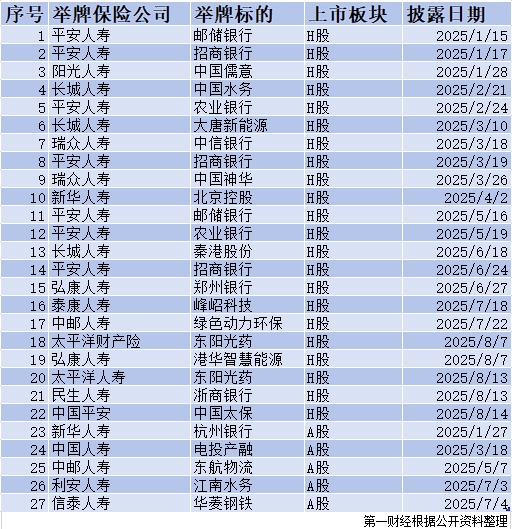
险资年内27次举牌:狂揽高股息H股,保险股进入“红利”范畴
Di Yi Cai Jing· 2025-08-14 12:44
中国平安回应称,相关投资属于财务性投资,是险资权益投资组合的常规操作。 值得注意的是,险资此前主要聚焦于银行、公用事业、能源、交运、电力设备等高股息、高分红板块。 而对于此次保险龙头之间的"互动",机构人士认为,这既是对自身行业的认同,同时也表明保险股同样 属于"红利"范畴。 保险举牌保险背后 事实上,保险公司之间相互持股此前早有先例。据了解,上一次险资举牌中国太保H股还是在2019年8 月至2020年10月,但此后该险资不断减持并于2022年11月重回5%港股流通股"举牌线"下方。 8月14日,中国太保H股股价达到历史新高,早盘最高触及36.78港元/股,年内涨幅近50%,250日涨幅 甚至超过100%。 中泰证券分析师葛玉翔认为,本次举牌亦释放了重要信号,险资作为长期资金,同样也会关注保险股, 保险股同样属于"红利"范畴。当前估值已较为充分反映保险股资负两端压力,险资举牌同行指向对自身 行业基本面的筑底向好的认同。 Wind数据显示,8月14日早盘,保险板块表现活跃,中国平安H股盘中创2021年7月以来的新高,最高触 及59.1港元/股,友邦保险创250日新高。在A股市场,受举牌消息影响,中国太保早盘领涨 ...

引导企业年金基金长钱长投的路径思考
Sou Hu Cai Jing· 2025-08-14 00:19
Group 1 - The article emphasizes the importance of long-term investment strategies in China's pension fund management, particularly for enterprise annuities, which are currently facing challenges due to short-term performance evaluations and conservative asset allocations [2][3][4] - The current annualized return for enterprise annuities since inception is 6.26%, with a noticeable downward trend in recent years, while the national social security fund has achieved a higher annualized return of 7.36% [4][5] - The implementation of personal investment choice rights is seen as a significant step towards enhancing the long-term investment capabilities of enterprise annuities, allowing employees to align their investments with personal risk preferences [7][8][10] Group 2 - The article outlines the challenges faced by enterprise annuities, including low risk tolerance and conservative equity allocations, which are influenced by the risk preferences of near-retirement employees [3][4] - It suggests that increasing equity allocations to 30%-40% could potentially yield an annualized return of around 7% over the long term, highlighting the need for a shift in investment strategy [5][6] - The article discusses the significance of personal investment choice rights, which can optimize governance structures and enhance employee engagement in pension fund management [7][8][10] Group 3 - The article provides insights into international practices regarding personal investment choice rights, noting that countries like the United States and Australia have successfully implemented such policies to enhance pension fund performance [11][12][13] - It highlights the importance of a phased approach to implementing personal investment choice rights in China, starting with sectors that are more open to experimentation [20][21][22] - Recommendations for the implementation of personal investment choice rights include categorizing employees based on their retirement proximity and risk tolerance, as well as establishing a clear and simple investment selection process [17][19][21]

申万宏源证券晨会报告-20250812
Shenwan Hongyuan Securities· 2025-08-12 00:50
Core Insights - The report emphasizes the importance of insurance capital in investing in bank stocks, highlighting that this strategy is both a short-term necessity and a long-term correctness under the "long money, long investment" policy framework [2][9] - It argues that in a low-interest-rate environment, insurance companies are compelled to allocate more towards high-dividend assets, particularly bank stocks, which offer stable returns and lower volatility [2][9] Insurance Capital Allocation - Insurance companies are expected to increase their allocation to high-dividend assets due to the constraints of a low-interest-rate environment and the ongoing asset scarcity [2][9] - The average return on equity (ROE) for listed banks from Q1 2015 to Q1 2025 is approximately 12%, significantly higher than the average of 4% for other sectors, indicating the stability and attractiveness of bank stocks [3][9] Investment Analysis - The report maintains a positive outlook on bank stocks, suggesting that they are poised for a long-term revaluation as economic conditions stabilize [4][10] - It identifies two main investment themes: the value extraction from quality city commercial banks and the potential for recovery in undervalued joint-stock banks [4][10] Potential for Future Investment - The report estimates that insurance capital could potentially allocate an additional 330 billion to bank stocks, indicating significant room for growth in this sector [9][10] - It highlights that the current allocation of insurance capital to bank stocks is still below optimal levels, suggesting that there is a substantial opportunity for increased investment [9] Market Trends - The report notes that the banking sector has shown resilience against previous market concerns regarding real estate and local government financing risks, which have been systematically addressed [3][9] - It also points out that the dividend yield of bank stocks remains attractive compared to other asset classes, reinforcing their position as a preferred investment choice for insurance capital [9]
停产!周末,重大利好!
中国基金报· 2025-08-10 14:23
Group 1: Market Overview - The A-share market showed positive performance last week, with the Shanghai Composite Index rising by 2.11%, the Shenzhen Component Index increasing by 1.25%, and the ChiNext Index up by 0.49% [2][3]. Group 2: Industry Insights - The suspension of mining operations at the Jiangxia Wokou mine of CATL is expected to positively impact the lithium industry, as this mine accounts for approximately 3% of global lithium production. The price of lithium carbonate futures surged to 76,960 yuan per ton following this news [4]. - The National Bureau of Statistics reported that the core CPI rose by 0.8% year-on-year in July, marking the third consecutive month of growth, while the PPI saw a month-on-month decline of 0.2% [7][8]. Group 3: Regulatory Developments - The China Securities Regulatory Commission (CSRC) plans to enhance the attractiveness and inclusivity of the domestic capital market by promoting long-term capital and implementing reforms to support long-term investments [8][9]. - The CSRC will maintain strict controls on IPOs to prevent large-scale expansions in the market, ensuring that the current market dynamics remain stable [9]. Group 4: Sector Analysis - Analysts from CITIC Securities suggest focusing on strong industry trends, particularly in sectors like non-ferrous metals, telecommunications, innovative pharmaceuticals, gaming, and military industry, while avoiding speculative trading in micro-cap stocks [16]. - Shenwan Hongyuan emphasizes that the bull market atmosphere is unlikely to dissipate easily, with expectations for supply-demand improvements in 2026 [17]. - Guojin Securities highlights that the current market adjustment is a structural shift rather than a sign of a market peak, with policy support being crucial for market stability [24]. Group 5: Investment Strategies - Investment strategies should focus on sectors with high growth potential, such as new consumption, defense, AI computing, and humanoid robots, as these areas are expected to perform well in the current market environment [22][27]. - The market is anticipated to transition to a performance-driven phase, with an upward adjustment in the index as liquidity improves and policies supporting infrastructure and anti-involution are implemented [25].


银行新周期、新格局系列之“险资还能买多少”:长钱长投,险资配置银行既是短期必行,也是长期正确
Shenwan Hongyuan Securities· 2025-08-10 13:13
Investment Rating - The report maintains a positive outlook on the banking sector, indicating that insurance funds are expected to continue allocating to high-dividend, high ROE bank stocks, establishing a solid and sustainable funding base for a long-term bullish trend in the banking sector [3][4]. Core Insights - The report emphasizes the necessity for insurance companies to invest in high-dividend assets due to the low interest rate environment and asset scarcity, making bank stocks an attractive option [4]. - It highlights that the banking sector has shown stable performance with an average ROE of approximately 12% from Q1 2015 to Q1 2025, which is significantly higher than the average of non-financial listed companies [4][8]. - The report suggests that insurance funds are currently under-allocated in bank stocks, with a potential increase in allocation that could lead to an influx of over 330 billion yuan into the banking sector [4][16]. Summary by Sections Why Invest - The low interest rate environment and asset scarcity compel insurance companies to seek stable, high-dividend investments, with bank stocks meeting these criteria [4][6]. Current Allocation - As of Q1 2025, insurance funds have over 7 trillion yuan allocated to equities, with approximately 570 billion yuan in bank stocks, indicating a low allocation compared to other indices [4][10]. Future Potential - The report estimates that insurance funds could potentially allocate an additional 330 billion yuan to bank stocks, based on the upper limits of equity allocation [16]. Investment Recommendations - The report recommends focusing on high-quality city commercial banks and undervalued joint-stock banks, suggesting specific banks such as Chongqing Bank and Industrial Bank for investment [4][17].




【财闻联播】莫迪将于8月31日访华?外交部回应!2连板际华集团被证监会立案
券商中国· 2025-08-08 13:01
Macro Dynamics - Modi is expected to visit China on August 31 to attend the Shanghai Cooperation Organization (SCO) summit, which will be the largest since the organization's establishment, with over 20 countries and 10 international organizations participating [2] - The Chinese government welcomes Modi's visit and anticipates a fruitful summit that will enhance cooperation and development within the SCO [2] Financial Institutions - Guo Wei has been elected as the new chairman of Guolian Minsheng, succeeding Ge Xiaobo, who will remain as the executive director and president [10] Market Data - The Shanghai Composite Index fell by 0.12% on August 8, with a total trading volume of 1.71 trillion yuan, a decrease of 115.3 billion yuan from the previous trading day [12] - The financing balance of the two markets increased by 3.531 billion yuan, with the Shanghai Stock Exchange reporting 1,013.802 billion yuan and the Shenzhen Stock Exchange reporting 978.687 billion yuan [13] Company Dynamics - Jihua Group is under investigation by the China Securities Regulatory Commission (CSRC) for suspected violations of information disclosure, although its main business does not involve brain-computer interface technology [14] - The CSRC has issued a notice of administrative penalty against *ST Gaohong for long-term engagement in non-commercial activities that inflated revenue and profits, proposing a fine of 160 million yuan [15] - Lio Co., Ltd. plans to use up to 3 billion yuan of its own funds for securities investments, including new stock subscriptions and bond investments [16]