促消费政策

Search documents
月度宏观经济回顾与展望:消费环境新阶段-2025-04-07
Orient Securities· 2025-04-07 05:31
Group 1: Economic Environment and Policy Changes - The March PMI showed a steady upward trend, alleviating previous concerns about small businesses and construction resumption post-holiday[4] - The focus of consumption policies has shifted towards pre-consumption factors such as income, credit, and social security, marking a new phase in consumption policy[6] - The introduction of birth support policies is part of a broader "talent competition," with various measures to attract graduates and support families[7] Group 2: Consumer and Investment Trends - In January-February, the total retail sales of consumer goods increased by 4% year-on-year, up from 3.7% at the end of last year[18] - Real estate investment saw a narrowing of negative growth to -9.8%, improving from -10.6% previously[18] - The sales of commercial housing in Hubei Tianmen increased by 6.1% year-on-year, indicating a potential link to birth policies that encourage home purchases[9] Group 3: Credit and Financing Developments - Personal consumption loan growth has slowed significantly, dropping to 1.4% in January-February from over 15% in 2018-2019[13] - New policies aim to support personal credit recovery, allowing banks to extend loan repayment terms for borrowers facing difficulties[11] - The issuance of local government bonds increased significantly, with a total of 16,967 billion yuan in new government bonds issued in February, up 10,956 billion yuan year-on-year[24]
小菜园两日涨超15%:消费政策暖风频吹,便民餐饮“钱”却没那么好赚了?
Zhi Tong Cai Jing· 2025-03-18 11:21
Core Viewpoint - The stock of Xiaocaiyuan has surged over 15% in two days, driven by favorable consumption policies and its inclusion in the Hong Kong Stock Connect program, indicating its potential as a growth stock [1][2]. Company Overview - Xiaocaiyuan is a leading player in the mass-market Chinese dining sector, focusing on affordable dishes priced between 50 to 100 RMB, and has established itself as a modern, standardized, and digitalized chain restaurant group [7]. - As of December 5, 2024, Xiaocaiyuan operates 663 stores across 146 cities in China, with a market share of 0.2% in the mass-market dining segment [7]. Market Dynamics - The mass-market dining segment has seen a compound annual growth rate (CAGR) of 3.8% from 2018 to 2023, with a market size reaching 36,187 billion RMB in 2023, and is projected to grow to 55,871 billion RMB by 2028 [8]. - The government has launched various consumption promotion policies, which are expected to boost service consumption and tourism, positively impacting the restaurant sector [4][5]. Financial Performance - Xiaocaiyuan's revenue has shown consistent growth, with figures of 26.46 billion RMB, 32.13 billion RMB, and 45.49 billion RMB from 2021 to 2023, respectively, and a profit increase of 123.53% in 2023 [9]. - For the first eight months of 2024, the company reported a revenue of 35.44 billion RMB, a 15.4% increase year-on-year, and a net profit of 4.01 billion RMB, up 1.5% [9]. Challenges - Despite revenue growth, key operational metrics such as same-store sales and operating profit margins have declined in 2024, indicating potential challenges ahead [10][12]. - The company aims to open 580 new stores from 2024 to 2026 to achieve a target of 1,000 stores, which will require significant capital investment amidst high debt levels [11][12].


坚定信心、相信未来——申万宏源2025资本市场春季策略会
2025-03-13 03:23
Summary of Key Points from the Conference Call Industry Overview - The conference call focuses on the **Chinese economy** and its macroeconomic trends for **2025**. Core Insights and Arguments - **Shift from Demand to Supply**: The macroeconomic trend for 2025 will transition from demand-driven to supply-driven, with key areas of focus being the recovery of consumer supply, expansion of service sector investment, and optimization of real estate inventory policies, which are expected to release pent-up demand and excess savings [3][4][20]. - **Impact of Weak External Demand**: Weak external demand will significantly affect Chinese exports, with developed countries' import growth slowing down. Even if the U.S. economy remains resilient, Chinese exports will face downward pressure [5][20]. - **Manufacturing Investment Risks**: Manufacturing investment is expected to decline in 2025 due to a weakening natural renewal cycle and limited impact from equipment renewal policies, posing a potential drag on the economy [6][20]. - **Real Estate Market Adjustments**: The primary issues in the real estate market stem from supply-side policy adjustments and completion risks, which lead to deferred demand. Optimizing inventory policies and controlling residential increments can stabilize housing prices and release pent-up demand [8][11][20]. - **Service Sector Investment**: The government aims to expand service sector investment to alleviate supply constraints on service consumption, which has been declining. This is a response to the imbalance between goods and services consumption [10][12][20]. - **Fiscal Policy Adjustments**: The fiscal policy for 2025 is expected to be more proactive, focusing on expanding financing to support key areas such as science and technology, debt servicing, and national defense, while also emphasizing consumer and livelihood protection [3][20][28]. Additional Important Content - **Excess Savings**: There is a significant amount of excess savings (approximately 13 trillion yuan) accumulated by residents over the past four years, which is expected to gradually support domestic demand [7][20]. - **Service Consumption Recovery**: Service consumption is showing signs of recovery, with increased fixed asset investment in the accommodation and catering sectors, indicating a potential rebound in service demand [18][20]. - **Regional Consumption Dynamics**: The central and western regions of China are becoming important consumption destinations due to improved infrastructure and rising disposable incomes, which support cross-regional consumption [19][20]. - **Government Support for Vulnerable Groups**: The government has implemented measures to support vulnerable groups, including increased unemployment benefits and social assistance, to prevent further declines in consumer confidence [33][20]. - **Long-term Institutional Reforms**: The government is focusing on long-term reforms to enhance social security and support for the elderly and children, which will have a significant impact on consumption patterns in the future [41][45][20]. This summary encapsulates the key points discussed in the conference call regarding the Chinese economy's outlook for 2025, highlighting the transition in macroeconomic drivers, potential risks, and government policy responses.

宏观点评报告:春节错月影响CPI同比负增长-2025-03-12
British Securities· 2025-03-12 06:36
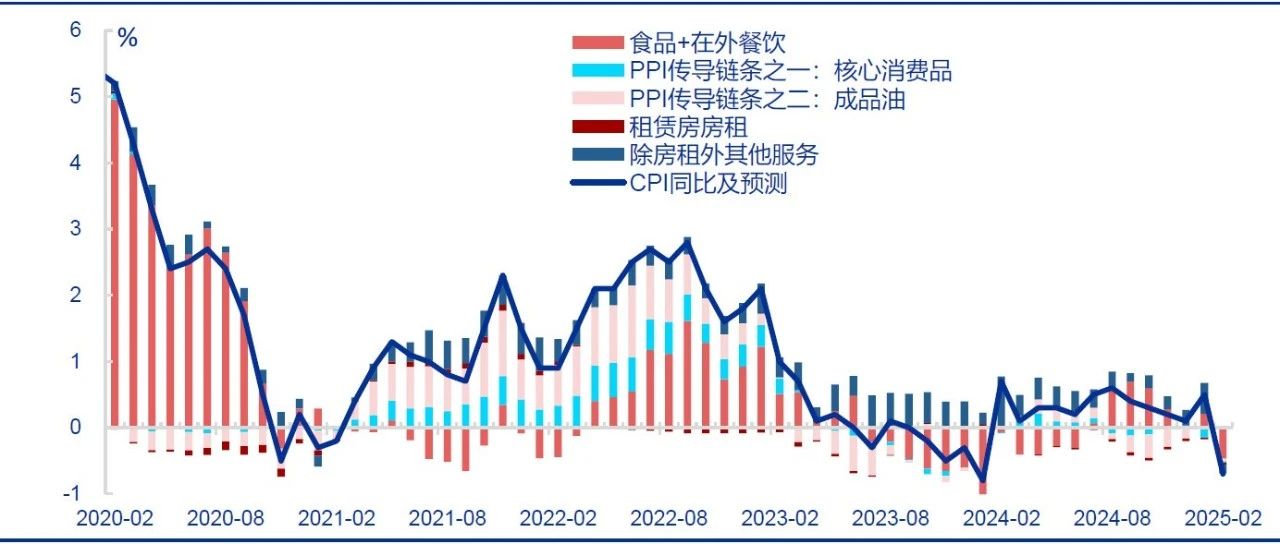
Investment Rating - The industry is rated as "Outperform the Market," indicating a positive outlook with expectations that the industry index will outperform the CSI 300 index in the next six months [21]. Core Insights - The report highlights a significant decline in the Consumer Price Index (CPI) for February, which fell by 0.7% year-on-year, marking the first negative growth since January 2024. This decline is attributed to various factors, including a high base effect from the previous year's Spring Festival [2]. - The Producer Price Index (PPI) also saw a year-on-year decrease of 2.2% in February, with production material prices dropping by 2.5%. The report suggests that the PPI decline may continue to narrow as industrial demand recovers [2]. - The report anticipates that with the implementation of consumption promotion policies, the CPI is expected to rebound, despite the current negative growth [2]. Summary by Sections Macro Research - February CPI decreased by 0.7% year-on-year, with food prices down by 3.3% and non-food prices down by 0.1%. The CPI also fell by 0.2% month-on-month [2]. - The PPI decreased by 2.2% year-on-year and 0.1% month-on-month, with significant drops in production material prices [2]. - The report notes that the industrial production is gradually recovering, and the PPI's year-on-year decline may continue to narrow [2]. Price Trends - The report provides insights into various price trends, including a notable decrease in fresh vegetable prices by 3.8% month-on-month due to warmer weather and a drop in pork prices by 1.9% [2]. - The report also mentions that prices in the new energy and artificial intelligence sectors are experiencing upward trends, with certain metal prices increasing [2].
万联证券:万联晨会-20250311
Wanlian Securities· 2025-03-11 03:24
Core Insights - The report indicates that consumption remains the primary driving force for economic development, with policies aimed at enhancing consumer confidence and spending capacity [10][12] - The government plans to implement a "Special Action Plan to Boost Consumption," focusing on improving consumption capacity, increasing quality supply, and enhancing the consumption environment [10][12] Market Review - On Monday, the A-share market experienced fluctuations, with the Shanghai Composite Index closing down 0.19% at 3,366.16 points, the Shenzhen Component Index down 0.17%, and the ChiNext Index down 0.25% [2][7] - The total trading volume in the A-share market reached 1.51 trillion RMB, with over 3,000 stocks rising [2][7] - In the industry sector, coal and non-ferrous metals led the gains, while the computer and media sectors saw declines [2][7] - The Hong Kong Hang Seng Index fell by 1.85%, and the Hang Seng Technology Index dropped by 2.52% [2][7] - Internationally, all three major U.S. stock indices declined, with the Dow Jones down 2.08%, the S&P 500 down 2.70%, and the Nasdaq down 4.00% [2][7] Important News - The Guangdong Provincial Government issued policies to promote innovation in the artificial intelligence and robotics industries, focusing on key technology breakthroughs, nurturing quality enterprises, and enhancing application scenarios [3][8] - The China Academy of Information and Communications Technology has initiated the compilation of technical standards for multimodal intelligent agents to accelerate their industrial application [3][8] Investment Highlights - The consumption policy will focus on two main areas: enhancing the "trade-in" policy and improving service quality [10][12] - The subsidy for the trade-in policy will increase from 150 billion RMB to 300 billion RMB, expanding the categories eligible for subsidies [10][12] - The report suggests that the food and beverage sector, particularly the liquor industry, will face increased tax burdens but may benefit from a shift towards direct sales to mitigate tax pressures [12] - The report highlights the potential growth in the social services sector, particularly in tourism and hospitality, driven by improved vacation policies and the expansion of the inbound tourism market [12]
“春节错位”下的“弱通胀”
赵伟宏观探索· 2025-03-09 14:42
Core Viewpoint - The significant drop in inflation readings is attributed to the misalignment of the Spring Festival, and even after excluding this effect, the actual levels remain weak [2][10]. Group 1: CPI Analysis - In February, the CPI decreased by 0.2% month-on-month, influenced by the high base effect from the previous year when the Spring Festival occurred in February [2][10]. - The food CPI fell by 0.5%, with fresh vegetables and pork prices decreasing by 3.8% and 1.9% respectively, reflecting a supply increase due to favorable weather and improved livestock inventory [10][11]. - The core service CPI saw a month-on-month decline of 0.8%, with travel-related prices dropping significantly, including a 22.6% decrease in airfares and a 9.6% drop in tourism prices [3][17]. Group 2: PPI Analysis - The PPI decreased by 0.1% month-on-month in February, with a year-on-year decline of 2.2%, which was below market expectations [12][14]. - The rise in international oil prices contributed positively to the PPI, while coal prices fell significantly, leading to a negative impact on the overall PPI [12][13]. - The low capacity utilization in downstream industries continues to exert downward pressure on the PPI, with expectations of a relative "over-decline" phenomenon in the future [12][13]. Group 3: Future Outlook - The supply-side constraints on inflation are expected to persist in the short term, and the impact of consumption-boosting policies may limit inflation recovery [13]. - In March, the CPI is likely to rebound above zero as the Spring Festival effects dissipate, but the actual recovery may be moderate due to sufficient supply and the "old-for-new" policy suppressing core CPI [13][14]. - The PPI is anticipated to remain under pressure due to low global oil inventories and potential demand suppression from tariff policies, with a projected year-on-year PPI midpoint of -1.2% by 2025 [5][13].