
十五五

Search documents
外资调研热情不减:月内涌入超百家A股公司,最青睐AI企业
Di Yi Cai Jing· 2025-11-18 11:08
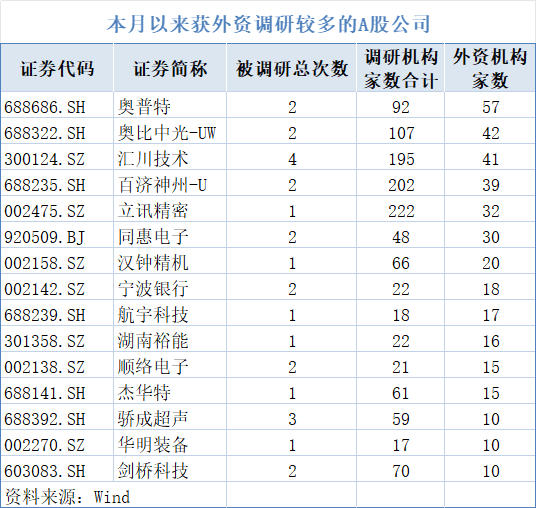
Core Viewpoint - Major investment banks like UBS and Goldman Sachs are optimistic about the performance of the Chinese market in 2026, highlighting opportunities in sectors such as AI and overseas expansion [1][7]. Group 1: Market Performance and Trends - The A-share market has experienced fluctuations, with the Shanghai Composite Index closing at 3939.81 points on November 18, down 0.81% [2]. - Despite market volatility, foreign investment interest remains high, with over 100 A-share companies receiving foreign research attention this month [2][4]. - The overall health of corporate earnings, supported by robust Q3 reports, indicates that recent market fluctuations are more influenced by sentiment rather than fundamental weaknesses [6]. Group 2: Foreign Investment and Research - AI companies are the most favored by foreign investors, with Optoelectronics receiving 92 institutional research visits, over half from foreign entities [2][3]. - Other notable companies attracting foreign research include BeiGene, Luxshare Precision, and Huichuan Technology, all of which are involved in AI or technology sectors [4][5]. - The trend shows that large-cap stocks continue to attract foreign interest, with companies like Wens Foodstuffs, Industrial Fulian, and BYD being included in recent foreign research lists [4]. Group 3: Future Outlook and Investment Themes - UBS forecasts that the Chinese stock market will experience another prosperous year in 2026, driven by innovation, particularly in AI, and supportive policies for private enterprises [7]. - Key investment themes identified by UBS include internet, hardware technology, and brokerage sectors, while high-dividend stocks are being deprioritized [7]. - Goldman Sachs also highlights several investment themes expected to outperform the market, including the return of private enterprises, overseas expansion, and AI-related sectors [7].






陈彦斌:从“十四五”到“十五五”——工业进阶 筑牢发展新根基
Zhong Guo Jing Ying Bao· 2025-11-18 08:45
Core Insights - The speech by Professor Chen Yanbin highlights the significant achievements of China's industrial development during the "14th Five-Year Plan" period, emphasizing the enhanced role of industry as an economic stabilizer, the improvement of the modern industrial system, the increase in innovation momentum, and the strengthened resilience of industrial development [1] Group 1: Achievements of the "14th Five-Year Plan" - The industrial sector has demonstrated a more pronounced stabilizing function for the economy [1] - The modern industrial system has become more comprehensive and refined [1] - There has been a notable increase in industrial innovation capabilities [1] - The resilience of industrial development has been significantly strengthened [1] Group 2: Importance and Focus of the "15th Five-Year Plan" - The high-quality development of China's industrial economy is crucial and requires a broader macroeconomic perspective [1] - It is essential to provide a vast demand market alongside improving industrial supply scale and quality [1] - The key to achieving high-quality industrial development lies in enhancing the macroeconomic governance system and coordinating stability, growth, and structural policies to create a virtuous cycle of demand driving supply and supply creating demand [1]
中字头军工股普跌,国防军工ETF回调逾1%触及半年线,场内溢价再起!资金连续6日净申购!
Xin Lang Ji Jin· 2025-11-18 02:11
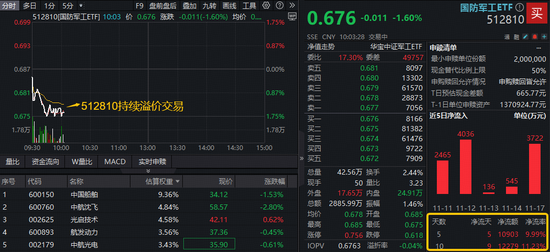
Core Viewpoint - The defense and military industry sector is experiencing a significant pullback, with the popular defense ETF (512810) declining over 1% and hitting a six-month low, while major military stocks are also seeing declines [1][2]. Group 1: Market Performance - The defense military ETF (512810) has seen a decline of 1.60%, trading at 0.676, with a drop of 0.011 [2]. - Major military stocks such as AVIC Shenyang Aircraft Corporation and China Shipbuilding Industry Corporation have dropped nearly 3% and over 1% respectively [1]. Group 2: Investment Opportunities - The ETF has attracted over 100 million yuan in net subscriptions over the past six trading days, indicating active interest from investors [1]. - Analysts suggest that the fourth quarter may see the gradual realization of "14th Five-Year Plan" related orders, coupled with military trade catalysts, which could lead to a resurgence in the defense and military market [1]. - The defense industry is expected to benefit from geopolitical risks, technological advancements, and policy support, with potential for high-end weapon exports and a revaluation of core asset values [1]. Group 3: Strategic Insights - CITIC Securities' report indicates a shift in China's defense industry from "cyclical growth" to "comprehensive growth," driven by domestic demand, foreign trade expansion, and civilian contributions [3]. - The defense ETF (512810) is highlighted as an efficient tool for investing in core defense assets, covering various hot themes such as commercial aerospace, low-altitude economy, and military AI [3].
国务院常务会议研究深入实施两重建设工作;上交所公布未来五年发展方向|每周金融评论(2025.11.10-2025.11.16)
清华金融评论· 2025-11-17 10:38
Core Viewpoint - The article discusses the recent initiatives and policies introduced by the Chinese government to enhance economic resilience, promote private investment, and support high-quality development in various sectors, particularly through the "Two Major" construction strategy and other related measures [5][9][11]. Group 1: Major Meetings and Policies - The State Council, led by Premier Li Qiang, held a meeting to discuss the implementation of the "Two Major" construction strategy, focusing on enhancing the adaptability of supply and demand in consumer goods and promoting consumption policies [5]. - The State Council issued measures to further promote private investment, encouraging private capital participation in key sectors such as railways and nuclear power, with specific guidelines on shareholding ratios [9][10]. - The Shanghai Stock Exchange outlined its development direction for the next five years, emphasizing risk prevention, strong regulation, and high-quality development [11]. Group 2: Significant Events and Data - The eighth China International Import Expo achieved a record transaction volume of $83.49 billion, marking a 4.4% increase year-on-year, showcasing China's commitment to opening up its market [12]. - As of the end of October, the total social financing scale reached 437.72 trillion yuan, reflecting an 8.5% year-on-year growth, indicating robust financial support for the real economy [14].
棕榈股份:聘任杨东平先生为公司董事会秘书
Mei Ri Jing Ji Xin Wen· 2025-11-17 10:13
Company Announcement - Palm Holdings (SZ 002431, closing price: 2.92 CNY) announced on November 17 that Ms. Feng Yulan has applied to resign from the position of Secretary of the Board due to job adjustment, but will continue to serve as the Deputy General Manager. The company has appointed Mr. Yang Dongping as the new Secretary of the Board [1]. Financial Performance - For the first half of 2025, Palm Holdings' revenue composition is as follows: engineering revenue accounts for 95.5%, design revenue accounts for 2.35%, urban operation accounts for 1.66%, and other businesses account for 0.49% [1]. Market Capitalization - As of the time of reporting, Palm Holdings has a market capitalization of 5.3 billion CNY [1].

知名经济学家杜帅评论:“十五五” 现代化进程的关键中继与改革攻坚期
Sou Hu Cai Jing· 2025-11-17 09:09
Core Viewpoint - The "15th Five-Year Plan" (2026-2030) is a critical transitional phase for China, serving as a bridge between the "14th Five-Year Plan" and the "16th Five-Year Plan," and is essential for achieving socialist modernization by 2035 [1] Strategic Positioning - The "15th Five-Year Plan" is a unique observation and transition period to assess previous development outcomes and accumulate momentum for future acceleration [3] - It is a completion point for over 300 major reform tasks from the 20th National Congress, with specific milestones set for 2026-2029 to ensure reforms translate into tangible results [3] - This period is also a window for China to align with global rule restructuring, particularly in international trade and digital governance, which will impact its competitive position in global agreements like CPTPP and DEPA [3] Industrial Development Focus - The emphasis on "real economy" and "manufacturing reasonable proportion" is not merely about expanding capacity but is centered on "value-oriented" scientific layout [4] - As of the first half of 2025, China's manufacturing value added accounted for 25.7% of GDP, indicating a need to balance between too high and too low proportions to avoid resource strain and economic vulnerability [4] - The goal is to shift from a "scale-oriented" approach to a "value-oriented" one, focusing on core component R&D, independent intellectual property breakthroughs, and technological innovation to drive high-end, intelligent, and green transformation in manufacturing [4] Governance Philosophy Upgrade - The report elevates the concept of "people-centered" governance to "people first," emphasizing investment in human capital as a key infrastructure focus [6] - Over 120 reform tasks directly address critical life stages from birth to end-of-life, with quantifiable and accountable targets to ensure tangible improvements in quality of life [6] - The plan aims to convert demographic dividends into quality dividends through vocational training and equalization of public services, ensuring inclusivity in modernization efforts [6] Economic Long-Term Outlook - Despite challenges, the long-term positive trend of China's economy during the "15th Five-Year Plan" remains intact, supported by three main advantages: a vast market, latecomer advantages for industrial upgrades, and sustained competitive edge through technological innovation [8] - The large population and middle-income group provide a solid market foundation, while China's manufacturing scale and complete industrial system are unmatched globally [8] - The country can leverage its latecomer status to adopt advanced international practices in emerging fields like AI and quantum technology, exemplified by its rapid advancements in the renewable energy sector [8] Conclusion - The "15th Five-Year Plan" is positioned as a pivotal period for China to deepen reforms, strengthen industries, and enhance livelihoods, laying a solid foundation for achieving socialist modernization [9]
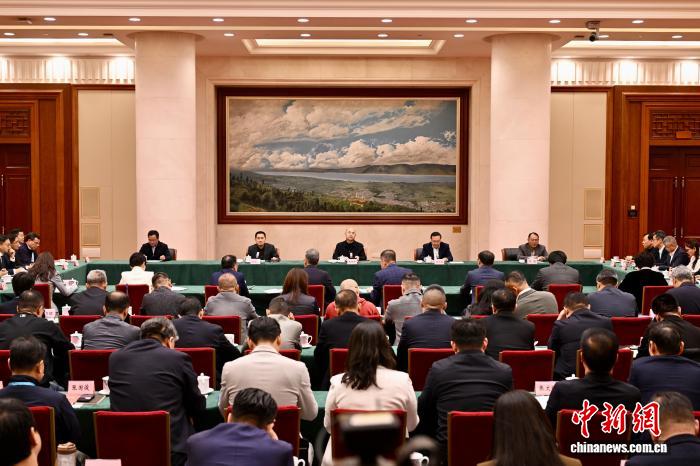
新的社会阶层人士“两会一团”学习贯彻党的二十届四中全会精神座谈会在昆明举行
Zhong Guo Xin Wen Wang· 2025-11-17 06:35
Core Points - The meeting focused on the implementation of the spirit of the 20th Central Committee of the Communist Party of China, emphasizing the importance of this period for achieving socialist modernization [1][3] - Participants were encouraged to enhance their political, ideological, and action consciousness in learning and implementing the conference's spirit [3] Group 1 - The meeting was attended by various leaders from new social strata associations and service teams, highlighting the collective effort needed for social governance and stability [3] - Wang Ruijun, the Deputy Minister of the United Front Work Department, underscored the significance of the 14th Five-Year Plan in the context of economic and social development [3] - The meeting aimed to clarify the role of builders in the socialist cause, urging participants to leverage their strengths in talent discovery and gathering [3]
薛鹤翔:新动能驱动 转型显韧性
Sou Hu Cai Jing· 2025-11-16 06:06
Group 1: Industrial Production - Industrial production in October continued to show steady growth, with the industrial added value of large-scale enterprises increasing by 4.9% year-on-year, and a cumulative growth of 6.1% from January to October, highlighting the characteristics of "new quality productivity leading and structural optimization upgrading" [1][6][18] - The equipment manufacturing and high-tech manufacturing sectors led the growth with rates exceeding 8% and 7% respectively, while new products like 3D printing equipment and electric vehicles maintained double-digit growth, becoming the core engines of industrial growth [1][6][18] - The industrial economy is accelerating its transition from scale expansion to quality and efficiency, but attention is needed on the insufficient vitality of small and medium-sized private enterprises, which requires targeted financing support and policy measures to unlock growth potential across the entire industrial chain [1][7][18] Group 2: Consumer Market - The consumer market in October continued to expand in scale and improve in quality, characterized by "service-led growth and structural optimization upgrading," with total retail sales increasing by 2.9% year-on-year and a cumulative growth of 4.3% from January to October [2][8][23] - The growth rate of service retail accelerated to 5.3%, with significant increases in experiential service consumption such as cultural, sports, and transportation services, indicating a shift in consumer demand from goods to services [2][8][23] - The rural market showed a notable growth rate higher than urban areas, supported by the improvement of the county commercial system and rural revitalization strategies, reflecting the continuous release of rural consumption potential [2][8][23] Group 3: Investment Structure - From January to October, fixed asset investment decreased by 1.7%, with the core characteristic of "real estate dragging down significantly while new momentum breaks through," indicating a structural change in investment dynamics [3][11][25] - Manufacturing investment continued to grow by 2.7%, becoming a key pillar for stabilizing investment, particularly in high-tech industries such as information services and aerospace equipment [3][11][25] - The residential market remains in deep adjustment, with both sales area and sales volume declining, but structural changes are noteworthy, such as the increasing proportion of existing home sales and the stabilization of housing prices in core urban areas [3][11][25] Group 4: Employment Market - The employment situation in 2025 is characterized by "overall stability with progress, prominent structural differentiation, and urgent quality improvement," with the urban survey unemployment rate averaging 5.2% from January to October [13] - Employment policies have effectively stabilized the job market, with significant reductions in costs for enterprises, but structural mismatches and low employment quality remain concerns [13] - The average weekly working hours for employees reached 48.4 hours, indicating hidden employment pressures as companies prefer to extend existing employees' hours rather than create new positions [13]

“十五五”发展县域经济,专家建议增发新型城镇化特别国债
第一财经· 2025-11-15 03:46
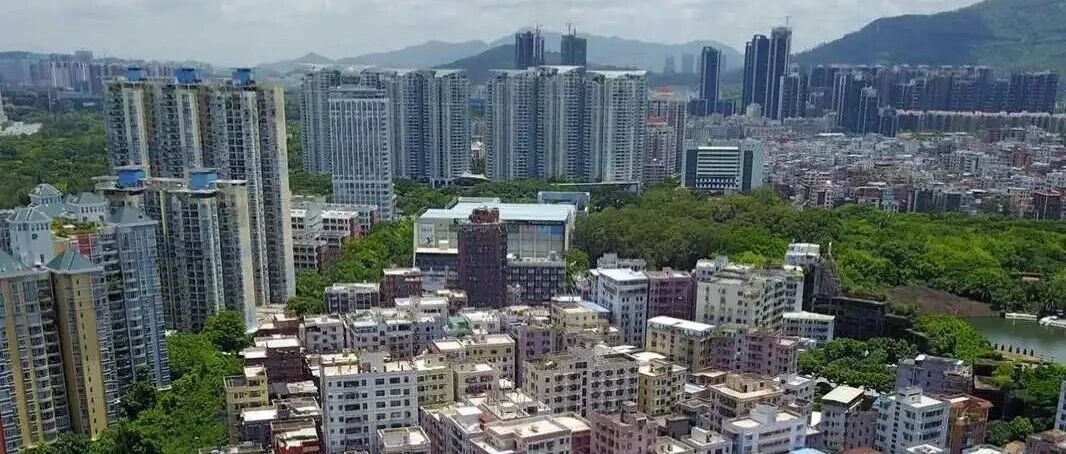
Core Viewpoint - The article emphasizes the importance of promoting new urbanization as a key strategy to boost domestic demand and economic growth during the "15th Five-Year Plan" period, with a focus on enhancing infrastructure and public services in county-level cities [3][4]. Group 1: New Urbanization Strategy - The core task of the "15th Five-Year Plan" is to enhance domestic demand and stabilize employment and income expectations through new urbanization [3]. - The proposal includes issuing "special bonds for new urbanization" to directly support county-level governments in improving infrastructure and public services [3][4]. Group 2: Financial Mechanisms - It is suggested that the central government should issue additional bonds to replace some local government debt, alleviating financial pressure on local governments [5]. - The article highlights the need for a structured approach to assess and implement key performance indicators (KPIs) related to urbanization and public service improvements, integrating these into local government evaluations [5]. Group 3: County-Level Development - The county level is identified as a crucial link for urban-rural integration and should focus on developing a "shortlist of leading industries" to concentrate resources effectively [5]. - Differentiated policies should be implemented based on the unique characteristics of each county, moving away from the traditional "GDP competition" model to address development contradictions [5]. Group 4: Urbanization Forecast - Predictions indicate that the urbanization rate in China during the "15th Five-Year Plan" period may maintain a growth rate of approximately 0.7 percentage points [5].
专家热议:“十五五”时期如何推进新型城镇化?
Zhong Guo Xin Wen Wang· 2025-11-15 03:18
Core Viewpoint - The article discusses the transition of China's urbanization from rapid growth to stable development, emphasizing the need to align with the new goals of the "14th Five-Year Plan" and to focus on quality improvement and efficiency in urban development [1][4]. Group 1: Urbanization Development Strategies - The current phase of urbanization should be understood within the context of China's modernization and global changes, aiming to meet the growing needs of the population [1]. - The "14th Five-Year Plan" period should focus on the deep integration of urban areas across seven dimensions: regional, urban-rural, industrial, digital, green, cultural, and safety [1]. - Urbanization is crucial for achieving economic and social development goals, serving as both a primary content and an important support for building a modern socialist society [2]. Group 2: Key Focus Areas for Urbanization - Emphasis on collaborative efforts to optimize urban clusters and metropolitan areas, ensuring infrastructure and public services are interconnected while allowing for distinctive local developments [2][3]. - High-quality urban development should be assessed through three dimensions: development capacity, livability, and safety, with a focus on creating a unique industrial structure and a responsive safety management system [2]. - Promoting rural-urban integration through reforms that facilitate the movement of farmers to cities and the flow of urban resources to rural areas is essential for modernizing agriculture and rural areas [3]. Group 3: Government Role and Challenges - The implementation of new urbanization should stimulate domestic demand by integrating rural populations into the modern economy, with a focus on local government incentives and accountability [3]. - Addressing the debt issues faced by local governments is critical to ensure continued investment in urbanization, household registration reform, and public services [3]. - The predicted urbanization speed during the "14th Five-Year Plan" period is expected to remain around 0.7 percentage points, with a primary focus on improving the quality of urbanization [4].