
固态电池产业化

Search documents
赢合科技三季度营收稳增,锂电设备工艺突破与海外领跑双线成长
Zheng Quan Shi Bao Wang· 2025-10-26 10:04
Core Insights - The company reported a significant increase in revenue and cash flow for Q3 2025, with revenue reaching 2.52 billion yuan, a year-on-year growth of 22.85%, and operating cash flow increasing by 116.85% compared to the same period last year [1] Group 1: Financial Performance - The company achieved a revenue of 2.52 billion yuan in Q3 2025, reflecting a 22.85% increase year-on-year [1] - Operating cash flow showed a remarkable growth of 116.85% compared to the same period last year, indicating improved cost control and management efficiency [1] Group 2: Technological Advancements - The company has focused on high-end product development, international business expansion, and digital management, leading to breakthroughs in lithium battery equipment technology [2] - R&D investment reached 473 million yuan in the first three quarters of 2025, marking an 18.14% increase year-on-year [2] - The introduction of a high-speed multi-station cutting and stacking machine has improved efficiency by 70% compared to industry standards, with precision cutting at the millimeter level [2] Group 3: Solid-State Battery Developments - The company has delivered core solid-state battery equipment to multiple clients, including fully automated slurry preparation and coating equipment [3] - The backlog of orders reached 2.947 billion yuan by the end of Q3, representing a 78.24% increase from the beginning of the year and a 101.31% increase year-on-year [3] Group 4: International Expansion - The company is actively expanding its overseas market presence, benefiting from the global trend of the electric vehicle and energy storage markets [4] - Recent achievements include successful acceptance of equipment by major clients in South Korea and Malaysia, as well as shipments to top battery manufacturers in Hungary [4] - The establishment of multiple subsidiaries and service networks globally ensures timely and professional after-sales support, enhancing the company's international strategy [4]

卫蓝、清陶固态电池进展追踪
高工锂电· 2025-10-25 11:19
Group 1 - The solid-state battery industry is transitioning from the "verification phase" to a critical stage of "application and cost reduction" [3] - Weilan New Energy has signed a procurement agreement for 4GWh solid-state cells and energy storage equipment worth approximately 4 billion yuan, marking the largest publicly available order for the company [3][4] - Qingtao Energy has developed a low-cost solid-state electrolyte, significantly reducing material costs and enhancing the potential for commercialization [4] Group 2 - Weilan New Energy is establishing a joint venture focused on solid-state and energy storage batteries, with an initial production line investment of about 1.2 billion yuan [3] - The new solid-state electrolyte developed by Qingtao Energy shows a cost reduction of approximately 27 times compared to traditional systems, addressing key challenges in the industry [4][5] - The breakthroughs in cost reduction and stability of sulfide systems are crucial for the competitive viability of solid-state batteries in the market [5]

锂电池产业链行业双周报:Q3我国储能电池出货量同比增超六成-20251024
Dongguan Securities· 2025-10-24 12:17
Investment Rating - The report maintains an "Overweight" rating for the lithium battery industry chain [1] Core Views - In Q3 2025, China's energy storage battery shipments increased by over 60% year-on-year, with total shipments for the first three quarters exceeding 30% of last year's total [4][40] - The domestic energy storage cell supply is tight, with leading battery companies operating at full capacity, and this supply-demand imbalance is expected to continue until Q1 2026 [4][45] - The new energy vehicle market is in a traditional peak season, particularly with rapid growth in sales of new energy commercial vehicles, sustaining overall demand for lithium batteries [4][45] - The report highlights the ongoing industrialization of solid-state batteries, with significant breakthroughs in key technologies, and anticipates increased demand for materials and equipment in the industry chain [4][45] Summary by Sections Market Review - As of October 23, 2025, the lithium battery index fell by 9.36% over the past two weeks, underperforming the CSI 300 index by 7.17 percentage points [11] - Year-to-date, the lithium battery index has risen by 49.03%, outperforming the CSI 300 index by 31.97 percentage points [11] Price Changes in the Lithium Battery Industry Chain - As of October 23, 2025, the average price of battery-grade lithium carbonate is 74,800 CNY/ton, up 2.61% in the last two weeks [25] - The price of lithium hydroxide (LiOH 56.5%) is 72,200 CNY/ton, increasing by 0.84% [25] - The price of lithium iron phosphate is 33,400 CNY/ton, down 2.62% [28] - The price of NCM523, NCM622, and NCM811 increased by 16.26%, 13.20%, and 8.36% respectively [28] - The price of electrolyte lithium hexafluorophosphate rose by 38.10% to 87,000 CNY/ton [31] - The average price of wet separators is 0.73 CNY/sqm, up 5.80% [36] Industry News - The report notes that in Q3 2025, China's energy storage lithium battery shipments reached 165 GWh, a 65% year-on-year increase [40] - The report also highlights that from January to September 2025, lithium battery exports increased by 19.14% in quantity and 26.75% in value [40] - The global battery production in September 2025 was 216.7 GWh, a 50.8% year-on-year increase [40] Company Announcements - The report identifies key companies to watch, including CATL, EVE Energy, and others, due to their technological and cost advantages in the industry [4][47] - CATL reported a net profit of 49.034 billion CNY for the first three quarters of 2025, a 36.20% increase year-on-year [47] - EVE Energy's battery shipments reached 34.59 GWh, a 66.98% increase year-on-year [47]




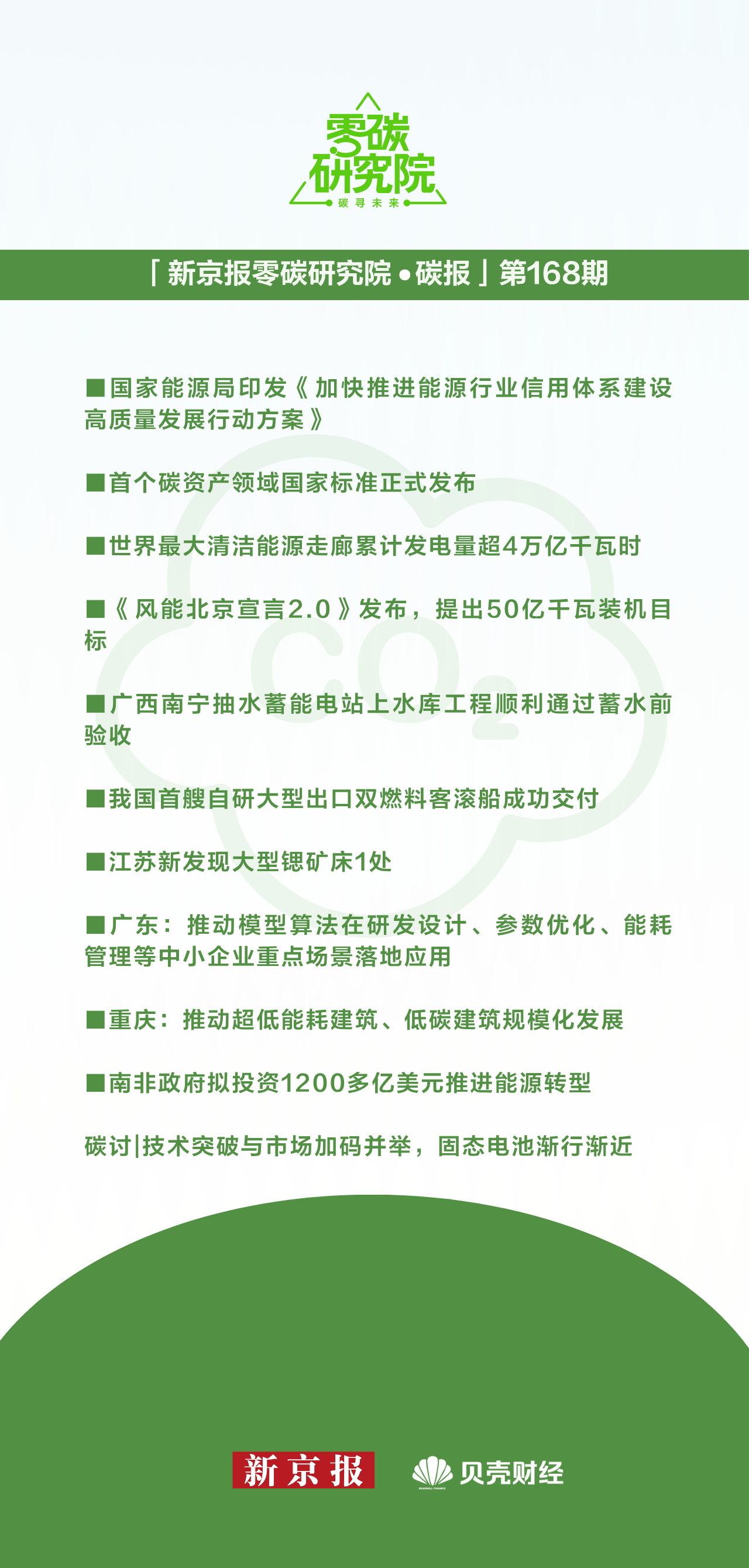
一周碳要闻:固态电池渐行渐近(碳报第168期)
Xin Jing Bao· 2025-10-24 12:05
Group 1: Policy Developments - The National Energy Administration issued an action plan to enhance the credit system in the energy sector by 2027, aiming for improved regulations, shared credit information, and effective mechanisms for rewarding trustworthiness and penalizing dishonesty [3] - The first national standard for carbon asset management was released, providing guidelines for organizations to enhance their carbon asset management capabilities [4] - The "Wind Energy Beijing Declaration 2.0" was launched, setting ambitious wind power installation targets for 2030 and 2035, emphasizing the importance of wind energy in achieving climate goals [7] Group 2: Industry Dynamics - The world's largest clean energy corridor, consisting of six major power stations, has generated over 4 trillion kilowatt-hours of electricity, significantly contributing to energy savings and CO2 emissions reduction [6] - The Guangxi Nanning pumped storage power station has completed its construction and is set to begin operations, marking a significant milestone in China's energy infrastructure [8] - South Africa plans to invest approximately $1267 billion to transition its energy sector, aiming to reduce coal dependency and increase renewable energy sources by 2039 [14] Group 3: Technological Advancements - Solid-state battery technology is progressing, with expectations for small-scale applications by 2030 and large-scale commercialization by 2035, driven by recent breakthroughs in battery performance [15][17] - Key technological advancements in solid-state batteries have been achieved, including improved energy density and efficiency, which are crucial for the battery's practical application [18] - The solid-state battery sector is experiencing increased market interest, with several ETFs related to this technology showing significant inflows and performance [19][20]


亿纬锂能/欣旺达/常州锂源/容百科技/诺德股份/大族锂电/逸飞激光/卡洛维德等企业亮相 高工金球奖首批公示(持续更新)
高工锂电· 2025-10-24 10:35
Core Viewpoint - The article highlights the upcoming 2025 High-Performance Lithium Battery Annual Conference and the ongoing 2025 Golden Ball Award selection, emphasizing the significance of these events in recognizing and promoting innovation within the lithium battery industry. Group 1: Event Details - The 2025 High-Performance Lithium Battery Annual Conference will take place from November 18-20, 2025, at the JW Marriott Hotel in Shenzhen Qianhai [2] - The event is organized by GGII and features various sponsors, including Hai Moxing Laser and Dazhu Lithium Battery [2] - The Golden Ball Award, often referred to as the "Oscar of the lithium battery industry," has been held since 2013 and aims to recognize credible products and brands in the industry [2] Group 2: Industry Participation - Over 160 companies are participating in the 2025 Golden Ball Award selection, showcasing the competitive landscape of the lithium battery sector [2] - Companies like EVE Energy, Xinwanda, and Longzhong Lithium are among those involved in the award selection process [2] Group 3: Company Highlights - EVE Energy ranked second globally in energy storage cell shipments in the first half of 2025, with a shipment volume of 28.71 GWh [3] - EVE Energy's power battery shipments reached 21.48 GWh, ranking fifth in domestic installations and second globally for medium and heavy commercial vehicles [3] - Xinwanda launched its Flash Charge Battery 4.0, achieving a charging time of just 5 minutes for its 1400A flash charge battery [6] - Longzhong Lithium introduced a new high-pressure density product, breaking industry bottlenecks and achieving significant international supply chain advancements [8] - Rongbai Technology has made breakthroughs in high-nickel materials and solid-state battery key materials, positioning itself as a leader in the lithium battery material sector [10] - Nord Technology has developed a nickel-plated alloy foil for solid-state batteries, addressing critical challenges in the industry [12] - Dazhu Lithium Battery has created a high-speed, flexible CTP-Pack production line, enhancing efficiency and adaptability in battery manufacturing [14] - Yifei Laser has launched a production line for fast-charging cylindrical batteries, significantly improving manufacturing efficiency and product performance [16]



亿纬锂能(300014):计提影响Q3利润 看好未来量利齐升
Xin Lang Cai Jing· 2025-10-24 10:35
Core Viewpoint - The company reported strong Q3 results with revenue of 16.832 billion yuan, a year-on-year increase of 35.9% and a quarter-on-quarter increase of 9.5%, while net profit attributable to shareholders was 1.211 billion yuan, up 15.1% year-on-year and 140.2% quarter-on-quarter, although it fell short of previous expectations due to one-time charges [1] Group 1: Financial Performance - Q3 revenue reached 16.832 billion yuan, reflecting a year-on-year growth of 35.9% and a quarter-on-quarter growth of 9.5% [1] - Net profit attributable to shareholders was 1.211 billion yuan, with a year-on-year increase of 15.1% and a quarter-on-quarter increase of 140.2% [1] - Adjusted net profit, excluding one-time charges, was 1.457 billion yuan for Q3 [1] Group 2: Business Segments Power Business - Power battery shipments in Q3 were 13.1 GWh, a quarter-on-quarter increase of 16%, with a gross margin exceeding 17% [1] - The commercial vehicle sector is expected to see significant growth, with a projected doubling in 2026 [1] - The company anticipates a gross margin of 20% for the power business in the coming year, indicating substantial improvement [1] Energy Storage - Energy storage battery shipments in Q3 reached 19.7 GWh, a quarter-on-quarter increase of 23%, with gross margin recovering to over 12% [2] - The company has introduced 30 GWh of external production capacity to meet demand, with domestic prices for energy storage batteries beginning to rise [2] - The export ratio of energy storage batteries reached 18% in Q3, with a target of over 25% for the next year [2] Solid-State Batteries - The company is making progress in solid-state battery technology, with a production base set to be completed by December 2025 [3] - The first solid-state battery product has been successfully launched, targeting high-end applications [3] - The company is also exploring semi-solid-state battery technology, indicating a strategic focus on future growth in this area [3] Group 3: Future Outlook - The company maintains a "buy" rating, with revised profit expectations for 2025-2027, projecting net profits of 4.504 billion, 8.273 billion, and 9.714 billion yuan respectively [4] - The target price has been adjusted to 96.96 yuan, reflecting a PE ratio of 24 for 2026 [4] - The company expects to benefit from improved customer conditions and increased production capacity in the coming years [4]
锂电池产业链双周报(2025、10、10-2025、10、23):Q3我国储能电池出货量同比增超六成-20251024
Dongguan Securities· 2025-10-24 08:46
Investment Rating - The report maintains an "Overweight" rating for the lithium battery industry chain [1] Core Views - In Q3 2025, China's energy storage battery shipments increased by over 60% year-on-year, with total shipments for the first three quarters exceeding 30% of last year's total [8][44] - The domestic energy storage cell supply is tight, with leading battery companies operating at full capacity, and this supply-demand imbalance is expected to continue until Q1 2026 [8][49] - The new energy vehicle market is in a traditional peak season, particularly with rapid growth in sales of new energy commercial vehicles, sustaining overall demand for lithium batteries [8][49] - The report highlights the ongoing industrialization of solid-state batteries, with significant breakthroughs in key technologies recently achieved [8][49] - It suggests focusing on leading companies with technological and cost advantages across the industry chain, particularly those involved in solid-state battery core processes and materials [8][49] Summary by Sections Market Review - As of October 23, 2025, the lithium battery index has decreased by 9.36% over the past two weeks, underperforming the CSI 300 index by 7.17 percentage points [15] - Year-to-date, the lithium battery index has increased by 49.03%, outperforming the CSI 300 index by 31.97 percentage points [15] Price Changes in the Lithium Battery Industry Chain - As of October 23, 2025, the average price of battery-grade lithium carbonate is 74,800 CNY/ton, up 2.61% in the last two weeks [29] - The price of lithium hydroxide (LiOH 56.5%) is 72,200 CNY/ton, increasing by 0.84% [29] - The price of lithium iron phosphate has decreased by 2.62% to 33,400 CNY/ton, while NCM523, NCM622, and NCM811 have seen increases of 16.26%, 13.20%, and 8.36% respectively [32] - The price of electrolyte lithium hexafluorophosphate has surged by 38.10% to 87,000 CNY/ton [35] - The average price of wet separators has risen by 5.80% to 0.73 CNY/sqm [40] Industry News - The report notes that in Q3 2025, China's energy storage battery shipments reached 165 GWh, a 65% increase year-on-year, with total shipments for the first three quarters reaching 430 GWh [44] - The report also highlights that from January to September 2025, China's lithium battery exports increased by 19.14% in quantity and 26.75% in value [44] - The global battery production in September 2025 was 216.7 GWh, a 50.8% year-on-year increase [44] Company Announcements - The report identifies key companies to watch, including CATL (300750), EVE Energy (300014), and others, based on their strong performance and market positioning [51]
聚焦SAECCE2025:比克固态电池以场景需求驱动技术进阶
Zhong Guo Neng Yuan Wang· 2025-10-24 07:53
Core Insights - The solid-state battery market is experiencing explosive growth opportunities, with projections indicating that global solid-state battery shipments will reach 614.1 GWh by 2030, corresponding to a market size exceeding 100 billion yuan, with semi-solid batteries accounting for approximately 85% of the total market size [3] - Despite the promising outlook, challenges such as high costs, interface impedance, and incomplete supply chains hinder the large-scale commercialization of all-solid-state batteries in the short term, with industrialization expected to occur post-2030 [5] - The semi-solid battery technology serves as a practical pathway towards all-solid-state batteries, balancing safety, performance, and manufacturability, as it retains 5%-10% of liquid electrolyte while mitigating thermal runaway risks [5] Industry Developments - The 32nd China Society of Automotive Engineers Annual Conference and Exhibition (SAECC 2025) will be held in Chongqing, China, from October 21 to 24, 2025, where BAK Battery's Chief Engineer will present advancements in solid-state battery technology and its applications [1] - BAK Battery has made significant breakthroughs in solid-state battery technology through in-situ curing techniques, achieving a liquid electrolyte content below 10%, ensuring safety through rigorous testing while maintaining high ionic conductivity [6] - The company has established a clean pilot line for high-purity solid-state batteries, adhering to automotive-grade dust control standards, facilitating the transition from laboratory safety metrics to commercial production [6] Product Innovations - In the digital security sector, BAK Battery has developed two semi-solid battery cells (1.2Ah and 7Ah) that excel in extreme conditions, ensuring stable power supply through rigorous testing [7] - For eVTOL applications, BAK Battery has created products capable of 4C-8C discharge rates, providing rapid energy replenishment to support low-altitude economic development [7] - In the two-wheeler market, BAK Battery's semi-solid cells meet national safety standards and demonstrate a capacity retention rate of ≥70% after 3000 cycles, addressing market demands for long-range, high-safety, and cost-effective solutions [7] - The company is also developing high-energy density cells (300-400 Wh/kg) for electric vehicles, achieving a capacity retention rate of ≥80% after 1000 cycles, showcasing durability and reliability [7] Strategic Focus - BAK Battery emphasizes a closed-loop approach of "scene pain points → battery solutions," leveraging real-world applications to drive technological iterations and enhance solid-state battery evolution [6][8] - The semi-solid technology acts as a critical bridge between existing technologies and the goal of all-solid-state batteries, addressing urgent market needs for high safety and high energy density batteries [8] - The company plans to continue advancing semi-solid technology in response to market demands, aiming to provide targeted solid-state battery solutions across various sectors while steadily progressing towards all-solid-state battery development [8]

亿纬锂能(300014):计提影响Q3利润,看好未来量利齐升
HTSC· 2025-10-24 06:35
Investment Rating - The report maintains a "Buy" rating for the company with a target price of 96.96 RMB, up from a previous target of 62.40 RMB [5][7]. Core Insights - The company reported Q3 2025 revenue of 16.832 billion RMB, a year-on-year increase of 35.9% and a quarter-on-quarter increase of 9.5%. The net profit attributable to shareholders was 1.211 billion RMB, up 15.1% year-on-year and 140.2% quarter-on-quarter, although it fell short of the previous expectation of 1.581 billion RMB due to one-time charges [1]. - The company is expected to benefit from improved customer structure and increased production capacity utilization in the future, particularly with the release of orders from the BMW cylindrical battery project and North American energy storage clients [1][2]. - The company anticipates a significant increase in demand for commercial vehicles, with the battery business expected to achieve a gross margin of 20% in 2026, up from over 17% in 2025 [2]. - The energy storage segment saw a 23% quarter-on-quarter increase in battery shipments, with gross margins improving to over 12% due to better customer structure [3]. - The company is making progress in solid-state battery technology, with plans for mass production and potential applications in high-end equipment [4]. Summary by Sections Q3 Financial Performance - Q3 2025 revenue was 16.832 billion RMB, with a year-on-year growth of 35.9% and a quarter-on-quarter growth of 9.5% [1]. - Net profit attributable to shareholders was 1.211 billion RMB, reflecting a year-on-year increase of 15.1% and a quarter-on-quarter increase of 140.2% [1]. Battery Business Outlook - The company shipped 13.1 GWh of power batteries in Q3 2025, with a gross margin exceeding 17% [2]. - The commercial vehicle sector is projected to double in growth by 2026, contributing to improved profitability [2]. Energy Storage Segment - Energy storage battery shipments reached 19.7 GWh in Q3 2025, with a gross margin recovery to over 12% [3]. - The company plans to increase the export ratio of energy storage batteries to over 25% next year [3]. Solid-State Battery Development - The company is advancing in solid-state battery technology, with a production base expected to be completed by December 2025 [4].
场景拓展打开增量空间,龙头引领固态技术升级 | 投研报告
Zhong Guo Neng Yuan Wang· 2025-10-24 03:29
Core Insights - The report highlights the steady growth in global electric vehicle sales, with commercial vehicle electrification emerging as a new growth point, and rapid expansion in the engineering machinery market, alongside a significant increase in global ship battery shipments and high domestic penetration rates for ship electrification [1] Investment Highlights - Scenario Expansion: The demand for lithium battery applications is rapidly expanding into diverse fields such as electric two-wheelers, low-altitude economy, robotics, and RVs. In the first half of 2025, domestic electric two-wheeler lithium battery sales are expected to surge over 40% year-on-year, with industrial and consumer-grade drone lithium batteries also experiencing rapid growth, projected to achieve a CAGR of 18.08% from 2025 to 2030. Global robot shipments are expected to grow by over 39% year-on-year in 2024, and RV lithium battery sales are projected to see a CAGR of 8.55% from 2025 to 2031 [2] - Technology Upgrade: Attention is drawn to leading companies accelerating the industrialization of solid-state batteries, with a continuous increase in patent applications for solid-state batteries in China, where leading firms hold a significant number of patents and have clear mass production plans [2] - Cycle: The report notes a price recovery and improvement in profitability, with cell prices rebounding and operating rates increasing. Since 2025, cell prices have gradually bottomed out, and the overall operating rate of energy storage battery companies in the first half of 2025 is expected to maintain above 50%, significantly exceeding previous years and showing a gradual upward trend [2] Storage and Power Battery Growth - Storage: The report emphasizes the rapid growth of distributed energy storage, with lithium iron phosphate batteries being the primary technology route in electrochemical storage. Global energy storage batteries are mainly used for centralized storage, with distributed storage growing rapidly. China has the largest installed capacity for energy storage, with the strongest growth. Demand for storage batteries is expected to reach 1384.00 GWh by 2028, with a CAGR of 39.07% from 2024 to 2028, and the share of distributed storage is expected to rise to 40.02% by 2028 [3] - Power: The focus is on the electrification of commercial vehicles, engineering machinery, and ships, with global electric vehicle sales steadily increasing. The report anticipates that power battery shipments will reach 2859.62 GWh by 2028, with a CAGR of 26.91% from 2024 to 2028, driven by rapid growth in light-duty, engineering machinery, and ship power batteries [3] - Consumer: The global consumer battery market is characterized by significant technological drivers, diverse application demands, and favorable policy environments. Total consumer battery shipments are projected to reach 55.13 billion units by 2029, with a CAGR of approximately 25.54% from 2023 to 2029, primarily driven by the continuous development of downstream industries such as medical devices and automotive electronics, as well as the rise of emerging fields like the low-altitude economy [3] Market Structure - The report indicates that the market landscape is stabilizing, with resources concentrating towards leading companies, while second-tier firms seek differentiated competition. The market share of leading global power battery companies remains stable, while the second tier is growing rapidly, leading to a decline in industry concentration [4] - The report notes that the highest costs are associated with positive electrodes, with lithium iron phosphate shipments dominating. The share of artificial graphite in negative electrodes is high, and silicon negative electrode shipments are expected to break through [5] - The report highlights that the electrolyte market faces significant overcapacity issues, with an oligopoly effect becoming apparent, and emphasizes the importance of monitoring the impact of internal competition [5] - The report also mentions that the market for separators is becoming increasingly concentrated, with leading companies benefiting from cost control and technological upgrades to enhance profitability [5] - The report concludes that the manufacturing equipment competition landscape is clear, with domestic manufacturers possessing global competitiveness, and emphasizes the importance of R&D efforts and technological upgrades among domestic companies [5]