社会融资规模

Search documents
山东这一增速,连续77个月快于全国
Feng Huang Wang Cai Jing· 2025-11-13 15:46
Core Insights - The financing scale and the growth rate of both domestic and foreign currency loans in Shandong Province have outpaced the national averages for 77 and 62 consecutive months respectively, providing strong financial support for the province's economic stability during the 14th Five-Year Plan period [1] Financing Growth - During the 14th Five-Year Plan period, Shandong Province achieved an average annual growth rate of 11.5% in social financing scale and 11.2% in domestic and foreign currency loans, contributing significantly to the stability of the provincial economy [1] - As of September 2025, the social financing scale and the balance of domestic and foreign currency loans in Shandong Province reached 25.6 trillion yuan and 16.2 trillion yuan respectively, marking increases of 67.8% and 65.4% compared to the end of 2020, thus exceeding the targets set in the "14th Five-Year Plan for Financial Development" [1] Monetary Policy Actions - The People's Bank of China Shandong Branch has implemented a total of 9 reductions in the statutory reserve requirement ratio for local financial institutions, releasing approximately 460 billion yuan in long-term funds, which has significantly enhanced the credit issuance capacity of financial institutions [1]
M2增速8.2% 金融总量保持合理增长
Bei Jing Shang Bao· 2025-11-13 15:45
Core Insights - The People's Bank of China reported that the cumulative social financing scale increased by 30.9 trillion yuan in the first ten months of 2025, which is 3.83 trillion yuan more than the same period last year [1] - The growth rate of social financing stock was 8.5% year-on-year as of the end of October, while the M2 money supply growth rate was 8.2%, both showing a slight decrease of 0.2 percentage points month-on-month [1][6] - The overall financial volume remains reasonably stable, reflecting a shift towards high-quality economic development rather than high-speed growth [1][7] Loan Data Analysis - As of the end of October, the balance of RMB loans reached 270.61 trillion yuan, with a year-on-year growth of 6.5% [3] - In the first ten months, RMB loans increased by 14.97 trillion yuan, with a monthly increase of 220 billion yuan in October, which is a seasonal decrease [3] - Household loans increased by 739.6 billion yuan, while corporate loans increased by 13.79 trillion yuan, indicating a mixed demand across sectors [3][5] Government Bond Impact - The net financing scale of government bonds accounted for 21.3% of the social financing scale in the first ten months, which is a 2 percentage point increase year-on-year [4] - The issuance of government bonds is aimed at supporting major projects and national strategies, thereby expanding demand and stabilizing the economy [4][5] Financing Structure Changes - The balance of inclusive small and micro loans reached 35.77 trillion yuan, growing by 11.6% year-on-year, while medium to long-term loans in the manufacturing sector reached 14.97 trillion yuan, growing by 7.9% [5] - The financing channels for enterprises have diversified, moving from reliance on bank loans to utilizing bonds and stocks, with non-loan financing methods now accounting for over half of the social financing scale increase [7] Monetary Policy Context - The average interest rate for newly issued corporate loans was 3.1%, down approximately 40 basis points from the previous year, indicating a supportive monetary environment [5] - Despite the low financing costs, the marginal efficiency of monetary policy has declined, suggesting a need for careful management of monetary conditions to avoid negative effects such as capital market volatility [8][9]


30.9万亿元!重要数据 央行最新发布!
Mei Ri Jing Ji Xin Wen· 2025-11-13 15:36
Core Insights - The People's Bank of China (PBOC) released financial statistics for October, indicating a steady growth in monetary supply and social financing, reflecting ongoing economic activity and liquidity in the market [1] Monetary Supply - As of the end of October, the broad money supply (M2) reached 335.13 trillion yuan, growing by 8.2% year-on-year. The narrow money supply (M1) was 112 trillion yuan, up 6.2%, while the currency in circulation (M0) stood at 13.55 trillion yuan, increasing by 10.6%. A net cash injection of 728.4 billion yuan occurred in the first ten months [2] Social Financing - The total social financing stock was 437.72 trillion yuan at the end of October, marking an 8.5% year-on-year increase. The RMB loans to the real economy amounted to 267.01 trillion yuan, up 6.3%, while foreign currency loans converted to RMB were 115 billion yuan, down 16.9% [3] Incremental Financing - In the first ten months, the cumulative increase in social financing was 30.9 trillion yuan, which is 3.83 trillion yuan more than the same period last year. RMB loans to the real economy increased by 14.52 trillion yuan, while foreign currency loans decreased by 114.6 billion yuan [4] Deposits - The total deposits in both domestic and foreign currencies reached 332.92 trillion yuan by the end of October, with a year-on-year growth of 8.3%. RMB deposits were 325.55 trillion yuan, up 8%, and the increase in RMB deposits over the first ten months was 23.32 trillion yuan [5] Loans - The total loans in both domestic and foreign currencies reached 274.54 trillion yuan by the end of October, with a year-on-year growth of 6.3%. RMB loans were 270.61 trillion yuan, increasing by 6.5%, with a total increase of 14.97 trillion yuan in the first ten months [6]
社融重要信号!新增贷款占比不到一半 政府债替代效应明显
2 1 Shi Ji Jing Ji Bao Dao· 2025-11-13 15:24
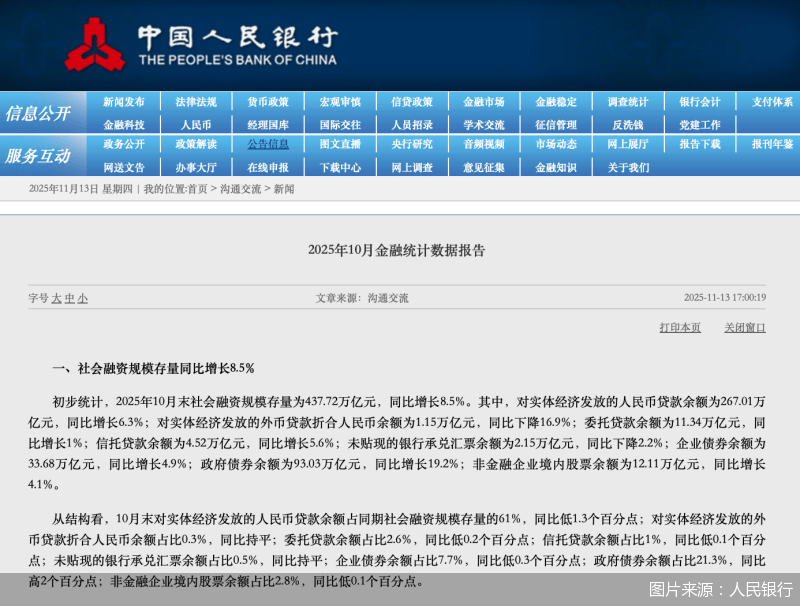
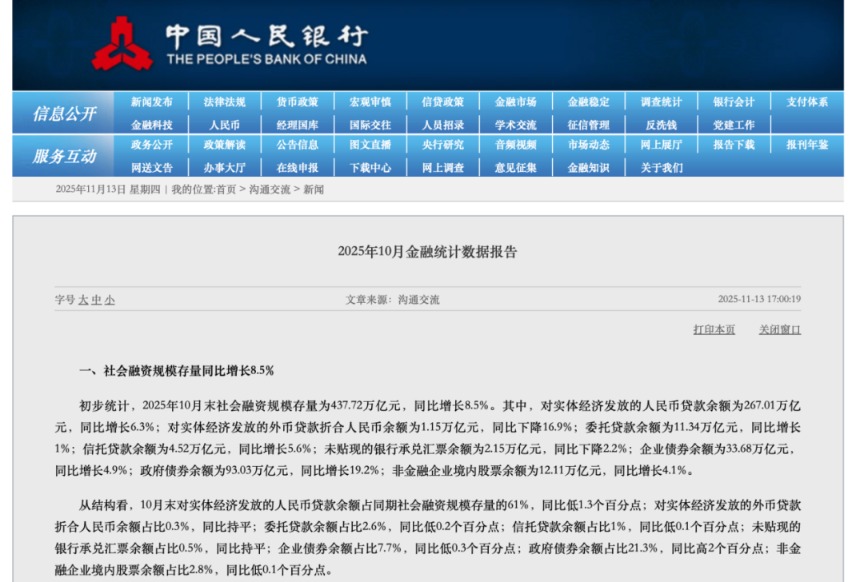
Core Viewpoint - The report from the People's Bank of China indicates that the rapid issuance of government bonds is increasingly substituting for loans, reflecting a shift in financing dynamics within the economy [1][2]. Financing Structure - As of the end of October 2025, the total social financing scale was 437.72 trillion yuan, with a year-on-year growth of 8.5%. The balance of RMB loans to the real economy was 267.01 trillion yuan, growing by 6.3% year-on-year, while government bonds increased by 19.2% to 93.03 trillion yuan [1]. - The proportion of RMB loans to the real economy in the total social financing scale was 61%, down by 1.3 percentage points year-on-year. Government bonds accounted for 21.3%, up by 2 percentage points [1]. Economic Indicators - By the end of October, the broad money supply (M2) was 335.13 trillion yuan, with a year-on-year increase of 8.2%. The narrow money supply (M1) was 112 trillion yuan, up 6.2% year-on-year, indicating a recovery in business activity and consumer demand [3]. - The October PMI output index was at 50.0%, signaling a stable economic environment, while the non-manufacturing business activity index was at 50.1%, indicating expansion [3]. Government Debt and Leverage - The government leverage ratio increased by 8.8 percentage points year-on-year to 67.5%, while non-financial corporate and household leverage ratios rose by 4.5 percentage points and slightly decreased by 1.2 percentage points, respectively [2]. - The issuance of government bonds is being used to support major projects and alleviate corporate debt burdens, contributing to a more sustainable economic development [2]. Monetary Policy and Inflation - The central bank's monetary policy remains supportive, with M2 growth consistently above 8%, outpacing nominal GDP growth by about 4 percentage points [6]. - The CPI turned positive at 0.2% year-on-year in October, while the core CPI rose by 1.2%, indicating signs of stabilization in price levels [5]. Future Outlook - The economic growth target for the year is set at around 5%, supported by ongoing macroeconomic policies and a favorable external environment [4]. - The government is expected to continue implementing policies that promote consumption and improve living standards, which will be crucial for enhancing consumer confidence and spending [7].
央行 重磅发布!
Zhong Guo Ji Jin Bao· 2025-11-13 14:28
Core Viewpoint - The People's Bank of China (PBOC) has reported that M2 and social financing growth rates remain high, creating a favorable monetary environment for economic recovery. The current monetary policy stance is supportive, aiming to promote reasonable price recovery and maintain strong support for the real economy [1][12]. Monetary Supply and Financing - As of October 2025, the M2 balance reached 335.13 trillion yuan, with a year-on-year growth of 8.2% [4]. - The social financing scale stood at 437.72 trillion yuan, reflecting a year-on-year increase of 8.5% [5]. - From January to October, the incremental social financing was 30.9 trillion yuan, which is 3.83 trillion yuan more than the same period last year [6]. - The balance of various loans in renminbi was 270.61 trillion yuan at the end of October, showing a year-on-year growth of 6.5% [7]. Loan Rates and Structure - The average interest rate for newly issued corporate loans (in both domestic and foreign currencies) in October was 3.1%, approximately 40 basis points lower than the same period last year [7]. - The structure of loans is continuously optimizing, with inclusive small and micro loans growing by 11.6% year-on-year, and medium to long-term loans for the manufacturing sector increasing by 7.9% [11]. Government Bonds and Financing Channels - The issuance of government bonds and special refinancing bonds has accelerated, significantly supporting the growth of social financing. In 2025, the issuance of ultra-long special government bonds increased from 1 trillion yuan to 1.3 trillion yuan [8]. - The financial system has become more diversified, with enterprises increasingly utilizing bonds and stocks for financing rather than relying solely on bank loans [8]. Economic Indicators and Price Trends - The Consumer Price Index (CPI) turned positive in October, rising by 0.2% year-on-year, while the core CPI (excluding food and energy) increased by 1.2%, marking the highest growth since March 2024 [12]. - The Producer Price Index (PPI) decreased by 2.1% year-on-year, with the rate of decline narrowing for three consecutive months [12]. Future Monetary Policy Outlook - The current monetary policy is deemed supportive, with expectations for continued implementation of moderately loose monetary policies to maintain strong support for the real economy [12].
【广发宏观钟林楠】如何理解10月金融数据
郭磊宏观茶座· 2025-11-13 14:27
Core Viewpoint - The article discusses the October social financing data, highlighting a lower-than-expected increase in social financing and a decline in credit to the real economy, primarily driven by reduced household loans and a challenging real estate market [1][6][7]. Summary by Sections Social Financing Overview - In October, social financing increased by 815 billion yuan, below the market average expectation of 1.2 trillion yuan, and a year-on-year decrease of 597 billion yuan. The stock growth rate of social financing was 8.5%, down 0.2 percentage points from the previous month [1][6]. Credit to Real Economy - Credit to the real economy decreased by 201 billion yuan, with a year-on-year reduction of 3.166 trillion yuan. This decline was mainly due to a drop in household short-term loans by 2.866 trillion yuan and long-term loans by 700 billion yuan, totaling a year-on-year decrease of 5.156 trillion yuan [1][7]. Corporate Loans - Corporate loans showed overall improvement, with short-term loans remaining flat year-on-year and bill financing increasing by 331.2 billion yuan. However, long-term loans increased by only 30 billion yuan, reflecting a year-on-year decrease of 140 billion yuan [2][8]. Government and Corporate Bond Financing - Government bond financing amounted to 489.3 billion yuan, a year-on-year decrease of 560.2 billion yuan. For the remaining months of the year, government bond financing is projected to be around 2.41 trillion yuan, down approximately 655.5 billion yuan year-on-year [9][10]. M1 and M2 Growth - M1 grew by 6.2%, down 1.0 percentage points from the previous month, while M2 increased by 8.2%, also down 0.2 percentage points. The slower growth in M1 and M2 is attributed to weak credit and reduced government bond supply [4][12]. Future Outlook - The market has already priced in discussions regarding the fourth quarter's social financing and M1 trends. The data from October did not present significant surprises, with the year-to-date increase in social financing being 14.1%, the highest in five years [5][13]. The first quarter of 2026 is seen as critical, with expectations for policy tools and project financing to impact growth positively [5][13].

财经聚焦丨近15万亿元新增贷款投向哪里?——透视我国前10个月金融数据
Xin Hua Wang· 2025-11-13 14:25
Core Insights - The People's Bank of China reported that nearly 15 trillion yuan in new RMB loans were issued in the first ten months of this year, indicating strong financial support for the real economy [1] - The total RMB loan balance reached 270.61 trillion yuan by the end of October, with a year-on-year growth of 6.5%, while the social financing scale stood at 437.72 trillion yuan, growing by 8.5% year-on-year [1] Loan Structure and Trends - Corporate loans, particularly medium to long-term loans, have seen significant growth, with corporate loans increasing by 13.79 trillion yuan in the first ten months, making them the main contributor to loan growth [1] - Medium to long-term loans accounted for over 60% of the new corporate loans, with an increase of 8.32 trillion yuan [1] - By the end of October, inclusive small and micro loans reached a balance of 35.77 trillion yuan, growing by 11.6% year-on-year, while medium to long-term loans in the manufacturing sector reached 14.97 trillion yuan, up by 7.9% [1] Financial Policy and Support - China Construction Bank announced a service plan to support new industrialization, aiming for a financing scale exceeding 5 trillion yuan in the manufacturing sector over the next three years [2] - The People's Bank of China reported that structural monetary policy tools supporting key financial initiatives had a balance of 3.9 trillion yuan by the end of September, with loan growth in these areas significantly outpacing overall loan growth [2] Monetary Supply and Interest Rates - By the end of October, broad money (M2) grew by 8.2% year-on-year, while narrow money (M1) grew by 6.2%, indicating a narrowing gap between M2 and M1 compared to the previous year [4] - The average interest rate for newly issued corporate loans was 3.1%, down approximately 40 basis points year-on-year, while the average interest rate for new personal housing loans was also 3.1%, down about 8 basis points year-on-year [5] Bond Financing and Social Financing Growth - In the first ten months, the total social financing increment was 30.9 trillion yuan, with net financing from corporate bonds at 1.82 trillion yuan, an increase of 1.36 trillion yuan year-on-year, and government bonds at 11.95 trillion yuan, up by 3.72 trillion yuan [6] - The share of government and corporate bond financing in new social financing rose to approximately 45%, reflecting a shift towards more diversified financing channels beyond traditional bank loans [6]

央行:社会融资已发生结构性变迁,贷款增速略低一些也合理
2 1 Shi Ji Jing Ji Bao Dao· 2025-11-13 14:11
Core Insights - The financing structure for enterprises in China is shifting from reliance on bank loans to a more diversified approach that includes bonds and stocks, reflecting changes in the economic and financial landscape [1] - The People's Bank of China reported that the total social financing increased by 30.9 trillion yuan in the first ten months of 2025, which is 3.83 trillion yuan more than the same period last year [1] - The net financing from corporate bonds reached 1.82 trillion yuan, an increase of 136.1 billion yuan year-on-year, while government bonds contributed 11.95 trillion yuan, up by 3.72 trillion yuan [1] Financing Structure - The proportion of non-loan financing methods has surpassed 50% of the total social financing increment this year, with government bonds accounting for nearly 40% [1] - The rapid issuance of government bonds, including national and local bonds, has significantly supported social financing growth and contributed positively to domestic demand and economic development [1] Economic Indicators - M2, the broad money supply, stood at 335.13 trillion yuan at the end of October, with a year-on-year growth of 8.2%, indicating a supportive monetary policy stance [3] - M1, the narrow money supply, increased by 6.2% year-on-year, reflecting improved business activity and consumer demand [3][4] - The M1-M2 spread narrowed to -2%, suggesting a shift towards more liquid deposits, which is a positive sign for economic activity [3] Loan Dynamics - In the first ten months, RMB loans increased by 14.97 trillion yuan, a decrease of 1.55 trillion yuan compared to the previous year, indicating a need for improvement in loan structures [7] - Corporate loans increased by 3.5 billion yuan in October, with significant contributions from bill financing, while household loans decreased by 360.4 billion yuan [7][8] - The demand for medium to long-term loans remains weak, particularly in traditional sectors like real estate and infrastructure, but there is potential for improvement with new policy tools being deployed [7] Future Outlook - The focus of future policies will be on boosting domestic demand and consumption, with an emphasis on enhancing social welfare spending and stabilizing employment and income levels [9] - The ongoing adjustments in housing policies in major cities may lead to a gradual recovery in the real estate market, although disparities in market performance are expected to continue [8][9]
10月末社融存量同比增长8.5% 专家:更多资金转化为活期存款,企业生产经营活跃度提升
Mei Ri Jing Ji Xin Wen· 2025-11-13 13:52
Group 1 - The core viewpoint of the articles indicates that the financial statistics for October 2025 show a reasonable growth in social financing and monetary supply, which supports the real economy [1][2] - As of the end of October, the total social financing scale reached 437.72 trillion yuan, with a year-on-year growth of 8.5%, while the broad money (M2) balance was 335.13 trillion yuan, growing by 8.2% [1][2] - The issuance of government bonds, including special refinancing bonds, has significantly contributed to the growth of social financing, with net financing from government bonds reaching 11.95 trillion yuan in the first ten months of the year, an increase of 3.72 trillion yuan year-on-year [2] Group 2 - The weighted average interest rate for newly issued corporate loans in October was 3.1%, down approximately 40 basis points from the previous year, indicating a favorable financing environment [3] - The total loan balance reached 274.54 trillion yuan by the end of October, with a year-on-year growth of 6.3%, reflecting a shift in credit structure towards high-quality development [4] - Loans to technology-oriented small and medium-sized enterprises, inclusive small and micro loans, and green loans grew by 22.3%, 12.2%, and 17.5% respectively, all exceeding the overall loan growth rate [4]
10月贷款规模合理增长,金融总量更看社融增速
Sou Hu Cai Jing· 2025-11-13 13:47
Core Insights - The People's Bank of China reported that the total social financing scale increased by 30.9 trillion yuan in the first ten months of 2025, which is 3.83 trillion yuan more than the same period last year [1] - The growth rate of social financing stock was 8.5% year-on-year as of the end of October, while the broad money supply (M2) growth rate was 8.2%, both showing a slight decrease compared to the previous month [1][8] - The overall financial volume remains at a reasonable growth level, reflecting a shift towards high-quality economic development rather than high-speed growth [1][10] Financing and Loan Data - As of the end of October, the balance of RMB loans was 270.61 trillion yuan, with a year-on-year growth of 6.5% [5] - In the first ten months, RMB loans increased by 14.97 trillion yuan, with a monthly increase of 220 billion yuan in October, which is a seasonal decrease [5][6] - The structure of loans shows that household loans increased by 739.6 billion yuan, while corporate loans increased by 13.79 trillion yuan, indicating a shift in demand and consumption patterns [5][7] Government Bonds and Financing Structure - The net financing scale of government bonds accounted for 21.3% of the total social financing scale in the first ten months, which is an increase of 2 percentage points year-on-year [6] - The issuance of government bonds and corporate bonds has significantly supported the growth of social financing, with government bond issuance reaching approximately 22 trillion yuan in the first ten months, an increase of nearly 4 trillion yuan compared to last year [8][10] - The financing structure is evolving, with direct financing (including government and corporate bonds) accounting for 44.4% of the total social financing scale, indicating a diversification of financing channels [10] Monetary Policy and Economic Outlook - The current monetary policy stance is supportive, with low financing costs for both enterprises and households, as evidenced by the average interest rates for new loans remaining low [7][11] - The report emphasizes the need for a balanced approach to monetary policy, focusing on both short-term growth and long-term structural adjustments [12][13] - Future monetary policy may see further easing, but the timing could be adjusted based on economic conditions, with a focus on enhancing macroeconomic governance and supporting sustainable growth [13]