能源安全

Search documents
阿布扎比国家石油公司计划进一步扩大投资
Shang Wu Bu Wang Zhan· 2025-11-27 02:38
Core Viewpoint - Abu Dhabi National Oil Company (ADNOC) plans to invest $150 billion over the next five years to enhance growth, production expansion, and energy security [1] Investment Plans - The company has approved a budget for the Ghasha project to accelerate the development of offshore gas fields [1] - ADNOC's international platform XRG is valued at $151 billion and will continue its global expansion in chemicals, natural gas, and renewable energy [1] Resource Development - ADNOC aims to deepen cooperation with international partners to develop unconventional resources, targeting 160 trillion cubic feet of natural gas and 22 billion barrels of oil reserves [1]
一天买空沙特!中国油粮金全面储备,底气十足!
Sou Hu Cai Jing· 2025-11-26 21:40
Group 1 - China's daily crude oil imports have surpassed Saudi Arabia's daily production, averaging 11.54 million barrels compared to Saudi's 9.63 million barrels [1] - Approximately 10% of the imported oil is being stored, leading to a daily accumulation of about 1.1 million barrels [1] - The implementation of the new Energy Law mandates that energy reserves are now a national obligation rather than a corporate choice [1] Group 2 - China's strategic oil reserves have grown from 100 million barrels in 2003 to an estimated 1.2 to 1.6 billion barrels currently, with plans to expand to 2 billion barrels in the next two years [3] - This reserve capacity is designed to cover approximately 180 days of consumption, significantly exceeding the internationally recognized safety line of three months [5] Group 3 - China's influence on global oil prices is substantial; a reduction in imports can lead to significant price drops, as seen when prices fell below $60 per barrel due to decreased purchases from the U.S. [6] - In the first ten months of the year, China's crude oil imports increased by 3.1%, while expenditures decreased by 9.5%, indicating a strategic approach to stockpiling at lower prices [8] Group 4 - China is diversifying its supply channels, with 18% of crude oil imports coming through land pipelines, and has established alternative payment methods to mitigate risks [9] - The country is not solely focused on oil; it is also building a comprehensive security system that includes gold and grain reserves, with significant holdings in these commodities [10][12] Group 5 - China's gold reserves have surpassed 2,303 tons, with a notable increase in holdings, while U.S. Treasury bond holdings have decreased significantly [12] - The country holds a substantial portion of global grain stocks, with corn, rice, and wheat inventories accounting for 68%, 59%, and 50% of global totals, respectively [12] Group 6 - Natural gas storage capacity is also being enhanced, with current capabilities at 21.3 billion cubic meters, projected to reach 80 billion cubic meters by 2030 [13] - The strategy of investing in both traditional and renewable energy sources positions China to secure its energy future while advancing technological capabilities [13] Group 7 - The accumulation of resources is not for military aggression but to ensure national security and stability in times of crisis [16] - China's proactive approach to resource management reflects a shift from passive acceptance to active shaping of its energy landscape, enhancing its global influence [18]

让化石能源推动非洲工业发展
Shang Wu Bu Wang Zhan· 2025-11-26 16:20
Core Viewpoint - The African Energy Chamber (AEC) calls for a fundamental shift in global energy policy to prioritize African fossil fuels for energy security, industrial growth, and poverty alleviation, emphasizing the need for responsible exploration to meet the energy demands of millions living without electricity [1][2]. Group 1: Energy Potential and Projections - AEC's "2026 Outlook" predicts that Africa's oil and gas production will reach 11.4 million barrels per day by 2026, increasing to 13.6 million barrels per day by 2030 due to exploration activities [1]. - By 2026, Africa is expected to account for approximately $41 billion in global upstream capital expenditure, driven by major projects in Mozambique, Angola, and Nigeria [1]. - Africa has proven natural gas reserves exceeding 620 trillion cubic feet, making it a crucial supplier for the global gas market and domestic energy development [1]. Group 2: Financing and Policy Challenges - Restrictive global financing frameworks, such as the World Bank's ban on fossil fuel loans, may hinder investment in Africa's energy sector, which is essential for industrial clusters, electrification, and gas infrastructure [2]. - Restoring capital flow presents a unique opportunity for Africa to leverage its natural resources, alleviate energy poverty, and enhance global energy security [2]. - The International Energy Agency (IEA) is urged to reassess its forecasts, which currently underestimate Africa's oil and gas resources and the role of gas in energy access, job creation, and industrial capacity [2]. Group 3: Energy Transition and Development - The call to phase out fossil fuels under the guise of climate justice threatens Africa's prosperity and exacerbates energy poverty for millions [3]. - A just energy future should be driven by African resources and labor, providing tangible benefits to communities [3]. - The G20 is urged to make fossil fuel development a core pillar of its Africa policy, unlocking financing potential, removing ideological barriers, and investing in gas infrastructure to support households, industries, and economies across the continent [3].
匈外长:匈牙利将向塞尔维亚提供必要能源支持
Yang Shi Xin Wen· 2025-11-26 15:38
Core Points - Hungary's Foreign Minister Szijjarto announced that Hungary will provide necessary energy support to Serbia to ensure its energy security [1] - The meeting resulted in an agreement on major political cooperation between Hungary and Serbia, with technical details to be finalized with Serbia's Minister of Mining and Energy [1] - The context of the meeting is significant as it occurred 49 days after the U.S. imposed sanctions on Serbia's oil company [1]
Atlas Copco Group (OTCPK:ATLC.Y) 2025 Capital Markets Day Transcript
2025-11-26 08:17
Summary of Atlas Copco Group's Capital Markets Day 2025 Company Overview - **Company**: Atlas Copco Group - **Event**: Capital Markets Day 2025 - **Date**: November 26, 2025 - **Location**: Stuttgart Key Points and Arguments Company Performance and Strategy - The company is focused on sustainable, profitable growth, with a historical organic growth rate of 5% over 12 years, with targets of 8% growth over the business cycle [4][10][44] - Despite current challenges, the company is well-equipped to continue its growth journey, emphasizing the importance of return on capital employed and stable profitability [5][10] - Q3 results showed flat orders for compressors and negative organic growth in gas and process, attributed to the nature of large orders in the business [6][8] - The service business continues to grow organically, indicating resilience in the company's operations [6][7] Regional Performance - North America shows good sequential and year-on-year growth, while South America is flat [8] - Europe has good year-on-year growth but is flat sequentially, and Asia faces modest growth, particularly in the compressor business [8] Market Dynamics and Opportunities - The company sees opportunities in energy transition and energy security, with potential roles in decarbonization and CO2 capturing [13][14] - Digitalization and AI are viewed as significant growth levers, with a focus on automation and operational efficiency [12][32] - The company aims to maintain a diverse customer base and penetrate niche markets for better resilience [15][17] Financial Targets - The company aims for a sustained high return on capital employed, targeting 50% of net profit in dividends [10][47] - Current return on capital employed is around 25%, with a focus on maintaining above 20% [50] - The company has a low debt ratio and strong cash generation capabilities, allowing for flexibility in acquisitions [55][56] Innovation and R&D - Continuous investment in R&D is emphasized, with a focus on increasing output and speed of innovation [34][36] - Recent innovations include energy-efficient compressors and advanced dispensing technologies [36][37] - The company has acquired 160 companies over the last 10 years, with a focus on integrating these acquisitions for faster synergies [38] Service Strategy - The service business is evolving from selling spare parts to offering comprehensive service solutions, leveraging technology for better customer engagement [21][59] - The company aims to enhance its service offerings across all business areas, utilizing data and connectivity for improved service delivery [22][33] Organizational Structure - The decentralized model allows for agility and responsiveness to market changes, with 650 companies monitored monthly for performance [28][29] - The company emphasizes a culture of freedom with accountability, ensuring standardized processes while allowing flexibility in operations [29][30] Additional Important Content - The company acknowledges the impact of external factors such as tariffs and currency fluctuations on its performance [65] - There is a commitment to maintaining operational excellence and adapting the cost structure in line with market demand [65] This summary encapsulates the key insights and strategic directions discussed during the Atlas Copco Group's Capital Markets Day 2025, highlighting the company's focus on sustainable growth, innovation, and market resilience.
过去受制于人,如今中国1154万桶原油进口破纪录,超沙特日产量
Sou Hu Cai Jing· 2025-11-26 06:13
Core Viewpoint - China's strategic response to investment losses in Africa and Latin America involves increasing oil reserves without aggressive confrontation, reflecting a calm approach to future uncertainties [1][5][9]. Group 1: Investment and Economic Strategy - China's average daily crude oil imports exceed 11.54 million barrels, surpassing Saudi Arabia's daily production, showcasing significant purchasing power [5][13]. - The implementation of the Energy Law in 2025 mandates that energy supply security is a national priority, transforming corporate responsibilities into state obligations [15][21]. - The country plans to build 11 new oil storage facilities within two years, aiming for a total reserve capacity of 2 billion barrels, emphasizing the importance of stable energy supply [21][27]. Group 2: Global Market Influence - China's procurement activities are reshaping global oil market dynamics, allowing it to stabilize international oil prices and influence market trends [9][13]. - The strategic oil reserve actions are not merely about stockpiling resources but represent a profound survival wisdom that enhances China's global economic standing [25][31]. - China's significant grain reserves, accounting for over half of the world's main food supplies, further solidify its position in global resource management [27][29]. Group 3: Long-term Vision and Preparedness - The comprehensive strategy includes diversifying energy sources through both traditional and renewable means, ensuring resilience against market fluctuations [23][31]. - Continuous accumulation of gold reserves, estimated at 250 tons, reflects a proactive approach to financial stability amid global uncertainties [25][33]. - The overarching strategy aims to provide a sense of security for the population, ensuring that essential resources are adequately stocked to face future challenges [29][35].
构建全方位合作新格局 擘画能源治理新图景 ——习近平主席贺信为全球能源市场注入更多确定性
Zhong Guo Dian Li Bao· 2025-11-26 06:02
Core Points - Xi Jinping's congratulatory letter emphasizes the positive role of China-Russia energy cooperation in promoting economic and social development, enhancing the well-being of both nations, and providing important guidance for practical cooperation between enterprises [1][2] - The letter aims to establish a new comprehensive energy cooperation framework between China and Russia, injecting more certainty into the global energy market [1][2] Group 1: Energy Cooperation - The China-Russia Energy Business Forum, initiated by the two heads of state, has received significant attention and guidance from both leaders [2] - The deepening of energy cooperation between China and Russia not only benefits both countries but also provides critical stability and certainty to the global energy market [2][3] - A multi-level communication mechanism has been established to facilitate discussions on various energy cooperation topics, laying a solid foundation for collaboration in oil, gas, nuclear energy, and renewable energy [2][3] Group 2: Global Energy Governance - Xi Jinping's letter points to the need for a fair, just, and balanced global energy governance system, with China as an active advocate and practitioner [3] - The letter reinforces the commitment of the electricity sector to green development, highlighting China's role in providing clean energy products and services to over 200 countries and regions [3] - The establishment of a self-controlled trading and pricing platform is suggested to enhance the credibility of energy trade between China and Russia, offering diverse and inclusive pathways for global energy cooperation [3][4]
背叛欧盟立场?德国高官力主恢复俄气供应,称这是理性选择
Sou Hu Cai Jing· 2025-11-26 05:30
Core Viewpoint - The article discusses the controversial stance of German politician Kretschmer advocating for the immediate resumption of natural gas imports from Russia once the Ukraine conflict ends, which has sparked significant debate within German politics and among Western allies [1][3][5]. Group 1: Economic Implications - Kretschmer's position highlights the economic challenges Germany faces due to the cessation of Russian gas imports, including rising energy costs that have impacted both households and businesses [7][9]. - The high energy prices have led many companies to reconsider their production locations, with some moving operations to countries with lower energy costs, posing a risk of deindustrialization in Germany [9][10]. - Kretschmer argues that sacrificing economic stability for restrictive measures could undermine national security, as a strong economy is essential for defense spending [10][15]. Group 2: Political Reactions - Kretschmer's comments have drawn sharp criticism from opposition parties and even within his own party, indicating a divide in opinion regarding energy policy and support for Ukraine [5][12]. - Supporters of Kretschmer view his stance as a rational choice based on economic realities, while opponents accuse him of jeopardizing Western unity and potentially weakening support for Ukraine [12][15]. - The article notes that energy issues are intertwined with geopolitical factors, complicating the balance that Germany must strike in its energy policy [14][15]. Group 3: Future Considerations - The ongoing developments in the Ukraine conflict will directly influence Europe's energy policy adjustments, with Germany's decisions being closely monitored due to its economic significance [15]. - The challenge for Germany lies in finding a balance between maintaining restrictive measures and stabilizing its economy through potential resumption of Russian gas imports [15].

国际能源署:能源安全将是重中之重
Zhong Guo Hua Gong Bao· 2025-11-26 02:25
Group 1 - The International Energy Agency (IEA) emphasizes that energy security will be the top priority for countries in a changing world, as highlighted in its "World Energy Outlook 2025" report [1] - The report analyzes various scenarios based on different assumptions regarding policy implementation and technological challenges, with the "Current Policies Scenario (CPS)" indicating that global oil and gas demand may continue to grow until 2050 [1] - A common trend across all scenarios is the increasing demand for energy services driven by transportation, residential and industrial heating, cooling, lighting needs, and advancements in data and artificial intelligence (AI) [1] Group 2 - Emerging economies, particularly India and Southeast Asia, along with countries from the Middle East, Africa, and Latin America, are expected to increasingly influence energy market trends in the coming years [1] - The report highlights the vulnerability of key mineral supply chains due to regional concentration, with 19 out of 20 strategic energy minerals being dominated by a single country, which poses risks to energy security [1] - Investment in electricity supply and electrification of equipment and facilities has accounted for half of global energy investments, indicating a shift towards an "electricity era" [2] Group 3 - The growth in electricity consumption is no longer limited to emerging markets and developing countries, as rapid demand growth driven by data centers and AI is also increasing electricity consumption in developed economies [2]
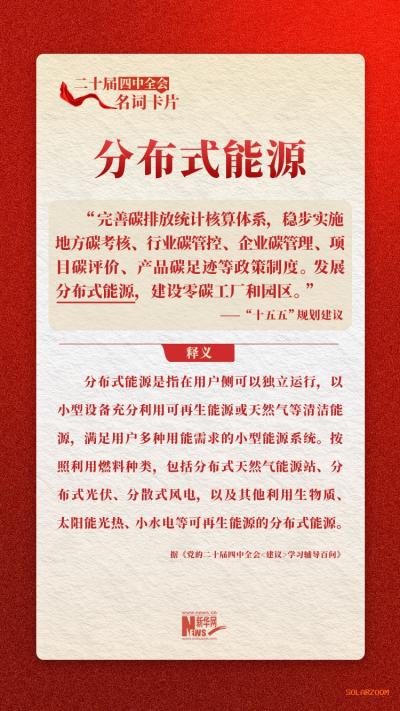
二十届四中全会名词卡片: 分布式能源
Xin Hua She· 2025-11-25 11:41
Core Insights - The development of distributed energy is crucial for optimizing energy structure, promoting energy conservation and emission reduction, and advancing sustainable economic and social development [1] Group 1: Importance of Distributed Energy - Distributed energy plays a significant role in achieving carbon peak and carbon neutrality, as it aligns better with the characteristics of renewable energy compared to centralized systems [1] - It effectively meets the energy needs of the public by providing flexible operational modes and localized energy solutions, especially in remote areas [1] - The development of distributed energy enhances energy security by increasing the supply of clean energy and reducing dependence on large energy systems [1] Group 2: Economic and Industrial Impact - Distributed energy projects have lower investment thresholds and can stimulate social investment and related industry development, supporting local economic growth [2] - Despite its potential, distributed energy faces challenges such as high operational costs and technological difficulties in small system integration [2] Group 3: Development Focus Areas - Key areas for development include the construction of zero-carbon parks that integrate various energy sources to meet diverse energy demands [3] - Promotion of zero-carbon rural construction through distributed solar and wind energy projects, utilizing complementary agricultural practices [4] - Integration of photovoltaic systems in buildings, enhancing energy efficiency through innovative architectural designs [6] - Fusion of clean energy with transportation, developing charging and hydrogen stations along transport infrastructure [6] - Strategic establishment of distributed natural gas energy stations to support power system stability [6] Group 4: Implementation Considerations - It is essential to avoid blind expansion of distributed energy projects by carefully planning development scales and layouts [8] - Ensuring adequate infrastructure and microgrid development to enhance the capacity for renewable energy integration is critical [9] - Promoting fair competition in the distributed energy market by regulating development practices and optimizing the business environment is necessary [9]