
量子计算

Search documents
【环球财经】共同应对全球关键挑战——世界经济论坛2026年年会聚焦对话与合作
Xin Hua She· 2026-01-19 08:38
Group 1: Core Insights - The World Economic Forum 2026 Annual Meeting has commenced in Davos, Switzerland, with nearly 3,000 representatives from over 130 countries discussing critical issues in economy, geopolitics, and technology [1] - The forum emphasizes the need for international dialogue to bridge divides and collaboratively address significant global challenges amid increasing geopolitical complexity and rapid technological advancements [1] Group 2: Global Risks - The 2026 Global Risks Report highlights that geopolitical economic confrontation is the primary risk, followed by armed conflict, extreme weather, social polarization, and misinformation [2] - Economic risks are rising the fastest, with 53% of chief economists surveyed anticipating continued uncertainty in the global economy over the next year, influenced by asset revaluation, debt accumulation, and the impact of AI technology [2][3] - The UN predicts a 2.7% growth in the global economy for 2026, slightly lower than the 2.8% forecast for 2025, citing low investment and limited fiscal space as factors hindering economic activity [2] Group 3: China's Role in Global Growth - China is recognized as a significant contributor to global growth, showcasing resilience in its economy amid ongoing global turmoil [4] - Experts note that advancements in China's frontier technology sectors are expected to drive productivity and growth opportunities in the coming years [4] - China's investments in clean energy, infrastructure, and the digital economy are setting a new paradigm for sustainable investment, aligning with global economic recovery efforts [4] Group 4: Importance of Dialogue - The theme of the 2026 Annual Meeting is "The Spirit of Dialogue," focusing on cooperation in a competitive world, unleashing new growth drivers, and scaling innovative technologies [6][7] - The forum stresses that constructive dialogue is essential for identifying potential cooperation paths that can promote common interests in a complex geopolitical environment [7] - The gathering of global leaders from government, business, and NGOs underscores the critical need for communication and mutual understanding to drive economic progress [7]
Riber receives a new order from Japan for MBE 6000 to scale Quantum Dot Laser production for Datacom.
Globenewswire· 2026-01-19 07:00
Core Insights - RIBER has received an order for an MBE 6000 production system from QD Laser, aimed at scaling quantum dot laser production for the Datacom sector, which is experiencing rapid growth due to data expansion and AI integration [1][3]. Company Overview - RIBER is a global leader in molecular beam epitaxy (MBE) equipment for the semiconductor industry, providing essential technology for advanced semiconductor development used in various applications, including photonics and telecommunications [7]. - QD Laser specializes in quantum-dot lasers and optoelectronic devices, recognized for delivering superior Quantum Dot solutions that excel in industrial qualification and technical precision [2][7]. Order Significance - This order marks the third MBE 6000 project for quantum-dot-based epiwafers in the Datacom sector within a month, reinforcing the MBE 6000 platform as a key industrial solution for high-value applications [3]. - The MBE 6000 system is designed to meet the specific growth conditions required for quantum-dot production, ensuring precise control over growth parameters [4]. Customer Relationship - QD Laser has been a strategic customer of RIBER since 2008, demonstrating a long-term partnership that reflects confidence in RIBER's technology and its role in advancing next-generation photonic technologies [5][6].


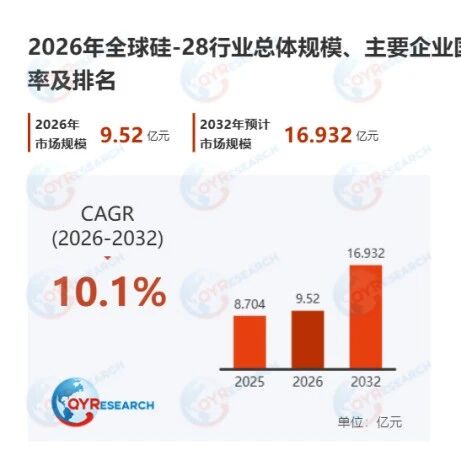
行业聚焦:全球硅-28行业头部生产商市场份额及排名调查
QYResearch· 2026-01-19 04:50
Core Viewpoint - The article discusses the significance of Silicon-28 as a stable isotope with high purity, its production processes, and its applications in advanced technologies, particularly in quantum computing and semiconductor manufacturing [2][3][4][5]. Group 1: Production and Purification - Silicon-28 is produced through complex and energy-intensive isotope separation techniques, primarily from natural silica, with only a few global institutions capable of large-scale purification [3]. - The production process involves converting silica into silane gas and then using high-speed centrifuges to separate isotopes based on their slight mass differences [3]. - The high purity Silicon-28 is essential for creating functional materials, particularly single crystals, which require stringent control over crystal defects and purity [3]. Group 2: Applications - The primary application of Silicon-28 is in quantum computing, specifically for constructing spin qubits, leveraging its unique nuclear spin properties for precise control of electron states [4]. - Silicon-28's stable lattice structure also shows potential in high-precision sensors and next-generation low-power semiconductor devices [4]. - The demand for Silicon-28 has shifted from niche research to a stable and scalable market driven by the needs of advanced semiconductor manufacturing [5]. Group 3: Market Dynamics - The global Silicon-28 market is projected to reach $230 million by 2031, with a compound annual growth rate (CAGR) of 10.7% in the coming years [7]. - Currently, the semiconductor industry accounts for approximately 84.4% of the demand for Silicon-28, indicating its critical role in this sector [12]. - The market is characterized by a shift from a few dominant players to a more competitive landscape, enhancing supply chain resilience and promoting technological advancements [5][9]. Group 4: Challenges and Opportunities - The high production costs and energy requirements for Silicon-28 isotope separation pose significant barriers to entry for potential users [16]. - Geopolitical factors and the strategic importance of Silicon-28 have led to a focus on supply chain security, prompting countries to support domestic production capabilities [17]. - The evolving landscape presents opportunities for new entrants and related industries, as demand for high-purity Silicon-28 substrates is expected to grow significantly [17].
首战捷报!2025年“兴火·燎原”创新马拉松公开赛 南部赛区决赛圆满落幕
Xin Lang Cai Jing· 2026-01-19 03:04
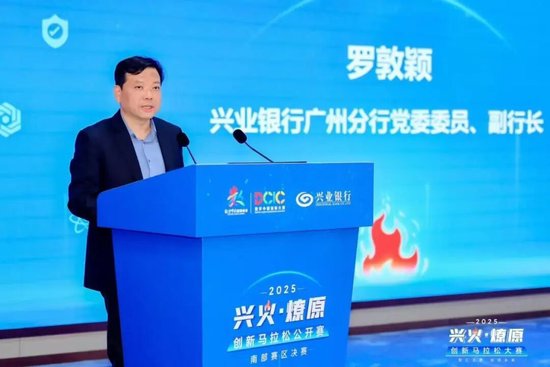
Core Viewpoint - The "Xinghuo·Liaoyuan" Innovation Marathon Finals for the Southern Region successfully concluded in Guangzhou, showcasing the vibrant innovation potential of the South China region through a collaborative effort involving multiple authoritative institutions [1][11]. Group 1: Event Overview - The competition was guided by the Digital China Construction Summit Committee and organized by Industrial Bank in partnership with various organizations, including the China Communications Society and Huawei [1][11]. - The Southern Region finals featured 14 projects that advanced to the final round, highlighting the innovative capabilities in the financial technology and ecological scene sectors [1][11]. Group 2: Institutional Role - Industrial Bank's Guangzhou branch emphasized its commitment to innovation as a core value and development strategy, aiming to discover real value and foster genuine cooperation through the competition [3][13]. - The bank plans to leverage its resources, including technology and market networks, to support promising projects, positioning itself as an "innovation partner" [3][13]. Group 3: Competition Details - A total of 223 projects from regions including Fujian, Guangdong, Guangxi, Hunan, Jiangxi, Hainan, and Hong Kong and Taiwan participated in the selection process [8][17]. - The evaluation panel, consisting of experts from Industrial Bank, Huawei, and other institutions, assessed projects based on innovation, feasibility, and overall value [5][14]. Group 4: Award Winners - The first prize was awarded to the AI self-learning system for financial big data by China Electronics Technology Group Corporation [10][19]. - The second prize went to the "AI Quality Inspection + Trusted Space" project for the textile industry by Xiamen University, and the financial quantum integrated OTN dedicated line system by Fujian Broadcasting Network Group [10][19]. - Additional awards included third prizes and excellence awards for various innovative projects in AI applications, data modeling, and intelligent risk control [10][19].

可扩展中性原子阵列技术获验证 为构建10万量子比特计算机奠定基础
Ke Ji Ri Bao· 2026-01-19 00:55
此外,超表面由氮化硅和二氧化钛制成,可承受超过2000瓦/平方毫米的激光强度,约为地表太阳光的 100万倍,这为大规模俘获原子提供了条件。 实验中,团队构建了多种高度均匀的二维原子阵列,还制备了一块直径3.5毫米,包含超过1亿个像素的 超表面,可生成600×600阵列,总计36万个光镊,规模比现有技术提升两个数量级。 该技术不仅有望推动大规模量子计算发展,还可应用于量子模拟和高精度光学原子钟等中性原子量子技 术。 (文章来源:科技日报) 中性原子阵列是构建量子计算机的新兴平台。研究团队在实验中俘获1000个锶原子,并验证该方法可在 原理上扩展至10万个以上,这些原子未来或可作为量子比特使用。 原子在量子计算中具有天然优势,可稳定呈现量子叠加和纠缠等特性,且彼此完全一致,无需像固态量 子比特那样校准与同步。但难点在于如何实现大规模精确操控。 过去十多年,科学家通常利用空间光调制器或声光偏转器生成光镊阵列。单个光镊是一束高度聚焦的激 光,可将单个原子固定在焦点上,阵列则由许多光镊组成,但设备复杂、体积庞大,限制了阵列规模。 此次研究中,超表面像素尺寸小于200纳米,远低于所操控的520纳米激光波长,可在无需额外光 ...
猎头黄仁勋的2025:高管从巨头挖,干活钟爱华人创业团队
量子位· 2026-01-18 05:29
henry 发自 凹非寺 量子位 | 公众号 QbitAI 已经是全球市值第一了,还怎么继续往上走? 英伟达给出的答案很简单: 挖人,挖更多的人。 过去的2025年,黄仁勋一边扩编管理层,一边掏钱收团队—— 从挖角市场、政策、人力资源高管,到收购初创公司"打包"引入技术负责人,一套典型的"黄氏挖人+黄氏收购"正在成型。 不止芯片,用挖人重塑"第二增长曲线" 2025财年,英伟达营收 1305亿 美元,较前一财年增长逾一倍,成为科技史上的增长奇迹。 与此同时,英伟达正在用挖人重塑自己的"第二增长曲线": 一方面系统性"挖人",补齐市场、政策、研究与组织管理等关键能力。 另一方面则通过收购初创公司,直接将核心技术负责人和软件骨干纳入体系。 在今年最新的人事动作中,英伟达把"挖人"的铲子伸向了谷歌。 据悉,英伟达将聘请谷歌云老将 Alison Wagonfeld 出任公司 首位首席营销官 (Chief Marketing Officer,CMO) 。 Wagonfeld于今年2月正式履新,将此前分散在多位高管手中的相关职责,统一整合,全面负责英伟达的市场与传播工作。 (注:英伟达此前从未设立过专职的首席营销官(CM ...


猎头黄仁勋的2025:高管从巨头挖,干活钟爱华人创业团队
Xin Lang Cai Jing· 2026-01-18 05:16
Core Viewpoint - Nvidia, now the world's most valuable company, aims to continue its growth by aggressively hiring talent and acquiring teams to enhance its capabilities and reshape its second growth curve [1][2][3]. Group 1: Talent Acquisition Strategy - Nvidia has been systematically hiring executives from various sectors, including market, policy, research, and organizational management, to fill key capabilities [3][4]. - The company has recently appointed Alison Wagonfeld, a former Google Cloud executive, as its first Chief Marketing Officer (CMO), consolidating marketing responsibilities under her leadership [5][6][8]. - Kristin Major, a seasoned HR executive from HPE, has joined Nvidia as Senior Vice President of Human Resources, bringing extensive experience in talent management [10][12][14]. - In the quantum computing domain, Nvidia hired Krysta Svore from Microsoft, who will oversee application research and engineering in quantum technology [16][19][20]. Group 2: Acquisitions and Strategic Hiring - Nvidia's strategy includes "acqui-hire" transactions, where the company acquires startups to integrate their core teams and technologies [27][66]. - The acquisition of Nexusflow aimed to strengthen Nvidia's position in AI agents and efficient inference, bringing in key personnel including CEO Jiantao Jiao [28][29][70]. - CentML was acquired for over $400 million to enhance CUDA toolchain and model deployment efficiency, integrating its founders and engineers into Nvidia's AI software team [34][75]. - Nvidia also acquired LeptonAI to bolster its cloud computing and AI platform capabilities, with its founders joining Nvidia's leadership [36][75]. Group 3: Market Position and Future Outlook - Nvidia's revenue for the fiscal year 2025 reached $130.5 billion, more than doubling from the previous year, marking a significant growth milestone in tech history [2][47]. - The company's strategic moves in hiring and acquisitions are designed to transition from being a GPU hardware supplier to a comprehensive system-level platform provider [45][84]. - Nvidia's focus on AI inference optimization, agent deployment, and computational scheduling positions it to maintain market dominance and prepare for future AI advancements [84][85].


九方智投2026高端投资峰会解码未来趋势
Zhong Guo Jin Rong Xin Xi Wang· 2026-01-18 01:39
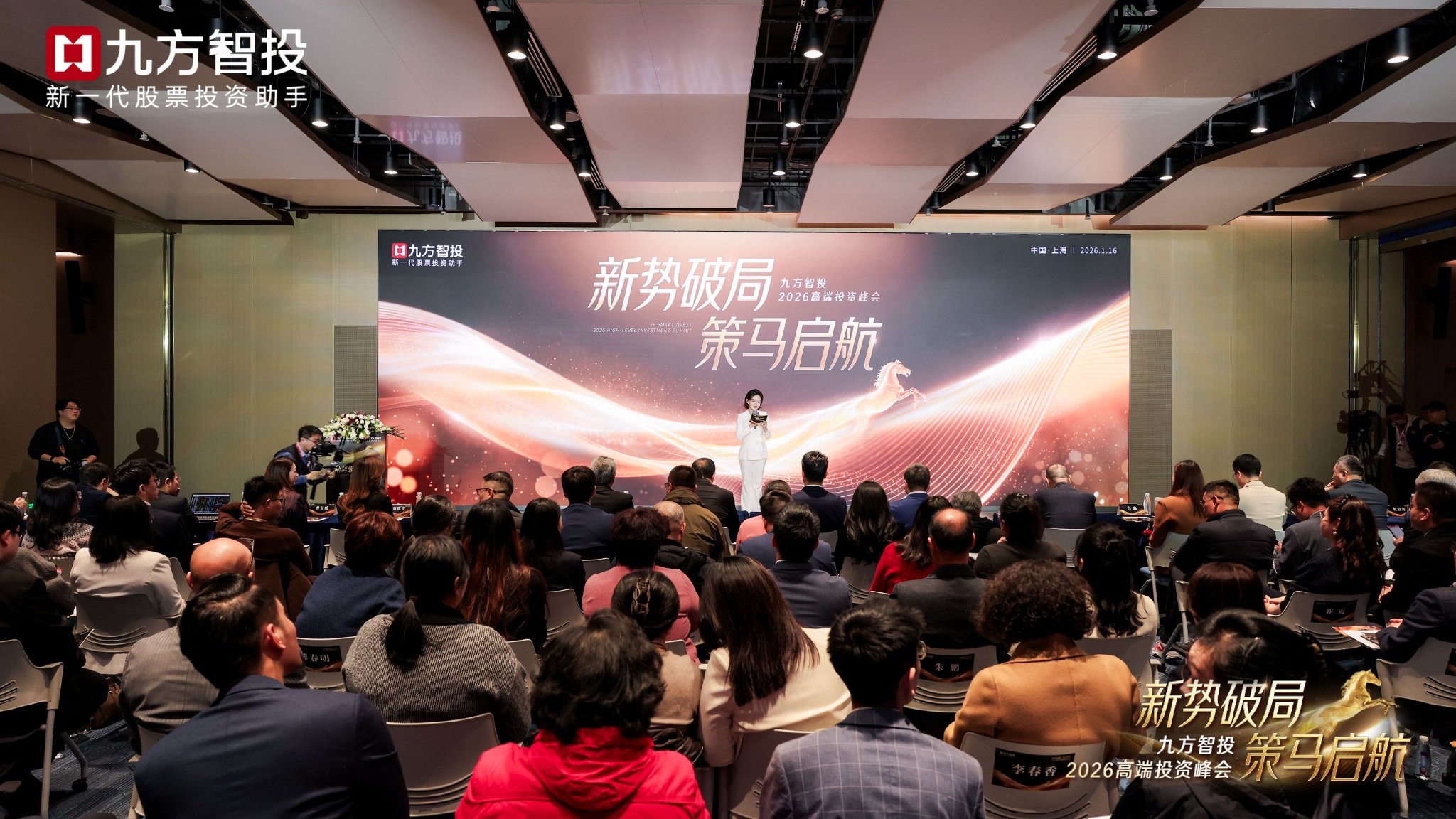
Core Insights - The 2026 high-end investment summit hosted by Jiufang Zhitu aims to create a high-quality interactive platform for wealth dialogue, focusing on strategic insights and discussions [1][2]. Group 1: Event Overview - Jiufang Zhitu is transitioning from a traditional "investment advisor" role to a solid partner in wealth journeys, emphasizing a customer-centric approach [2]. - The summit featured prominent experts discussing new trends in the capital market for 2026, including insights from Jiufang Zhitu's Chief Economist and other leading economists [5][9]. Group 2: Economic Insights - The Chief Economist, Xiao Lisheng, highlighted that China's economy is in a critical structural transformation phase, with expectations of continued "moderately loose" monetary policy and expanded fiscal spending by 2026 [5][9]. - Jin Canrong discussed the importance of industrialization as a foundation for national wealth, noting China's rapid industrialization over the past three decades [7][9]. - The sixth industrial revolution is anticipated to reshape global industry, with a focus on hard technology sectors such as AI and new energy [9][11]. Group 3: Policy Recommendations - Guan Tao outlined three main tasks for the "14th Five-Year Plan" period: strengthening the domestic market, achieving technological self-reliance, and expanding openness [11]. - He also presented five "musts" and five key focus points for economic work in 2026, emphasizing the need to explore economic potential and integrate investment in both goods and people [11][13]. Group 4: Investment Opportunities - The roundtable discussion emphasized the development and valuation of AI technology companies, acknowledging the presence of bubbles but viewing them as typical in the early stages of technological breakthroughs [14]. - Experts noted that while the real estate market is stabilizing, a full recovery in prices will take time, advising investors to remain cautious [15].
The Stock Market Has a Serious Federal Reserve Problem -- and It's Not What You Think It Is
Yahoo Finance· 2026-01-17 09:26
Trump has been quite vocal about his calls for the Federal Open Market Committee (FOMC) -- the 12-person body, which includes Powell, that's responsible for setting U.S. monetary policy -- to significantly lower interest rates. A lower interest rate environment would potentially lessen credit burdens on consumers and lower mortgage rates for homeowners.While the prospect of never-before-seen criminal charges for a Fed chair is making headlines, this spat between President Trump and Fed Chair Powell concerni ...
知名策略师“抛弃”比特币,理由是“担心量子计算很快实现”
Hua Er Jie Jian Wen· 2026-01-17 01:53
Core Viewpoint - Christopher Wood, the global equity strategist at Jefferies, has completely removed Bitcoin from his investment portfolio due to concerns that advancements in quantum computing may undermine the cryptocurrency's viability as a reliable store of value, particularly for long-term investors like pension funds [1]. Group 1: Investment Strategy Changes - Wood has liquidated his 10% Bitcoin position in his portfolio model and reallocated the funds to 5% in physical gold and 5% in gold mining stocks [1]. - The decision is based on the belief that the emergence of quantum computing could destabilize Bitcoin's foundational principles, potentially occurring in the next few years rather than over a decade [1]. Group 2: Quantum Computing Concerns - Wood highlights that quantum computers could theoretically break Bitcoin's encryption algorithms, allowing for the reverse engineering of private keys used for transaction authorization [1]. - This potential capability could undermine Bitcoin's status as a store of value and its role as a digital alternative to gold [1]. Group 3: Industry Perspectives - The debate within the cryptocurrency community regarding the risks posed by quantum computing is indicative of broader uncertainties, with some developers downplaying the threat while others believe the community has not adequately addressed it [2]. - Wood asserts that the long-term implications of quantum computing are likely to be beneficial for gold, which he describes as a historically tested hedge in an increasingly uncertain geopolitical environment [2].