
物理AI

Search documents
AI周报 | 智谱、MiniMax港股上市大涨;商务部回应审查Meta收购Manus
Di Yi Cai Jing· 2026-01-11 02:58
Group 1 - Google's market capitalization surpassed Apple's for the first time since 2019, closing at $3.89 trillion compared to Apple's $3.85 trillion, marking a significant shift in the tech sector [4] - Nvidia's market cap stands at $4.6 trillion, establishing a new ranking of Nvidia, Google, and Apple as the top three companies by market value [4] - The market perceives the shift in rankings as a reflection of differing AI strategies between Google and Apple, with a focus on AI technology reshaping industry dynamics [4] Group 2 - MiniMax and Zhizhu, two AI model companies, saw significant stock price increases upon their Hong Kong listings, with MiniMax rising nearly 110% to a market cap of over HKD 105 billion, while Zhizhu increased over 20% to a market cap of HKD 69.8 billion [2] - The contrasting stock performances suggest differing investor sentiments towards their business models, indicating a preference for consumer-facing (C-end) companies over business-facing (B-end) ones [2] Group 3 - Meta's $2 billion acquisition of Chinese AI startup Manus is under scrutiny by China's Ministry of Commerce to ensure compliance with local laws and regulations regarding technology exports [3] - Manus, founded by Chinese entrepreneur Xiao Hong, gained rapid valuation growth, reaching $500 million after a $75 million funding round, before being targeted for acquisition by Meta [3] Group 4 - xAI, led by Elon Musk, completed a Series E funding round raising $20 billion, doubling its valuation to $230 billion, with participation from top global investors including Nvidia and Cisco [5] - The funding round reflects the ongoing trend of substantial capital inflows into AI startups, with xAI now among the top three highest-valued AI companies [5] Group 5 - Nvidia unveiled its new Rubin platform featuring six new chips, including the Rubin GPU, which boasts performance metrics significantly surpassing previous models, indicating a leap in computational capabilities [7] - The Rubin GPU's performance is five times that of its predecessor, highlighting Nvidia's focus on enhancing AI processing power [7] Group 6 - AMD's CEO emphasized the need for a 100-fold increase in global computing power to meet the growing demand for AI, projecting that active AI users will reach 5 billion by 2030 [8] - The conversation around computational capacity at CES reflects the industry's urgent need to optimize performance to keep pace with AI model growth [8] Group 7 - Lenovo's chairman stated that the AI era will not see a "winner-takes-all" scenario, emphasizing the importance of collaboration across hardware, chip, and AI model companies [9] - Lenovo introduced its personal superintelligent device, Lenovo Qira, and announced a partnership with Nvidia to create an AI cloud super factory [9] Group 8 - OpenAI launched ChatGPT Health, targeting the healthcare market, which is projected to grow significantly, with the global AI healthcare market expected to reach approximately $505.59 billion by 2033 [10] - The integration of health-related functionalities into ChatGPT highlights the increasing demand for AI applications in healthcare [10] Group 9 - TianShu ZhiXin, a domestic AI chip manufacturer, went public in Hong Kong, raising approximately HKD 3.7 billion, with plans to invest in GPU chip development and AI solutions [12] - Despite revenue growth, TianShu ZhiXin has not yet achieved profitability, indicating challenges in the competitive GPU market [12] Group 10 - Arm announced the establishment of a physical AI department, merging its automotive and robotics divisions, aiming to enhance labor efficiency and economic impact through physical AI solutions [14] - The focus on physical AI at CES underscores the growing interest in hardware solutions that interact with the real world [14]


黄仁勋:物理AI走进现实世界,拼的不单是算力
聪明投资者· 2026-01-11 02:06
Group 1 - The article highlights the impressive technological innovations showcased at the CES, particularly emphasizing NVIDIA's CEO Jensen Huang's presentation on the imminent arrival of physical AI [1] - Huang's engaging offline discussions following his main presentation are noted for their personality and interest [2] - The article recommends several insightful readings, including Huang's full speech at CES 2026, which covers three key topics and introduces a "chip monster" [3] Group 2 - The article mentions a bullish consensus among private equity firms regarding a return to 4000 points in the market, focusing on identifying "uncrowded growth" opportunities and capturing "low-hanging fruit" [3] - It references insights from Duan Yongping's 2025 sharing, stressing the importance of investing in good companies and the necessity for individuals to understand and learn about AI [3] - Liu Yuhui's latest commentary on the "G2 competition" era emphasizes the significance of edge intelligence, gold, and commodities as major beta factors [3] - The article notes that key variables include monetary policy, with Ray Dalio's latest review predicting a long-term return of only 4.7% for the US stock market [3]

机器人产业跟踪:从CES看 简单量产叙事将边际变弱 AGI叙事将边际变强
Xin Lang Cai Jing· 2026-01-11 00:32
风险提示 厂商生产不及预期、场景需求落地不明确导致低于预期、国家政策变化导致行业发展放缓、行业融资不 及预期、模型发展和数据采集慢于预期、订单执行效果低于预期、产品降价风险。 看好具备构建大脑能力的领跑公司及产业链。相比于快速上量,我们认为国家也在引导大脑能力的建 设。近期国家发改委提到要着力防范重复度高的产品"扎堆"上市、研发空间被压缩等风险;支持企业、 高校、科研机构等围绕"大小脑"模型协同、云侧与端侧算力适配、仿真与真机数据融合等技术进行攻 关,解决产业卡点堵点问题。我们认为两类领跑型公司具有投资机会,第一类是特斯拉核心产业链,特 斯拉官宣在自研世界模型中训练Optimus,第二类是具有垂直场景的本体公司,场景应用有利于数据和 模型的积累。 人形机器人在近期CES 展中大放异彩,我国产业链快速发展,具有极强的竞争力。向前看,我们认为 简单机器人的量产对投资的影响会边际变弱,但AGI 的叙事有望边际变强,看好具备构建大脑能力的 领跑公司及产业链,包括特斯拉核心产业链和具有垂直场景的本体公司。相关标的:拓普集团 (601689,买入)、三花智控(002050,买入)、五洲新春(603667,买入)、恒立液压 ...

美国消费电子展上的 人工智能新趋势
Xin Lang Cai Jing· 2026-01-10 23:42
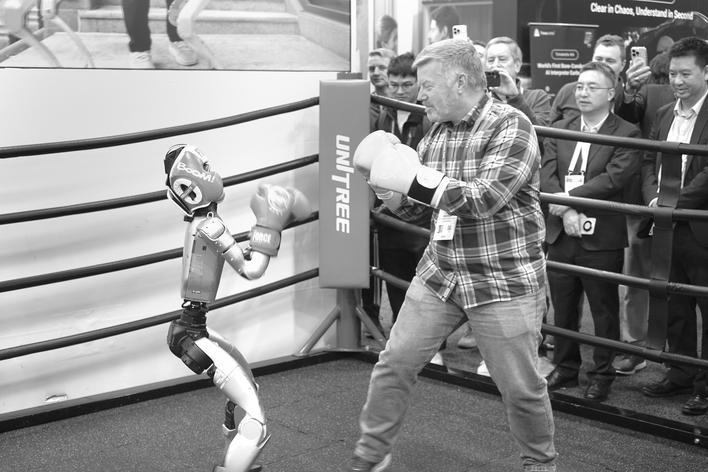
Group 1 - The core focus of the CES 2026 has shifted from "model capabilities" to "product capabilities," emphasizing scalable applications of AI rather than just technical showcases [2][3] - AI is becoming a "system-level capability," with discussions centered around practical applications, integration into existing systems, and large-scale deployment [2][3] - The exhibition showcased a variety of AI devices and solutions that demonstrate autonomous decision-making and interaction with real-world environments, indicating a move towards industrial application [2][3] Group 2 - Robotics was a major highlight at CES, with products designed for specific applications in manufacturing, logistics, retail, and elder care, focusing on long-term operational stability [5] - Robots demonstrated capabilities in various environments, performing tasks such as sorting, transporting, and providing services, showcasing advancements in automation and reliability [5] - The development of Chinese robotics was noted for its rapid progress and ability to perform daily tasks reliably, reflecting advancements in perception, computation, and control technologies [5] Group 3 - The trend of running AI models locally on devices is increasing, addressing needs for real-time processing, energy efficiency, and privacy, while cloud services continue to support training and updates [6] - This shift highlights the importance of collaboration between edge and cloud computing, with both needing to evolve together for future AI development [6] Group 4 - The CES reflects a change in industry logic, with AI reshaping product forms and industry divisions, elevating the importance of chips, manufacturing, and system integration beyond just internet companies [7] - The focus on deep collaboration between hardware and software is becoming a competitive edge, as single technological breakthroughs are no longer sufficient for sustained advantage [7] - The transition of AI from a rapid experimentation phase to a more reliable and secure industrial phase is evident, marking CES as a key platform for observing global AI industry trends [7]
投顾周刊:物理AI将迎来“ChatGPT时刻”
Wind万得· 2026-01-10 22:15
Group 1 - Over 50 trillion yuan in time deposits are facing maturity, leading to a "deposit migration" and a re-pricing of asset allocation. By the end of 2026, the scale of time deposits maturing is estimated to be around 57 trillion yuan, with a focus on reallocation of funds in the context of deposit rates entering the "1% era" [2] - Bank wealth management continues to prioritize "fixed income+" at the beginning of the year, but product offerings are increasingly emphasizing multi-asset and diversification. In 2026, bank wealth management will enter a new phase of comprehensive net value, with newly issued products primarily consisting of closed-end fixed income types [2] - New regulations on public fund sales expenses will take effect from January 1, 2026, imposing stricter constraints on short-term trading behavior, with redemption fees for equity and mixed funds based on holding periods [2] Group 2 - Public funds are experiencing a "high-low switch" in positioning, with the digital economy expected to be a key focus area. Fund managers indicate a shift in expectations from AI technology infrastructure to application realization, with strong performance in the digital economy sector [4] - China's foreign exchange reserves reached a ten-year high, with gold reserves increasing for 14 consecutive months. As of December 2025, foreign exchange reserves stood at 3.3579 trillion USD, up by 11.5 billion USD [4] - Morgan Stanley has applied to issue cryptocurrency ETFs, marking its entry into the popular fund sector two years after the surge in U.S. cryptocurrency ETFs [4] Group 3 - Recent global stock market performance has been mixed, with the Chinese market showing gains while the U.S. market experienced declines. The Shanghai Composite Index rose by 3.82%, while the Dow Jones Industrial Average fell by 2.32% [6] - Recent trends in government bond yields show a mixed performance, with the 1-year Chinese government bond yield declining by 4.35 basis points to 1.29%, while the 10-year yield rose by 3.55 basis points to 1.88% [7] - The recent week saw stable performance in the Wande Fund Index, with the total stock fund index rising by 4.96% [10] Group 4 - In the commodity market, precious metals showed mixed trends, with COMEX gold rising by 4.36% and silver by 12.36%, while international oil prices continued to rise [12] - The recent week saw a rebound in the U.S. dollar index by 0.69%, with slight fluctuations in the RMB to USD exchange rate [12] - Recent data indicates that fixed income+ funds dominate both in number and scale, with 359 such funds accounting for 50.56% of total products and 66.54% of total scale [13][14] Group 5 - Bank wealth management subsidiaries have become the core force in financial product issuance, with 517 subsidiaries participating, accounting for 72.82% of all institutions [15] - City commercial banks and rural commercial banks have also been active in product issuance, contributing significantly to the issuance of bank-related products [16] - The overall trend indicates a shift from "scale-driven" to "capability-driven" for wealth management subsidiaries, providing diversified options for investors [17] Group 6 - Reports indicate that overseas "long money" is actively positioning in Chinese assets, with a notable increase in interest in the Chinese stock market, particularly in technology and biotechnology sectors [20] - Domestic institutions believe the market is likely to evolve from a "structural bull" to an "index bull," with a focus on AI applications and humanoid robot production [21] - There is a divergence in Wall Street's outlook on gold prices, with some institutions optimistic while others predict a decline in 2026 [22]

加州大学伯克利Dr. Allen Yang:物理AI的分水岭时刻尚未到来|CES 2026
Tai Mei Ti A P P· 2026-01-10 14:33
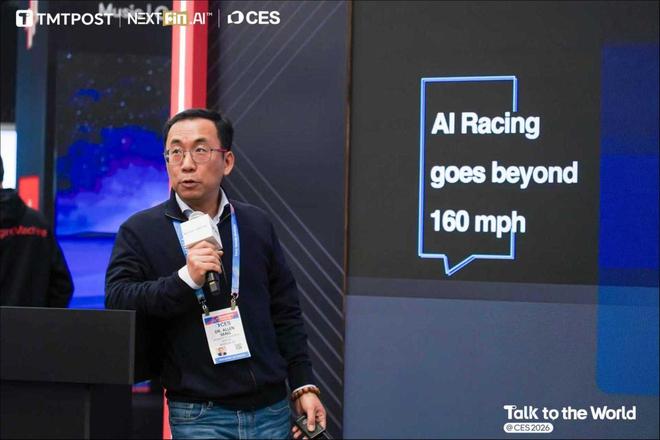
Core Insights - The artificial intelligence industry is currently engaged in a "GPU race," with a focus on cloud-based AI applications, but there is a call to shift attention towards physical AI and its potential breakthrough moments [1][5][16] - Dr. Allen Yang emphasizes that while AI has made significant strides with models like AlphaGo, physical AI is still awaiting its own "watershed moment" due to unique challenges rooted in the complexities of the physical world [2][6][12] Group 1: Challenges in Physical AI - Physical AI lacks comprehensive training data for extreme scenarios, unlike language models that can leverage vast internet data [2][13] - Real-time decision-making with millisecond-level latency is critical for applications like autonomous driving, where delays can lead to failures [2][14] - Many cutting-edge scenarios lack reliable cloud connectivity, necessitating the use of edge AI deployed locally on devices [2][15] Group 2: Innovations and Competitions - The Berkeley AI Racing Team has achieved significant milestones, including a top speed of 163 miles per hour in autonomous driving competitions, showcasing the need for complex real-time perception and planning [4][18] - The upcoming Tianmen Mountain humanoid robot challenge aims to test robots' mobility and decision-making in unstructured terrains, further pushing the boundaries of physical AI [4][29] - The collaboration with nine universities in China for the Tianmen Mountain challenge highlights the importance of interdisciplinary cooperation and real-world experience in advancing physical AI [4][26] Group 3: Future Directions - The focus on physical AI is expected to grow, with the potential for new breakthroughs that could redefine the field, similar to past milestones in AI history [2][18][29] - The upcoming competitions and challenges are designed to foster innovation and collaboration among institutions, aiming to discover the next "AlphaGo moment" in physical AI [25][29]
物理AI落地的标杆答案,深庭纪给出了户外陪伴的最优解
Tai Mei Ti A P P· 2026-01-10 11:55
Core Insights - The emergence of physical AI is reshaping industry perceptions and driving market evolution, with significant advancements showcased at CES 2026 [1][4] - The introduction of the Rovar X3 by DeepTingJi marks a pivotal moment in the outdoor companion robot sector, demonstrating the potential for practical applications beyond mere demonstrations [3][12] Industry Trends - The CES 2026 event highlighted a strong presence of Chinese companies in the embodied intelligence sector, with over 50% representation, although many products remain confined to controlled environments [3][4] - The global outdoor consumption market has surpassed $500 billion, growing at over 15% annually, indicating a substantial unmet demand for intelligent companionship in outdoor activities [5][7] Product Development - Rovar X3 is designed to transition from indoor to outdoor environments, addressing the need for reliable companionship and emotional value in outdoor settings [5][11] - The robot features a terrain-adaptive power system and advanced multi-modal perception technology, enabling it to navigate complex outdoor terrains effectively [11][12] Market Positioning - The outdoor companion robot market is still in its early stages, with Rovar X3 positioned to capture the attention of outdoor enthusiasts aged 30-50 [7][13] - DeepTingJi aims for an initial sales target of 10,000 units in the first year, focusing on brand establishment and customer satisfaction before expanding to other markets [13][15]
人形机器人利好!T链一级供应商,冲刺IPO
Xin Lang Cai Jing· 2026-01-10 09:40
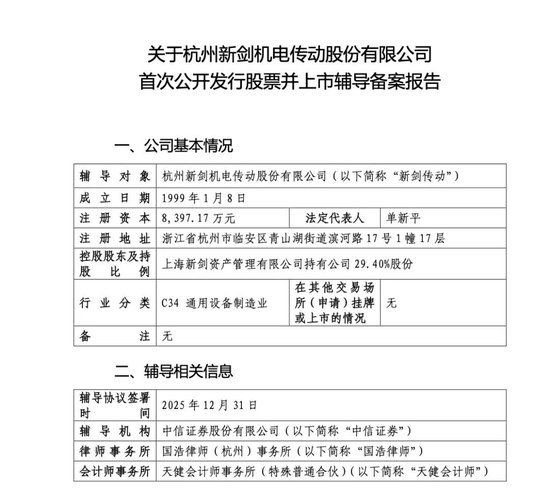
炒股就看金麒麟分析师研报,权威,专业,及时,全面,助您挖掘潜力主题机会! 据证监会官网,杭州新剑机电传动股份有限公司(下称"新剑传动")于1月9日启动上市辅导,中信证券 担任辅导机构。 因与特斯拉Optimus产业链的密切关系,新剑传动此前虽未上市,但在产业界和投资界仍拥有极高的知 名度。多位券商分析师称,新剑传动为人形机器人T链(即"特斯拉")的一级供应商。 | 辅导对象 | | 杭州新剑机电传动股份有限公司(以下简称"新剑传动") | | | | --- | --- | --- | --- | --- | | 成立 н | 期 | 1999年1月8日 | | | | 注 数 资 本 | | 8,397.17 万元 | 法定代表人 | 单新平 | | 注 费 地 址 | | 浙江省杭州市临安区青山湖街道演河路17号1幢17层 | | | | 控股股东及持 股 比 例 | | 上海新剑资产管理有限公司持有公司 29.40%股份 | | | | 行 业 分 类 C34 通用设备制造业 | | | 在其他交易场 所(申请)挂牌 | 无 | | | | | 或上市的情况 | | | 香 注 | | 元 | | | ...

【环球财经】美消费电子展上演讲嘉宾如何谈AI
Xin Hua She· 2026-01-10 05:13
Core Insights - The 2026 CES highlighted the next phase of AI development, focusing on breakthroughs in computing power, the transition from "cloud virtual" to "physical AI," and personalized services driven by intelligent agents [1] Group 1: Computing Power Breakthroughs - The CEO of AMD, Lisa Su, stated that the number of active global AI users has surpassed 1 billion and is expected to exceed 5 billion in the future. Current computing power is insufficient to support the vision of ubiquitous AI, necessitating a 100-fold increase in global computing power over the next few years [2] - The industry is evolving from traditional methods of enhancing chip performance to a full-stack collaborative design approach, integrating chips, networks, and storage into a unified AI computing platform [2] - NVIDIA's CEO, Jensen Huang, introduced the "Vera Rubin" platform, a system-level computing platform comprising six chips, designed to significantly reduce model training time and inference costs [2] Group 2: Physical AI Implementation - Huang emphasized the evolution of AI towards "physical AI," which will understand the physical world, marking a pivotal moment for AI akin to the "ChatGPT moment" [3] - The transition from passive systems to interactive systems capable of understanding and assisting human interaction with the world is underway, with applications in autonomous driving, robotics, and industrial automation [3] - Siemens' chairman highlighted the shift towards AI-driven products and industries, indicating that industrial AI is becoming a transformative force rather than just a functional tool [3] Group 3: Development of Intelligent Agents - The co-founder of Liquid AI, Ramin Hasani, predicted that this year will be the year of "proactive intelligent agents," moving beyond reactive assistants to systems that can understand complex goals and autonomously take action [4] - Lenovo introduced its first personal super intelligent agent, Lenovo Qira, which operates across platforms and devices, enhancing user experience through context awareness and preference prediction [4] Group 4: Hybrid AI and Human-Centric Development - Lenovo's CEO, Yang Yuanqing, emphasized that hybrid AI, integrating personal, enterprise, and public intelligence, is crucial for personalized and diverse AI development [5] - The CEO of Havas Group stressed that AI should serve as a collaborative partner in human creativity rather than a replacement, reinforcing the importance of keeping humans at the center of technological advancements [5]


何小鹏为高德“飞行街景”上线点赞:将持续探索物理世界与 AI 深度耦合的更多可能
Xin Lang Cai Jing· 2026-01-10 04:59
Core Insights - The chairman and CEO of XPeng Motors, He Xiaopeng, praised the launch of Gaode's "Flying Street View" on Weibo, highlighting its potential to allow small businesses to create "flying" storefronts using mobile phones [1] - This development is seen as not just an upgrade in experience but also a significant breakthrough in AI's ability to understand and replicate the physical world [1] - The company believes that world models will become the core technological foundation driving the next generation of vehicles, robots, and flying cars [1] - XPeng Motors is committed to deepening its exploration of physical AI and the integration of the physical world with AI [1] - The company looks forward to collaborating with Gaode Map and other industry players to further advance this initiative [1]