
市场流动性

Search documents
8月以来央行加码投放中长期流动性
Zhong Guo Zheng Quan Bao· 2025-08-24 20:10
Group 1 - The central bank is expected to continue using various monetary policy tools to maintain ample liquidity in the banking system, with a focus on medium and short-term market liquidity adjustments [1][2][3] - As of August 22, the central bank's net medium-term liquidity injection reached 600 billion yuan, double that of the previous month, indicating a strong supportive monetary policy stance despite stable macroeconomic conditions [2] - The central bank has been actively managing market volatility by announcing operation quantities and durations before conducting reverse repos and MLF operations, which helps in conveying policy signals and stabilizing market fluctuations [2][3] Group 2 - The upcoming week will see a total of 20.77 billion yuan in reverse repos maturing, along with 30 billion yuan in MLF and 90 billion yuan in buyout reverse repos, reflecting ongoing liquidity management efforts [1] - The central bank conducted a 600 billion yuan MLF operation on August 25, marking the sixth consecutive month of increased MLF operations, with a net injection of 300 billion yuan [1] - Market experts predict that the central bank will likely continue to inject medium-term liquidity through increased MLF and reverse repo operations, keeping market liquidity in a stable and slightly loose state [2]
中期流动性净投放创半年来最大规模,8月6000亿元续作后,MLF有望继续加量
Bei Jing Shang Bao· 2025-08-24 10:49
Core Viewpoint - The People's Bank of China (PBOC) is increasing the Medium-term Lending Facility (MLF) operations to maintain ample liquidity in the banking system, with a planned injection of 600 billion yuan for a one-year term on August 25, 2025 [1] Group 1: MLF Operations - The PBOC will conduct a 600 billion yuan MLF operation on August 25, 2025, using a fixed quantity, interest rate bidding, and multi-price bidding method [1] - The net injection from MLF operations in August is 300 billion yuan, marking the sixth consecutive month of increased MLF operations since March 2025 [4][5] - The total net injection of mid-term liquidity in August reaches 600 billion yuan, which is double the amount in July 2025 and the largest since February 2025 [7] Group 2: Market Conditions and Policy Coordination - The increase in MLF operations is a response to the peak period of government bond issuance and regulatory guidance for financial institutions to enhance credit supply [4] - The PBOC's actions reflect a coordinated approach between monetary and fiscal policies, aimed at promoting credit expansion to meet financing needs of enterprises and households [4][5] - Despite a stable macroeconomic environment in the first half of the year, the PBOC continues to adopt a supportive monetary policy stance [5] Group 3: Future Outlook - The likelihood of a reserve requirement ratio (RRR) cut in the short term is low, with the PBOC expected to maintain liquidity through MLF and reverse repos [6] - Economic indicators, such as the manufacturing PMI, suggest increasing downward pressure on the economy, which may lead to potential RRR cuts and resumption of government bond trading in the fourth quarter [6] - Overall, market liquidity is anticipated to remain stable and slightly loose in the second half of the year, with limited upward pressure on market interest rates [6]

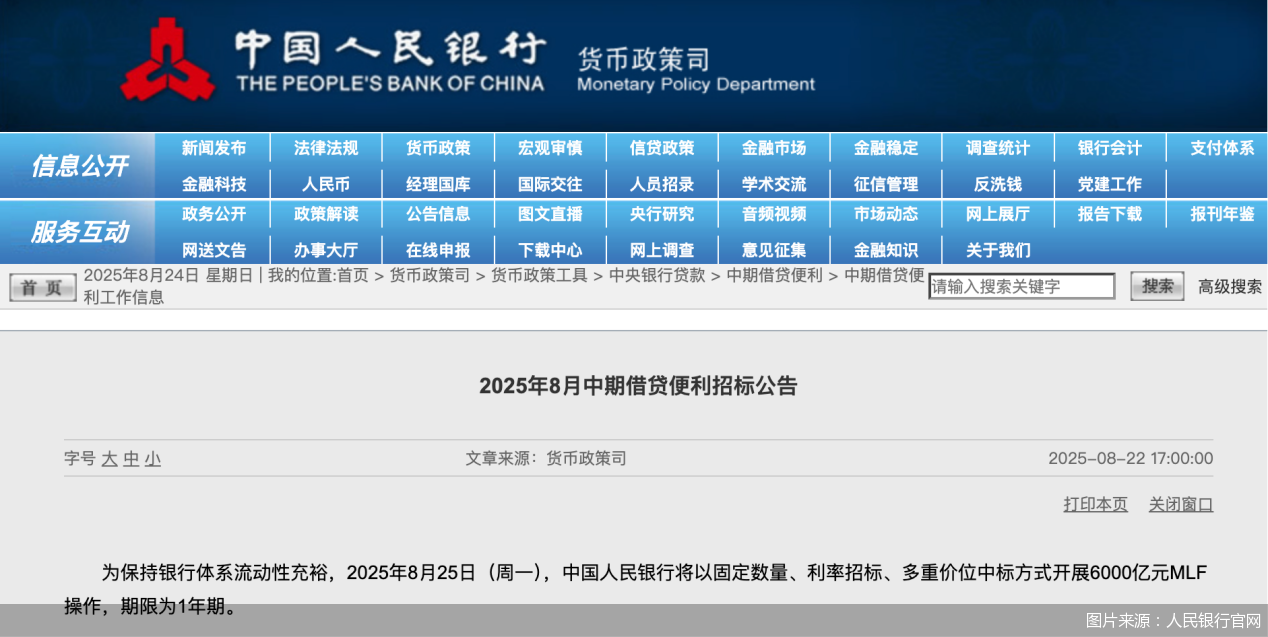
央行开展6000亿元MLF操作 专家称有助于稳定市场预期
Zhong Guo Jing Ying Bao· 2025-08-23 14:27
Group 1 - The People's Bank of China (PBOC) announced a 600 billion MLF operation to maintain liquidity in the banking system, resulting in a net injection of 300 billion yuan, aligning with market expectations and marking the sixth consecutive month of increased operations [1] - As of August, the total MLF operations for the year reached 33.5 trillion yuan, with 28.89 trillion yuan maturing, resulting in a net injection of 4.61 trillion yuan [1] - The continuous injection of medium-term liquidity reflects the coordination between monetary and fiscal policies, aiding in the credit expansion process to better meet financing needs of enterprises and households [1] Group 2 - Recent market conditions, including rising stock market indices and tightening liquidity, prompted the PBOC to increase fund injections through MLF and other tools to stabilize market expectations [2] - The A-share market has seen a resurgence, with the Shanghai Composite Index surpassing 3,800 points, marking a ten-year high, indicating strong market performance [2] - The PBOC's ongoing medium-term liquidity injections signal a supportive monetary policy stance despite a stable macroeconomic environment in the first half of the year [2] Group 3 - In August, the PBOC conducted two rounds of reverse repos, injecting medium-term liquidity of 30 billion yuan through operations on August 8 and August 15 [3] - The reverse repo tool, introduced in October 2024, allows the PBOC to adjust market liquidity more precisely and timely [3] - Experts anticipate further monetary policy adjustments, including potential rate cuts, to maintain liquidity and support economic growth [3][4] Group 4 - Following the May reserve requirement ratio cut, the average reserve requirement ratio for financial institutions is 6.2%, with some rural small financial institutions facing a "hidden lower limit" of 5% [4] - The PBOC is expected to continue implementing reserve requirement cuts to inject long-term liquidity into the market [4]
央行发布公告,即将开展6000亿元MLF操作
Jin Rong Shi Bao· 2025-08-23 09:37
Core Viewpoint - The People's Bank of China (PBOC) is implementing a 600 billion MLF operation to maintain liquidity in the banking system, with a net injection of 300 billion MLF in August, marking the sixth consecutive month of increased operations [1] Group 1 - The PBOC will conduct a 600 billion MLF operation on August 25, 2025, with a one-year term, using a fixed quantity and multi-price bidding method [1] - In August, 300 billion MLF is set to mature, leading to a net injection of 300 billion MLF, which aligns with expectations [1] - The total net liquidity injection for mid-August reached 600 billion, equivalent to double the amount from the previous month, due to an additional 300 billion reverse repo operation [1] Group 2 - Analysts expect the PBOC to continue using various monetary policy tools to enhance liquidity management in the short to medium term, ensuring sufficient liquidity to meet government bond issuance needs [1] - The central bank's actions are aimed at supporting the upcoming peak in government bond issuance during August and September [1] - The PBOC's ongoing operations reflect a commitment to maintaining a moderately accommodative monetary policy [1]
华泰期货流动性日报-20250821
Hua Tai Qi Huo· 2025-08-21 03:40
Summary of Key Points 1. Report Industry Investment Rating No relevant information provided. 2. Report's Core View The report presents the market liquidity situation on August 20, 2025, including the trading volume, holding amount, and trading - holding ratio of various sectors such as stock index, treasury bond, basic metal, precious metal, energy chemical, agricultural product, and black building materials sectors, as well as their changes compared with the previous trading day [1][2]. 3. Summary by Directory I. Plate Liquidity - Provides data on the trading volume, holding amount, and trading - holding ratio of various sectors, and their changes compared with the previous trading day, including stock index, treasury bond, basic metal, precious metal, energy chemical, agricultural product, and black building materials sectors [1][2] II. Stock Index Plate - On August 20, 2025, the trading volume was 7988.73 billion yuan, a +20.55% change from the previous trading day; the holding amount was 13042.25 billion yuan, a +5.40% change; the trading - holding ratio was 61.01% [1] III. Treasury Bond Plate - On August 20, 2025, the trading volume was 6811.35 billion yuan, a +1.40% change from the previous trading day; the holding amount was 7939.97 billion yuan, a -1.62% change; the trading - holding ratio was 85.67% [1] IV. Basic Metal and Precious Metal (Metal Plate) - Basic metal: On August 20, 2025, the trading volume was 4609.23 billion yuan, a +26.01% change from the previous trading day; the holding amount was 4936.47 billion yuan, a -2.64% change; the trading - holding ratio was 113.62% [1] - Precious metal: On August 20, 2025, the trading volume was 2727.21 billion yuan, a +48.25% change from the previous trading day; the holding amount was 4205.49 billion yuan, a -0.96% change; the trading - holding ratio was 87.95% [1] V. Energy Chemical Plate - On August 20, 2025, the trading volume was 6065.40 billion yuan, a +32.41% change from the previous trading day; the holding amount was 4176.58 billion yuan, a -2.00% change; the trading - holding ratio was 128.89% [1] VI. Agricultural Product Plate - On August 20, 2025, the trading volume was 3822.27 billion yuan, a +8.91% change from the previous trading day; the holding amount was 5888.62 billion yuan, a -3.97% change; the trading - holding ratio was 58.38% [1] VII. Black Building Materials Plate - On August 20, 2025, the trading volume was 4074.99 billion yuan, a +27.15% change from the previous trading day; the holding amount was 3791.84 billion yuan, a -3.75% change; the trading - holding ratio was 101.71% [2]
A股冲击十年高点,大摩:这一次不一样,关注四大“可持续信号”
Hua Er Jie Jian Wen· 2025-08-20 09:35
A股市场正强势冲击十年高点,风云变幻间,本轮牛市似有不同寻常的脉络。 据追风交易台消息,摩根士丹利最新研报认为,本轮上涨得益于流动性改善、资金从债券和存款转向股市,以及政策宽松预期,与过去几轮短暂 冲高有所不同。尤为重要的是,国债收益率自6月以来走高,表明投资者对长期宏观经济前景持更为积极看法。 上证综指及沪深300指数年初至今分别上涨11%和8%,尤其是自6月底以来,涨势明显加速。8月15日,上证综指成功突破3700点,创下自2015年 以来近10年新高。与此同时,沪深300指数也突破4200点,这一水平此前仅在2024年9月和2023年1月短暂出现过。 流动性改善与资金配置转向推动市场上行 摩根士丹利认为,国内流动性状况正在稳步好转。该机构自有的"自由流动性指标"(Free Liquidity Indicator)在2025年6月首次转为正值,并在7月份 维持正数,这主要得益于政府债券发行所带来的资金通过传导效应流入企业部门。 摩根士丹利认为,投资者应关注四大关键信号以判断此轮上涨是否可持续:债券收益率变化、政策催化剂、二季度财报表现以及政府可能的干预 措施。当前市场动能有望持续至夏季,沪深300指数短期 ...


A股83%个股今年来整体上涨 360只个股翻倍
Cai Jing Wang· 2025-08-20 00:48
Market Overview - The A-share market has shown a strong upward trend, with the Shanghai Composite Index, Shenzhen Component Index, and ChiNext Index rising by 11.23%, 13.64%, and 21.69% respectively since the beginning of the year [1] - There is significant internal structural differentiation in the market, with 28 out of 31 Shenwan first-level industries experiencing overall increases, particularly in telecommunications and non-ferrous metals, which have both exceeded 30% growth [1][2] Industry Performance - The top five performing industries include telecommunications, non-ferrous metals, pharmaceutical biology, machinery equipment, and comprehensive industries, all with annual growth rates exceeding 20% [1] - Conversely, industries such as coal, food and beverage, and oil and petrochemicals have seen overall declines this year [1] - Among thematic industries, biotechnology, precious metals, pharmaceuticals, and software have all recorded growth rates above 30%, while sectors like highways, oil and gas, and coal remain in a downward trend [1] Individual Stock Performance - Out of 5,424 A-shares, 4,514 stocks have risen this year, representing 83% of the total [2] - 360 stocks have doubled in value, accounting for 6.6% of the total, with only 6 of these having a market capitalization above 100 billion yuan, indicating a strong performance from smaller companies [2] - Among the 160 stocks with a market capitalization over 100 billion yuan, 49 have declined, showing that smaller market cap companies are outperforming larger ones [2] Market Drivers - The current market uptrend is primarily driven by liquidity, with quantitative products, small active equity products, and retail investors contributing significantly to the influx of funds into small-cap stocks [3][4] - The financing heat in smaller sectors is rising faster than in larger weight sectors, indicating a preference for small-cap investments [3] Valuation and Future Outlook - Despite some industries experiencing significant growth, the overall valuation of the A-share market remains within a reasonable range, with the CSI 300's dynamic price-to-earnings ratio around 12.2 times, which is approximately at the 69th percentile historically since 2010 [5] - The total market capitalization of A-shares is around 100 trillion yuan, with the ratio to GDP remaining relatively low compared to major global markets, suggesting potential for further growth [5][6] Liquidity and Capital Flow - The market liquidity is improving, with the average monthly trading volume as a percentage of the A-share market capitalization reaching the 74.80th percentile since 2015 [7] - The margin financing balance has surpassed 2 trillion yuan, approaching historical peaks, indicating a healthy liquidity environment [7]
华泰期货流动性日报-20250819
Hua Tai Qi Huo· 2025-08-19 03:22
Report Summary 1) Report Industry Investment Rating Not provided in the given content. 2) Core View of the Report The report presents the market liquidity situation on August 18, 2025, including the trading volume, holding amount, and trading - holding ratio of different sectors such as stock index, treasury bond, basic metal, precious metal, energy chemical, agricultural product, and black building materials sectors, as well as their changes compared with the previous trading day [1][2]. 3) Summary by Relevant Catalogs I. Plate Liquidity The report shows the trading volume, holding amount, and trading - holding ratio of various sectors and their changes compared with the previous trading day. The stock index sector had a trading volume of 843.847 billion yuan, a holding amount of 1291.566 billion yuan, and a trading - holding ratio of 64.97%, with a trading volume change of +11.33% and a holding amount change of +6.79% compared with the previous trading day. The treasury bond sector had a trading volume of 678.306 billion yuan, a holding amount of 831.298 billion yuan, and a trading - holding ratio of 83.14%, with a trading volume change of +40.81% and a holding amount change of +1.42%. The basic metal sector had a trading volume of 405.897 billion yuan, a holding amount of 513.179 billion yuan, and a trading - holding ratio of 100.78%, with a trading volume change of - 4.72% and a holding amount change of +0.11%. The precious metal sector had a trading volume of 190.488 billion yuan, a holding amount of 426.647 billion yuan, and a trading - holding ratio of 53.02%, with a trading volume change of - 24.01% and a holding amount change of - 1.80%. The energy chemical sector had a trading volume of 463.258 billion yuan, a holding amount of 427.233 billion yuan, and a trading - holding ratio of 95.44%, with a trading volume change of - 8.21% and a holding amount change of - 0.90%. The agricultural product sector had a trading volume of 405.612 billion yuan, a holding amount of 611.646 billion yuan, and a trading - holding ratio of 59.40%, with a trading volume change of +18.19% and a holding amount change of +0.91%. The black building materials sector had a trading volume of 389.852 billion yuan, a holding amount of 396.071 billion yuan, and a trading - holding ratio of 90.50%, with a trading volume change of +10.32% and a holding amount change of +0.02% [1][2]. II. Stock Index Plate The trading volume of the stock index sector was 843.847 billion yuan, with a change of +11.33% compared with the previous trading day; the holding amount was 1291.566 billion yuan, with a change of +6.79%; and the trading - holding ratio was 64.97% [1]. III. Treasury Bond Plate The trading volume of the treasury bond sector was 678.306 billion yuan, with a change of +40.81% compared with the previous trading day; the holding amount was 831.298 billion yuan, with a change of +1.42%; and the trading - holding ratio was 83.14% [1]. IV. Basic Metal and Precious Metal (Metal Plate) The basic metal sector had a trading volume of 405.897 billion yuan, with a change of - 4.72% compared with the previous trading day; the holding amount was 513.179 billion yuan, with a change of +0.11%; and the trading - holding ratio was 100.78%. The precious metal sector had a trading volume of 190.488 billion yuan, with a change of - 24.01% compared with the previous trading day; the holding amount was 426.647 billion yuan, with a change of - 1.80%; and the trading - holding ratio was 53.02% [1]. V. Energy Chemical Plate The trading volume of the energy chemical sector was 463.258 billion yuan, with a change of - 8.21% compared with the previous trading day; the holding amount was 427.233 billion yuan, with a change of - 0.90%; and the trading - holding ratio was 95.44% [1]. VI. Agricultural Product Plate The trading volume of the agricultural product sector was 405.612 billion yuan, with a change of +18.19% compared with the previous trading day; the holding amount was 611.646 billion yuan, with a change of +0.91%; and the trading - holding ratio was 59.40% [1]. VII. Black Building Materials Plate The trading volume of the black building materials sector was 389.852 billion yuan, with a change of +10.32% compared with the previous trading day; the holding amount was 396.071 billion yuan, with a change of +0.02%; and the trading - holding ratio was 90.50% [2].
3700点会有颠簸 李大霄:千万不要在这个时候被“抖下车”
Xin Lang Zheng Quan· 2025-08-18 01:38
不过,看到这个视频的听众朋友们、观众朋友们,听我一句话:千万不要在这个时候被抖掉。我可以预 言,大部分人都会被抖掉,因为这是规律。没有人能够忍过5年套牢的痛苦,他们再也不想再发生这种 事了。这种人占99.99999%。因为拿到我的书的人也只是百万分之一,他们没有搞懂这个道理。他们一 卖,市场就开始涨了。为什么呢?因为我们书中有详细的答案,就是忍无可忍,不能再忍了。等到卖出 最后一手,市场就开始腾飞了,因为这个时候筹码收集差不多完成了。等到最有耐性的散户朋友卖出了 之后,市场的腾飞就开始了。 炒股就看金麒麟分析师研报,权威,专业,及时,全面,助您挖掘潜力主题机会! 8月18日,目前投资者情绪上升较快,市场后续是否存在过热可能?慢牛行情后续将会如何演化?新浪 财经连线前券商首席经济学家@李大霄 为投资者解析"3700点何去何从">>视频直播 对于当下市场流动性水平,李大霄指出,我的思路是这样的:量小,就是底部;量大,就不是一个很好 的进场位置。这次的成交量顶部是3.2万亿到3.4万亿。当成交量超过2万亿时,这个时候是开户比较活跃 的阶段,是增量资金入场的时期。 很多人到了3700点左右,会跑到券商那边找回密码,查 ...
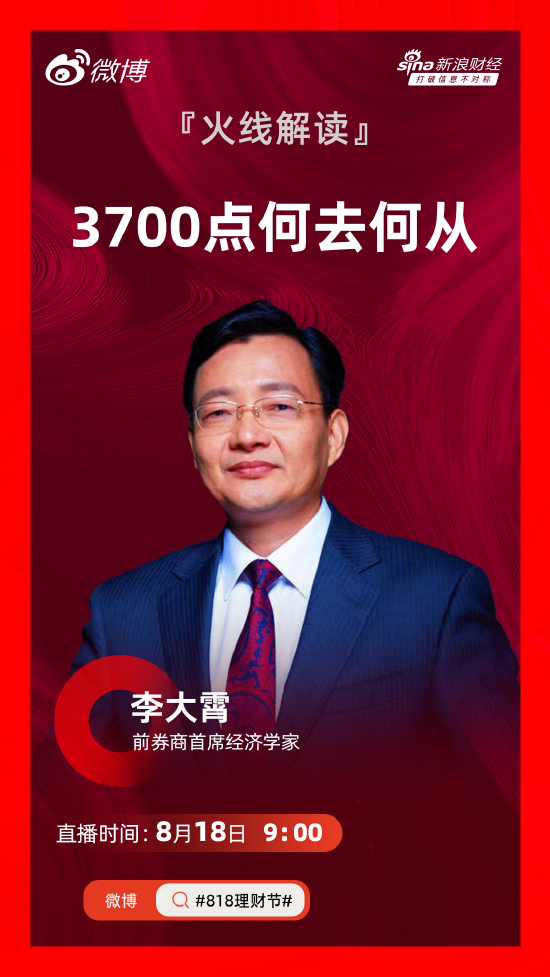
如何看成交量超过2万亿?李大霄:正是增量资金入场的时期
Xin Lang Zheng Quan· 2025-08-18 01:35
Group 1 - Current investor sentiment is rising quickly, leading to concerns about potential market overheating and the evolution of the slow bull market [1][2] - The trading volume at the market peak is noted to be between 3.2 trillion and 3.4 trillion, with a significant increase in activity when volume exceeds 2 trillion, indicating a phase of active account openings and new capital inflow [1] - Investors who were previously trapped for five years at around 3700 points are likely to sell once they reach that level again, leading to market fluctuations as they seek to exit their positions [2] Group 2 - The process of these long-term investors selling at 3700 points is just beginning, and it is expected to create volatility in the market [2] - Once these trapped investors sell off their positions, the market may be able to rally again as the selling pressure is alleviated [2]