产业结构转型

Search documents
A股长期向好,A500ETF嘉实(159351)布局各行业优质资产投资机遇
Xin Lang Cai Jing· 2025-12-08 02:42
Group 1 - The core viewpoint indicates that the A-share market is experiencing short-term volatility due to fluctuations in overseas market risk appetite, but the long-term bullish trend remains intact [1] - In the third quarter of 2025, the overall profitability of the A-share market improved, particularly in the technology sector, reflecting the continuation of industrial trends [1] - The current A-share market is in a state of capital inflow, which supports valuations [1] Group 2 - Huachuang Securities highlights four major directions for industry allocation within the CSI A500 index: 1) Technology sector focusing on stable growth and commercialization in optical components, PCBs, and integrated circuits [2] 2) Cyclical sectors such as non-ferrous metals, chemicals, building materials, steel, and coal, which have performance elasticity under re-inflation trading [2] 3) Export-oriented industries with high overseas exposure, including batteries, motors, engineering machinery, communication equipment, and energy metals [2] 4) Real estate and consumer chain sectors, which are expected to recover after hitting a mid-term bottom, presenting high odds opportunities [2] - As of November 28, 2025, the top ten weighted stocks in the CSI A500 index include Ningde Times, Kweichow Moutai, China Ping An, and others, accounting for a total of 20.04% of the index [2]
——基于高收入经济体的经济特征比较:未来什么样?
Huachuang Securities· 2025-12-04 08:25
Group 1: Economic Characteristics of High-Income Economies - High-income economies generally maintain continuous growth in total factor productivity (TFP) as a key characteristic[1] - Traditional high-income economies and catching-up economies experience a slowdown in TFP growth around a per capita GDP of approximately $10,000, yet still maintain positive growth[2] - Middle-income economies see negative TFP growth when per capita GDP reaches the $2,000-$3,000 range[3] Group 2: Structural Transformation and Efficiency - The structural transformation in high-income economies features a leading service sector and a stable industrial sector, ensuring that productivity does not decline during the transition[4] - High-income economies maintain a stable industrial value-added share of GDP, which is crucial for sustained productivity growth[5] - Catching-up economies experience a decline in consumption rates during rapid industrialization, which later rebounds as per capita GDP exceeds $10,000[6] Group 3: Technological Progress and Education - Significant investment in research and education is observed in catching-up economies, contributing to their successful transition from middle-income to high-income status[7] - R&D expenditure per capita in catching-up economies is higher than in traditional high-income economies, indicating a strong correlation with economic growth[8] - Education metrics show that catching-up economies have higher average years of education and enrollment rates in higher education compared to traditional high-income economies[9] Group 4: Export Value and Government Efficiency - High-income economies focus on increasing the value-added of exports, which is essential for sustained export growth[10] - Traditional high-income economies exhibit strong government intervention in the early stages of development, with government spending stabilizing around 25% of GDP after reaching a per capita GDP of $10,000[11] - Lower corruption levels in high-income economies enhance institutional efficiency and resource allocation[12]

今天为何大跳水?
表舅是养基大户· 2025-11-27 13:34
Group 1 - The article discusses the recent fire incident in Hong Kong's high-rise buildings, highlighting the unsafe conditions that contributed to the rapid spread of the fire, such as aging buildings undergoing simultaneous renovations and the use of flammable materials [1][2]. - It emphasizes the importance of fire safety measures for residents, particularly in high-rise buildings, suggesting that families should have fire extinguishers, smoke masks, and conduct regular fire drills [3]. - The article notes that the recent market movements in A-shares and Hong Kong stocks reflect a broader trend of volatility, particularly in sectors that have seen excessive short-term investment [5][6][7]. Group 2 - The article points out that the current market conditions indicate a potential for increased volatility as short-term investment enthusiasm reaches its peak, suggesting that investors should be cautious about entering hot sectors [6][9]. - It discusses the performance of leading real estate stocks and their impact on the broader market, indicating that while these stocks have faced significant declines, other sectors like insurance and banking have remained stable [13][14]. - The article highlights the ongoing transformation in the economy, with new economic sectors expected to surpass traditional real estate and infrastructure in driving GDP growth by 2025, suggesting a shift in investment focus [18][20]. Group 3 - The article mentions the establishment of a large private fund by Sunshine Insurance, which is part of a trend where insurance capital is increasingly allocated to equity markets, indicating a shift in investment strategies [24]. - It notes that the "high dividend" sector remains a key focus for fund companies, as the yield on equities continues to be attractive compared to bonds, suggesting a structural opportunity in this area [25]. - The article encourages a long-term investment approach during market fluctuations, advocating for a diversified and balanced asset allocation strategy [27].


外贸城市变局:东莞杀回前五 杭州挑战青岛?
Mei Ri Jing Ji Xin Wen· 2025-10-21 15:28
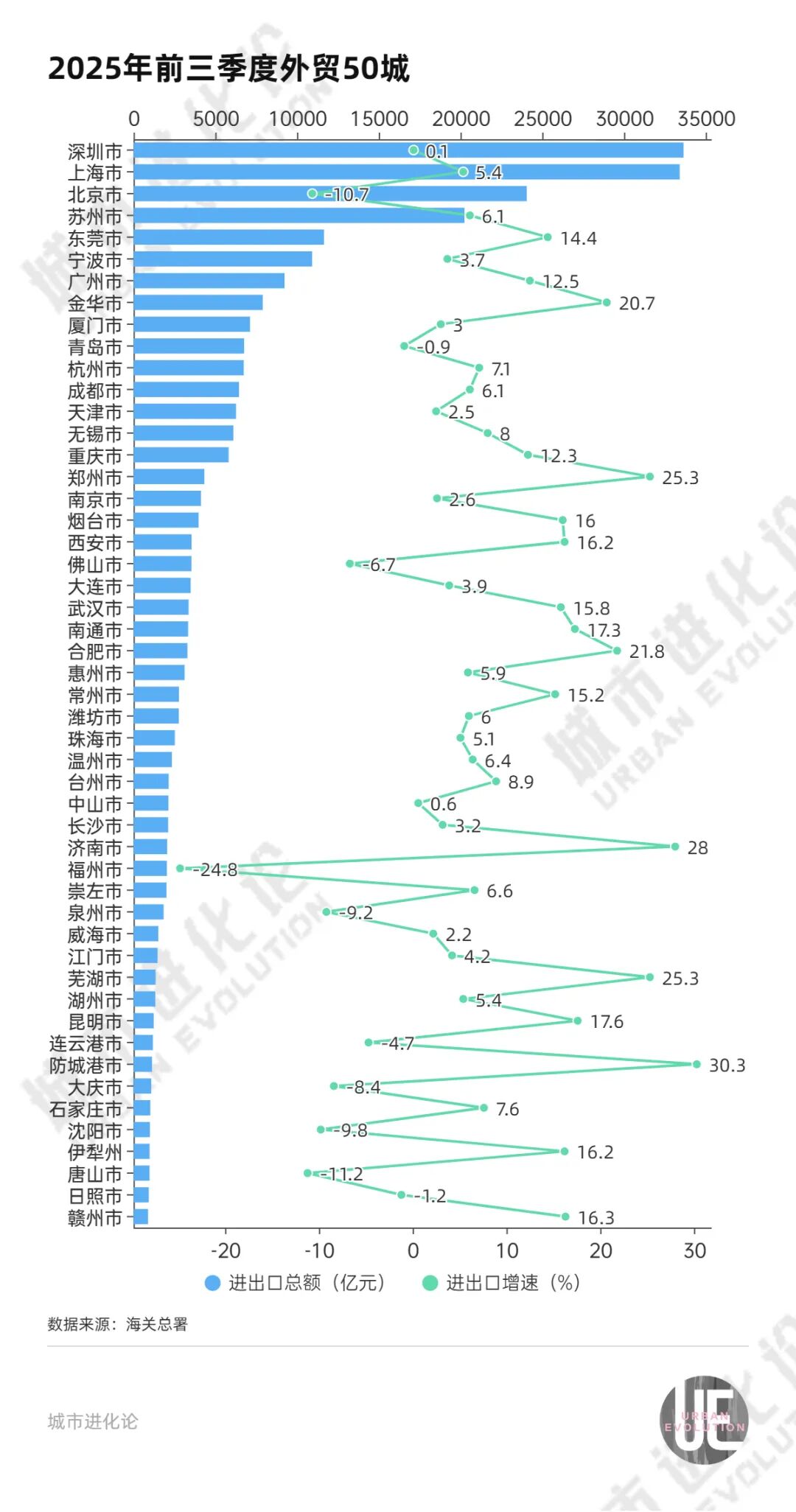
Core Insights - China's foreign trade has shown resilience in a complex external environment, with a year-on-year growth of 4% in the first three quarters, reaching a total of 33.61 trillion yuan [1] - Major provinces like Guangdong, Jiangsu, Zhejiang, Shanghai, and Shandong contributed over 80% to the national import and export growth, playing a crucial role in stabilizing foreign trade [1] - Key cities such as Shenzhen, Shanghai, Beijing, Suzhou, and Dongguan accounted for 81% of the national foreign trade, with a total import and export value of 27.24 trillion yuan [1] Provincial Contributions - Guangdong's foreign trade base is not limited to Shenzhen and Dongguan; Guangzhou also performed well with an import and export total of 9236.77 billion yuan and a growth rate of 12.5% [6] - Dongguan surpassed Ningbo to reclaim the title of "Fifth Foreign Trade City" with a growth rate of 14.4%, achieving an import and export total of 1.17 trillion yuan [5][6] - The city of Jinhua in Zhejiang achieved a remarkable growth of 20.7%, with a total foreign trade value of 7906.6 billion yuan, driven by exports of electric vehicles and lithium batteries [6] City Rankings and Trends - The top ten cities accounted for 16.50 trillion yuan in import and export totals, representing a significant portion of the national foreign trade [7] - Emerging cities like Yantai and Xi'an showed strong growth rates of 16% and 16.2%, respectively, with Xi'an's general trade increasing by 22.1% [10] - Traditional foreign trade cities like Foshan and Fuzhou faced challenges, with negative growth rates of -6.7% and -24.8% respectively [11] Market Diversification - China's trade with countries involved in the Belt and Road Initiative reached 17.37 trillion yuan, growing by 6.2% and accounting for 51.7% of total trade [16] - The export of mechanical and electrical products reached 12.07 trillion yuan, growing by 9.6% and making up 60.5% of total exports [16] - The diversification of markets has been significant, with trade to ASEAN and other emerging markets showing robust growth [17] Product Structure Changes - The export of high-tech products such as electronic information and high-end equipment has seen substantial growth, with increases of 8.1% and 22.4% respectively [18] - New energy vehicles and solar batteries have become key drivers of foreign trade growth in many cities, influencing the competitive landscape [18]
金融行业周报(2025、10、19):看好保险板块投资价值,建议长线布局优质银行股-20251019
Western Securities· 2025-10-19 12:42
Investment Rating - The report maintains a positive outlook on the insurance sector and recommends long-term investment in quality bank stocks [1][3]. Core Insights - The financial sector's performance this week shows a mixed trend, with the non-bank financial index down by 1.34%, while the banking sector saw an increase of 4.89%, outperforming the CSI 300 index by 7.12 percentage points [1][9]. - The insurance sector experienced a notable increase of 3.65%, driven by positive earnings forecasts from New China Life, which projected a 45% to 65% increase in net profit for the first three quarters of 2025 [1][11]. - The report emphasizes the growth potential of the insurance industry, attributing it to supply-side reforms and the benefits from rising equity assets [1][12]. Summary by Sections 1. Weekly Performance and Sector Insights - The non-bank financial index decreased by 1.34%, while the banking sector increased by 4.89%, with state-owned banks leading the gains [1][9]. - The insurance sector outperformed the CSI 300 index by 5.87 percentage points, with New China Life's earnings announcement boosting overall market confidence [1][11]. 2. Insurance Sector Analysis - New China Life's earnings forecast led to a 12.58% increase in its stock price over five trading days, contributing to a six-day rally in the insurance sector [1][11]. - The report highlights the potential for the insurance sector to benefit from structural changes in the economy and improved asset performance [1][12]. 3. Brokerage Sector Analysis - The brokerage sector saw a decline of 3.13%, with a price-to-book (PB) ratio of 1.44x, indicating potential undervaluation [2][15]. - The report notes that the recent revisions to corporate governance standards by the CSRC could enhance the sector's governance and performance [2][15]. 4. Banking Sector Analysis - The banking sector's performance was strong, with a 4.89% increase, driven by a flight to quality amid market uncertainties [1][18]. - The report suggests focusing on banks with high growth potential and stable performance for both short-term and long-term investments [1][21].



“四轮驱动”重塑区域经济增长逻辑
Qi Lu Wan Bao· 2025-09-25 21:48
Core Insights - The establishment of the Penghui Energy zero-carbon manufacturing base in Qingdao represents a significant investment of 4 billion yuan and aims for a production capacity of 12 GWh, marking a pivotal shift in the region's industrial landscape towards green energy [1][4] - The transition from a rail transport-dominated economy to a diversified industrial base, including green energy, integrated circuits, and low-altitude economy, is being driven by technological breakthroughs and ecological restructuring [1][8] Industry Transformation - The rail transport industry was previously the backbone of the Qingdao economy, with CRRC Sifang Co., Ltd. generating 38.25 billion yuan in revenue in 2020, accounting for 34.5% of the total revenue of high-tech enterprises in the region [2] - A decline in industrial added value by 4.8% in 2021 highlighted the risks of over-reliance on a single industry, prompting the need for structural optimization and upgrades [2][3] Cross-Industry Innovation - The integration of rail transport's industrial capabilities into the low-altitude economy has led to innovations, such as using rail component testing technologies for drone reliability verification [2][3] - The successful transformation of existing industrial advantages into new productive forces is emphasized as a core driver of industrial upgrade [3][8] Ecosystem Development - The strategy of "leading chains and building ecosystems" has been pivotal in addressing the challenges of a single-industry structure, with CRRC Sifang contributing nearly 200 billion yuan in output during the 13th Five-Year Plan, increasing local suppliers from 162 to 235 [4][5] - The rapid establishment of the zero-carbon manufacturing base by Penghui Energy, from initial discussions to project signing in just six months, exemplifies effective chain-based招商 (investment attraction) strategies [4][5] Technological Advancements - Qingdao Heertai Intelligent Control Technology Co., Ltd. has developed a "no electrolytic capacitor" technology that reduces energy consumption by 20% and costs by 5% for smart appliances [6][7] - The "source-grid-load-storage" microgrid system developed by Qingdao Zhongdian Green Network New Energy Co., Ltd. showcases advanced technology for efficient renewable energy utilization, achieving zero-carbon power supply for various projects [7][8] Policy Support and Investment - The Qingdao region has implemented a "technological transformation and chain strengthening" initiative, mobilizing 697 million yuan in funding over three years to support over 600 new technological transformation projects, leading to nearly 20 billion yuan in industrial investment [8] - The region's industrial structure transformation has resulted in a 12.2% increase in industrial added value in 2024, with the green energy sector experiencing a revenue growth rate of 16.2% in the first half of the year [8]
哪来的牛市?
Sou Hu Cai Jing· 2025-09-18 01:19
Group 1 - The core viewpoint of the article is that despite declining economic indicators, the stock market has been rising, driven by changes in valuation and investor sentiment [1][10]. - The stock market gains can be attributed to two main sources: dividend income and capital gains, with capital gains being influenced by the company's earnings per share (EPS) and price-earnings (P/E) ratio [3][5]. - The A500 index is highlighted for its advantages in reflecting market performance, including its market capitalization weighting and sector representation, which allows for a more accurate depiction of the market's industry distribution [7][8]. Group 2 - The recent market rally is largely driven by valuation changes, with over half of the increase attributed to this factor, supported by ample liquidity and rising investor risk appetite [8][10]. - Historical analysis indicates that stock prices often recover before economic growth, as positive expectations can lead to increased consumer spending and business investment, creating a self-fulfilling cycle [10][12]. - The potential for continued market growth exists, particularly if external conditions remain stable and if the Federal Reserve resumes a dovish monetary policy, which could further enhance valuations [12][14]. Group 3 - The article emphasizes the importance of sector performance during China's industrial transformation, suggesting that different sectors will experience varying prospects, and investors should consider price when making decisions [15]. - For individual investors, the recommendation is to consider broad-based index funds, such as the A500 ETF, which can provide exposure to the overall market without the need for sector-specific analysis [15][21]. - The A500 ETF is noted for its significant scale and low tracking error, which are critical factors for investors seeking to capitalize on market trends [21][24].

李家超:积极培育新能源、AI与数据科学等新兴产业
Zheng Quan Shi Bao Wang· 2025-09-17 03:57
Core Viewpoint - The Hong Kong government is committed to promoting industrial structural transformation by consolidating traditional industries and actively cultivating emerging sectors to create quality job opportunities and enhance economic benefits [1] Group 1: Traditional Industries - The government aims to strengthen traditional advantageous industries such as finance and legal services [1] Group 2: Emerging Industries - The focus will also be on developing new industries, including advanced manufacturing, life and health technology, new energy, artificial intelligence, and data science [1] - These efforts are intended to generate more quality employment opportunities and increase income for individuals [1]
10年!A股市值版图“大变迁”
天天基金网· 2025-08-25 07:42
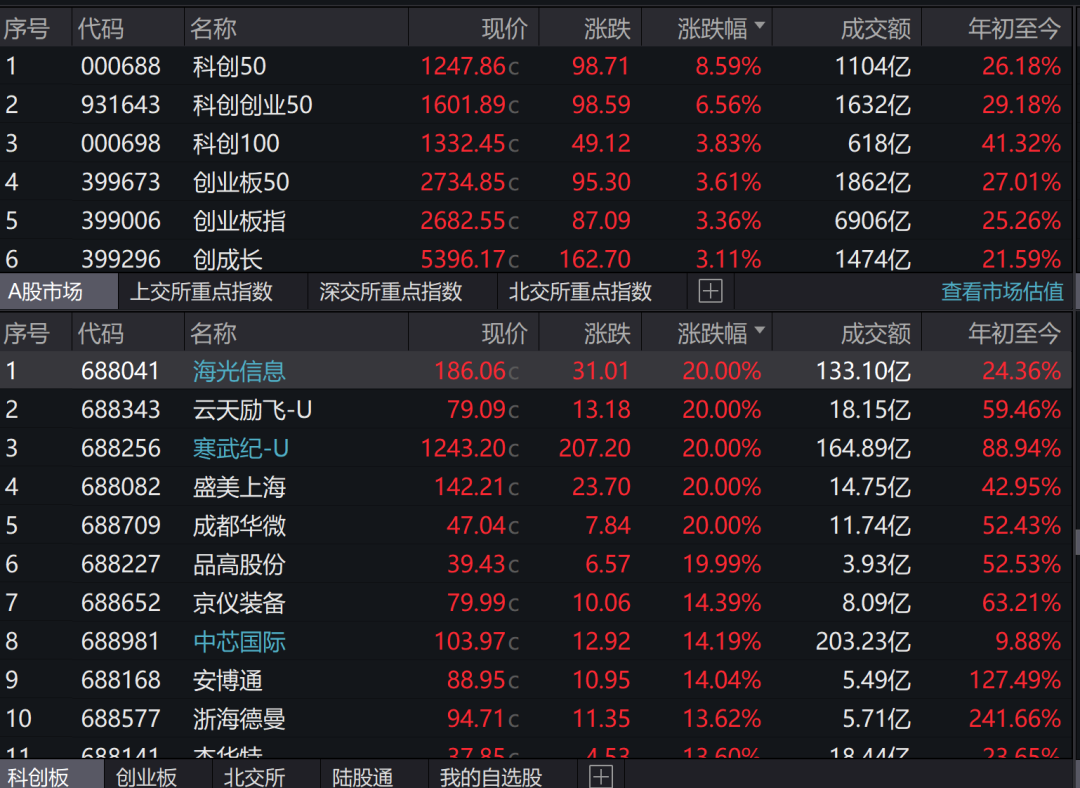
Core Viewpoint - The A-share electronic industry has surpassed the banking sector in market capitalization, marking a significant shift in China's economic structure towards innovation-driven growth [2][3][6]. Group 1: Market Performance - As of August 22, the A-share electronic industry reached a market capitalization of 11.38 trillion yuan, surpassing the banking sector and becoming the largest industry in A-shares [3][6]. - The electronic industry experienced a daily increase of 4.82%, leading all sectors in the Shenwan industry classification [3]. - Other technology sectors, such as telecommunications and computers, also showed strong performance with increases of 3.77% and 3.50%, respectively [3]. Group 2: Individual Company Performance - Within the electronic sector, Industrial Fulian leads with a market capitalization of 910.16 billion yuan, followed by Cambrian with 520.09 billion yuan, and Haiguang Information with 432.47 billion yuan [3]. - Several electronic and computer-related stocks, including Haiguang Information and Cambrian-U, achieved the maximum daily increase of 20% [3]. Group 3: Industry Trends - Over the past decade, the market capitalization of the electronic industry has grown more than fourfold from 2.15 trillion yuan at the end of 2016 to the current 11.38 trillion yuan, rising from 9th to 1st place in industry rankings [6][7]. - The telecommunications industry has also seen significant growth, with its market capitalization reaching 3.25 trillion yuan, moving up from 22nd to 13th place in the same period [7]. - In contrast, traditional industries such as real estate and oil have seen a decline in both market capitalization and industry ranking [7]. Group 4: Changes in Market Composition - The structure of the "billion market value club" has shifted from being dominated by traditional industries to featuring a significant number of emerging industries, with over 70 companies from high-end equipment manufacturing and new-generation information technology [8]. - As of August 22, 2025, the top 20 companies by market capitalization include several emerging industry leaders, such as China Mobile and BYD, with market values exceeding 1 trillion yuan [9].





10年!A股市值版图“大变迁”
Shang Hai Zheng Quan Bao· 2025-08-24 03:47
Core Viewpoint - The A-share electronic industry has surpassed the banking sector in market capitalization, reaching a new high of 11.38 trillion yuan, marking a significant shift in China's economic structure towards innovation-driven growth [1][3][7]. Industry Performance - On August 22, the electronic industry saw a market capitalization increase of 4.82%, leading all sectors in the Shenwan industry classification [3]. - The communication and computer sectors also performed well, with increases of 3.77% and 3.50%, respectively, contributing to a strong upward trend in the A-share technology sector [3]. Market Capitalization Changes - The electronic industry's market capitalization has grown over four times from 2.15 trillion yuan at the end of 2016 to 11.38 trillion yuan as of August 22, 2025, rising from 9th to 1st place in industry rankings [7][11]. - The communication sector's market capitalization has increased from 1.05 trillion yuan in 2016 to 3.25 trillion yuan, moving up from 22nd to 13th place [7]. Individual Company Highlights - Industrial Fulian leads the electronic sector with a market capitalization of 910.16 billion yuan, followed by Cambrian with 520.09 billion yuan, and Haiguang Information with 432.47 billion yuan [3]. - Several companies, including Haiguang Information and Cambrian-U, achieved a "20cm" limit-up, indicating strong market confidence in the semiconductor and chip design sectors [3]. Historical Context - Over the past decade, the A-share market has seen a significant transformation, with emerging industries gaining prominence while traditional sectors like real estate and oil have declined [6][7]. - As of August 22, 2025, there are 165 companies with a market capitalization exceeding 100 billion yuan, with over 70 from strategic emerging industries, representing more than 40% of this group [8]. Top Market Capitalization Companies - Major companies with market capitalizations exceeding 1 trillion yuan include China Mobile, BYD, and CATL, while Industrial Fulian and SMIC are also notable players in the electronic sector [9][10].