医药

Search documents
超315亿元“杀入” 定增市场配置价值凸显
Zhong Guo Jing Ji Wang· 2025-10-20 00:59
Core Insights - The public offering of private placements in China has seen a significant recovery this year, with total subscriptions exceeding 31.5 billion yuan, marking a growth of over 50% compared to the same period in 2024 [1][2]. Group 1: Market Trends - The increase in market sentiment has led many public funds to engage in private placements to achieve returns through discounts and valuation enhancements, particularly benefiting from the strong performance of technology stocks [1][2]. - As of October 17, 2023, 35 fund companies participated in private placements, with total subscriptions reaching 31.592 billion yuan, a notable increase from the previous year [2]. Group 2: Fund Participation - Notable fund companies such as Nuode Fund and Caitong Fund have each subscribed over 9 billion yuan, while others like E Fund and GF Fund have subscriptions ranging from 1.2 billion to 2.7 billion yuan [2]. - The current supply of private placement projects is relatively low, suggesting that the favorable market conditions may continue [2]. Group 3: Future Outlook - The private placement market is expected to see stable growth in supply in 2025, although discount rates and additional ratios are lower than the previous year, indicating increased interest and participation in private placement assets [3]. - The demand for private placements is largely driven by supply, and with a favorable project supply outlook, the market is anticipated to remain positive unless significant adverse factors emerge [2]. Group 4: Investment Strategies - The focus of large fundraising projects this year has been on sectors such as technology innovation, high-end manufacturing, and pharmaceuticals, with the potential for dual benefits from "discount Alpha" and "asset Alpha" [4]. - Investors are advised to conduct in-depth fundamental research rather than relying solely on discount rates, emphasizing the importance of relative valuation within historical and industry contexts [4]. Group 5: Sector Opportunities - There is a growing interest in sectors like artificial intelligence, semiconductors, and innovative pharmaceuticals, which are particularly appealing to institutional investors [5].
超315亿元“杀入” 这一市场火了
Zhong Guo Ji Jin Bao· 2025-10-20 00:31
Core Insights - The public offering of additional shares (定增) has seen a significant recovery this year, with total subscriptions exceeding 31.5 billion yuan, marking a growth of over 50% compared to the same period in 2024 [1][2] Group 1: Market Trends - The increase in market sentiment has led many public funds to engage in additional share offerings to gain benefits from discounts and valuation improvements, particularly in the technology sector [2][4] - As of October 17, 2023, 35 fund companies participated in additional share offerings, with a total subscription amount of 31.592 billion yuan, a significant increase from the previous year [2] - Major contributors include Nord Fund and Caizheng Fund, each with subscriptions exceeding 9 billion yuan, while other firms like E Fund and GF Fund contributed between 1.2 billion to 2.7 billion yuan [2] Group 2: Future Outlook - The supply of additional share offerings is expected to remain stable or increase in 2025, although discount rates and additional ratios are lower than the previous year, indicating heightened interest and participation in the market [3] - The current liquidity environment is relatively loose, and market confidence is on the rise, suggesting that the additional share strategy may benefit from both "discount Alpha" and "asset Alpha" [4][6] - There is a focus on merger and acquisition financing projects as new growth points in the additional share market, with the potential for higher returns compared to traditional offerings [4][5] Group 3: Investment Strategy - Investors are advised to focus on companies with growth potential and solid fundamentals when selecting additional share projects, while also emphasizing diversification to mitigate overall risk [6] - The investment approach should not solely rely on discount rates but should incorporate in-depth fundamental research and consider dynamic changes within industries [4][6]
超315亿元“杀入”,这一市场火了
Zhong Guo Ji Jin Bao· 2025-10-20 00:12
Core Insights - The public offering of additional shares (定增) has seen a significant recovery this year, with total subscriptions exceeding 31.5 billion yuan, marking a 50% increase compared to the same period in 2024 [1][2]. Group 1: Market Trends - The market sentiment has improved, leading many public funds to participate in additional share offerings to gain benefits from discounts and valuation increases, particularly in the technology sector [2][4]. - A total of 35 fund companies have participated in additional share offerings this year, with notable contributions from Nord Fund and Caitong Fund, each exceeding 9 billion yuan in subscriptions [2]. Group 2: Supply and Demand Dynamics - The supply of additional share projects is currently low, but there is an expectation for continued market trends due to supportive policies like "merger and acquisition guidelines" and "Sci-Tech Innovation Board regulations" [2][3]. - The demand for additional share offerings is largely influenced by supply, and the overall supply is expected to be more favorable compared to 2024, provided there are no significant adverse market factors [2]. Group 3: Investment Strategies - The current liquidity environment is relatively loose, and investors are encouraged to focus on fundamental research rather than solely on discount rates when making investment decisions [4][6]. - There is a growing interest in merger and acquisition financing projects, which have shown potential for higher returns compared to traditional additional share offerings [4]. Group 4: Future Opportunities - The A-share market continues to present good investment value, with particular attention on sectors such as artificial intelligence, semiconductors, and innovative pharmaceuticals [5]. - The dual benefits of "discount Alpha" and "asset Alpha" are expected to enhance the value of additional share offerings, making them an attractive investment strategy [6].
收评:沪指收跌0.19% 稀土永磁、黄金等板块走强
Jing Ji Wang· 2025-10-14 01:50
Core Viewpoint - The Chinese stock market experienced a decline, with the Shanghai Composite Index closing at 3889.50 points, down 0.19%, while the Shenzhen Component Index and the ChiNext Index also saw declines of 0.93% and 1.11% respectively, indicating a bearish sentiment in the market [1] Market Performance - The Shanghai Composite Index closed at 3889.50 points, with a trading volume of 1,085.41 billion yuan [1] - The Shenzhen Component Index closed at 13231.47 points, with a trading volume of 1,269.33 billion yuan [1] - The ChiNext Index closed at 3078.76 points, with a trading volume of 574.19 billion yuan [1] Sector Performance - The rare earth permanent magnet sector saw significant gains, with Northern Rare Earth and China Rare Earth hitting the daily limit [1] - The gold sector strengthened, with companies like Western Gold also reaching the daily limit [1] - The military trade sector was active, with Changcheng Military Industry achieving two consecutive limit-ups [1] - Other sectors that performed well included controllable nuclear fusion, semiconductors, software, and banking [1] - Conversely, sectors that experienced declines included humanoid robots, automotive, building materials, and pharmaceuticals [1]


港股收盘 | 恒指收跌0.29% 有色股多数走强 宣布拟被私有化、恒生银行大涨25%
Zhi Tong Cai Jing· 2025-10-09 08:50
Market Overview - After the National Day holiday, A-shares resumed trading, and southbound funds returned, with Hong Kong's three major indices showing mixed results. The Hang Seng Index fell by 0.29% to 26,752.59 points, with a total turnover of HKD 38.68 billion [1] - CITIC Securities believes that the Hong Kong market benefits from a complete domestic AI industry chain and the increasing number of quality A-share companies listing in Hong Kong. The firm expects the long bull market that began in early 2024 to continue despite short-term geopolitical and trade uncertainties [1] Blue Chip Performance - HSBC Holdings led blue-chip stocks, rising by 25.88% to HKD 149.8, contributing 36.11 points to the Hang Seng Index. HSBC announced plans to privatize Hang Seng Bank at a price of HKD 155 per share, a 30% premium over the previous closing price [2] - Other notable blue-chip movements included Lenovo Group up 7.26%, Zijin Mining up 5.43%, while China Biologic Products fell by 7.49% and SMIC dropped by 6.7% [2] Sector Highlights - Large technology stocks showed mixed results, with Kuaishou rising over 3% and Alibaba falling over 2%. Precious metals saw significant gains during the holiday, with gold, silver, copper, and aluminum prices rising sharply [3][4] - The AI sector experienced varied performance, with Lenovo and Bilibili seeing gains, while Alibaba faced a decline. The recent acceleration in AI investments and applications is expected to strengthen the narrative around the sector [4][5] Notable Stocks - Shanghai Electric surged by 17.4% after achieving a key breakthrough in nuclear fusion technology, positioning itself as a leader in this field [7] - Goldwind Technology rose by 8.43%, benefiting from its role in promoting green energy transitions [8] - Jinli Permanent Magnet reached a new high, increasing by 8.67%, following announcements of export controls on rare earth-related items by the Ministry of Commerce [9] - HSBC Holdings faced pressure, dropping by 5.97%, amid its announcement regarding the privatization of Hang Seng Bank [10]


港股早盘高开震荡,H股ETF(510900)交投活跃,实时成交额超1亿元
Mei Ri Jing Ji Xin Wen· 2025-09-30 02:31
Group 1 - The Hong Kong stock market opened higher with technology stocks leading the gains, as of 10:10, the Hang Seng China Enterprises Index rose by 0.5% [1] - Notable performers among the index constituents include SMIC, which increased by over 4%, Sunny Optical Technology and Geely Automobile both rising by over 3%, and BeiGene up by over 2% [1] - The H-share ETF (510900) recorded a real-time transaction volume exceeding 100 million yuan, indicating strong investor interest [1] Group 2 - Huatai Securities highlighted that the market's central tendency remains intact due to a liquidity-rich environment, stable domestic policies, and positive trends in industries such as AI, new consumption, and pharmaceuticals [1] - The Hang Seng China Enterprises Index consists of 50 large-cap and actively traded companies listed in Hong Kong, with the top three sectors being consumer discretionary, information technology, and financials, collectively accounting for nearly 80% of the index [1] - The H-share ETF (510900) tracks this index and has a latest scale of 8.7 billion yuan, making it the largest among similar ETFs, providing investors with a convenient way to access investment opportunities in mainland Chinese companies listed in Hong Kong [1]
绩优基金吸金效应显著 15位基金经理晋级“百亿操盘手”
2 1 Shi Ji Jing Ji Bao Dao· 2025-09-24 23:16
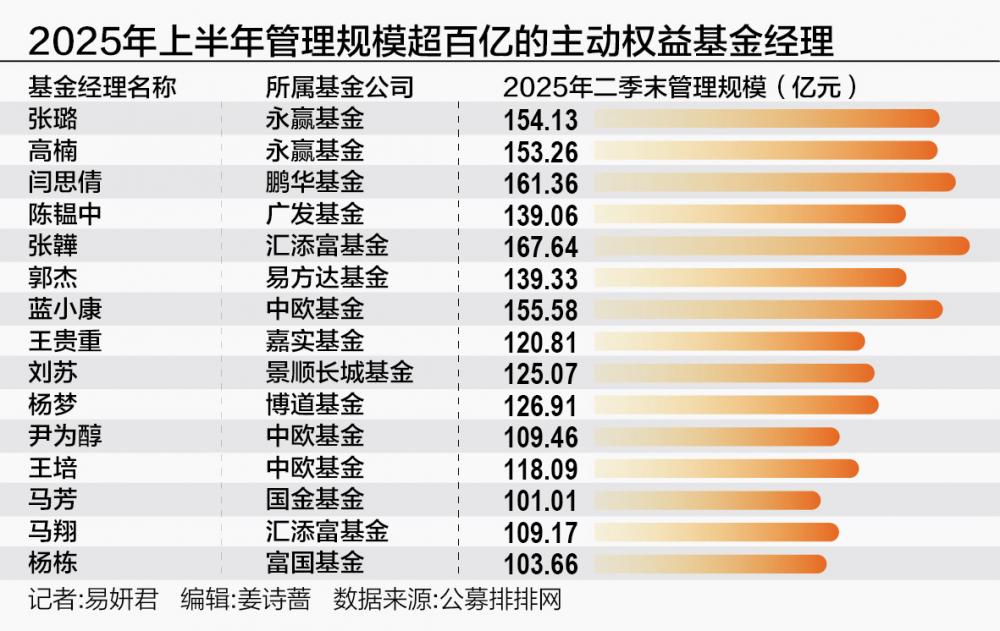
Core Insights - The A-share market's structural trends have led to a significant increase in the management scale of high-performing fund managers, with 84 active equity fund managers managing over 10 billion yuan as of the end of Q2 2025, an increase of 15 from the end of 2024 [1][3][5] Fund Manager Performance - The newly promoted "billionaire fund managers" primarily come from 11 public fund institutions, including China Europe Fund, Huatai-PB Fund, and Yongying Fund, with notable increases in management scale exceeding 100% [1][3][5] - Among the 15 new managers, three from China Europe Fund, two each from Huatai-PB Fund and Yongying Fund, and one from eight other firms have achieved this status [1][3][5] Management Scale Growth - The top three fund managers by management scale are Zhang Wei from Huatai-PB Fund (167.64 billion yuan), Yan Siqian from Penghua Fund (161.36 billion yuan), and Lan Xiaokang from China Europe Fund (155.58 billion yuan) [4][5] - Significant growth rates were observed, with Zhang Lu and Gao Nan from Yongying Fund seeing increases of 761.20% and 337.03%, respectively [7][6] Fund Performance - As of September 22, 2023, 77 active equity funds achieved returns exceeding 100%, while 1,167 funds returned between 50% and 100% [3] - The Yongying Advanced Manufacturing Select A/C fund managed by Zhang Lu saw its scale grow from 17.62 billion yuan to 138.45 billion yuan, with a return rate of 46.28% in the first half of the year [9][10] Investment Strategies - The newly promoted fund managers are focusing on sectors such as robotics, pharmaceuticals, and "anti-involution" strategies for the second half of the year [11][12] - Zhang Wei emphasizes investment in innovative pharmaceutical companies with global competitiveness, while Chen Yanzhong sees potential in domestic demand and the valuation of Chinese assets [11][13] Market Outlook - The managers believe that the Chinese asset market will continue to attract global capital, especially with the potential for a Federal Reserve rate cut, enhancing the appeal of RMB assets [13][14] - Lan Xiaokang highlights opportunities in both traditional industries and new productivity, focusing on low PB valuation leading companies across various sectors [13][14]

【金工】股票ETF资金转为净流入,科技板块基金净值涨幅优势延续——基金市场与ESG产品周报20250922(祁嫣然/马元心)
光大证券研究· 2025-09-23 23:06
Market Performance Overview - The domestic equity market indices showed mixed performance during the week of September 15-19, 2025, with the ChiNext Index rising by 2.34% [4] - In terms of sectors, coal, power equipment, and electronics industries had the highest gains, while banking, non-ferrous metals, and non-bank financial sectors experienced the largest declines [4] Fund Product Issuance - The domestic new fund market saw increased activity, with 63 new funds established, totaling 748.28 billion units issued. This included 27 bond funds, 27 equity funds, 7 mixed funds, 1 international (QDII) fund, and 1 REIT [5] - A total of 31 new funds were issued across the market, with 21 being equity funds, 4 FOF funds, 4 mixed funds, 1 bond fund, and 1 international (QDII) fund [5] Fund Product Performance Tracking - Various industry-themed funds exhibited volatile and divergent performance, with TMT theme funds continuing to show a net value increase of 2.56%, while financial and real estate theme funds saw a notable decline [6] - As of September 19, 2025, the performance of different themed funds was as follows: New Energy (2.07%), National Defense and Military Industry (1.50%), Balanced Industry (0.92%), Rotation Industry (0.49%), Consumption (-0.53%), Cyclical (-1.63%), Pharmaceutical (-2.41%), and Financial Real Estate (-2.68%) [6] ETF Market Tracking - Domestic stock ETFs experienced a net inflow of funds, while Hong Kong stock ETFs maintained significant inflows. Specifically, stock ETFs had a median return of 0.03% with a net inflow of 77.93 billion yuan [7] - Hong Kong stock ETFs recorded a median return of 0.84% with a net inflow of 166.52 billion yuan, and cross-border ETFs had a median return of 1.56% with a net inflow of 1.227 billion yuan [8] Fund Positioning Monitoring - The estimated equity positioning of actively managed funds decreased by 0.27 percentage points compared to the previous week. Increased allocations were observed in the automotive, electronics, and basic chemicals sectors, while banking, pharmaceutical, and agriculture sectors saw reduced allocations [9] ESG Financial Products Tracking - A total of 34 new green bonds were issued this week, with a cumulative issuance scale of 379.48 billion yuan. The domestic green bond market has steadily developed, with a total issuance scale of 4.82 trillion yuan and 4,153 bonds issued as of September 19, 2025 [10] - The median net value changes for ESG funds were as follows: active equity funds (1.42%), passive equity index funds (0.21%), and bond ESG funds (0.04%). Funds focused on climate change, low-carbon economy, and carbon neutrality showed significant performance advantages [10]

15位基金经理晋级“百亿操盘手”
2 1 Shi Ji Jing Ji Bao Dao· 2025-09-23 14:35
Core Insights - The A-share market's structural trends have led to a significant increase in the management scale of high-performing fund managers, with 84 active equity fund managers managing over 10 billion yuan as of the end of Q2 2025, an increase of 15 from the end of 2024 [1][4]. Fund Manager Performance - The 15 newly promoted fund managers to the "billionaire operator" status are from 11 public fund institutions, including notable firms like China Europe Fund and Huatai-PB Fund, with many achieving over 100% growth in management scale [1][4][10]. - The top three fund managers by management scale are Zhang Wei from Huatai-PB with 16.764 billion yuan, Yan Siqian from Penghua with 16.136 billion yuan, and Lan Xiaokang from China Europe with 15.558 billion yuan [5][8]. Fund Performance Metrics - As of September 22, 2025, there are 77 active equity funds with returns exceeding 100% this year, while 1,167 funds have returns between 50% and 100%. In comparison, major indices like the CSI 300 and ChiNext 50 have seen increases of 14.94% and 51.49%, respectively [3][4]. Growth in Management Scale - The management scale of the newly promoted fund managers has seen substantial growth, with some managers like Zhang Lu and Gao Nan from Yongying achieving increases of 761.20% and 337.03%, respectively [5][8][10]. - The management scale of several fund managers has doubled in the first half of the year, indicating strong performance and investor confidence [5][8]. Investment Strategies - The newly promoted fund managers are focusing on sectors such as robotics, pharmaceuticals, and traditional industries, with an emphasis on companies with strong competitive advantages and growth potential [11][12]. - Zhang Wei highlights the importance of core robotics companies and supportive domestic policies, while other managers like Chen Xizhong and Lan Xiaokang are optimistic about domestic demand and the valuation of Chinese assets [11][12].

15位基金经理晋级“百亿操盘手”
21世纪经济报道· 2025-09-23 13:59
Core Viewpoint - The article highlights the significant growth in the number of active equity fund managers in the A-share market, with 15 new managers surpassing 10 billion yuan in assets under management in the first half of 2025, driven by strong performance and market conditions [1][3]. Group 1: Fund Manager Growth - As of the end of Q2 2025, there are 84 active equity fund managers managing over 10 billion yuan, an increase of 15 from the end of 2024 [1][3]. - The new managers come from 11 different public fund institutions, with notable contributions from China Europe Fund, Huatai-PB Fund, and Yongying Fund [1][3]. - The management scale of these new managers has increased by over 100%, indicating strong performance and investor confidence [1][3]. Group 2: Performance Metrics - A total of 77 active equity funds achieved returns exceeding 100% year-to-date, while 1,167 funds returned between 50% and 100% [3]. - The major indices, including CSI 300 and ChiNext 50, saw increases of 14.94% and 53.13%, respectively, highlighting a favorable market environment for active equity funds [3]. Group 3: Individual Fund Manager Performance - The top three fund managers by management scale are Zhang Wei from Huatai-PB (16.764 billion yuan), Yan Siqian from Penghua (16.136 billion yuan), and Lan Xiaokang from China Europe (15.558 billion yuan) [4][6]. - Significant growth rates were observed, with Zhang Lu and Gao Nan from Yongying achieving increases of 761.20% and 337.03%, respectively [7][6]. - Other managers like Guo Jie from E Fund and Chen Yanzhong from GF Fund also reported substantial growth, with increases of 198.47% and 239.96% [7][6]. Group 4: Investment Strategies - The newly promoted fund managers are focusing on sectors such as robotics, pharmaceuticals, and domestic consumption, reflecting a trend towards innovation and growth [10][12]. - Zhang Lu emphasizes the importance of core robotics companies and government support for the industry, while Zhang Wei is focusing on innovative pharmaceutical companies with global competitiveness [10][12]. - Blue Xiaokang highlights opportunities in both traditional industries and new production capabilities, suggesting a balanced approach to investment across various sectors [12].