扩张性财政政策

Search documents
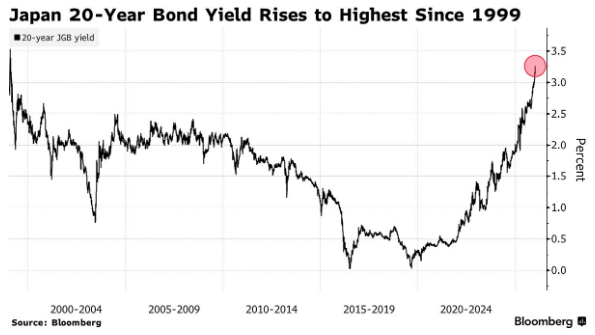
日本20年期国债收益率创1999年新高,今日拍卖面临财政忧虑大考
Sou Hu Cai Jing· 2026-01-20 01:16
Group 1 - The Japanese government plans to introduce a food tax reduction policy, causing market turbulence and investor anxiety ahead of the upcoming 20-year government bond auction [1] - Bond prices fell sharply on Monday, leading to a significant rise in 20-year and longer-term bond yields to multi-year highs, with the auction results being a critical test of whether rising yields can offset concerns about the government's deteriorating fiscal situation [1] - Barclays Securities strategists highlighted the significant risk of expansionary fiscal policies appearing in party platforms ahead of the House of Councillors elections, which could lead to weak auction results [1] Group 2 - Recent polls indicate Prime Minister Suga's approval rating remains high at 67%, with 52% of respondents believing the ruling coalition should win a majority, although the formation of the "Center Reform Alliance" increases election risk [2] - The 20-year bond yield reached 3.265%, the highest level since 1999, with 30-year and 40-year bond yields also hitting record highs [2] - Investors are closely monitoring the Bank of Japan's policy decision on Friday for clues on future interest rate hikes, as policymakers are increasingly concerned about the yen's impact on inflation [2]
日本20年期国债收益率创1999年新高 今日拍卖面临财政忧虑大考
Zhi Tong Cai Jing· 2026-01-20 00:57
Group 1 - The Japanese government plans to introduce a temporary food sales tax reduction, which has caused market volatility and investor anxiety ahead of the upcoming 20-year government bond auction [1] - Bond prices fell sharply on Monday, leading to a significant rise in the yields of 20-year and longer-term bonds to multi-year highs [1] - Barclays Securities strategists highlighted the risk of expansionary fiscal policies appearing in party platforms ahead of the House of Councillors election, which could negatively impact bond values [1] Group 2 - Recent polls indicate Prime Minister Suga's approval rating remains high at 67%, with 52% of respondents believing the ruling coalition should win a majority [2] - The establishment of the "Center Reform Alliance" increases the risk of election dynamics, despite high approval ratings suggesting an easy victory for the Prime Minister [2] - On Monday, the yield on 20-year government bonds reached 3.265%, the highest level since 1999, with 30-year and 40-year bond yields also hitting record highs [2]

日本国债期货走低 受日本财政担忧影响
Xin Lang Cai Jing· 2026-01-20 00:25
日本国债期货在东京早盘交易中因日本存在财政担忧而小幅走低。日本首相高市早苗周一表示,她计划 于周五解散议会下院。她证实,正式竞选活动将于1月27日开始,投票将于2月8日进行。EFG的Sam Jochim在一封电子邮件中称:"这带来了实施更具扩张性财政政策的可能性。"这位经济学家补充说,自 民党若大获全胜,可能会"重新点燃高市早苗行情,从而带动日本股市上涨,并导致日本国债和日元遭 抛售"。10年期日本国债收益率上涨3.0个基点,至2.3%。20年期日本国债收益率上涨4.0个基点,至 3.295%。 日本国债期货在东京早盘交易中因日本存在财政担忧而小幅走低。日本首相高市早苗周一表示,她计划 于周五解散议会下院。她证实,正式竞选活动将于1月27日开始,投票将于2月8日进行。EFG的Sam Jochim在一封电子邮件中称:"这带来了实施更具扩张性财政政策的可能性。"这位经济学家补充说,自 民党若大获全胜,可能会"重新点燃高市早苗行情,从而带动日本股市上涨,并导致日本国债和日元遭 抛售"。10年期日本国债收益率上涨3.0个基点,至2.3%。20年期日本国债收益率上涨4.0个基点,至 3.295%。 责任编辑:王永生 M ...
突然决定提前大选,高市咋这么急
Xin Lang Cai Jing· 2026-01-18 17:25
Core Viewpoint - Japanese Prime Minister Sanna Takashi has decided to dissolve the House of Representatives on January 23, ahead of the scheduled elections, which has drawn criticism from opposition parties for prioritizing the interests of the ruling Liberal Democratic Party (LDP) over national concerns [2][3]. Group 1: Political Context - The decision to dissolve the House of Representatives comes as Takashi's cabinet approval ratings remain high, prompting calls within the LDP for early elections [2]. - Internal surveys indicated that the LDP could secure more than half of the seats (233) in the upcoming elections [2]. - The last House of Representatives election was held in October 2024, but the Prime Minister has the authority to call for early elections [2]. Group 2: Opposition Response - Opposition parties, including the Constitutional Democratic Party, have criticized Takashi's decision as a betrayal of her commitment to address high living costs [3][4]. - Concerns have been raised that dissolving the House may delay the approval of the 2026 budget, potentially requiring a temporary budget to maintain government operations, which could negatively impact citizens' lives [3][4]. Group 3: Internal Party Dynamics - There are mixed reactions within the LDP regarding the timing of the dissolution, with some members expressing surprise and dissatisfaction at the lack of communication from Takashi [5][6]. - Senior LDP members were reportedly unaware of the decision until it was announced, indicating a lack of consensus within the party [5][6]. Group 4: Market Reactions - Following the announcement, concerns about Japan's fiscal situation intensified, leading to a decline in government bond prices and a depreciation of the yen [5][6]. - The yield on the new 10-year government bonds rose sharply to 2.16%, the highest level since February 1999, as investors reacted to the potential for increased fiscal risks [5][6]. Group 5: Future Implications - Analysts suggest that the high cabinet approval ratings may not last, and any future scandals could jeopardize Takashi's government [6][7]. - The upcoming budget discussions and the potential for political controversies may further complicate the government's ability to maintain public support [6][7].

刘俏:推动消费品以旧换新政策支持范围覆盖至服务消费
Xin Lang Cai Jing· 2026-01-17 13:36
Group 1 - The core viewpoint emphasizes the need for a more expansive fiscal policy to enhance consumer support and increase residents' income levels during the "14th Five-Year Plan" period [2][3] - The suggestion includes implementing policies that promote the replacement of old consumer goods with new ones, extending this support to service consumption [3] - The current fiscal space allows for an increase in central government debt, which can be used to combine "investment in goods" with "investment in people" [2] Group 2 - Structural monetary policies are recommended to support consumer spending, particularly in sectors like culture, sports, elderly care, childcare, and healthcare [3] - A recent announcement from the central bank to lower re-lending and rediscount rates by 0.25 percentage points is seen as beneficial for repairing residents' balance sheets [3] - The focus on "anti-involution" policies and supporting enterprises to expand internationally is expected to improve corporate profits and income distribution, thereby enhancing consumer spending [3][4] Group 3 - The proposal includes a new model for real estate development that utilizes social capital and reforms the housing provident fund system, rental housing, and REITs [4] - The aim is to create a financing loop that involves development, nurturing, and exit strategies for rental housing projects [4] - This approach is expected to stabilize and promote the recovery of the real estate market [4]

北大光华刘俏:更大力度推动“反内卷” 大力支持企业出海
Zheng Quan Shi Bao Wang· 2026-01-17 04:40
Group 1 - The core viewpoint is that China will implement a resident income increase plan during the "14th Five-Year Plan" period, focusing on enhancing property income and consumer willingness and capacity [1] - The current fiscal policy space allows for an expansionary approach, with suggestions to increase central government debt to support both "investment in goods" and "investment in people" [1] - Recommendations include innovative policy tools to change marginal consumption tendencies, such as issuing consumption vouchers and increasing rural pension standards [1] Group 2 - The recent announcement by the central bank to lower re-lending and rediscount rates by 0.25 percentage points is expected to help repair residents' balance sheets [2] - Structural "rate cuts" can lower financing costs for small and micro enterprises, which account for over 80% of employment, thereby promoting business expansion and increasing employment demand [2] - The push for "anti-involution" policies and support for enterprises going abroad can improve corporate profits and income distribution, ultimately enhancing consumer spending [2] Group 3 - Suggestions to stabilize and recover the real estate market include a new model that utilizes social capital, involving a tripartite reform of housing provident funds, rental housing, and REITs [3] - The establishment of a "real estate mother fund" with participation from market institutions and financial institutions is proposed to facilitate rental housing construction and acquisition [3] - The aim is to create a closed-loop financing model that includes development, nurturing, exit, and redevelopment of rental housing [3]
如何提高货币政策效力?
Sou Hu Cai Jing· 2026-01-15 14:43
Group 1 - The central bank of China is expected to continue implementing a loose monetary policy to eliminate negative output gaps and promote reasonable price recovery, with expectations of further rate cuts and reserve requirement ratio reductions in 2026 [2][3] - The current economic environment shows that while liquidity is not lacking, there is a deficiency in loan demand, making the necessity for interest rate cuts higher than for reserve requirement reductions [3][4] - The Consumer Price Index (CPI) for 2025 is projected to remain flat compared to 2024, significantly below the target inflation rate of around 2%, indicating that the current economic growth rate is below its potential level [2][3] Group 2 - The effectiveness of monetary policy is influenced by the economic cycle, with expansionary fiscal policy often proving more effective during economic downturns, as it can directly create new demand [4][5] - The transmission efficiency of monetary policy is also affected by the balance sheets of households and enterprises; if these are damaged, the effectiveness of expansionary monetary policy declines [5][6] - The quality of collateral available to commercial banks is crucial for credit availability; a decline in real estate prices has negatively impacted the quality of collateral, leading to reduced credit growth [6][7] Group 3 - To enhance the effectiveness of monetary policy, it is recommended to strengthen the coordination between fiscal and monetary policies, with a focus on more active fiscal measures to stimulate domestic demand [7][8] - Efforts should be made to stabilize the real estate market, as falling property prices are a significant factor affecting the balance sheets of households and enterprises [7][8] - The central government should increase the issuance of government bonds of various maturities to provide funding for expansionary fiscal policies and to supplement the quality of collateral in the banking system [8][9]

【高端访谈】专访经济学家、华夏新供给经济学研究院创始院长贾康:政府有效投资是提振消费的重要动力之一
Sou Hu Cai Jing· 2026-01-14 12:46
Core Viewpoint - The article emphasizes the implementation of a more proactive fiscal policy in 2026, aimed at stimulating domestic demand and supporting high-quality economic development as part of the "14th Five-Year Plan" [1][3]. Fiscal Policy Expansion - The term "more proactive" indicates an increase in the expansionary fiscal policy, with a focus on maintaining a high deficit rate, which was over 4% last year, and matching borrowing scales to cover the deficit [4][10]. - The coordination between fiscal and monetary policies is crucial, with fiscal policy playing a significant role in structural adjustments while monetary policy focuses on total demand management [4][10]. Key Areas for Fiscal Investment - Fiscal policy will prioritize areas such as industrial upgrading, technological self-reliance, and social welfare to enhance high-quality development [5][6]. - Specific measures include tax incentives, special funds, and support for critical sectors like semiconductors and aerospace to address "bottleneck" issues [5][6]. Enhancing Domestic Demand - The government aims to better coordinate supply-side structural reforms with domestic demand expansion, focusing on boosting consumption and improving investment efficiency [7][8]. - Effective investment is essential for job creation, particularly in the private sector, which has seen a decline in investment activity [8][9]. Social Security and Consumer Confidence - Strengthening the social security system is vital to alleviate public concerns regarding healthcare, education, and housing, thereby encouraging consumer spending [9]. - Specific measures to stimulate consumption include subsidies for replacing old products and local governments issuing consumption vouchers [9]. Coordination of Fiscal and Monetary Policies - The article discusses the importance of aligning fiscal and monetary policies, particularly during economic downturns, where fiscal policy is more effective in driving growth [10][11]. - The current approach involves a "double easing" strategy, combining proactive fiscal measures with moderately loose monetary policies to enhance liquidity and support economic recovery [11]. Innovation and Productivity - Developing new quality productivity is essential for high-quality growth, requiring a focus on institutional innovation alongside technological advancements [12][13]. - Fiscal support is necessary for original innovation, particularly in the early stages of research and development, to mitigate risks and encourage private sector participation [14][15].

突然决定提前大选,高市早苗为什么急了?
Qi Lu Wan Bao· 2026-01-14 11:34
Core Viewpoint - Japanese Prime Minister Sanae Takaichi has decided to dissolve the House of Representatives on January 23, ahead of a general election, despite previous commitments to prioritize addressing high prices and economic issues [1][2]. Group 1: Political Context - The decision to dissolve the House comes amid high approval ratings for Takaichi's cabinet, prompting voices within the ruling Liberal Democratic Party (LDP) to push for an early election [1][5]. - The last House of Representatives election was held in October 2024, but the Prime Minister has the authority to dissolve the House and call for early elections [1]. - If the House is dissolved on January 23, two potential election schedules are proposed: one with an announcement on January 27 and voting on February 8, and another with an announcement on February 3 and voting on February 15 [1]. Group 2: Opposition Response - Opposition parties criticize Takaichi's decision as a betrayal of her commitment to prioritize public welfare over party interests, arguing it could negatively impact the economy and delay the approval of the 2026 budget [2][3]. - The leader of the Constitutional Democratic Party expressed that the dissolution of the House is meaningless and is preparing for the upcoming election [2]. Group 3: Internal Party Dynamics - There are mixed reactions within the LDP, with some members surprised by the sudden decision, as it was previously believed that the dissolution would occur later in the year [3][5]. - Concerns have been raised about the timing of the dissolution, as it may disrupt the passage of the new fiscal year's budget, which is critical during the January to March period [3]. Group 4: Market Reactions - The announcement has led to increased concerns about Japan's fiscal situation, resulting in a decline in government bond prices and a depreciation of the yen [3][4]. - The yield on newly issued 10-year government bonds rose to 2.16%, the highest since February 1999, indicating market apprehension regarding fiscal policies [3]. Group 5: Future Implications - Analysts suggest that Takaichi's urgency stems from the need to capitalize on current high approval ratings before they decline due to unresolved economic issues [5][6]. - There are fears that if the LDP wins the upcoming election, it may further exacerbate fiscal risks through expansionary policies [4].
历史新高!突破54000点!日本股市,再度大涨!日本央行,发布重大预告
券商中国· 2026-01-14 09:30
Core Viewpoint - The Japanese stock market has reached a new historical high, with the Nikkei 225 index surpassing 54,000 points, reflecting strong market performance despite rising bond yields and concerns over fiscal policy due to potential early elections [1][3]. Group 1: Stock Market Performance - On January 14, the Nikkei 225 index opened high and closed with a gain of nearly 1.5%, reaching 54,341 points, marking a historical peak [1][3]. - The index has seen a cumulative increase of over 4,000 points since the beginning of 2026, representing an approximate rise of 8% [3]. Group 2: Bond Market Dynamics - Japanese government bonds faced significant selling pressure, with the 10-year bond yield rising to 2.18%, the highest level since February 1999 [2][7]. - The 5-year bond yield also reached a record high of 1.615%, while the newly issued 20-year bond yield climbed to 3.165%, setting a new historical benchmark [7]. Group 3: Currency Fluctuations - The Japanese yen weakened significantly, trading at 159.456 yen per dollar, the lowest since July 2024 [8]. - Analysts suggest that if the yen falls below 161, it may trigger intervention to stabilize the currency, potentially impacting expectations for interest rate hikes by the Bank of Japan [8]. Group 4: Political Developments - Prime Minister Kishi Sanae is expected to dissolve the House of Representatives on January 23, leading to early elections, which may affect fiscal policy and market stability [9][10]. - Concerns are rising regarding the potential for increased fiscal risks if the ruling party wins the upcoming elections, as it may lead to more expansive fiscal policies [10].