环境保护

Search documents
哥伦比亚将上调塑料袋消费税
Shang Wu Bu Wang Zhan· 2025-12-24 16:27
Core Viewpoint - Colombia will increase the consumption tax on plastic bags to 73 pesos (approximately $0.02) per bag by 2026, representing a 5.3% year-on-year increase. This tax aims to reduce the usage of plastic bags and promote environmental protection [1] Group 1: Tax Increase Details - The plastic bag consumption tax will rise to 73 pesos per bag by 2026 [1] - The increase in tax is projected to be 5.3% compared to the previous year [1] Group 2: Environmental Impact - From July 2024 to February 2025, the number of plastic bags in circulation in Colombia is expected to decrease by approximately 232 million bags, a reduction of over 60% [1]
登山客随手扔垃圾社区一周清理约半吨
Xin Lang Cai Jing· 2025-12-21 22:46
Group 1 - The core issue highlighted is the increasing amount of litter at Nanyue Mountain in Guiyang, with visitors discarding waste such as plastic bags, beverage bottles, and food packaging, which is affecting the environment [1][2] - Local community workers report that the number of visitors has surged, leading to a rate of littering that exceeds the speed of waste collection, resulting in persistent garbage accumulation [2] - The community has initiated a month-long special cleanup operation, which includes deploying sanitation workers and setting up temporary waste collection bags along the trails to address the littering problem [2] Group 2 - Recent efforts by the community have led to the collection of approximately half a ton of various types of garbage, effectively eliminating several sanitation dead corners [2] - The lack of adequate sanitation facilities at Nanyue Mountain has been identified as a contributing factor to the ongoing litter issue, complicating mechanical cleanup efforts due to the complex terrain [2] - Community feedback indicates a strong desire from local residents and visitors to maintain the natural beauty of the area and prevent litter from impacting the environment [1]
【渭南】学习贯彻党的二十届四中全会精神“好记者讲好故事”宣讲报告会在渭南举行
Shan Xi Ri Bao· 2025-12-18 22:53
Core Points - The event held on December 18 focused on the spirit of the 20th Central Committee of the Communist Party of China, emphasizing the importance of storytelling in journalism [1] - Nearly 200 representatives from various media organizations attended the event, highlighting the collective effort in cultural dissemination and social development [1] Group 1: Event Overview - The event was organized by the Shaanxi Provincial Journalists Association and took place in Weinan [1] - Nine outstanding journalists shared touching stories from their interviews, covering themes such as cultural communication, environmental protection, and rural revitalization [1] Group 2: Key Stories and Themes - A journalist from the Yulin City Media Center shared a story about the women’s militia in the Mu Us Desert who have worked for half a century to transform the desert into an oasis, illustrating the practical application of the strategic deployment from the 20th Central Committee [1] - Another journalist emphasized the importance of cultural heritage and innovation, expressing a commitment to sharing impactful stories with a broader audience [1][2]
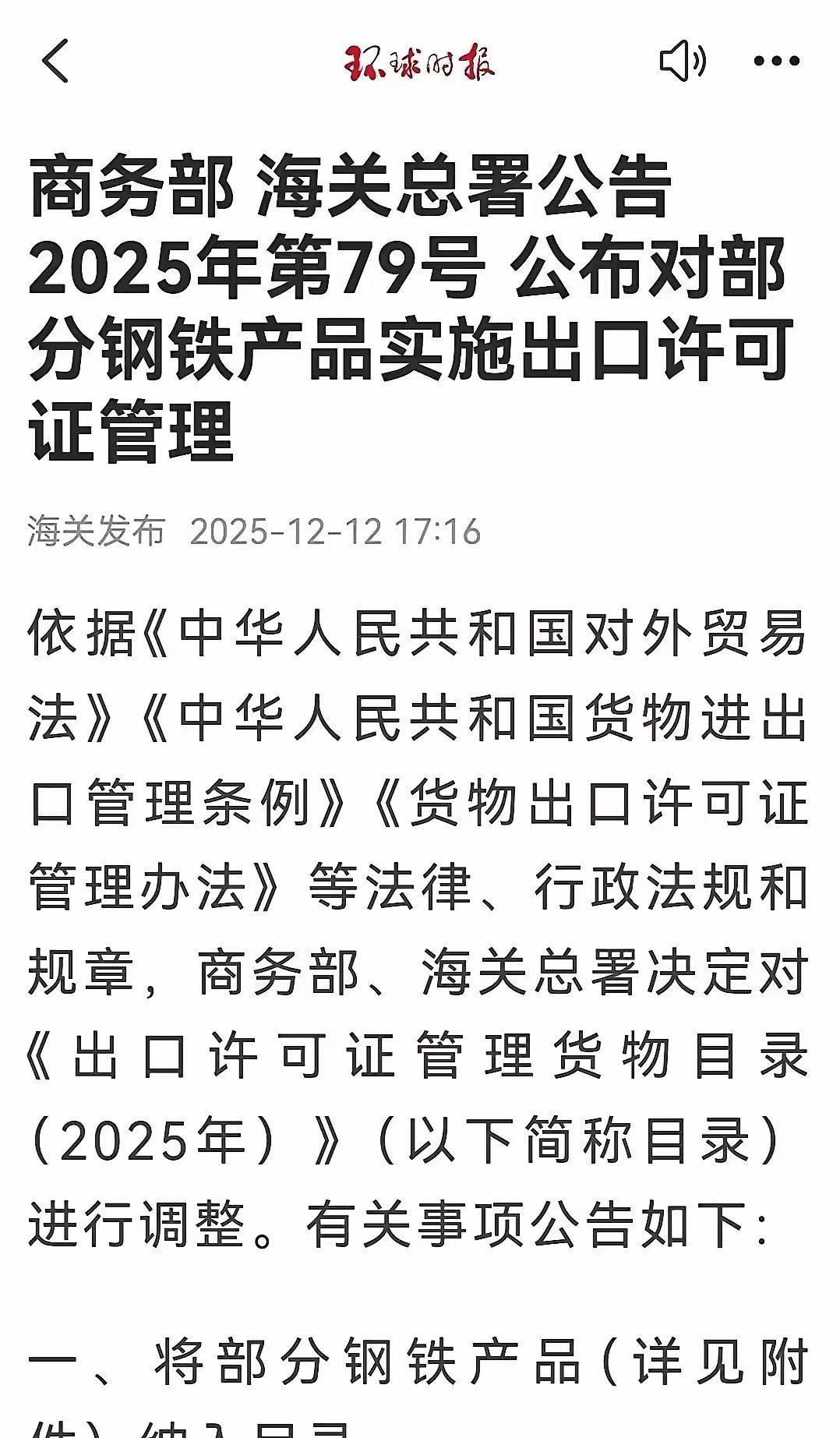
稀土牌还没打完,又要打钢铁牌?商务部:中国对部分钢铁产品实行出口许可管理!
Sou Hu Cai Jing· 2025-12-15 03:12
Core Viewpoint - The Chinese government has announced export licensing management for certain steel products, indicating a strategic shift to limit steel exports while focusing on higher value-added products [1][3]. Group 1: Export Management - China produces over half of the world's steel, with crude steel production exceeding 1 billion tons last year and steel exports nearing 80 million tons [3]. - The export licensing management is not a complete halt on exports but aims to smartly manage exports, focusing on high-value products while regulating low-efficiency crude steel [3][6]. - The international market has reacted with rising steel prices in Europe and the U.S., highlighting the dependency on Chinese steel for infrastructure and manufacturing [3][6]. Group 2: Industry Transformation - Domestic steel manufacturers are encouraged to shift their focus from relying on export tax rebates to enhancing technological capabilities, with a future emphasis on specialty steel and high-end plates [3][6]. - The steel industry accounts for over 15% of national carbon emissions, and reducing low-end exports contributes to environmental protection efforts [6]. Group 3: Strategic Positioning - The global economic landscape is changing, and China aims to move beyond being the world's factory, seeking to gain control over core resources like steel [7]. - This strategic move is seen as a multi-faceted approach to achieve industrial upgrading, environmental sustainability, and strategic autonomy [7].

市场监管总局批准发布一批重要国家标准 涉及新兴领域、安全生产等方面
Yang Shi Wang· 2025-12-09 02:41
Summary of Key Points Core Viewpoint - The recent approval and release of a series of important national standards by the State Administration for Market Regulation (National Standards Committee) aim to enhance the quality of life for citizens, ensure safety, and support the development of various sectors including emerging fields, transportation, environmental protection, safety production, and public services [1][2][3]. Group 1: Emerging Fields - Five national standards related to cybersecurity technology have been released to strengthen national cybersecurity defenses and promote healthy digital economic development [1]. - Seven national standards in information technology have been published to ensure interoperability and security of information systems through unified technical application specifications [1]. - Three national standards for social experiments in artificial intelligence have been introduced to support the healthy and orderly development of intelligent societies [1]. - Seven national standards in nanotechnology have been established to aid in the unification of relevant technical characterization and testing specifications [1]. Group 2: Transportation and Environmental Protection - A total of 44 national standards covering automotive steering systems, vehicle brake fluids, railway construction machinery, rail transit vehicles, shore power for ships, containers, and aerospace components have been released to support the construction of a strong transportation nation [1]. - Ten energy-saving and environmental protection standards have been published, focusing on industrial boiler economic operation, meat processing, food processing, alcoholic beverages, and lead-zinc industries, contributing to pollution prevention efforts [1]. Group 3: Safety Production - National standards for assessing combustible dust explosion risks and guidelines for the construction and operation of gas protection stations in chemical parks have been released to enhance safety management in hazardous chemical production [2]. - Five emergency management national standards, including guidelines for emergency drills and scenario construction methods, have been introduced to improve emergency response capabilities [2]. - Eleven mandatory national standards for fire trucks have been published to ensure technological advancement in fire truck products and enhance the operational capabilities of firefighting teams [2]. Group 4: Public Services - Three national standards related to the management of educational organizations and seven guidelines for standardized education courses in logistics, elderly care, automation, and the Internet of Things have been released to foster talent development and promote education integration [2]. - Guidelines for the usability of home health care products and services have been published to support the construction of an age-friendly society [2]. - Four national standards focusing on the digital maturity of asset management and the valuation of cultural digital assets have been introduced to enhance the digitalization level of asset management and improve transparency and security in digital asset transactions [2]. Group 5: Daily Life - National standards for smart textiles have been released to guide the standardized development of smart textile products [3]. - A national standard for biodegradable plastic shopping bags has been published to promote resource recycling [3]. - Two national standards for testing methods related to formaldehyde content in leather and fur, as well as short-chain chlorinated paraffins, have been established to improve detection of harmful substances [3]. - Eight national standards for surgical implants and sterilization of medical products have been introduced to enhance the quality and safety of medical devices [3]. - Additional national standards covering rice, navel oranges, rural toilets, and oil drilling equipment have also been released [3].
独家专访世界贸易组织前总干事帕斯卡尔·拉米:中国将在下一阶段全球化扮演重要角色
2 1 Shi Ji Jing Ji Bao Dao· 2025-12-09 00:37
Group 1 - The World Trade Organization (WTO) Appellate Body has been "inactive" for nearly six years due to the United States' unilateral and protectionist measures that undermine WTO principles [1][4] - Pascal Lamy, former WTO Director-General, suggests that the WTO must adapt to new realities and continue to operate even without U.S. participation [1][4] - Lamy emphasizes the urgent need for collective action to address climate change, as 90% of the global population is affected by environmental crises [1][3] Group 2 - Lamy identifies two main issues in international trade: the lack of enforceable regulations despite global agreements and the U.S.'s non-cooperation, which hampers international progress [4][6] - He advocates for a platform to address North-South tensions and believes that international trade and labor division can benefit the environment [4][5] - Lamy proposes a comprehensive forum on climate change and trade, emphasizing the need for open discussions based on expertise rather than negotiations [5] Group 3 - The transition from "fast globalization" to "slow globalization" is noted, with international trade still growing but at a slower pace [6][7] - Lamy highlights three characteristics of the current multilateral trade system: weaponization of trade, U.S. protectionism, and the rise of preventive trade measures due to public health and environmental concerns [6][8] - He points out that while the U.S. accounts for only 13% of global imports, the remaining 87% of countries can maintain a stable global trade system if not affected by protectionism [7] Group 4 - China is identified as a major player in global trade, with a projected total import and export value of 43.85 trillion yuan in 2024, a 5% increase year-on-year [9] - Lamy advises that companies must enhance their strategic flexibility and adaptability in response to geopolitical and technological changes [9][10] - Digitalization is recognized as a new variable affecting global trade, with digital technologies lowering transaction costs and facilitating service trade growth [10] Group 5 - Reform of the WTO is deemed necessary, particularly in balancing power between members and the secretariat to improve decision-making efficiency [10] - Lamy calls for the WTO to enhance trade facilitation in areas such as trade, environment, e-commerce, and subsidy disciplines [10]

独家专访拉米:美国实质上已退出WTO 全球化路在何方?
2 1 Shi Ji Jing Ji Bao Dao· 2025-12-08 09:51
Group 1: WTO and Global Trade Dynamics - The WTO Appellate Body has been "inactive" for nearly six years due to the U.S. obstructing the appointment of members since 2017, leading to its official "shutdown" in December 2019 [1] - Pascal Lamy, former WTO Director-General, suggests that the WTO must adapt to new realities and continue to operate even without U.S. participation, as the U.S. has effectively withdrawn from the organization [1] - Lamy emphasizes the need for a platform to address the North-South tensions regarding climate change and trade, advocating for international trade and labor division to benefit the environment [3][4] Group 2: Environmental Concerns and Trade - Lamy identifies two main issues: the lack of enforceable regulations despite global agreements like the Paris Agreement, and the U.S.'s non-cooperation, which hampers international efforts [3] - He proposes that the world must pursue both open trade and environmental protection simultaneously, highlighting the complexity of balancing these objectives [4] - The rise of preventive trade protectionism, driven by public health and environmental concerns, is noted, with examples like carbon pricing mechanisms in China and Europe [6] Group 3: China's Role in Globalization - China's import and export value is projected to reach 43.85 trillion RMB in 2024, marking a 5% year-on-year increase, with exports growing by 7.1% and imports by 2.3% [7] - Lamy asserts that China will play a crucial role in the next phase of globalization, needing to balance its macroeconomic adjustments while expanding into emerging markets [7] - Companies are urged to enhance their strategic flexibility and adaptability in response to geopolitical and technological changes [7][8] Group 4: Digital Trade and Governance - Digital technology is reshaping global trade, lowering transaction costs and facilitating service trade growth, but differing data governance regulations create new barriers [8] - Establishing an international digital governance framework is critical for sustainable global trade development [8] - Lamy calls for reforms within the WTO to address systemic contradictions, such as the imbalance of power between members and the secretariat, which affects decision-making efficiency [8][9]
独家专访拉米:美国实质上已退出WTO,全球化路在何方?
2 1 Shi Ji Jing Ji Bao Dao· 2025-12-08 09:45
Core Viewpoint - The World Trade Organization (WTO) appellate body has been "inactive" for nearly six years due to the United States' unilateral and protectionist measures, which have undermined the organization's principles and obstructed the appointment of appellate body members [2][3] Group 1: WTO's Current Situation - The WTO appellate body officially ceased operations on December 11, 2019, after over 20 years of functioning [2] - Pascal Lamy, former WTO Director-General, suggests that the WTO must adapt to new realities and continue to operate even without U.S. participation [2][3] - Lamy warns that avoiding large-scale wars and environmental degradation should be prioritized in the coming years, as 90% of the global population is affected by these crises [2] Group 2: Climate Change and Trade - Lamy emphasizes the need for a friendly trade environment to protect against the harmful effects of environmental degradation while utilizing Earth's resources more effectively [3][4] - There is a lack of consensus between developed and developing countries on addressing climate change, necessitating a platform to resolve North-South tensions [3] - Existing global agreements lack enforceable regulations, leading to fragmented actions that could escalate trade frictions [3][4] Group 3: Global Trade Regulations - Some global regulations have pointed the way to resolving trade disputes, but trade protectionism remains a significant barrier [4] - Lamy notes that developed countries often adopt avoidance strategies regarding climate issues, while some developing countries resist discussions that could lead to negotiations within the WTO [4][5] - A proposed comprehensive forum on climate change and trade could facilitate discussions based on expertise and openness, rather than formal negotiations [5] Group 4: The Future of Global Trade - Lamy argues that the world must pursue open trade, environmental protection, and domestic economic development simultaneously, especially for developing countries [5][6] - The transition from "fast globalization" to "slow globalization" is underway, with international trade still growing but at a slower pace [6] - The new normal of the multilateral trade system is characterized by trade weaponization, U.S. protectionism, and the rise of preventive trade measures due to public health and environmental concerns [6][7] Group 5: China's Role in Global Trade - China's total import and export value is projected to reach 43.85 trillion yuan in 2024, a 5% increase year-on-year, with exports growing by 7.1% and imports by 2.3% [7] - As a major player in global trade, China must balance its macroeconomic rebalancing with the need to explore emerging markets and optimize trade structures [7][8] Group 6: Digitalization and Trade - Digitalization is reshaping global trade dynamics by lowering transaction costs and facilitating service trade growth [8] - However, significant differences in data governance and regulatory frameworks across countries create new barriers for service trade [8] Group 7: Reforming the WTO - The WTO faces a systemic contradiction as the U.S. participates in decision-making while having withdrawn from its constraints [9] - Lamy calls for reforms to improve the WTO's structure and efficiency to better address complex new issues [9] - A rebalancing of power between members and the secretariat is necessary to enhance decision-making efficiency within the WTO [9]
挪威推迟首轮深海采矿许可
Zhong Guo Hua Gong Bao· 2025-12-08 02:54
Core Viewpoint - The Norwegian government has reached an agreement with left-wing parties to postpone the first round of deep-sea mining licenses until at least 2029, emphasizing the need for further research and regulatory framework improvement while maintaining its long-term policy goals [1] Group 1: Regulatory Changes - The decision to delay exploration and extraction activities for four years is part of budget negotiations [1] - Environmental organizations, such as the World Wildlife Fund, welcomed the postponement, viewing it as a positive step for environmental protection [1] Group 2: Resource Significance - The Norwegian continental shelf is rich in strategic mineral resources, including cobalt, copper, zinc, and rare earth elements, which are crucial for green technologies like batteries and wind power [1] - Despite the postponement of deep-sea mining plans, global competition for Arctic mineral resources continues to intensify [1] Group 3: Regional Resource Distribution - The distribution of mineral resources in the Arctic is uneven but holds significant strategic value, with Greenland rich in rare earth elements and northern Sweden's mining areas producing both copper and rare earth minerals [1] - Other regions contain various minerals such as germanium, gallium, antimony, titanium, tungsten, and precious metals [1]
39页|2025年化肥行业低碳发展系列研究报告-中国化肥减量增效十年之路
Sou Hu Cai Jing· 2025-12-07 02:43
Core Viewpoint - The Chinese fertilizer industry has achieved significant reduction and efficiency improvements over the past decade, becoming a key example of sustainable agricultural transformation globally. Since the launch of the "Zero Growth Action for Fertilizer Use" in 2015, the national fertilizer application has decreased for nine consecutive years, from 60.23 million tons to 49.88 million tons, a reduction of 17.2% [1][13][35]. Group 1: Industry Transformation and Achievements - The fertilizer application rate for the three major grain crops has increased from 35% to 42.6%, indicating more scientific and precise fertilization methods [1][13]. - The total grain production in China has remained stable at over 1.3 trillion jin since 2015, with a projected first-time increase to over 1.4 trillion jin in 2024, further ensuring food security [1][13]. - The actions taken have cumulatively avoided approximately 126 million tons of fertilizer application from 2015 to 2024 [1][35]. Group 2: Policy and Market Mechanisms - The transformation of the fertilizer industry is a result of multiple policies and market mechanisms working in synergy, involving technological innovation, management optimization, and production structure adjustments [1][12]. - The "dual carbon" goals of the state are driving the fertilizer industry towards a green and low-carbon direction, facing complex challenges in balancing food security, environmental protection, and economic benefits [1][12]. Group 3: Global Context and Future Outlook - The process reflects not only domestic agricultural modernization but also provides reference value for global agricultural sustainable development [2]. - The fertilizer industry must explore more efficient and environmentally friendly development paths to support the dual goals of food security and ecological protection [2].