生猪产能去化

Search documents
生猪周报:反套或低多远月-20251213
Wu Kuang Qi Huo· 2025-12-13 13:00
反套或低多远月 生猪周报 2025/12/13 028-86133280 wangja@wkqh.cn 从业资格号:F0273729 交易咨询号:Z0002942 王 俊 (农产品组) CONTENTS 目录 01 周度评估及策略推荐 04 需求端 02 期现市场 05 成本和利润 03 供应端 06 库存端 01 周度评估及策略推荐 周度评估及策略推荐 ◆ 现货端:上周国内猪价先跌后涨,周内受降温降雪影响,市场备货有所增加,屠宰量稳步增多,上游顺势出栏,交易均重略微下滑,肥标价差 小幅抬高;具体看,河南均价周涨0.1元至11.48元/公斤,周内最低11.22元/公斤,四川均价周涨0.76元至12.06元/公斤,周内最低11.5元/公 斤,广东均价周涨0.24元至12.16元/公斤;散户和集团场供应陆续增加,但在腌腊等需求放量的带动下,整体走货顺畅,预期未来猪价以仍微 涨走势为主。 ◆ 供应端:10月官方母猪存栏为3990万头,环比回落1.1%,仍比正常母猪保有量多2.3%,去年以来母猪产能的持续增加,或导致今年及明年上半 年供应基调维持偏空;不过,当前政策端强制去产能的预期较强,或在今年亏损有限的背景下改善 ...
11月生猪数据解读及行业近况更新
2025-12-11 02:16
11 月生猪数据解读及行业近况更新 20251210 摘要 2025 年母猪产能去化幅度约为 2%,低于前两轮(15%和 7%),但 8 月起出现小幅下降趋势,预计产能调整将持续至 2026 年上半年。集团 企业产能利用率从 78%降至 73%,预示产能去化刚开始。 11 月新生仔猪数量首次环比下跌 1.2%,但同比仍增加 8%,预示至 2026 年 5 月前生猪供应量将持续增加,之后才会环比减少。仔猪价格 自 9 月起亏损,7 公斤重仔猪价格已降至 200 元以下,补栏意愿低迷。 2025 年疫病较 2024 年严重,但轻于 2023 年。11 月起山东、苏北等 地出现零星疫病,12 月有所扩散,山东商品猪受损约 10%。江苏苏北、 河南等地疫情上升,对商品猪影响较大,但对母猪影响相对较小。 受疫病影响,北方养殖户积极出栏,南方因消费习惯偏好大肥猪导致标 猪需求不足,出栏节奏偏慢。冬至前及春节前将有集中抛售行为,需重 点关注供应释放情况。 12 月二育入场比例下降,栏舍利用率环比下降约 5%,因疫情严重及调 运频繁,二育意愿降低。前期二育尚未完全出栏,约 30%-40%待出。 局部疫情导致中大猪损失占比达 ...
生猪月报:从高空近月到低多远月-20251205
Wu Kuang Qi Huo· 2025-12-05 14:15
1. Report Industry Investment Rating No relevant content provided in the report. 2. Core Viewpoints of the Report - The theoretical and planned pig slaughter volume remains large. With high slaughter volume, the average weight of pigs is still higher than the same period last year and continues to increase month - on - month. The price difference between fat and standard pigs has stagnated at a high level, and the pens for secondary fattening by individual farmers are slowly releasing. The supply - side pressure remains high. Near - term contracts are still under pressure from spot prices, but when prices are too low, there may be fluctuations due to spot prices and positions. The expectation of capacity reduction in the long - term is strong, and the downside space may be limited. It is recommended to maintain the reverse spread idea, but gradually shift the focus from shorting near - term contracts at high levels to going long on far - term contracts at low levels [10][12]. 3. Summary According to Relevant Catalogs 3.1 Monthly Assessment and Strategy Recommendation - **Spot Market**: Since November, domestic pig prices have been oscillating downward. The supply of live pigs in the market is abundant, while the demand is affected by the lack of obvious cooling. Curing has only been carried out sporadically, and individual farmers mainly focus on selling pigs, lacking support from secondary fattening. The price is under overall pressure. The price difference between fat and standard pigs has slightly decreased, and the average trading weight has slowly increased. In November, the average price in Henan dropped by 1.12 yuan to 11.38 yuan/kg, in Sichuan by 0.8 yuan to 11.3 yuan/kg, and in Guangdong by 1.04 yuan to 11.92 yuan/kg. This month, due to the increased supply from large enterprises and individual farmers, the supply may increase significantly. The demand may remain stable in the early stage and may have difficulty absorbing the supply. However, with the peak of curing later, there may be a sharp increase when the spot price is too low, but the overall sufficient supply may limit the increase. Therefore, it is expected that pig prices will be weak first and then strong this month, but the overall center of gravity will still decline [11][22]. - **Supply Side**: In October, the official inventory of breeding sows was 39.9 million, a 1.1% month - on - month decrease, still 2.3% more than the normal level. The continuous increase in sow production capacity since last year may lead to a bearish supply situation this year and in the first half of next year. However, there is a strong expectation of mandatory capacity reduction from the policy side, which may improve the supply situation next year. The implementation of policy - driven capacity reduction in the next few months needs to be closely monitored. From the data of piglets, the basic supply from now to May next year shows an increasing trend month by month. Coupled with the backward accumulation of inventory caused by frozen pork storage and secondary fattening this round, as well as the pre - arranged supply to cope with the off - season after the Spring Festival, it is expected that the pig market before the Spring Festival this year will still face a bearish configuration of high slaughter volume and large - weight pigs. In the short term, after the National Day, the slaughter volume has remained high, the frozen pork inventory has continued to rise, and the average trading weight of pigs is larger than the same period last year and has increased month - on - month. The short - term market still has an oversupply situation [11]. - **Demand Side**: After the National Day, the demand has increased month - on - month. On the one hand, low prices have stimulated consumption, and frozen pork and secondary fattening have entered the market. On the other hand, basic consumption has increased after the temperature dropped. However, the temperature drop from October to November was limited, and there is still some time until the Spring Festival. A significant increase in consumption needs to wait until December [11]. - **Trading Strategy**: For unilateral trading, it is recommended to short contracts 01 and 03 after a rebound, with a profit - to - loss ratio of 2:1 and a recommended period of 0.5 - 1 month, driven by supply, weight, and consumer demand. For arbitrage, it is recommended to conduct reverse spreads for contracts 3 - 7 and 3 - 9, with a profit - to - loss ratio of 2:1 and a recommended period of 2 months, driven by policies, weight, basic supply, and the price difference between fat and standard pigs [13]. 3.2 Futures and Spot Market - **Spot Price Trend**: The domestic pig price has been oscillating downward since November. The supply is abundant, and the demand is weak. It is expected that the price will be weak first and then strong this month, but the overall center of gravity will decline [22]. - **Basis and Spread Trend**: The spot market is generally weak, and the near - term futures follow the spot. The far - term futures trade on the expectation of capacity reduction, and the monthly spread tends to be in a reverse spread [25]. 3.3 Supply Side - **Breeding Sows and Changes**: In October, the official inventory of breeding sows was 39.9 million, a 1.1% month - on - month decrease, still 2.3% more than the normal level. The production capacity reduction in the early stage was slow, but there are signs of acceleration recently [33]. - **Inventory and Slaughter**: From the data of piglets, the basic supply from now to April next year shows an increasing trend month by month. Before the Spring Festival this year, the pig market will face a bearish configuration of high slaughter volume and large - weight pigs. In the short term, the market has an oversupply situation [42][49]. 3.4 Demand Side - After the National Day, the demand has increased month - on - month. However, due to limited temperature drop from October to November and some time until the Spring Festival, a significant increase in consumption needs to wait until December [58]. 3.5 Cost and Profit - Due to factors such as feed cost and efficiency improvement, the cost has been continuously declining. However, the pig price is the weakest in the same period in recent years. Although the cost is low, there has been an overall loss this year [69]. 3.6 Inventory Side - The frozen pork inventory is in a state of slow recovery and active inventory accumulation [74].
中信证券:10月产能去化加速,继续推荐生猪板块
Mei Ri Jing Ji Xin Wen· 2025-12-02 00:25
Group 1 - The core viewpoint of the article indicates that the de-stocking of breeding sows accelerated in October, leading to a continued loose supply situation in the industry, which puts pressure on pork prices [1] - The report suggests that the ongoing capacity reduction is expected to support the cyclical prosperity and its duration after the second half of 2026 [1] Group 2 - The report continues to recommend leading companies with strong innovation and dividend capabilities [1] - It also highlights cost-leading companies as favorable investment opportunities [1] - Companies involved in mergers and acquisitions are identified as potential growth drivers [1]

中信证券:10月产能去化加速 继续推荐生猪板块
Di Yi Cai Jing· 2025-12-02 00:19
Core Viewpoint - The report from CITIC Securities indicates that the destocking of breeding sows accelerated in October, leading to a sustained loose supply situation in the industry, which is putting pressure on pork prices. However, the ongoing destocking is expected to support the cyclical recovery starting in the second half of 2026 [1]. Group 1: Industry Supply and Pricing - The supply side of the industry continues to maintain a loose situation, resulting in fluctuations and pressure on pork prices [1]. - The ongoing destocking process is anticipated to continue, which may enhance the cyclical prosperity and its duration post-2026 H2 [1]. Group 2: Investment Recommendations - The report recommends focusing on leading companies with strong cash flow and dividend capabilities [1]. - It also suggests investing in cost-leading companies [1]. - Additionally, companies that are involved in mergers and acquisitions for growth are highlighted as potential investment opportunities [1].
供需矛盾持续 生猪产能去化缓慢
Qi Huo Ri Bao· 2025-12-01 23:25
Core Viewpoint - The pig market is experiencing a prolonged period of oversupply, leading to significant price declines and deep losses for producers, with the current average price of live pigs falling nearly 30% year-on-year [2][5]. Group 1: Market Dynamics - The shift in trading focus from the 2601 to the 2603 futures contract indicates a temporary easing of pressure on near-term contracts, but the overall rebound remains weak due to ongoing supply-demand imbalances [1]. - As of the end of November, the average price of live pigs in China is between 11.4 to 11.7 yuan per kilogram, reflecting a substantial year-on-year decrease [2]. - The current pig production capacity reduction is slow, with only about 800,000 fewer breeding sows in the year, despite a recent decline in the breeding sow population below 40 million for the first time in 15 months [2][3]. Group 2: Production Capacity Challenges - The slow pace of capacity reduction is attributed to three main factors: the resilience of large-scale farms, incomplete capacity reduction among smallholders, and an increase in the number of heavier pigs being raised [2][3]. - Large-scale farms are less inclined to reduce production due to their financial and technical advantages, with a slight increase in breeding sow numbers in certain regions [2]. - Smallholder farmers are hesitant to reduce their herds, hoping for a rebound in prices due to seasonal demand, which has led to a lack of significant capacity reduction [2][5]. Group 3: Supply Pressure and Market Expectations - The phenomenon of secondary fattening has intensified supply pressures, with a notable increase in the proportion of heavier pigs being sold, exacerbating the oversupply situation [4][5]. - Producers are facing a "price inversion" situation where the cost of fattening exceeds the selling price, leading to increased losses [4]. - The expectation of a recovery in demand has not materialized, with consumer spending on dining out at a 15-month low, further complicating the market dynamics [5]. Group 4: Policy and Regulatory Environment - The current regulatory framework aims to balance long-term production capacity control with short-term market stabilization measures, but the effectiveness of these policies is limited by the deep supply-demand imbalance [6][7]. - The Ministry of Agriculture has set a target for breeding sow numbers and will implement counter-cyclical management to address significant deviations from this target [7]. - The temporary meat storage policy is intended to provide short-term market support, but its impact is minimal due to limited storage capacity and the time lag in implementation [7][8]. Group 5: Future Outlook - The effects of production capacity adjustments are expected to manifest in 10 to 12 months, while immediate price pressures can only be temporarily alleviated through storage policies [8]. - Without a substantial recovery in consumer demand, the overall weak market conditions in the pig industry are likely to persist [8].
生猪去化趋势不改,择机参与板块配置
GOLDEN SUN SECURITIES· 2025-11-30 12:48
Investment Rating - The industry investment rating is "Maintain Increase" [4] Core Views - The trend of pig reduction continues, suggesting a strategic opportunity for participation in the sector [15][16] - The price of lean meat pigs as of November 28, 2025, is 11.09 CNY/kg, down 9.1% from the previous month, indicating ongoing industry losses [15][18] - The average profit for self-breeding pigs is -147.99 CNY/head, a decrease of 58.66 CNY/head from the previous month, while the profit for purchased piglets is -248.82 CNY/head, down 69.1 CNY/head [15][23] - The number of breeding sows has decreased to 39.9 million, and further production capacity reduction is expected due to policy and low prices [15][16] - The mushroom sector shows a sustained price rebound for enoki mushrooms, with strong performance expected from key companies [16] - The seed industry is seeing a clear trend of variety replacement, with transgenic varieties entering commercial sales, indicating potential growth for related companies [16] - In poultry farming, seasonal price elasticity opportunities are noted for yellow feathered chickens, while white feathered chickens are affected by avian influenza in Europe [17] Summary by Sections Pig Farming - The lean meat pig price is 11.09 CNY/kg, down 9.1% from last month [18] - The average wholesale price of pork is 17.83 CNY/kg, down 1.1% [18] - The profit for self-breeding pigs is -147.99 CNY/head, a decrease of 58.66 CNY/head [23] - The profit for purchased piglets is -248.82 CNY/head, down 69.1 CNY/head [23] Mushroom Sector - Enoki mushroom prices remain strong, confirming a sustained price rebound [16] - The release period for Cordyceps sinensis as a key new product is approaching, with strong performance expected [16] Seed Industry - A clear trend of variety replacement in corn is noted, with transgenic varieties entering commercial sales [16] - Companies like Kangnong Seed Industry and Longping High-Tech are highlighted for potential growth [16] Poultry Farming - The price of meat chicken chicks is 3.47 CNY/chick, down 3.1% from last month [28] - The average price of white feathered chickens is 7.19 CNY/kg, up 1.4% [32] - The average price of chicken products is 8.95 CNY/kg, up 0.6% [32] Agricultural Products - Domestic corn prices increased to 2329.8 CNY/ton, up 4.0% [44] - Domestic wheat prices rose to 2507.28 CNY/ton, up 0.7% [46] - Domestic soybean prices increased to 4014.74 CNY/ton, up 0.4% [57]


去化提速!能繁母猪跌破4000万头,猪肉股盘中上涨,低费率畜牧养殖ETF(516670)近20日“吸金”9600万元
2 1 Shi Ji Jing Ji Bao Dao· 2025-11-26 03:36
Core Insights - The pork stocks have seen an increase, with notable gains in companies like Luoniushan and Jinxinnong, while the Livestock Breeding ETF has also experienced a net inflow of approximately 96 million yuan over the past 20 trading days [1][3] Industry Overview - The Ministry of Agriculture and Rural Affairs reported that the national breeding sow inventory for October was 39.9 million heads, a decrease of 450,000 heads from September, marking a decline of 1.1% [1] - The average price of live pigs as of November 24 was 11.6 yuan/kg, down from 12.25 yuan/kg on September 30, indicating a price drop of 0.65 yuan/kg [3] - The price of piglets also fell to 21.21 yuan/kg, down 1.01 yuan/kg from 22.22 yuan/kg on September 30 [3] - The pig-to-grain ratio is currently at 5.23, down from 5.44 at the end of September, reflecting significant supply pressure in the industry [3] Financial Performance - The current profitability for purchased piglets and self-bred piglets is reported at -234.64 yuan/head and -135.9 yuan/head respectively, indicating an increase in losses compared to the previous week [3] - The industry is facing comprehensive losses, with supply pressures expected to persist in the short term, leading to passive capacity reduction [3] Future Outlook - Analysts suggest that the industry may enter an accelerated phase of capacity reduction due to dual pressures from policy adjustments and production losses, presenting potential investment opportunities in the pig farming sector [4] - In the medium to long term, leading breeding companies are expected to see a decrease in costs and an increase in profit margins, supported by stable cash flows and dividend expectations [4] - The Livestock Breeding ETF, which tracks the livestock breeding index, has the lowest management fee rate of 0.2% per year among similar ETFs, making it an attractive option for investors [4]

生猪产能去化加速,板块迎来配置机遇
2025-11-24 01:46
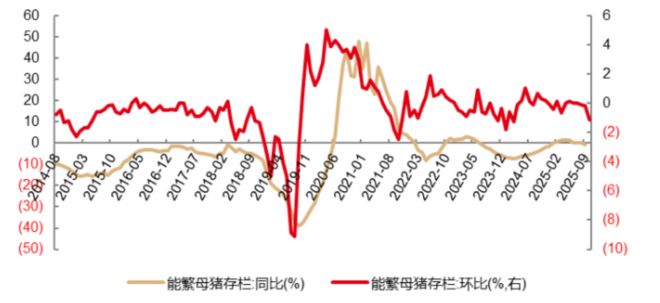
生猪产能去化加速,板块迎来配置机遇 20251123 目前生猪板块正处于新一轮的起点,进入了去产能的逻辑。自 2025 年 6 月以 来,行业逐步从政策炒作转向稳定发展,并在 10 月份加速了去产能进程。农 业农村部数据显示,10 月份能繁母猪存栏量已降至 4,000 万头以下,相比 9 月份下降了 0.9%。这一趋势表明行业正在加速去化。 2025 年下半年的猪价走势如何? 2025 年下半年猪价持续低迷。尽管市场上曾有部分观点看好下半年猪价,但 我们一直持悲观态度。从数据来看,今年头部猪企出栏增速显著,全年出栏增 速达 20%,绝对值增加了 3,400 多万头。而去年(2024 年)仅为 5%左右, 增加约 800 万头。这种快速增长导致供给压力巨大,加之需求端未见显著变化, 10 月份能繁母猪数量加速下降,预计下降速度可能会维持在每月环比 0.9%至 1%左右,行业将逐步进入产能去化加速的阶段。市场情绪非常 悲观。 当前行业环境下,应选择成本低、具有扩张潜力、资产负债率低且现金 流强劲的公司作为投资标的。推荐牧原股份和温氏股份,小型企业如天 康、德康、神农、巨星和丽华也值得关注。年底是政策密集出台期,对 ...
广发证券:10月整体亏损持续 上市猪企整体出栏量增长提速 销售均重环比上升
智通财经网· 2025-11-14 03:25
Core Viewpoint - The report from GF Securities indicates that several listed companies have released monthly operational data, showing an overall increase in pig output in October 2025, despite a recent decline in pig prices below 12 yuan/kg, leading to continued losses across the industry. The expectation is for low piglet prices to persist in the upcoming months due to the off-peak season for restocking, with a recommendation to prioritize leading companies with cost advantages given the current low valuation of the sector [1]. Group 1: Listed Companies' Output Tracking - In October 2025, the overall pig output from 15 listed companies increased by 23.7% month-on-month and 46.4% year-on-year, totaling 18.43 million pigs. Excluding Muyuan Foods, the output was 11.35 million pigs, reflecting a month-on-month increase of 21.8% and a year-on-year increase of 73.0% [2]. - From January to October 2025, the total pig output from listed companies reached 154.79 million, marking a year-on-year growth of 35.0%. Excluding Muyuan Foods, the output was 90.39 million, with a year-on-year increase of 27.5% [2]. - Major companies like Muyuan Foods, Wens Foodstuff Group, New Hope, and Dekang Agriculture reported significant increases in pig output, with Muyuan Foods alone contributing 7.08 million pigs in October, reflecting a month-on-month increase of 27.0% and a year-on-year increase of 14.6% [2]. Group 2: Small and Medium-sized Breeding Enterprises - In October, small and medium-sized enterprises such as Tangrenshen, Tiankang Biological, Shennong Group, and Juxing Agriculture reported pig outputs of 619,000; 304,000; 335,000; and 459,000 respectively, with month-on-month increases of 50.7%, 13.7%, 46.5%, and 30.6% [3]. - From January to October 2025, these companies had cumulative outputs of 4.38 million; 2.59 million; 2.45 million; and 3.39 million pigs, with year-on-year increases of 33.2%, 6.5%, 31.0%, and 64.4% respectively [3]. Group 3: Sales Price Analysis - In October, the average sales price for listed companies (excluding Dongrui) was 11.46 yuan/kg, reflecting a month-on-month decrease of 11.8%. Variations in sales prices were influenced by factors such as sales regions, product quality, and piglet sales proportions [4]. - The average weight of pigs sold in October was approximately 119.74 kg per head, showing a month-on-month increase of 0.8% [4]. Group 4: Investment Recommendations - The report highlights that the recent decline in pig prices has led to ongoing losses across the industry, with piglet prices expected to remain low in the near term. The current industry losses, combined with a trend towards reducing production capacity, suggest a potential acceleration in the pace of capacity reduction [5]. - The report recommends focusing on leading companies with cost advantages, specifically highlighting Wens Foodstuff Group and Muyuan Foods as key investment targets, while also suggesting attention to Dekang Agriculture and New Hope. For potential recovery plays, Zhengbang Technology is noted, along with small and medium-sized enterprises like Tiankang Biological, Shennong Group, and Tangrenshen [5].