
网络水军

Search documents
“网络水军”“黑公关”频发,上汽集团坚决“亮剑”,共筑汽车行业清朗新生态
Xin Lang Cai Jing· 2025-11-19 08:06
Core Viewpoint - The automotive industry is facing increasing challenges from online misinformation, malicious defamation, and commercial slander, prompting a coordinated response from various stakeholders to protect the industry's integrity and promote high-quality development [1][3]. Group 1: Government and Industry Response - In September, the Ministry of Industry and Information Technology and five other departments issued a notice to launch a three-month campaign to address online chaos in the automotive sector, focusing on illegal accounts spreading false information [1][3]. - The industry is witnessing a collaborative effort among multiple domestic car manufacturers to combat online rumors and "black public relations," establishing a firewall against these issues [3][4]. - The government has emphasized the importance of a healthy public opinion environment as a crucial part of the business ecosystem, launching various initiatives to tackle malicious attacks on companies [6][7]. Group 2: Company Actions - SAIC Motor Corporation has actively responded to online rumors, reporting malicious accounts to law enforcement and successfully addressing over 10,000 instances of false information in the first ten months of the year [2][5]. - The company has publicly announced a reward of up to 5 million RMB for information related to malicious rumors and defamation against its brands, encouraging public participation in maintaining a clean online environment [4][5]. - SAIC Motor is committed to using legal means to protect its rights and has called for collaboration among enterprises, media, and the public to create a new governance model for online management [7].

身份不明的人,竟敢黑小米雷军?
Sou Hu Cai Jing· 2025-11-14 07:55
Core Viewpoint - The article discusses the challenges faced by Lei Jun and Xiaomi, highlighting the backlash against Lei's call to combat online misinformation and the perception of arrogance following a recent car accident involving a Xiaomi vehicle [4][5]. Group 1: Public Perception and Criticism - Lei Jun has been criticized for being labeled an opportunist and for his approach to business, with emphasis on the need for both hard work and seizing opportunities [1]. - Following a serious incident involving a Xiaomi vehicle, public sentiment has turned against Lei's call to resist online attacks, with many interpreting it as dismissive of legitimate safety concerns [4]. - Critics argue that Xiaomi's response to public criticism reflects a failure to fully embrace a consumer-first philosophy, as noted by former Global Times editor Hu Xijin [4]. Group 2: Industry Context and Reactions - The automotive industry is characterized by intense scrutiny, especially regarding safety, with competitors like Geely emphasizing safety over aesthetics in vehicle design [5]. - There is a widespread acknowledgment within the industry of the use of online tactics to undermine competitors, which complicates the landscape for companies like Xiaomi [5][7]. - Despite efforts from industry leaders to combat negative online narratives, such as BYD and Great Wall Motors offering rewards for information on black public relations activities, the effectiveness of these measures remains questionable [7].


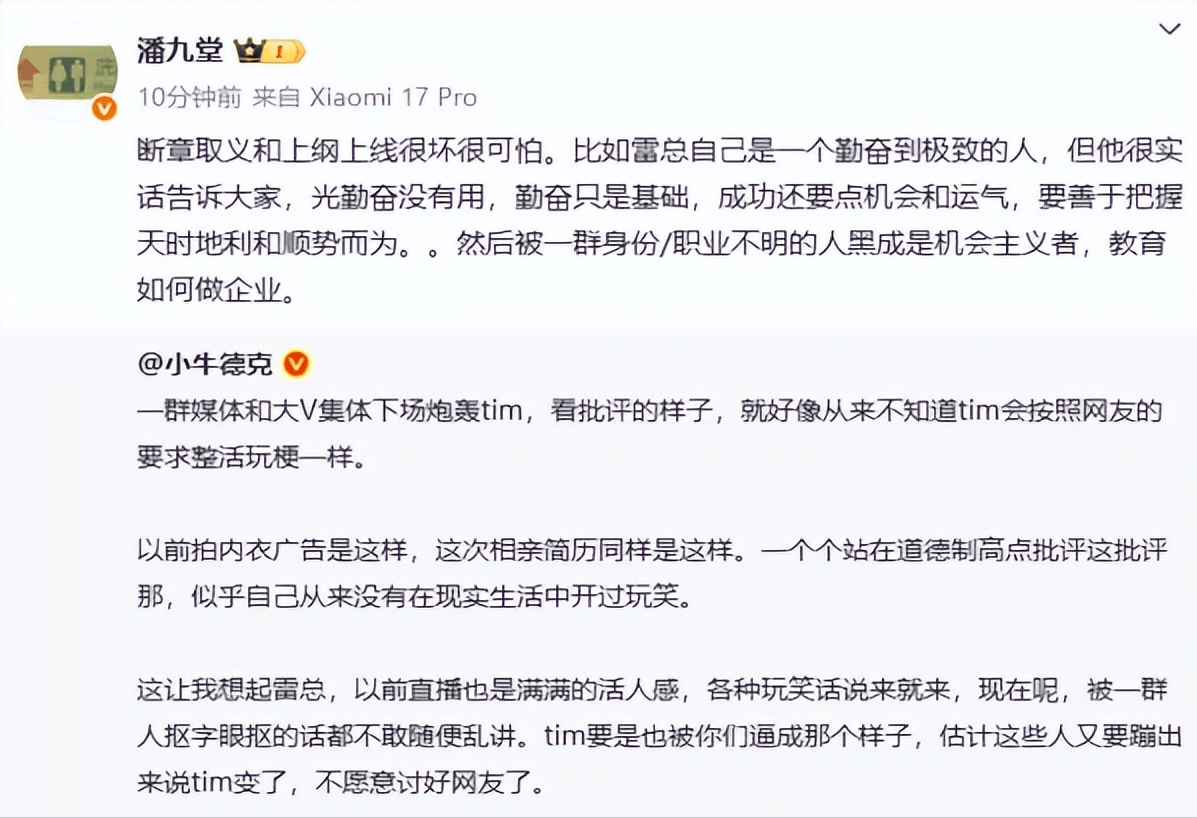
被网暴小米车主获赔背后:车圈网暴风气从何而起,如何遏制?
Nan Fang Du Shi Bao· 2025-11-05 06:15
Core Viewpoint - The article highlights the increasing prevalence of online harassment and "black public relations" in the automotive industry, particularly targeting car owners and brands, leading to a toxic environment for consumers and companies alike [6][9][12]. Group 1: Online Harassment and Its Impact - Dismissive and abusive comments towards car owners have become common, with individuals facing severe online bullying for their vehicle choices, as seen in the case of Ms. Deng who faced threats and insults after purchasing a Xiaomi SU7 [7][8][15]. - The negative sentiment has escalated from online platforms to real-world actions, including vandalism of vehicles, indicating a troubling trend where online aggression translates into physical harm [12][14]. - The automotive sector is witnessing organized campaigns of defamation, with coordinated efforts to discredit certain brands and their customers, often driven by "water army" tactics [9][11]. Group 2: Legal and Corporate Responses - Companies are beginning to take legal action against online harassment, with Ms. Deng successfully suing her harassers and receiving compensation, setting a precedent for others [15][16]. - Automotive brands like Xiaomi are establishing support channels for affected customers, providing legal assistance and gathering feedback to combat online abuse [16][19]. - Regulatory bodies are also stepping in, with initiatives aimed at curbing illegal activities related to online defamation and misinformation in the automotive industry [19][20]. Group 3: The Role of "Black Public Relations" - The article discusses the emergence of a "black public relations" industry that employs deceptive tactics to undermine competitors, including the spread of false information about vehicle safety and performance [11][19]. - This industry is characterized by organized efforts to manipulate public perception, often using social media to amplify negative narratives about specific brands [9][12]. - Companies are responding with financial incentives for information on malicious activities, indicating a growing recognition of the threat posed by these tactics [19][20].

大快人心!官方出手,李想总算能出口恶气,雷军一个字都没说错
Sou Hu Cai Jing· 2025-10-23 09:38
Core Viewpoint - Li Xiang is portrayed as a successful entrepreneur who has faced public scrutiny and controversy, particularly regarding his company, Li Auto, amidst rumors and misinformation in the automotive industry [1][3][5]. Group 1: Entrepreneurial Journey - Li Xiang co-founded the popular website Bubble Network and later shifted his focus to the automotive industry, leading to the establishment of Li Auto [3][34]. - He gained significant attention for his entrepreneurial spirit, having previously achieved remarkable success in the tech sector before venturing into automobiles [34][32]. - Li Auto's model, the Li L6, received over 10,000 orders within three days of its launch, highlighting the brand's rapid acceptance in a competitive market [35]. Group 2: Public Controversies - Li Xiang faced a wave of negative publicity and rumors about Li Auto's potential bankruptcy, which were exacerbated by online misinformation campaigns [39][40]. - The company was targeted by organized smear campaigns, including a group that was exposed for its malicious tactics against Li Auto [40][42]. - In response to the attacks, Li Auto's legal team took action to gather evidence and pursue legal recourse against those spreading false information [42][46]. Group 3: Industry Response - Social media platforms like Weibo have begun to take action against accounts spreading misinformation, indicating a shift towards protecting companies from online defamation [44][48]. - The crackdown on malicious actors serves as a deterrent for those attempting to profit from spreading false information about companies [49][56]. - The situation surrounding Li Auto reflects broader industry challenges with online misinformation and the need for collective action against such practices [54][58].

最危险的时刻!官媒痛批小米汽车,雷军怒斥黑公关
Sou Hu Cai Jing· 2025-10-20 23:18
Core Viewpoint - Xiaomi's automotive division is currently facing intense scrutiny and criticism following two severe accidents involving the SU7 model, leading to significant public concern over safety issues [1][15][16] Group 1: Recent Incidents - A major safety incident occurred on October 13, where a Xiaomi SU7 Ultra caught fire after a collision, resulting in the unfortunate death of the owner [3][15] - This incident follows another serious accident that took place just six months prior, raising alarms about Xiaomi's driving technology and safety protocols [15][16] Group 2: Public and Media Response - Xiaomi's CEO Lei Jun has publicly condemned "black public relations" and online trolls, but his comments have been criticized as tone-deaf given the timing of the recent tragedy [3][11] - Major state media outlets have issued strong criticisms of Xiaomi, emphasizing the need for the company to address safety concerns rather than deflecting blame onto external factors [6][7][11] Group 3: Legal and Corporate Strategy - Xiaomi's legal department has been proactive, evaluating over 16,465 pieces of public sentiment and filing lawsuits against 92 malicious accounts, indicating a robust strategy to manage public perception [6] - Despite these efforts, the backlash from official media suggests that Xiaomi's approach may not be sufficient to quell public concern regarding safety [6][11] Group 4: Broader Implications - The ongoing safety issues and negative media coverage have led to a decline in consumer trust, with criticisms directed at Xiaomi's business model, marketing strategies, and overall product safety [8][13][15] - The company is at a critical juncture where it must reassess its strategies and address the underlying safety issues to regain consumer confidence and stabilize its market position [16]
雷军走下神坛,下一个是谁?
Sou Hu Cai Jing· 2025-10-17 05:31
Core Viewpoint - The recent incidents involving Xiaomi's vehicles have raised significant concerns about safety and public perception, leading to a decline in the founder Lei Jun's popularity among fans and the public [6][24][32]. Group 1: Incident Overview - A traffic accident involving a Xiaomi SU7 Ultra resulted in the death of the driver, who was suspected of driving under the influence [6][17]. - Following the accident, negative comments flooded Xiaomi's live streaming channels, with accusations regarding the safety and design of their vehicles [6][8]. - The incident has led to a significant drop in followers for Lei Jun on social media, indicating a shift in public sentiment [6][24]. Group 2: Public and Media Reaction - Many netizens have criticized the design of the Xiaomi SU7, particularly the external door handle mechanism, which lacks a traditional mechanical option [17][24]. - There are ongoing discussions about the presence of "water armies" (paid commenters) attacking competitors in the electric vehicle market, raising questions about the integrity of online discourse [10][13]. - Lei Jun's delayed response to the accident and continued marketing efforts have been criticized, suggesting a lack of sensitivity to the situation [21][22]. Group 3: Industry Context - The electric vehicle industry is experiencing heightened competition, with companies like BYD and others also addressing issues of black public relations and online harassment [11][12]. - The need for improved safety measures in electric vehicles has been emphasized, with calls for the industry to prioritize safety features and transparent communication [24][27]. - The overall sentiment in the industry suggests that safety concerns are paramount, and companies must address these issues to maintain consumer trust [32].
虚假流量和病态流量都是必须铲除的毒瘤
Nan Fang Du Shi Bao· 2025-09-28 02:53
Core Viewpoint - The rise of "internet water armies" has evolved from individual actions to large-scale operations, distorting market competition and eroding social trust through tactics like black public relations and fake traffic [1][2] Group 1: Impact on Market and Social Trust - Internet water armies have become a malignant force that distorts market competition, damages platform ecosystems, and undermines social trust [1] - The phenomenon of "pathological traffic" has led to the banning of influencers like Hu Chenfeng and Lan Zhanfei for spreading negative information, highlighting governance issues [1] - The manipulation of public sentiment through the creation of division and anxiety by influencers has turned the online space into a "garbage dump" of negative emotions [2] Group 2: Systemic Erosion of Online Ecosystem - The presence of fake traffic distorts value judgment standards, making extreme opinions more favorable than rational discourse, which discourages quality content creation [2] - The operations of water armies and malicious influencers challenge platform content review mechanisms and recommendation logic, leading to a toxic social atmosphere [2] - The normalization of division and hostility in public discourse compresses the space for rational dialogue, gradually eroding social trust [2] Group 3: Governance and Regulatory Actions - Collaborative governance is essential to address the intertwined issues of fake and pathological traffic, with law enforcement agencies conducting special operations [3] - In 2024 alone, over 900 cases of internet water army activities were resolved, resulting in the arrest of more than 5,000 suspects [3] - Platforms must enhance their responsibilities by optimizing algorithms to reduce the weight of extreme content and support quality, rational content [3] Group 4: Technological and Community Engagement - The use of AI-generated content and coordinated operations by water armies necessitates advanced technological solutions for early warning and precise interception of fake traffic [3] - Public awareness and emotional resilience are crucial in combating the influence of malicious actors, with platforms encouraged to facilitate user reporting of divisive content [4]
谁在制造虚假流量?起底网络水军“生意经”
Xin Lang Cai Jing· 2025-09-26 06:26
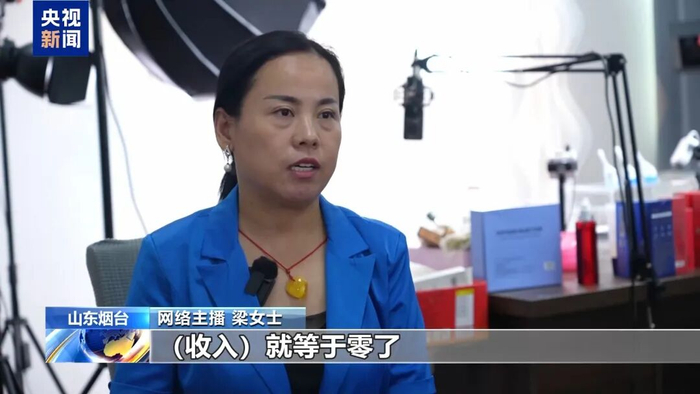
Core Viewpoint - The article highlights the growing issue of organized "internet water armies" that manipulate online perceptions through tactics such as mass liking, malicious reporting, and fake reviews, significantly harming industry integrity and consumer trust [1][10][56]. Group 1: Impact on Individual Streamers - A case study of a streamer, Ms. Liang from Yantai, illustrates the severe consequences of malicious reporting, which led to the permanent suspension of her live-streaming account, erasing her six months of hard work [1][3][8]. - Ms. Liang experienced a significant increase in sales, reaching tens of thousands of yuan per day, before her account was unexpectedly banned, resulting in a total loss of income [3][5]. - Despite submitting various certifications and reports to appeal the ban, her attempts were unsuccessful, revealing the challenges faced by legitimate streamers against malicious competitors [5][7]. Group 2: Law Enforcement Response - The Yantai police uncovered a network of 10 criminal groups involved in providing water army services, leading to the arrest of 42 individuals and the shutdown of over 200 fake traffic selling websites [10][21][56]. - Investigations revealed that competitors were hiring water armies to file false reports against rival streamers, causing significant disruptions in the live-streaming market [10][19]. - The police's efforts included a specialized task force that traced the operations of these water army groups, which utilized advanced technology to simulate real user behavior and evade detection [17][39]. Group 3: Nature of Water Army Operations - The water army industry has evolved into a sophisticated black market, offering a range of services from fake interactions to malicious reporting, with clear pricing structures for different types of services [22][24][28]. - Services are categorized and priced based on effectiveness, with options for both automated and human-operated interactions, indicating a well-organized operational model [32][34]. - The existence of a "mom group" (宝妈团) highlights the use of flexible part-time workers to execute these tasks, further complicating the enforcement of regulations against such practices [45][46]. Group 4: Broader Industry Implications - The rise of water armies has distorted market competition, undermined platform integrity, and eroded consumer trust, prompting increased scrutiny and legal action from authorities [48][56]. - Recent judicial actions, including the first comprehensive case against a water army in Jiangsu, demonstrate the legal system's response to these growing threats [54][56]. - The scale of the problem is underscored by the police's nationwide crackdown, resulting in thousands of arrests and the closure of numerous illegal platforms, indicating a significant effort to restore order in the digital marketplace [56].
还车圈一个清朗“江湖”
Zhong Guo Zhi Liang Xin Wen Wang· 2025-09-19 05:09
Core Viewpoint - The Chinese government has initiated a three-month special rectification action to address online chaos in the automotive industry, focusing on illegal profit-making, exaggerated and false advertising, and malicious attacks, aiming to create a fair market environment for high-quality development in the automotive sector [1] Group 1: Government Action and Industry Response - The Ministry of Industry and Information Technology and other departments have issued a notice to regulate marketing behaviors in the automotive industry [1] - Numerous car manufacturers, including BYD and Lantu, have expressed their support for the rectification action, indicating that they have long suffered from online chaos [1][2] - The monitoring platform reported over 210,000 discussions related to "internet water army" and "black public relations" from January last year to April this year, highlighting the intense competition and complex public opinion ecology in the automotive industry [1] Group 2: Legal Actions and Industry Challenges - BYD has taken legal action against a self-media influencer for spreading false and defamatory information, resulting in a court ruling that requires the influencer to apologize and compensate BYD over 2 million yuan [2] - Other brands like Great Wall and Zeekr have also joined the fight against "black public relations," indicating a collective effort among car manufacturers to protect their interests [2] - The automotive industry's online chaos is not solely due to a few "internet water armies" but is a result of a broader competitive environment where some companies are both victims and perpetrators [2] Group 3: Advertising and Marketing Issues - The China Advertising Association has criticized the automotive advertising sector for misleading marketing practices, such as exaggerating autonomous driving capabilities and concealing safety information [3] - The association warns that such disordered marketing can harm market order, consumer rights, and the reputation of honest companies, leading to a loss of consumer trust [3] Group 4: Industry Transformation and Future Directions - The automotive industry is at a critical juncture, requiring a shift towards innovation-driven and value-oriented development, alongside a fair competitive environment [4] - The special rectification action aims to establish a long-term mechanism for a clear online space, transparent consumer environment, and fair market competition through a combination of regulation, technology, and self-discipline [4][5] - The expected outcomes include the promotion of AI monitoring systems for identifying false information, the establishment of unified marketing standards, and a cultural shift towards a "cooperative and win-win" approach among car manufacturers [5]
申银万国期货早间策略-20250911
Shen Yin Wan Guo Qi Huo· 2025-09-11 05:11
1. Report Industry Investment Rating - No investment rating information provided in the report 2. Core View of the Report - The U.S. three major indices showed mixed performance. The previous trading day saw the stock index rebound with oscillations, with the communication sector leading the gains and the power equipment sector leading the losses. The market turnover was 2.00 trillion yuan. On September 9, the margin trading balance increased by 5952 million yuan to 2303.495 billion yuan. In 2025, domestic liquidity is expected to remain loose, and it is in a policy window period. In the fourth quarter, more incremental policies may be introduced to boost the real economy, and external risks are gradually easing. The increasing probability of the Fed's interest - rate cut in September further enhances the attractiveness of RMB assets. The current market is in a resonance period of "policy bottom + capital bottom + valuation bottom", but one needs to adapt to the accelerating sector rotation and structural differentiation. The CSI 500 and CSI 1000 indices, which are mostly composed of technology - growth stocks, are more offensive, with larger fluctuations but potentially higher returns. The SSE 50 and CSI 300, which are mostly composed of dividend blue - chip stocks, are more defensive, with smaller fluctuations but relatively weaker price elasticity. Since July, the stock index has continued to rise with a large increase, and it may undergo shock consolidation in the short term, but the probability of a long - term market continuation is high [2] 3. Summary by Relevant Catalogs 3.1 Stock Index Futures Market - **IF Contracts**: The previous two - day closing prices of IF contracts (current month, next month, next quarter, and far - quarter) were 4426.20, 4419.20, 4399.60, and 4379.20 respectively, and the previous day's closing prices were 4432.40, 4422.80, 4400.60, and 4378.20 respectively. The price increases were 11.60, 10.00, 7.40, and 4.60 respectively, and the corresponding increases in the CSI 300 were 0.26, 0.23, 0.17, and 0.11. The trading volumes were 76988.00, 6115.00, 38360.00, and 9217.00 respectively, and the open interest was 113485.00, 15085.00, 106452.00, and 40453.00 respectively. The changes in open interest were 944.00, 828.00, 4011.00, and 1524.00 respectively [1] - **IH Contracts**: The previous two - day closing prices of IH contracts (current month, next month, next quarter, and far - quarter) were 2925.40, 2925.80, 2924.80, and 2926.60 respectively, and the previous day's closing prices were 2937.80, 2936.20, 2936.80, and 2939.80 respectively. The price increases were 15.80, 14.60, 15.00, and 16.60 respectively, and the corresponding increases in the SSE 50 were 0.54, 0.50, 0.51, and 0.57. The trading volumes were 33015.00, 2270.00, 14970.00, and 2994.00 respectively, and the open interest was 48255.00, 5673.00, 32649.00, and 9310.00 respectively. The changes in open interest were - 159.00, - 802.00, 623.00, and 245.00 respectively [1] - **IC Contracts**: The previous two - day closing prices of IC contracts (current month, next month, next quarter, and far - quarter) were 6872.80, 6813.60, 6696.40, and 6550.00 respectively, and the previous day's closing prices were 6863.40, 6803.00, 6682.80, and 6531.20 respectively. The price decreases were 3.40, 5.00, 9.20, and 15.20 respectively, and the corresponding decreases in the CSI 500 were 0.05, 0.07, 0.14, and 0.23. The trading volumes were 75803.00, 7440.00, 39131.00, and 12223.00 respectively, and the open interest was 105294.00, 15435.00, 88732.00, and 37927.00 respectively. The changes in open interest were 1013.00, 556.00, 801.00, and - 638.00 respectively [1] - **IM Contracts**: The previous two - day closing prices of IM contracts (current month, next month, next quarter, and far - quarter) were 7165.80, 7100.60, 6956.40, and 6776.80 respectively, and the previous day's closing prices were 7151.00, 7088.60, 6938.20, and 6750.00 respectively. The price decreases were 2.40, 3.80, 10.60, and 19.80 respectively, and the corresponding decreases in the CSI 1000 were 0.03, 0.05, 0.15, and 0.29. The trading volumes were 161976.00, 14887.00, 74810.00, and 23421.00 respectively, and the open interest was 154502.00, 30109.00, 132535.00, and 66557.00 respectively. The changes in open interest were - 826.00, 1901.00, 1429.00, and 539.00 respectively [1] - **Inter - month Spreads**: The current values of the inter - month spreads of IF (next month - current month), IH (next month - current month), IC (next month - current month), and IM (next month - current month) were - 9.60, - 1.60, - 60.40, and - 62.40 respectively, and the previous values were - 7.00, 0.40, - 59.20, and - 65.20 respectively [1] 3.2 Stock Index Spot Market - **Major Indexes**: The previous values of the CSI 300, SSE 50, CSI 500, and CSI 1000 indexes were 4445.36, 2939.59, 6932.11, and 7230.17 respectively, and the previous two - day values were 4436.26, 2928.63, 6928.97, and 7226.03 respectively. The increases were 0.21, 0.37, 0.05, and 0.06 respectively. The trading volumes (in billions of lots) were 203.60, 56.40, 189.92, and 252.67 respectively, and the total trading amounts (in billions of yuan) were 5355.39, 1338.02, 3596.67, and 3961.05 respectively [1] - **Industry Indexes**: Among the CSI 300 industry indexes, the energy, raw materials, industrial, and optional consumption sectors had decreases of - 0.47%, - 1.21%, - 0.88%, and - 0.61% respectively. The major consumption, medical and health, real - estate finance, and information technology sectors had increases of 0.31%, - 0.71%, - 0.08%, and 2.13% respectively. The telecommunications business and public utilities sectors had increases of 4.05% and 0.00% respectively [1] 3.3 Futures - Spot Basis - **IF Contracts and CSI 300**: The previous values of the basis of IF (current month - CSI 300), IF (next month - CSI 300), IF (next quarter - CSI 300), and IF (far - quarter - CSI 300) were - 12.96, - 22.56, - 44.76, and - 67.16 respectively, and the previous two - day values were - 10.06, - 17.06, - 36.66, and - 57.06 respectively [1] - **IH Contracts and SSE 50**: The previous values of the basis of IH (current month - SSE 50), IH (next month - SSE 50), IH (next quarter - SSE 50), and IH (far - quarter - SSE 50) were - 1.79, - 3.39, - 2.79, and 0.21 respectively, and the previous two - day values were - 3.23, - 2.83, - 3.83, and - 2.03 respectively [1] - **IC Contracts and CSI 500**: The previous values of the basis of IC (current month - CSI 500), IC (next month - CSI 500), IC (next quarter - CSI 500), and IC (far - quarter - CSI 500) were - 68.71, - 129.11, - 249.31, and - 400.91 respectively, and the previous two - day values were - 56.17, - 115.37, - 232.57, and - 378.97 respectively [1] - **IM Contracts and CSI 1000**: The previous values of the basis of IM (current month - CSI 1000), IM (next month - CSI 1000), IM (next quarter - CSI 1000), and IM (far - quarter - CSI 1000) were - 79.17, - 141.57, - 291.97, and - 480.17 respectively, and the previous two - day values were - 60.23, - 125.43, - 269.63, and - 449.23 respectively [1] 3.4 Other Domestic and Overseas Indexes - **Domestic Indexes**: The previous values of the Shanghai Composite Index, Shenzhen Component Index, Small and Medium - sized Board Index, and ChiNext Index were 3812.22, 12557.68, 7686.96, and 2904.27 respectively, and the previous two - day values were 3807.29, 12510.60, 7676.37, and 2867.97 respectively. The increases were 0.13%, 0.38%, 0.14%, and 1.27% respectively [1] - **Overseas Indexes**: The previous values of the Hang Seng Index, Nikkei 225, S&P 500, and DAX Index were 26200.26, 43837.67, 6532.04, and 23632.95 respectively, and the previous two - day values were 25938.13, 43459.29, 6512.61, and 23718.45 respectively. The increases were 1.01%, 0.87%, 0.30%, and - 0.36% respectively [1] 3.5 Macroeconomic Information - China's CPI in August was flat month - on - month and decreased by 0.4% year - on - year due to the high base and the drag of food prices. The core CPI increased by 0.9% year - on - year, with the increase expanding for the fourth consecutive month. The PPI decreased by 2.9% year - on - year, with the decline narrowing by 0.7 percentage points compared with the previous month, and was flat month - on - month, ending the eight - month downward trend [2] - The report on the implementation of the national economic and social development plan since this year pointed out that in the second half of the year, it is necessary to better coordinate domestic economic work and international economic and trade struggles, coordinate high - quality development and high - level security, maintain policy continuity and stability, enhance flexibility and predictability, focus on stabilizing employment, enterprises, the market, and expectations, and promote the domestic and international dual - cycle, aiming to promote a reasonable recovery of the price level, social employment stability, and economic growth [2] - China will unswervingly expand high - level opening - up, actively align with international high - standard economic and trade rules, accelerate pilot implementation in platforms such as free trade pilot zones and national service trade innovation and development demonstration zones, and promote high - quality development of service trade [2] - China opposed the negative words and deeds of the US side, which damaged China's legitimate rights and interests and interfered in China's internal affairs [2] 3.6 Industry Information - Six departments including the Ministry of Industry and Information Technology jointly launched a special rectification action on network chaos in the automotive industry, focusing on issues such as online trolls and "black public relations" [2] - China has made major breakthroughs in prospecting for strategic emerging industry minerals, discovering an "Asian lithium belt" spanning four provinces and regions and multiple large and super - large lithium mines [2] - In August, the comprehensive inventory coefficient of automobile dealers was 1.31, a 3% month - on - month decrease and a 12.9% year - on - year increase. The inventory level was below the warning line but higher than the reasonable range. The passenger car terminal retail sales in September are expected to increase steadily month - on - month [2] - The China E - commerce Logistics Index in August was 112.3 points, up 0.3 points from the previous month, reaching a new high this year, and has increased for six consecutive months [2]