股息率

Search documents
小摩:削中海物业目标价至3.7港元 评级降至“减持”
Zhi Tong Cai Jing· 2026-01-29 03:03
Core Viewpoint - Morgan Stanley predicts that China Overseas Property (02669) will experience a 10% year-on-year decline in net profit for the previous year, with a further 2% decline expected for the next two years due to profit margin pressure [1] Group 1: Financial Performance - The company is expected to raise its dividend payout ratio by 4 percentage points to 40% to maintain a year-on-year dividend per share that is flat, compensating investors [1] - The dividend yield is only 3.8%, which is less attractive compared to the industry average of 4.6% [1] - The company issued a profit warning, forecasting a 9% to 10% year-on-year decline in net profit, contrasting with the firm's and market's expectations of a 5% increase [1] Group 2: Market Reaction - Following the announcement of related party transactions in Q4 2023, the company's stock price dropped by 24% in a short period [1] - After the disappointing earnings report in the subsequent quarter, the stock price fell by 25% [1] - Since mid-2024, the company's earnings growth has returned to a positive trajectory, but the latest profit warning is expected to further damage investor confidence in the management's execution capabilities [1]
A股市场快照:宽基指数每日投资动态2026.01.28-20260128
Jianghai Securities· 2026-01-28 06:29
- The report tracks and analyzes the market data of major indices, including their daily performance, moving averages, trading volume, and turnover rates[2][3][4] - The report evaluates the distribution of daily returns for various indices, highlighting the kurtosis and skewness of these distributions[25][26] - The report assesses the risk premium of different indices relative to the 10-year government bond yield, providing insights into their relative investment value and deviation[28][29][30] - The report examines the PE-TTM (Price-to-Earnings ratio based on trailing twelve months) of various indices, considering their historical percentiles and current values to gauge investment attractiveness[40][43][44] - The report analyzes the stock-bond yield ratio, comparing the inverse of the PE-TTM with the 10-year government bond yield to determine the relative attractiveness of stocks versus bonds[47] - The report tracks the dividend yield of different indices, noting their historical percentiles and current values to assess the attractiveness of dividend-paying stocks[48][49][54] - The report monitors the percentage of stocks trading below their book value (PB ratio < 1) within each index, indicating market valuation attitudes and potential undervaluation[55][58][60]
A股市场快照:宽基指数每日投资动态-20260127
Jianghai Securities· 2026-01-27 04:29
- The report tracks and analyzes the market data of major indices, including their performance, moving averages, turnover rates, and risk premiums[1][2][3] - The indices' daily performance is evaluated, with the CSI 500 showing the highest annual increase of 13.95%, followed by the CSI 1000 and CSI 2000[10] - The comparison of indices with their moving averages and the highest and lowest points over the past 250 trading days is provided, showing significant pullbacks after reaching new highs[12][13] - The turnover rates of various indices are analyzed, with the CSI 2000 having the highest turnover rate of 5.34%[16] - The distribution of daily returns is examined, with the ChiNext Index showing the largest negative skewness and the CSI 500 the smallest[22][23] - The risk premiums of the indices relative to the 10-year government bond yield are calculated, with the Shanghai 50 and CSI 300 having the highest 5-year percentile values[25][26][29] - The PE-TTM ratios of the indices are analyzed, with the CSI 500 and CSI 1000 having the highest 5-year percentile values of 99.92%[37][40][41] - The dividend yields of the indices are tracked, with the ChiNext Index and CSI 300 having the highest 5-year historical percentile values[45][51][53] - The percentage of stocks trading below their net asset value is analyzed, with the Shanghai 50 having the highest percentage of 24.0%[52][55]
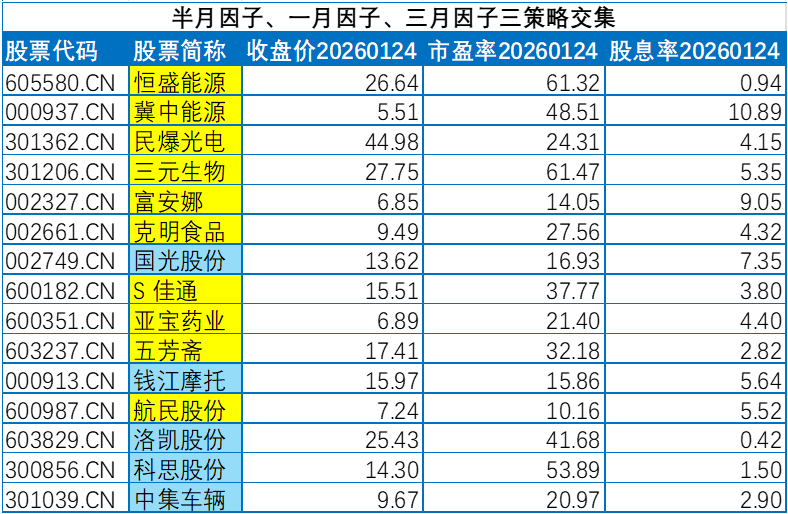
第九期筛选结果:虽然股息率看起来还行,但是成长方面,不少股票并不给力
Xin Lang Cai Jing· 2026-01-25 05:55
Core Insights - The article presents a summary of stock performance based on three testing strategies, highlighting a total of 15 stocks with an average dividend yield of 4.60% and an average price-to-earnings (P/E) ratio of 32.54 [1] Group 1: Stock Performance Summary - The intersection of the three strategies includes 15 stocks with an average dividend yield of 4.60% and an average P/E ratio of 32.54 [1] - The union of the three strategies results in 20 stocks with an average dividend yield of 4.76% and an average P/E ratio of 33.96, indicating a higher dividend yield compared to the previous period while the P/E ratio is lower [2][3] Group 2: High-Value Stocks - Jizhong Energy (000937) is a leading coal mining company with a P/E ratio of 48.51 and a high dividend yield of 10.89%, despite a significant drop in net profit [4] - Thinking Control (603508) specializes in railway safety equipment with a P/E ratio of 18.2 and a dividend yield of approximately 5.8%, showing a positive net profit growth [4] - Hangmin Co. (600987) is a leader in the dyeing industry with a low P/E ratio of 10.06 and a stable dividend yield of 3.23%, despite facing industry challenges [5] - Kemin Food (002661) is a leading noodle manufacturer with a P/E ratio of 15.2 and a dividend yield of about 4.8%, although it has experienced a decline in net profit [5] Group 3: Mid-Value Stocks - Zhongjian Vehicles (301039) is a global leader in commercial vehicles with a P/E ratio of 20.97 and a stable net profit despite a year-on-year decline [6] - Yabao Pharmaceutical (600351) is a leader in traditional Chinese medicine with a P/E ratio of 22.3 and a dividend yield of approximately 3.5%, showing stable cash flow [6] - Qianjiang Motorcycle (000913) is a major player in the motorcycle industry with a P/E ratio of 18.5 and a dividend yield of about 2.1%, facing market challenges [6] - Wufangzhai (603237) is a well-known brand in the rice dumpling market with a P/E ratio of 25.6 and a dividend yield of approximately 3.8%, despite a decline in net profit [6] Group 4: Cautious Stocks - Hengsheng Energy (605580) operates in the thermal power sector with a high P/E ratio of 61.83, indicating overvaluation concerns [7] - S Jiatong (600182) is in the tire industry with a P/E ratio of around 45 and a low dividend yield of 0.3%, facing profitability challenges [7] - Delmar (301332) is a small appliance company with a P/E ratio of about 40, showing weak brand strength compared to peers [7] - Wenfeng Co. (601010) is a retail company with a P/E ratio of about 22, experiencing a significant decline in net profit [7]

A股行情能走多远?不期望“疯牛”“蛮牛”,投资者这一操作最致命
券商中国· 2026-01-24 23:37
Core Viewpoint - The article emphasizes the importance of managing investment expectations and highlights the potential for A-shares to provide stable returns, especially in the context of a rising market and the influx of capital from maturing deposits [1][3]. Group 1: Market Context - The Shanghai Composite Index has reached 4100 points, marking a nearly 10-year high since 2015, with predictions of 50 trillion to 70 trillion yuan in time deposits maturing this year [1]. - The current 10-year government bond yield is only 1.8%, prompting investors to seek returns above 2%, potentially leading to a shift of savings into the stock market [1]. Group 2: Investment Expectations - Investors often amplify their return expectations from a modest annualized rate of over 2% to unrealistic daily gains, which can jeopardize their principal and long-term wealth accumulation [1][4]. - The article cites investor Dan Yongping, who suggests a target return of slightly above long-term government bonds, around 8%, and emphasizes the importance of maintaining a rational mindset towards investment returns [1]. Group 3: Dividend Yield and Stock Selection - The current dividend yield for the A-share dividend index is 4.8%, while the Shanghai 180 Index has a yield of 3.2%, indicating potential annualized returns exceeding 8% when combined with GDP growth [1]. - Nearly 500 stocks have a dividend yield exceeding 3%, with a total market capitalization of 37 trillion yuan, suggesting numerous opportunities for investors seeking stable returns [1]. Group 4: Importance of Dividends - Dividends serve as a reliable indicator of a company's quality, with 80% of companies fitting the criteria of low valuation, high cash flow, and high dividends [4][5]. - Companies that consistently increase dividends typically outperform those that do not, indicating strong financial health and confidence in future cash flow growth [5]. Group 5: Investment Philosophy - The article warns against the tendency of investors to shift from high-quality stocks to lower-quality, high-growth stocks during bull markets, which can lead to significant losses in bear markets [6]. - It stresses the importance of sticking to the original investment goals of capital preservation and beating inflation, rather than succumbing to speculative behaviors [6].

小摩:下调华润啤酒今明两年业绩预测 降目标价至38港元
Zhi Tong Cai Jing· 2026-01-23 06:44
Core Viewpoint - Morgan Stanley has downgraded the earnings forecast for China Resources Beer (00291), expecting a slight sales decline of 0.2% last year and a modest increase of 2.1% this year, while adjusted EBIT is projected to rise by 4.4% and 13.8% respectively [1] Group 1: Sales and Earnings Forecast - The sales forecast for China Resources Beer is expected to decline by 0.2% for the previous year and increase by 2.1% for the current year [1] - Adjusted EBIT is anticipated to grow by 4.4% last year and 13.8% this year [1] Group 2: Management Insights - Management indicated that beer consumption demand this year may be similar to last year, with low single-digit volume growth and stable average selling prices [1] - Cost control measures have been implemented, particularly for aluminum and barley, which are expected to remain stable [1] Group 3: Financial Health and Future Outlook - The company reported that the sales and loss situation for liquor in the second half of last year was worse than in the first half, potentially leading to goodwill impairment in Q4 [1] - The visibility for this year's outlook remains low [1] - Continuous cost-saving measures and efficiency improvements are expected to support profit margins [1] - The company aims to increase its dividend payout ratio from 60% last year to 70% by 2027, suggesting a projected dividend yield of over 5% by 2027 [1]

大金融基本面和配置展望
2026-01-20 01:50
Summary of Key Points from Conference Call Records Industry Overview - The financial sector is experiencing a cautious outlook, particularly in the real estate market, which shows signs of growth but is subject to seasonal and policy influences. Key data in March and April will be critical for assessing market stability [1][5] - The non-bank financial sector is expected to perform strongly in 2025, with significant growth in both insurance and securities companies. A reduction in margin requirements by exchanges is seen as a preemptive risk control measure with limited impact [1][6] Real Estate Market Insights - Recent data indicates a recovery in the real estate market, with Beijing's transaction volume from January 1 to 18 showing a year-on-year increase of nearly 24% and a month-on-month increase of approximately 13%. However, this recovery may be influenced by seasonal effects and policy changes [2] - The sustainability of this recovery is uncertain, and the performance of data in March and April will be crucial. Without significant policy changes, the market may still face considerable pressure [5] Stock and Real Estate Price Relationship - There is a long-term correlation between stock prices and real estate prices, both reflecting economic fundamentals, but not necessarily a causal relationship. Stock prices reflect corporate earnings growth, while real estate prices are more indicative of income and rental growth [3][4] Banking Sector Analysis - The banking sector has faced significant outflows since Q3 of the previous year, with public funds and ETFs reallocating investments. The banking sector has seen the highest decline among major industries since the beginning of the year [7][8] - Despite recent declines, quality bank stocks are viewed as having rebound potential, particularly those with strong fundamentals and benefiting from macroeconomic recovery [7][10] - The current PB (Price-to-Book) valuation of the banking sector is low, with many state-owned banks expected to have dividend yields exceeding 4% in 2025, making them attractive investments [11][12] Future Outlook for Banking Sector - Major commercial banks are expected to maintain stable growth in 2026, with credit growth projected to be in line with national averages. The focus will be on corporate lending, responding to regulatory emphasis on economic efficiency [13] - Quality risks in the banking sector, particularly in retail loans, need to be monitored. The structure of credit is primarily corporate and government-related, which helps stabilize asset quality [14] Investment Recommendations - Recommendations include focusing on high ROE (Return on Equity) regional commercial banks and stable, high-dividend large commercial banks. These institutions are expected to provide stable returns and perform well in long-term investments [15]
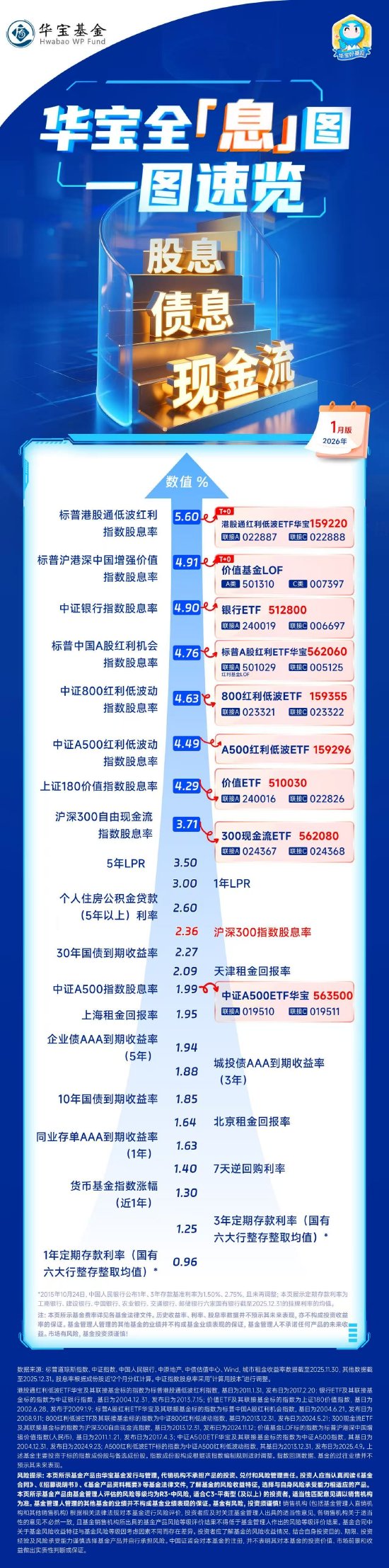
港股展现高股息优势,银行红利属性再加强 | 华宝全息图(2026年1月)
Xin Lang Cai Jing· 2026-01-16 01:08
Group 1 - The article discusses various dividend yields of different indices and ETFs, highlighting the performance of low volatility and high dividend yield funds in the Chinese market [1][3][7] - The S&P Hong Kong Stock Connect Low Volatility Dividend ETF has a dividend yield of 5.60%, while the S&P China A-Share Dividend Opportunity ETF has a yield of 4.76% [1][7] - The China A500 Low Volatility Dividend Index has a yield of 4.49%, and the Shanghai Stock Exchange 180 Value Index has a yield of 4.29% [2][3][7] Group 2 - The article provides a comparison of various financial metrics, including the 5-year Loan Prime Rate (LPR) at 3.50% and the 1-year LPR at 3.00% [3][7] - It also mentions the yield of 30-year government bonds at 2.27% and the rental return rates in major cities, such as Tianjin at 2.36% and Shanghai at 1.95% [3][7] - The article notes that the yields and rates are based on data as of December 31, 2025, and are subject to change [3][7]
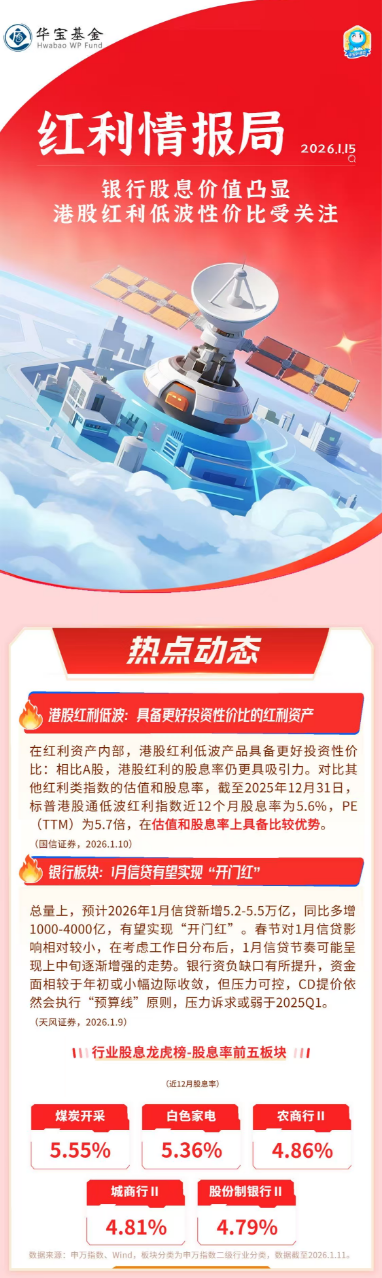
红利情报局:银行股息价值凸显,港股红利低波性价比受关注
Xin Lang Cai Jing· 2026-01-15 10:07
Group 1 - The core viewpoint of the article highlights the attractiveness of Hong Kong dividend low-volatility assets compared to A-shares, with a focus on their better investment cost-performance ratio [2][10] - As of December 31, 2025, the S&P Hong Kong Stock Connect Low Volatility Dividend Index had a 12-month dividend yield of 5.6% and a PE (TTM) of 5.7 times, indicating a comparative advantage in valuation and dividend yield [2][10] - The banking sector is expected to achieve a "good start" in January 2026, with new credit additions projected between 5.2 trillion to 5.5 trillion yuan, an increase of 100 billion to 400 billion yuan year-on-year [2][10] Group 2 - The impact of the Spring Festival on January credit is expected to be relatively small, with a gradual increase in credit activity anticipated in the first half of the month [2][10] - The banking sector's asset-liability gap has increased, but the pressure on liquidity is manageable, and CD pricing will continue to follow a "budget line" principle [2][10] - The dividend yield rankings for various sectors show that coal mining has a yield of 5.55%, white goods at 5.36%, and rural commercial banks at 4.86% [11][12]
研报掘金丨长江证券:齐鲁银行长期重点推荐,维持“买入”评级
Ge Long Hui A P P· 2026-01-13 08:58
Core Viewpoint - Qilu Bank's stock price valuation has been significantly adjusted due to market trading factors since the third quarter of 2025, indicating a potential undervaluation of its long-term growth value [1] Group 1: Market Impact and Valuation - The stock price of Qilu Bank has been influenced by market trading factors, leading to a sufficient adjustment in its valuation [1] - The management team has recently completed a new round of stock buybacks, reinforcing the belief that the bank's long-term growth value is underestimated by the market [1] Group 2: Future Projections - Qilu Bank is set to enter a new three-year planning cycle in 2026, which may provide further growth opportunities [1] - Profit growth projections suggest that the dividend yield for 2025 and 2026 will be 4.65% and 5.20%, respectively, aligning with the needs of long-term investment funds [1] Group 3: Investment Recommendation - The bank is recommended as a long-term investment, maintaining a "buy" rating [1]