资产多元化配置

Search documents
RYOEX:鹰派主席传闻触发金银回撤
Xin Lang Cai Jing· 2026-01-30 12:39
Core Viewpoint - The precious metals market experienced a significant adjustment following a sharp rise, primarily influenced by rumors regarding the potential appointment of Kevin Warsh as the new Federal Reserve Chair, which led to a notable drop in gold prices [1][4]. Group 1: Gold Market - Spot gold fell over 5% on Friday, reaching approximately $5,172.80 per ounce, down from a record high of $5,594.82 [1][5]. - Despite the sharp decline, gold has maintained its strongest monthly growth since 1982, with a cumulative increase of over 20% in January, potentially achieving six consecutive monthly gains [1][5]. - Analyst Tim Waterer noted that the drop was triggered not only by personnel rumors but also by a rebound in the dollar index and the long-term overbought status of gold prices [5]. Group 2: Silver Market - The silver market also faced volatility, with spot silver dropping from a historical high of $121.64 to $109.03, marking a daily decline of 6.1% [2][6]. - Despite this drop, silver has recorded a cumulative increase of 53% this month, establishing its best monthly performance in history [2][6]. - High physical demand is evident, with Switzerland exporting a record number of gold bars to the UK, and new gold ETFs showing strong performance in the secondary market [2][6]. Group 3: Industrial Precious Metals - Platinum and palladium showed weaker performance, with spot platinum falling 7.1% after reaching a high of $2,918.80, while palladium dropped to $1,860.00 [3][6]. - The overall decline in these metals is largely attributed to a short covering in the dollar exchange rate, making dollar-denominated metal assets more expensive for overseas buyers [3][6]. Group 4: Market Sentiment and Future Outlook - The market's volatility reflects a struggle between expectations for the next Fed chair's policies and the ongoing demand for safe-haven assets [2][7]. - Despite concerns over potential tightening of monetary policy with Warsh's possible appointment, the trend towards global asset diversification remains strong, suggesting that gold's deep correction should be viewed as a reorganization of bullish forces [7]. - The expectation of two interest rate cuts by 2026 remains unchanged, indicating that precious metals still have the potential to reach higher levels amid complex geopolitical environments [7].


信心动摇,全球资本悄然“抛售美国”
Huan Qiu Shi Bao· 2026-01-25 22:47
Core Viewpoint - The trend of "selling America" continues among global investors, despite temporary market stabilization following President Trump's withdrawal of tariff threats against eight European countries at the Davos Forum [1][2]. Group 1: Market Reactions - Following Trump's announcement, the U.S. stock market experienced a brief recovery, with the market sentiment shifting from decline to increase [2]. - On January 23, the U.S. dollar index fell by 0.78%, closing at 97.593, indicating ongoing pressure on the dollar [2]. - U.S. stock funds saw a net outflow of $16.8 billion in the previous week, while European stock funds experienced their strongest inflow in six weeks since June of the previous year [2]. Group 2: Capital Flows and Investment Strategies - Concerns over U.S. domestic policies and attractive investment opportunities abroad are driving capital away from U.S. assets towards diversification [2][3]. - Denmark's AkademikerPension announced its exit from $100 million in U.S. Treasury bonds due to worries about fiscal discipline and the weakening dollar [3]. - The Reserve Bank of India has also been reducing its holdings of U.S. Treasury bonds, with its long-term bond holdings dropping to $174 billion, a 26% decrease from the peak in 2023 [3]. Group 3: Global Asset Diversification - The International Monetary Fund reported that the dollar's share in global foreign exchange reserves has fallen below 60%, the lowest in decades, as central banks diversify their asset allocations [4]. - Gold is becoming a more favored reserve asset among central banks, with Poland's central bank planning to increase its gold reserves by 150 tons [4]. - Investors are increasingly wary of potential risks associated with U.S. domestic policies, which are seen as more systemic compared to geopolitical threats [4]. Group 4: Emerging Markets and Investment Opportunities - Record inflows into emerging market funds are being observed, with the MSCI Emerging Markets Index reaching historical highs [5][6]. - The index has gained approximately 7% since the beginning of the year, driven primarily by Asian technology stocks [6]. - The attractiveness of non-U.S. assets is leading to a quiet "sell-off" of U.S. bonds as investors seek better opportunities elsewhere [6].
华尔街面临新风险:欧洲投资者“罢买”美国资产
财联社· 2026-01-25 03:55
Core Viewpoint - Foreign investors, particularly from Europe, have played a crucial role in driving U.S. stock market highs, but increasing tensions in U.S.-Europe relations under President Trump's potential second term may lead to a withdrawal of these key buyers from the market [1][5] Group 1: European Investment Trends - European investors currently hold approximately $10.4 trillion in U.S. stock assets, with over half coming from eight countries previously threatened by tariffs [2][4] - The trend of reducing reliance on U.S. assets has been noted since April 2025 and has accelerated recently, as indicated by Amundi SA's Chief Investment Officer [1][5] - European investors' holdings in U.S. stocks have increased by 91% over the past three years, amounting to about $4.9 trillion, driven by both continued purchases and rising asset prices [6] Group 2: Market Risks and Reactions - The potential for a coordinated sell-off of U.S. assets by European investors is low, but the ongoing threats from Trump have led to increased inquiries from asset managers about reducing exposure to U.S. assets [5][8] - Although direct sell-offs of U.S. stocks have been limited so far, the situation adds a new risk factor to an already historically high U.S. stock market valuation [8] - The Canadian Prime Minister highlighted the need for countries reliant on U.S. financial integration to reconsider their relationships due to the weaponization of interdependence by Trump [9] Group 3: Future Outlook - There is a possibility that the weight of U.S. assets in global asset allocation may be adjusted in the long term, as investors may no longer fully trust the dollar or U.S. assets [10] - The current environment suggests that investors should be cautious about having all their assets exposed to U.S. stocks or the dollar [8][11]

全球央行购金热潮 正在重塑黄金市场的需求结构
Yang Shi Xin Wen Ke Hu Duan· 2026-01-23 19:39
Core Viewpoint - The international gold price has surged over 64% in 2025, marking the largest annual increase since 1979, driven by geopolitical risks and central bank demand for gold as a reserve asset [1][3]. Group 1: Central Bank Activities - Central banks have significantly increased their gold purchases, with net buying exceeding 1,000 tons annually from 2022 to 2024, reaching a record high of 1,089.4 tons in 2024 [9]. - The share of central bank gold purchases in global gold demand has risen from 1.85% in 2010 to 23.57% in 2024, indicating a strategic shift towards gold as a long-term asset [11]. - High levels of geopolitical tension are prompting central banks to seek alternatives to the US dollar, leading to diversified asset allocations [11]. Group 2: Market Dynamics - Goldman Sachs has raised its year-end gold price target from $4,900 to $5,400 per ounce due to increasing demand from private investors and central banks [3]. - A report indicates that gold has surpassed US Treasury bonds as the primary reserve asset for central banks outside the US, with global central banks holding 28,358.6 tons of gold valued at approximately $3.92 trillion [13]. - The International Monetary Fund (IMF) reports that the dollar's share in global foreign exchange reserves has fallen below 60%, the lowest in decades, reflecting a decline in the dollar's international status [17]. Group 3: Private Sector Perspectives - Private investors are also cautious about dollar assets, often selling off US stocks, bonds, and currencies during significant political turmoil in the US [19]. - The Danish "Academic Pension Fund" announced plans to sell $100 million worth of US government bonds due to concerns over the US government's fiscal situation [15].
高盛上调黄金年末价格预期后 金价收复部分跌幅
Xin Lang Cai Jing· 2026-01-22 07:55
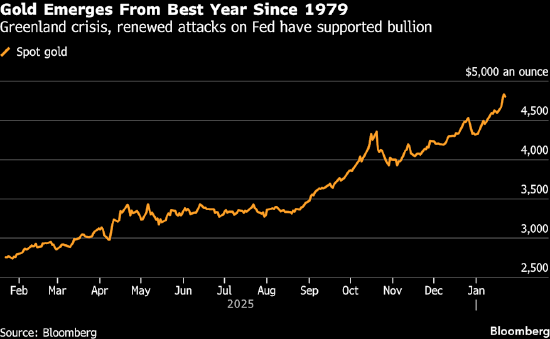
Core Viewpoint - The easing of tensions related to Greenland has led to a reversal in gold prices, with Goldman Sachs raising its year-end target price for gold by $500 due to increasing demand from central banks and private investors [1][4]. Group 1: Gold Market Dynamics - Spot gold is currently trading around $4,830 per ounce, recovering from an early drop of 1.2% earlier in the week [1][5]. - Gold prices have surged nearly 5% this week, driven by geopolitical tensions and a crisis in U.S.-NATO relations, with gold prices reaching historical highs over the past year [3][7]. - Goldman Sachs has increased its year-end gold price target from $4,900 to $5,400, citing rising demand from private investors and central banks [4][8]. Group 2: Geopolitical Influences - The geopolitical risks have intensified, with President Trump’s policies causing diplomatic crises with European allies, which in turn has increased gold's appeal as a safe-haven asset [3][7]. - Trump's criticism of the Federal Reserve has weakened market confidence in the dollar, further supporting precious metal prices [3][7]. Group 3: Silver Market Insights - Silver prices have also seen a rise, with an increase of 1.2% to over $94 per ounce, driven by unprecedented demand from retail investors [4][9]. - The recent adjustments in China's silver export license policies have created market confusion, heightening expectations of silver scarcity [9].
150吨黄金大手笔!波兰央行官宣增持跻身前十,金价再刷历史新高
Sou Hu Cai Jing· 2026-01-21 04:40
Core Insights - The Polish central bank has approved a plan to purchase up to 150 tons of gold, increasing its total gold reserves from 550 tons to 700 tons by the end of 2025, positioning Poland among the top ten countries globally in terms of gold reserves [1] - The central bank governor, Adam Glapinski, emphasized that gold is a zero-credit-risk asset, unaffected by other countries' monetary policy decisions, and provides strong resilience against financial shocks [1] - By the end of December 2025, gold is expected to account for 28.22% of Poland's foreign exchange reserves, making it one of the central banks with the fastest adjustments in reserve structure globally [1] Market Context - The announcement of the gold purchase plan coincides with a period of rising international gold prices, marking a significant trend in the current gold price cycle [2] - The World Gold Council has reported that in 2025, central banks globally are expected to continue increasing their gold reserves, with 95% of surveyed central banks anticipating further purchases in the next 12 months [1] - The Polish Mint's director, Marta Bassani-Prusik, noted that the decision to buy gold is driven by multiple factors, including the asset's immunity to monetary policy and credit risks, as well as the goal of diversifying assets and reducing reliance on single currencies like the US dollar [1]
银行大额存单利率新低,部分跌破1%
Jin Rong Shi Bao· 2026-01-15 07:19
Core Insights - The deposit market is undergoing significant changes in 2026, with large-denomination certificates of deposit (CDs) seeing a decline in interest rates, with some small and medium-sized banks offering 3-month products below 1%, marking a historic low [1][2] - This shift is altering depositors' perceptions of "high-interest deposits" and is prompting a restructuring of asset allocation in the financial market [1] Summary by Category Interest Rate Trends - The interest rates for short-term large-denomination CDs have dropped below 1% for the first time, with most banks focusing on products with a maturity of one year or less, while the issuance of three-year products has significantly decreased [1] - The average interest rate for three-year products is now generally below 2%, and one-year rates are often less than 1.5%, with rates for products under one year falling below 1% [1] Market Dynamics - Small and medium-sized banks, which previously had an advantage over state-owned banks in terms of interest rates, are not showing expected competitive rates in new products, with some offering rates as low as 0.95% for 3-month CDs [2] - The downward trend in deposit rates is expected to continue, indicating a shift away from the era of "easy earnings" from savings [2] Regulatory and Competitive Landscape - The decline in interest rates is attributed to multiple factors, including sustained pressure on banks' net interest margins, leading them to lower long-term product rates [2] - Regulatory efforts to curb irrational deposit competition have also played a role in suppressing high-interest deposit offerings [2] Future Outlook - Experts predict that the interest rates for large-denomination CDs will continue to decline, particularly for short-term products, which may approach zero [4] - Investors are advised to diversify their asset allocations, with recommendations for stable investments like fixed-term deposits and government bonds, while those with higher risk tolerance may consider "fixed income plus" products and equity investments [4][5]




Moneta Markets外汇:2026年金价展望 5000美元时代
Xin Lang Cai Jing· 2026-01-12 10:55
Core Viewpoint - The global precious metals market is at a historic turning point, with gold experiencing a remarkable 64% increase in 2025 and reaching a new all-time high by the end of December 2025 [1][2] Group 1: Market Dynamics - The strong recovery of gold prices at the end of 2025 demonstrates its resilience as a safe-haven asset, with bullish momentum taking control of the market [1][2] - The key driver behind the surge in gold prices is the profound change in the macroeconomic environment, particularly the sustained decline in U.S. real interest rates, which have reached their lowest level since 2023, significantly reducing the opportunity cost of holding non-yielding assets [3] - The expansion of public debt in developed economies is expected to rise to approximately 110% of GDP this year, undermining the credibility of traditional currencies [3] Group 2: Strategic Demand - Institutional investors and global central banks are anticipated to maintain strategic reserves of gold at a high level of 4,850 metric tons, nearing the peak levels seen since 2011 [3] - Recent geopolitical tensions, particularly military actions against key political figures in Latin America, have ignited safe-haven sentiments, leading to a rapid breakthrough of critical resistance levels in gold prices [3] Group 3: Future Outlook - Major institutions like HSBC and UBS predict that gold prices could reach the $5,000 mark in the first half of 2026, supported by the current market conditions [2][3] - The defensive attributes of gold as a safe-haven asset and its value in asset diversification are becoming increasingly prominent in the current turbulent financial environment, with a long-term bullish trend expected to continue into 2026 [4]
全球资管巨头“锚定”香港
Xin Lang Cai Jing· 2026-01-11 11:00
Core Insights - The global economic landscape is becoming increasingly polarized, with the Federal Reserve entering a rate-cutting cycle and a rising trend of de-dollarization, prompting investors to reassess their asset portfolios [1] - Hong Kong is emerging as a strategic hub for global asset management, attracting international investment firms due to its unique institutional advantages and comprehensive financial ecosystem [1][2] - The influx of capital into Hong Kong has accelerated since 2024, with total assets under management increasing by 13% year-on-year and net inflows surging by 81%, reaching a total of 35 trillion HKD by the end of 2024 [1] Group 1: Investment Trends - Hong Kong is becoming a key destination for mainland Chinese capital seeking global allocation, handling approximately 80% of offshore RMB transactions [2] - The "Cross-Border Wealth Management Connect 2.0" initiative has significantly increased the number of accounts for mainland investors in Hong Kong wealth products from 25,000 to 110,000 [2] - The asset management market in Hong Kong is characterized by a diverse investor base, with overseas investors consistently holding over 54% of assets [1][2] Group 2: Institutional Strategies - International asset management giants are establishing Hong Kong as a core point for their Asian strategies, with firms like PIMCO focusing on fixed income and alternative assets [3] - Future Asset is leveraging its expertise in industry sectors such as renewable energy and semiconductors to identify investment opportunities in Hong Kong [4] - Southern Eastern, a major ETF issuer in Hong Kong, has seen significant growth, managing 36 ETFs and achieving a market share of 87% in the Hang Seng Tech Index ETF [5] Group 3: Market Dynamics - The competitive landscape between domestic and international institutions is becoming more pronounced, with domestic firms capitalizing on their understanding of mainland needs and international firms leveraging their global research capabilities [2][6] - Fidelity International is focusing on active management strategies, emphasizing the potential for growth in the Hong Kong market [6] - Invesco is utilizing Hong Kong's offshore RMB status to create a cross-border investment platform, aligning with global asset allocation trends [7] Group 4: Long-term Outlook - International investors view Chinese assets as a long-term value proposition, particularly given their low correlation with U.S. equities [8][9] - The Hong Kong IPO market is expected to remain robust, driven by the fundraising needs of Chinese companies and ongoing reforms by the Hong Kong Stock Exchange [10] - The anticipated economic growth in China and the continued appeal of Hong Kong as a hub for foreign investment are expected to sustain momentum in 2026 [11]
TMGM官网:日本股市上涨,为何本土散户资金持续流向海外?
Sou Hu Cai Jing· 2026-01-05 06:13
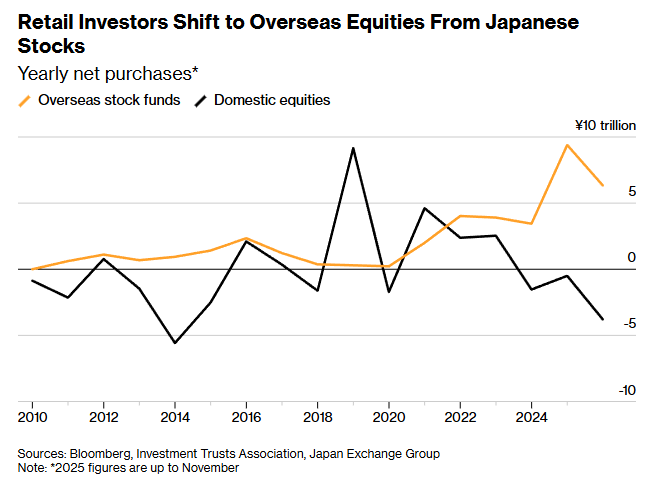
Group 1 - The Japanese financial market is witnessing a significant trend where retail investors are increasingly shifting their funds to overseas markets despite a strong domestic stock market performance [1][4] - As of November last year, Japanese retail investors net sold approximately 3.8 trillion yen in domestic stocks and related investment trusts, marking a record high in over a decade [1] - In contrast, net purchases of overseas stocks through investment trusts are nearing a record level of approximately 9.4 trillion yen [1] Group 2 - Key factors driving this trend include a weakening yen, which enhances the attractiveness of overseas assets, particularly U.S. tech stocks, due to additional returns from currency exchange [4] - Long-standing market habits, where investors have developed a tendency to sell high and take profits, continue to influence funding decisions despite changes in market conditions [4] - The introduction of tax-exempt investment accounts in Japan has lowered investment barriers, facilitating the flow of funds to overseas markets [4] Group 3 - Continuous capital outflow is putting pressure on the yen's exchange rate, as the yield gap between Japanese and U.S. government bonds remains significant, and domestic real interest rates are in negative territory [4] - Current allocations by Japanese retail investors are heavily concentrated in overseas tech stocks, which are at historically high valuations, raising concerns about potential market volatility if the global tech investment boom adjusts [4] - Analysts suggest that investors may need to consider diversifying their asset allocations in the future [4]