A股市场调整

Search documents
超100亿元,大举加仓了!
Zhong Guo Ji Jin Bao· 2025-09-19 03:44
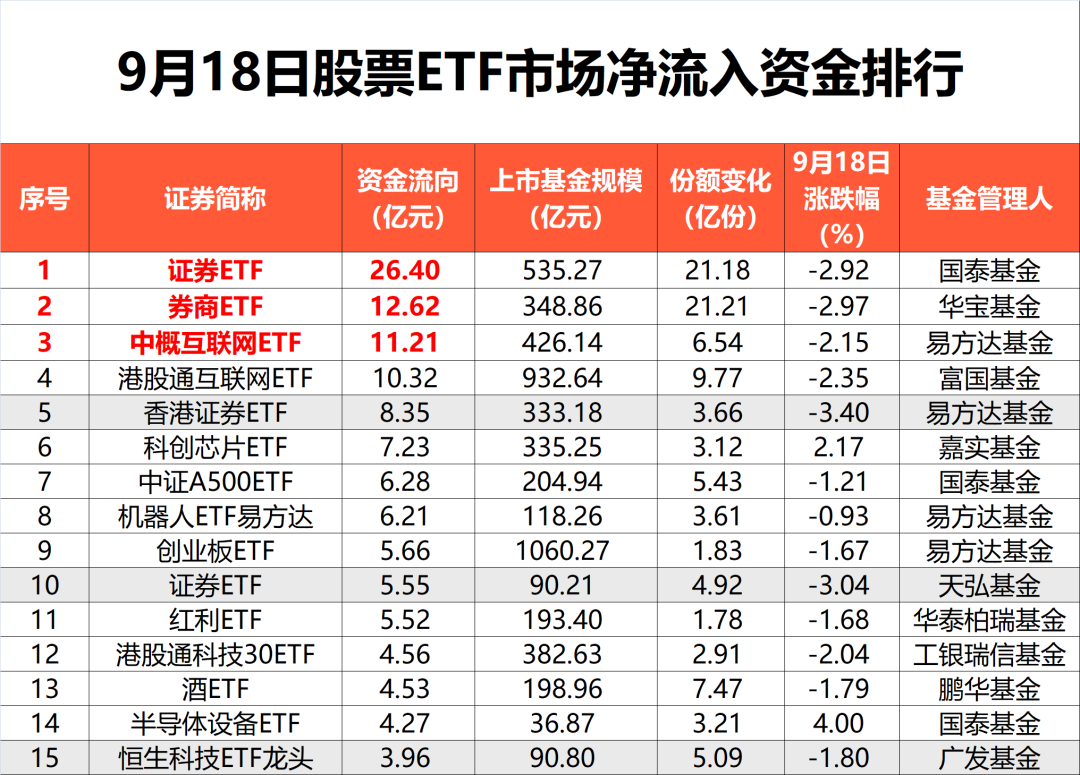
Group 1 - The core viewpoint of the article highlights that despite a decline in the A-share market, there was a significant net inflow of over 100 billion yuan into stock ETFs, with brokerages and Chinese concept stocks being the main beneficiaries [1][2][4] - On September 18, the total net inflow into the stock ETF market reached 108.19 billion yuan, with the total scale of 1,209 stock ETFs amounting to 4.39 trillion yuan [2][4] - The securities company index saw the highest net inflow of 51.34 billion yuan, while the industry-themed ETFs and Hong Kong market ETFs also attracted substantial investments [2][4] Group 2 - In terms of specific ETFs, the top performers included the securities ETF with a net inflow of 26.40 billion yuan and the brokerage ETF with 12.62 billion yuan, despite a general market downturn [3][6] - Conversely, broad-based ETFs experienced a net outflow of 56.94 billion yuan, with the CSI 300 index leading the outflows at 17.61 billion yuan [5][6] - Major fund companies like E Fund and Huaxia Fund reported significant inflows into their ETFs, indicating continued investor interest despite market volatility [4][5] Group 3 - Analysts from Galaxy Fund noted that the recent adjustments in the A-share market could be influenced by the Federal Reserve's stance on not entering a loosening cycle, which may affect foreign capital flows and high-valuation sectors [7] - Despite short-term market fluctuations, institutions remain optimistic about the future performance of the A-share market, citing factors such as domestic risk-free yield decline and accelerated capital market reforms [7]

刚刚!A股,突变!发生了什么?
券商中国· 2025-09-16 04:05
Core Viewpoint - The A-share market experienced a sudden decline, with significant drops in the non-ferrous metals sector, particularly in rare earth permanent magnets, despite positive market catalysts [1][3][5]. Group 1: Market Performance - On Tuesday morning, the A-share market saw a sharp drop, with the Shanghai Composite Index down 0.10%, the Shenzhen Component down 0.26%, and the ChiNext Index down 0.32% [1]. - The non-ferrous metals sector, particularly the rare earth permanent magnet index, saw a decline of over 3% during the session, with major stocks like China Rare Earth and Jinko Solar dropping more than 5% [3]. - High-position blue-chip stocks also faced profit-taking, with stocks like Ningde Times and Muyuan Foods experiencing declines of over 1% and 4%, respectively [3]. Group 2: Market Drivers - Despite favorable news such as easing US-China trade tensions and expectations of a US interest rate cut, the A-share market still faced downward pressure [5]. - Analysts suggest that the market adjustment is likely due to profit-taking in high-position stocks, as sectors like optical modules and solid-state batteries have seen significant gains recently [6][8]. Group 3: Future Outlook - The adjustment in the equity market may present opportunities, as the risk appetite in the bond market remains stable, and the narrative driving the recent stock market rise has not fundamentally changed [8]. - Analysts predict that the upcoming period may resemble the market conditions of 2016-2017, driven by fundamental improvements in prices, profits, and inventory levels [8]. - Economic data for August indicates a mixed picture, with industrial production growth at 5.2% and service sector growth at 5.6%, suggesting GDP growth remains around 5% [9].

短期调整有利于市场风险释放 A股长期上行趋势并
Xin Lang Cai Jing· 2025-09-07 20:21
Core Viewpoint - The A-share market experienced significant fluctuations at high levels, with a notable adjustment in the computing power sector impacting the index, leading to a general decline in industry indices, except for the banking index which rose [1] Group 1: Market Performance - On September 4, the strong-performing computing power sector's adjustment caused the index to retreat, while on September 5, the A-share market rebounded, with the Shanghai Composite Index returning to 3,800 points [1] - Historical analysis by Huaxi Securities indicates that in past A-share rallies exceeding 30%, a pullback of 6% to 10% typically occurs [1] Group 2: Investor Behavior - Since early April, the A-share market has been on an upward trend for five consecutive months, leading to profit-taking demands from some investors [1] - The accelerated market rally since August has intensified capital concentration, resulting in increased volatility due to the crowded nature of large-cap growth stocks [1] Group 3: Market Outlook - Huaxi Securities suggests that the recent short-term adjustment in the A-share market is a phase of emotional fluctuation and concentrated trading, which serves as a risk release process, ultimately benefiting the stability and longevity of the market trend [1]
短期调整有利于市场风险释放 A股长期上行趋势并未改变
Shang Hai Zheng Quan Bao· 2025-09-07 18:30
Group 1 - A-share market experienced wide fluctuations at high levels, with a notable adjustment in the computing power sector leading to a general decline in industry indices, except for the banking index which rose [1] - Historical analysis indicates that A-share markets often see a 6% to 10% pullback after rallies exceeding 30%, suggesting that the recent adjustments are part of a normal risk release process [1] - The recent market pulse adjustment is significant for future trends, as it helps to digest existing issues such as reduced market value and increased trading congestion in technology growth sectors [1][2] Group 2 - Institutions agree that the driving forces behind the current market rally remain unchanged, with no signs of overheating in market sentiment as the margin financing scale is at historical averages [2] - The overall valuation levels in the market are low, with many blue-chip stocks priced at lower levels, indicating potential for upward movement [2] - The market is entering a consolidation phase, with recommendations to focus on relatively "lagging" sectors such as cyclical, consumer, and dividend stocks, while maintaining a long-term focus on technology growth sectors [2] Group 3 - Short-term market style is expected to shift from technology growth stocks to cyclical sectors, with increased interest in low-priced related stocks as high-priced sectors adjust [2][3] - Specific cyclical sectors identified with potential for upward movement include renewable energy, chemicals, non-ferrous metals, and building materials [3]
短期震荡调整或并未结束,操作上适当防御或休息
British Securities· 2025-09-05 02:33
Market Overview - The report indicates that the recent market adjustment is a result of multiple factors, including technical correction needs after significant price increases, profit-taking by investors from high-valuation sectors, and the challenge of sustaining high trading volumes without continued capital inflow [1][4][11] - The short-term market may continue to experience high-level fluctuations, and investors are advised to wait for stabilization signals [1][11] - Despite the short-term adjustments, the underlying support from policy, liquidity, and economic fundamentals remains strong [2][11] Policy and Economic Fundamentals - The policy environment is expected to remain favorable, with the Ministry of Commerce planning to introduce measures to expand service consumption in September [2][11] - The liquidity environment is maintained at a loose level, supporting market activities [2][11] - Economic fundamentals are showing signs of recovery, with the manufacturing PMI for August reported at 49.4%, indicating a month-on-month improvement and a faster pace of business activity expansion [2][11] Sector Performance - Consumer stocks, including retail and food and beverage sectors, showed resilience and strength during the market downturn, driven by new consumption voucher initiatives in various cities [7][11] - The securities sector has been highlighted as a potential area for investment, with expectations of performance improvement due to favorable policies and market reforms [8][11] - The photovoltaic equipment sector is also noted for its active performance, supported by ongoing global demand for renewable energy solutions [9][11] Investment Strategy - Investors are advised to adopt a defensive approach or take a break from active trading during this adjustment period [1][12] - For those looking to buy on dips, it is recommended to wait until the market shows signs of stabilization and to focus on low-valuation sectors with strong earnings support [12][11] - Attention should be directed towards blue-chip stocks that have undergone sufficient adjustments and possess stable fundamentals, as they may attract renewed investor interest [12][11]
A股:调整结束?周五,大盘指数分析
Sou Hu Cai Jing· 2025-09-04 21:38
Market Overview - The recent market adjustment is viewed as a minor correction rather than the end of a bull market, with a significant drop in technology stocks over three trading days, falling by 20% [3] - The Shanghai Composite Index is expected to experience a rebound, with a potential target of 4000 points, as the recent decline is seen as a necessary cooling period for the market [5][7] Sector Analysis - Financial sectors such as banks, securities, and insurance are anticipated to see a rebound, contributing to the overall market recovery [5] - The technology sector is expected to continue its volatility, with potential for further selling pressure before stabilizing [3][5] Investment Strategy - Investors are advised to remain cautious and not to become overly excited during market rallies, as this could lead to significant losses [3][7] - The current strategy involves selectively buying on dips while maintaining a defensive posture, with a focus on protecting previous profits [5][6]

跌破3800!调整还是倒车接人?
Sou Hu Cai Jing· 2025-09-04 09:25
Group 1 - The recent adjustment in the A-share market has led to a significant drop below the important 3800-point threshold, with a notable increase in the number of declining stocks, raising concerns about the end of the anticipated bull market [2] - Despite the overall market decline, certain sectors, such as the battery ETF, have shown strong performance, driven by a potential turning point in the solid-state battery industry, with leading companies experiencing an 80% surge in orders [2] - The current market conditions, including a low PE valuation at nearly 30% below the 10-year average, have attracted significant buying interest, resulting in a simultaneous increase in both volume and price [2] Group 2 - Speculation links the recent market movements to the upcoming Federal Reserve interest rate cuts, with a 90.5% probability of a rate cut in September, which could significantly impact global asset prices [4][6] - Historical context suggests that previous market rallies have been initiated by shifts in U.S. monetary policy, indicating that the anticipated rate cuts could provide a favorable environment for the Chinese market [5][6] - The potential for a new phase in the stock market is highlighted, particularly benefiting small-cap stocks, which are expected to attract liquidity and show growth potential as the market adjusts to a more favorable monetary policy [8] Group 3 - The current market is characterized by stable trading volumes, consistently maintaining above 1 trillion, which is seen as a positive indicator for the continuation of the current market trend [10] - Government support for the stock market remains strong, with measures in place to prevent abnormal declines, including mechanisms like "stabilization funds" and policies to increase A-share investments from insurance premiums starting in 2025 [11] - The combination of government support and anticipated Federal Reserve rate cuts suggests that there is still room for market growth, although it may not happen rapidly [12]

科技股大幅回调,新能源赛道拉升
Zheng Quan Shi Bao· 2025-09-04 04:33
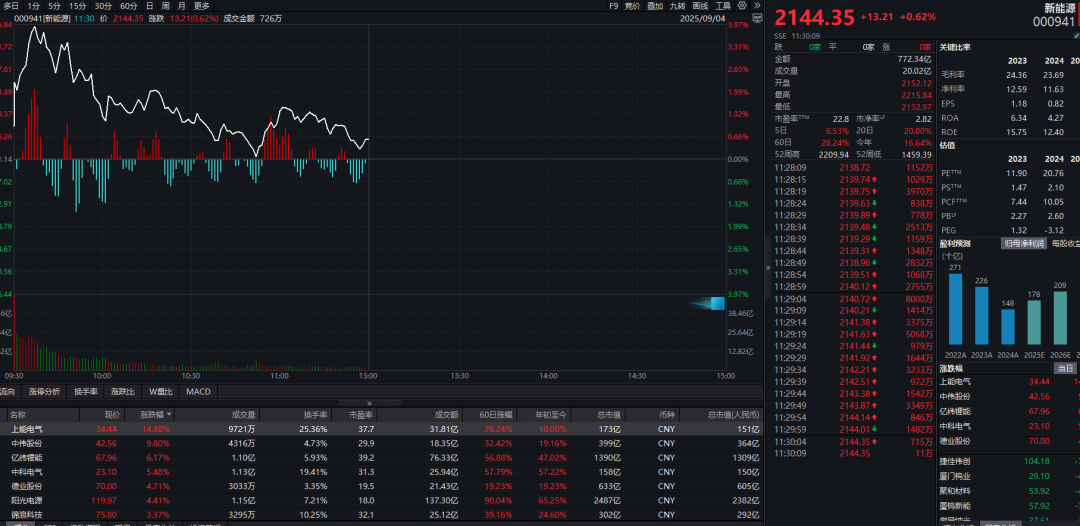
Market Overview - The A-share market experienced a significant adjustment, with major indices declining, including the Shanghai Composite Index dropping over 2% and the ChiNext Index falling by more than 3.8% [3] - The STAR 50 Index saw a sharp decline, with an intraday drop exceeding 5% [3] Sector Performance - The telecommunications sector faced a substantial decline, with intraday losses exceeding 8%, impacting several previously high-performing stocks [4] - Notable stocks such as Xinyi Technology and Zhongji Xuchuang experienced intraday drops of over 14% [5] - The electronics sector also suffered, with a drop exceeding 4%, and leading stocks like Cambrian Technologies fell by over 13% [6] - Other sectors such as non-ferrous metals, defense, and pharmaceuticals also ranked among the largest decliners [7] - Conversely, sectors like retail, social services, textiles, and electric equipment showed resilience, performing well against the market trend [8] New Energy Sector - The new energy sector stocks demonstrated strong performance, with the CSI New Energy Theme Index showing an intraday increase of nearly 4% [9] - Key stocks in this sector, such as EVE Energy, saw intraday gains exceeding 13% [11] - Other notable performers included Zhongwei Co., which rose over 14%, and Shanneng Electric, which increased by over 16% [12] - EVE Energy reported a total revenue of 28.17 billion yuan for the first half of 2025, marking a year-on-year growth of 30.06% [12]
证监会终于发力!8月29日,明天将迎来更大的变盘?
Sou Hu Cai Jing· 2025-08-29 01:47
Group 1 - The China Securities Regulatory Commission (CSRC) is taking action to precisely control risks in key areas of the capital market, indicating a cautious outlook despite the A-share market's current prosperity [1] - The recent performance of the micro-cap stock index, which dropped 3.66% and previously nearly 4%, suggests underlying risks that need to be closely monitored [1] - The technology sector, including stocks like Cambrian and SMIC, is showing signs of accelerated growth, which historically indicates a market nearing its peak [1] Group 2 - A-shares' three major indices closed collectively higher, with a notable rebound in technology stocks, although the trading volume decreased by nearly 200 billion compared to the previous day [3] - The market is experiencing a mixed performance where individual stocks are either gaining or losing, reflecting a split sentiment among investors [3] - The recent volatility in the market, including a significant drop of 1.7% followed by a recovery, indicates a turbulent trading environment where both bullish and bearish opportunities exist [5][6] Group 3 - The market experienced a sudden drop, with the Shanghai Composite Index falling below 3800 points twice, but later rebounded with the ChiNext Index rising nearly 4% and the Sci-Tech 50 Index increasing over 7% [6][7] - The total trading volume in the two markets reached 2.97 trillion, a decrease of 194.8 billion from the previous trading day, suggesting a potential end to the recent sell-off [6] - The current market dynamics indicate that the recent sharp decline may have served as a washout, potentially leading to a broader rally in the near future [6]

午后!A股,突然异动!发生了什么?
Zheng Quan Shi Bao Wang· 2025-08-27 07:12
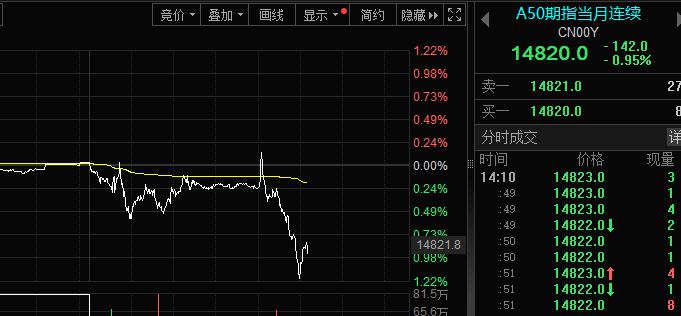
Market Adjustment - The A-share market experienced a significant adjustment, with the FTSE China A50 index futures dropping over 1% in the afternoon, leading to a decline in major A-share indices, including a drop of over 60 points in the Shanghai Composite Index [1][2] - Nearly 4,000 stocks in the market were reported to be down, indicating widespread selling pressure [1] Bond Market Reaction - In response to the stock market's decline, government bond futures saw an increase, with the 30-year main contract rising by 0.2%, and the 10-year, 5-year, and 2-year contracts also showing slight increases [1] Stock Performance Divergence - Despite the overall market downturn, the average stock price index showed an increase, while the number of stocks experiencing declines exceeded 4,000, suggesting that gains were concentrated in high-priced stocks [4] - Notably, the stock price of Cambrian reached 1,464.98 yuan per share, surpassing Kweichow Moutai, becoming the most expensive stock in the A-share market [4] Analyst Insights on Market Trends - Analysts have noted that recent adjustments in the market are partly due to the exposure of external risks, particularly related to long-term bonds, and the observation of overheating in certain segments of the A-share market [1][5] - Several brokerages have begun advocating for a "slow bull" market, emphasizing the importance of sustainable growth rather than rapid increases driven by leverage and external funding [5][6] Long-term Market Outlook - The long-term outlook suggests a shift towards a "slow bull" market model, influenced by structural changes in the market, including the entry of long-term capital and the promotion of high-dividend value creation [6][7] - The expectation is that a comprehensive bull market will require further accumulation of positive factors, including improvements in the fundamental economic outlook and the integration of Chinese enterprises into global supply chains [6][7]