
A股慢牛行情

Search documents
存款搬家暗流涌动,散户跑步入场A股了吗?
第一财经· 2025-08-19 15:10
Core Viewpoint - The article discusses the current state of the A-share market, highlighting a recent pullback after a significant rise, and the cautious sentiment among retail investors despite the ongoing "slow bull" market trend [3][4][7]. Market Performance - On August 19, the Shanghai Composite Index experienced a slight decline of 0.02%, while the Shenzhen Component and ChiNext Index fell by 0.12% and 0.17%, respectively. The total trading volume was 2.64 trillion yuan, a decrease of over 170 billion yuan compared to the previous trading day [3][4]. - Since July, A-share indices have been on a continuous upward trend, with trading activity in the Shenzhen market surpassing previous highs from the "924 market" and early 2023 [6]. Retail Investor Sentiment - Retail investors are exhibiting a cautious approach, with many expressing a reluctance to enter the market aggressively. This contrasts with the exuberance seen during previous bull markets [4][8]. - Analysts note that the participation of retail investors is lower than during the "924 market" and previous bull markets in 2015 and 2020. The current market is primarily driven by high-net-worth individuals and institutional investors [7][8]. Fund Flows and Market Dynamics - Despite the overall market rise, there has been no significant influx of retail funds. Publicly offered equity funds have not seen a substantial increase in new issuances, indicating a lack of confidence among retail investors [7][8]. - The article highlights a shift in household savings, with a reported increase of 10.77 trillion yuan in household deposits in the first half of 2025, suggesting a potential flow of funds into the stock market [11]. Long-term Outlook - Analysts maintain a positive long-term outlook for the A-share market, predicting that the current "slow bull" trend could persist until at least 2027. The focus should shift towards company performance and valuations rather than solely on liquidity-driven market movements [12][13].


A股交投持续火爆 存款搬家还有多少后劲?
Di Yi Cai Jing· 2025-08-19 14:24
Group 1: Market Overview - The recent A-share market has shown a slow bull trend, attracting more investors as deposit rates decline, leading to a potential restart of fund investments [1][5] - As of August 19, A-share indices experienced a slight decline, but trading volume remained high, with a total turnover of approximately 2.6 trillion yuan [2] - The A-share market capitalization has surpassed 100 trillion yuan, with significant trading activity and record highs in various indices [1][2] Group 2: Investor Behavior - Retail investors have become the main source of incremental funds in the current market, with a notable increase in new account openings and small order net inflows [3][6] - The trend of retail investors moving funds from other safe assets into the stock market has been observed, indicating a shift in investment preferences [6][7] - The potential scale of household deposits entering the market is estimated to be between 5 trillion to 7 trillion yuan, which could exceed previous market cycles [7] Group 3: Financial Sector Performance - The banking sector has been a key driver of the market, with significant increases in market capitalization, particularly for major state-owned banks [4] - Agricultural Bank of China has reached a market capitalization of 2.24 trillion yuan, becoming the largest bank by market value [4] Group 4: Economic Indicators - The decline in deposit rates has led to a noticeable shift in household savings towards the stock market, with a significant reduction in fixed-term deposits [5][6] - The overall liquidity environment and macroeconomic expectations will influence the sustainability of the current market trend [5][7]
A股交投持续火爆,存款搬家还有多少后劲?
第一财经网· 2025-08-19 14:13
Group 1 - The potential scale of funds from residents' deposits entering the market is estimated to be around 5 trillion to 7 trillion yuan, which may exceed the scale of deposits entering the market during previous bull markets in 2016-2017 and 2020-2021 [1][8] - The recent A-share market has shown signs of a slow bull market, with a significant increase in search interest for "bull market" on social media, indicating growing investor attention [1][2] - In July, the number of new A-share accounts reached 1.96 million, reflecting a strong interest from retail investors, with net inflows from small orders increasing significantly [3][6] Group 2 - The current market rally is primarily driven by retail investor sentiment and foreign capital inflows, with insurance funds providing long-term support [3][5] - The banking sector has been a highlight, with Agricultural Bank of China reaching a market capitalization of 2.24 trillion yuan, marking a significant milestone [4][5] - The trend of residents' deposits moving towards the stock market is becoming more pronounced, with a notable decrease in fixed-term deposits and an increase in non-bank deposits [6][7] Group 3 - The overall market is expected to remain active, with potential for accelerated rotation, influenced by the progress of residents' financial migration and the global liquidity environment [6][8] - Historical data shows that during previous asset shortages, excess savings were significantly consumed in real estate and stock markets, indicating a pattern that may repeat [8] - The current environment of declining deposit rates and increased market activity suggests a shift in investor behavior, with a focus on equities over traditional savings [6][7]


券商板块利好消息不断,牛市旗手还能强势多久?
2 1 Shi Ji Jing Ji Bao Dao· 2025-08-19 00:15
Group 1 - The brokerage sector is experiencing strong performance, with several firms like Changcheng Securities and Hualin Securities seeing significant gains [1] - The largest securities ETF in the market rose by 4.75% on August 15, with a trading volume of 5.239 billion yuan, marking a new high for the year [1] - The first batch of brokerage firms reporting their mid-year results showed net profit growth exceeding 25% year-on-year, indicating a positive trend for larger firms' upcoming reports [1][2] Group 2 - Recent mergers and acquisitions in the brokerage sector are gaining momentum, with the approval of Western Securities as a major shareholder of Guorong Securities [3] - The acceleration of mergers in the brokerage industry is evident, with significant transactions like Guosen Securities acquiring 96.08% of Wanhua Securities [3] Group 3 - Analysts believe the brokerage sector still has room for growth, as current performance is lagging behind historical gains [4] - The PB valuation of the brokerage industry is at historical lows, suggesting strong potential for valuation recovery as market activity increases [4] Group 4 - The A-share market is expected to maintain strength driven by liquidity, with active retail participation still cautious [5] - The market is likely to experience volatility and consolidation as it attempts to break previous highs, but the overall trend remains upward [5] Group 5 - The asset allocation research team indicates a bullish outlook for the market, with a preference for mid-cap stocks during the current phase of volume expansion [6] - Investment focus areas include technology sectors like consumer electronics and AI software, as well as themes like commercial aerospace [6]

A股慢牛行情下!私募产品“超涨”榜揭晓!远信、久期、前海博普等夺冠!
私募排排网· 2025-08-17 03:03
Core Viewpoint - The article discusses the performance of private equity funds in the context of a bullish market trend in A-shares, emphasizing the importance of both offensive and defensive capabilities of these funds to capture investment opportunities and mitigate risks [1][3]. Offensive Capability (Upward Capture Rate) - Offensive capability measures how sensitive a fund is to market uptrends, with a higher value indicating stronger performance against the market. The upward capture rate is calculated as: (Cumulative return of the portfolio during the benchmark's up period + 1) / (Cumulative return of the benchmark during the up period + 1) - 1 [2]. Defensive Capability (Downward Capture Rate) - Defensive capability assesses how well a fund performs during market downturns, with a lower value being preferable. A negative value indicates that the fund can generate positive returns even in a declining market. The downward capture rate is calculated similarly to the upward capture rate but focuses on down periods [3]. Performance Summary of Private Equity Funds - For the year to date, the average return of 4,377 qualifying private equity products is 15.28%, with an average offensive capability of 1.356 and a defensive capability of 0.128. The top three funds in terms of offensive capability among large private equity firms (over 5 billion) are from Yuanxin Investment, Harmony Huiyi Asset, and Longqi Technology [5]. - The top fund, "Yuanxin China Active Growth C Class," managed by Wang Aoye, has achieved significant returns and is noted for its strong offensive capability [5][6]. - In the small private equity category (under 5 billion), the top three funds are from Nengjing Investment Holdings, Hunan Zijin Private Equity, and Jiuge Investment [8]. Recent Performance Trends - Over the past year, the average return of 4,165 qualifying products is 36.34%, with an overall offensive capability of 0.975 and a defensive capability of -0.130. The leading funds in this category are from Jiuqi Investment, Heiyi Asset, and Stable Investment [10]. - The top fund, "Jiuqi Value Selection No. 1," managed by Jiang Yunfei, has demonstrated strong performance metrics [12][13]. Three-Year Performance Overview - For the past three years, the average return of 2,638 qualifying products is 43.03%, with an average offensive capability of 0.881 and a defensive capability of 0.248. The top funds in this category are from Qianhai Bopu Asset, Kaishi Private Equity, and Hainan Xiwa [16]. - The leading fund, "Bopu Value Far-reaching No. 1 A Class," managed by Yuan Hao, has shown impressive performance [18][19].

谁在“做多”,谁仍“畏高”?
Soochow Securities· 2025-08-17 00:04
Core Insights - The report indicates that since the tariff impact in April, the A-share market has entered a four-month trend, showing a gradual bull market pattern. Recent market activity has intensified, with the Shanghai Composite Index breaking through significant resistance levels of 3674 and 3700, and trading volume exceeding 2 trillion yuan [1] Market Participation - Retail investors are beginning to enter the market, but there remains a prevailing "fear of heights" sentiment, leading to low overall participation [2][4] - The "scar effect" from previous market adjustments has dampened retail investors' willingness to engage in A-shares through indirect channels [3] Retail Investor Sentiment - Retail investors are hesitant about the current bull market, primarily due to the need for stronger signals to confirm the trend. They may require more sustained and robust price increases to feel confident [4] - Despite some retail investors increasing their positions, the overall momentum is limited. Recent weeks have seen a net inflow of 113.4 billion yuan from small trades, but this is still significantly lower than the average of 131.2 billion yuan per week in the first quarter [5] Fund Flows and Market Dynamics - The report highlights that speculative trading activity has reached a new high for the year, with an average daily trading amount of 30.8 billion yuan in the first half of August [5] - Leveraged funds have seen continuous net inflows since late June, accumulating over 200 billion yuan, pushing the margin balance above 2 trillion yuan [5] - Private equity has expanded significantly, with the number of registered products reaching 2448, accounting for 45% of all private equity securities products [5] Future Outlook - The report suggests that FOMO (Fear of Missing Out) funds are likely to gradually enter the market, driven by the trend of asset migration among residents [6][8] - Institutional funds, including foreign and insurance capital, are expected to increase their inflows into the market [7][8] - The report recommends focusing on sectors such as consumer electronics, autonomous driving, domestic computing power, AI software, new consumption, and thematic investments like commercial aerospace and brain-computer interfaces [8]
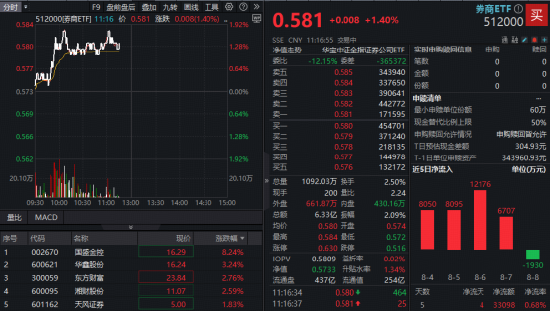
“旗手”躁动,国盛金控触及涨停!A股顶流券商ETF(512000)放量冲击2%!机构:慢牛有望延续,关注券商补涨
Xin Lang Ji Jin· 2025-08-11 04:05
Group 1 - The core viewpoint of the news highlights the strong performance of brokerage stocks in the A-share market, with a notable increase in trading volume and a bullish sentiment among investors [1][3]. - The A-share brokerage ETF (512000) saw a mid-day surge of 2%, with trading volume exceeding 630 million yuan within half a day, surpassing the total trading volume of the previous day [1]. - All 49 listed brokerage firms experienced gains, with Guosheng Financial hitting the daily limit, and other firms like Huaxin Securities, Dongfang Caifu, and Xiangcai Securities also showing significant increases [1]. Group 2 - The margin trading balance has remained above 2 trillion yuan for four consecutive trading days, indicating a high level of market sentiment and leverage, which is at a 10-year high [3]. - Unlike the 2015 bull market characterized by chaotic leverage, the current market environment is marked by economic structural optimization, strict regulation, and a more mature investor base, suggesting a more stable and rational development phase for the A-share market [3]. - Analysts from Fangzheng Securities and Xibu Securities express optimism about the brokerage sector, indicating that the increase in margin trading reflects a rise in market risk appetite and suggesting potential for a sustained slow bull market [3]. Group 3 - The brokerage ETF (512000) passively tracks the CSI All Share Securities Company Index, which includes 49 listed brokerage stocks, with nearly 60% of its holdings concentrated in the top ten leading brokerages [3]. - The ETF serves as an efficient investment tool that allows for concentrated exposure to leading brokerages while also accommodating the high growth potential of smaller firms [3].

停产!周末,重大利好!
Zhong Guo Ji Jin Bao· 2025-08-10 14:32
Group 1: Market Overview - The Shanghai Composite Index rose by 2.11%, the Shenzhen Component Index increased by 1.25%, and the ChiNext Index gained 0.49% over the past week [1] Group 2: Lithium Industry Update - Ningde Times' mining operations in the Jiangxia Wokou area will cease production starting from August 10, with no immediate plans for resumption, affecting approximately 3% of global lithium supply [3] - Following the production halt, lithium carbonate futures surged to 76,960 yuan per ton, with expectations of rising spot prices and manufacturers holding back sales [4] Group 3: Economic Indicators - In July, the Consumer Price Index (CPI) rose by 0.4% month-on-month, while the core CPI, excluding food and energy, increased by 0.8% year-on-year, marking a continuous expansion for three months [5] - The Producer Price Index (PPI) decreased by 0.2% month-on-month and remained down 3.6% year-on-year, with the decline narrowing by 0.2 percentage points from the previous month [5] Group 4: Regulatory Developments - The China Securities Regulatory Commission (CSRC) plans to enhance the cultivation of long-term and patient capital, aiming to support a policy framework for long-term investments [6] - The CSRC will maintain strict controls on IPO approvals to prevent large-scale market expansions, ensuring a balanced approach to market growth [7] Group 5: Robotics Industry Forecast - The humanoid robot market is expected to double its shipment volume annually over the next few years, with potential for significant increases in output due to technological breakthroughs [8] Group 6: Real Estate Policy Changes - Beijing has implemented targeted relaxations in housing purchase restrictions outside the Fifth Ring Road, allowing eligible families to buy an unlimited number of properties [9][10] Group 7: Market Sentiment and Predictions - Various brokerages express confidence in the ongoing bull market, with expectations of continued upward trends in A-shares, particularly in sectors like defense, AI computing, and innovative pharmaceuticals [14][15][16][17][18][19][20][21][22][23]
两融余额突破2万亿元,重回10年来高位
Sou Hu Cai Jing· 2025-08-10 12:40
Core Viewpoint - The balance of margin trading in the Shanghai and Shenzhen markets has surpassed 2 trillion yuan, returning to a 10-year high, but under a different market context compared to the 2015 bull market [1][3] Group 1: Market Context - The current increase in margin trading balance reflects an improved market risk appetite, indicating a potential continuation of a slow bull market in A-shares [3][8] - The current environment is characterized by economic structural optimization, strict regulation, and increasingly mature investors, marking a shift towards a more stable and rational development phase for the A-share market [3][8] Group 2: Margin Trading Data - As of August 5, the margin trading balance reached 20,003 billion yuan, accounting for 2.3% of the A-share market's circulating market value and 10.2% of trading volume [8] - The top margin trading stocks include Oriental Fortune with 23.235 billion yuan, followed by China Ping An with 21.852 billion yuan, and other notable companies like Kweichow Moutai and BYD also feature prominently [4] Group 3: Investor Behavior Changes - Over the past decade, investor behavior has significantly changed, with a more diversified and less homogenous approach to trading compared to the concentrated investments in financial stocks seen in 2015 [6][7] - The number of margin trading stocks has increased from around 900 to 4,150, allowing for a broader selection and more balanced capital flow across various sectors, including technology and renewable energy [7][8] Group 4: Future Outlook - The market is expected to maintain a slow bull trend, supported by steady economic growth and improving corporate profitability, with a focus on sectors like TMT, cyclical stocks, and consumer goods [8] - The current liquidity is ample, and the risk appetite has improved, which is likely to drive the A-share market forward [8]





三大事件齐发,有望推动金价趋势上行
Mei Ri Jing Ji Xin Wen· 2025-08-06 00:59
Group 1 - The liquidity in the stock market remains abundant, which is favorable for the sustained slow bull market of A-shares [1] - Since June 23, the A-share market has shown a clear characteristic of "rotating upward and low-level replenishment," with better sustainability of the profit-making effect [1] - The financing balance of A-shares has risen to around 2 trillion, accounting for 2.3% of the circulating market value, reflecting a broad source of incremental funds [1] Group 2 - The demand for AI servers has widened the supply-demand gap for high-end PCBs, leading the industry into a new round of innovative expansion cycle [2] - This round of PCB capital expenditure expansion cycle is expected to start in Q4 2024 and may last for about two years, with the potential for an extended boom due to infrastructure demand [2] - There is a growing trend of monthly acceleration in PCB capital expenditure by the second half of 2025, indicating a possibility of continuous upward revision of industry orders [2] Group 3 - Three major events in early August are expected to drive the upward trend of gold prices [3] - The July non-farm employment data was lower than expected, leading to downward revisions of previous months' data, which raises concerns about economic strength [3] - The resignation of a key Federal Reserve official and political interference in labor statistics have cast doubt on the credibility of future economic data and the independence of monetary policy, reinforcing the long-term bullish logic for gold [3]


