
创新驱动

Search documents
商务部官员谈应对光伏贸易摩擦:做行业赋能者,而不是产能转移者
Xin Lang Cai Jing· 2025-12-18 08:27
炒股就看金麒麟分析师研报,权威,专业,及时,全面,助您挖掘潜力主题机会! 围绕光伏行业如何应对包括贸易摩擦在内的各类挑战,顾宇表示,首先要秉持长期主义,坚定发展信 心。光伏行业的发展前景依然广阔。今年以来,在市场和政策的双向驱动下,行业反内卷已见成效,我 国光伏产业正稳步迈向高质量发展新阶段。其次,要坚持创新驱动,促进合作共赢。在这场行业寒冬 中,创新将是个体企业能否生存的关键。企业要坚持贯彻新发展理念,推动光伏行业转型升级,继续加 大对先进技术研发投入力度,以质量和技术构建行业竞争力,为全球光伏行业及终端用户提供更多更好 的中国解决方案。 12月18日消息,在今天举行的2025光伏行业年度大会上,商务部贸易救济调查局副局长顾宇表示,中国 光伏行业在全球产业链中占有最重要的位置,不仅提供了优质的产品和服务,也为全球减碳事业发展作 出了重大贡献。他指出,当前光伏行业遭遇贸易摩擦,有两大趋势值得关注,第一是发达国家对我光伏 限制措施进一步强化,第二是新兴国家与我贸易摩擦抬头。 顾宇谈到,未来一段时期,受地缘政治及产业格局重塑影响,新兴国家恐通过各种手段减少对中国供应 链的依赖,光伏产品出口及企业出海或将面临多线受 ...
“十四五”佛山经济总量连跨3个千亿台阶 规上工业企业突破1万家
Nan Fang Ri Bao Wang Luo Ban· 2025-12-18 07:39
Economic Growth and Development - During the "14th Five-Year Plan" period, Foshan's economic total is expected to reach 1.33 trillion yuan in 2024, achieving stable overall development this year [1] - Foshan has maintained a strong focus on manufacturing, with 10 industrial clusters reaching a scale of 100 billion yuan and over 10,000 industrial enterprises above designated size [1] Quality Improvement and Investment - Foshan has leveraged fiscal funds to mobilize nearly 400 billion yuan in social capital for technological transformation, with 78.7% of industrial enterprises undergoing digital transformation [1] - The city has established a 20 billion yuan new momentum industry fund and has attracted over 3,000 projects with investments exceeding 1 billion yuan, totaling 1.8 trillion yuan in signed investments [1] Innovation and Reform - Foshan has been approved to build a national innovative city and has led the province in the number of provincial science and technology awards for six consecutive years [2] - The city has pioneered local regulations to support market entities, resulting in a growth of 83.1% in operating entities, surpassing 1.72 million [2] Urban-Rural Coordination - Foshan has made significant progress in urban-rural coordination, being recognized as "excellent" in provincial assessments for two consecutive years [2] - The per capita disposable income of rural residents exceeds 43,000 yuan, with the urban-rural income ratio narrowing to 1.6:1, better than national and provincial averages [2]
只此山东|菏泽的“拼劲” :“牡丹之都”谱写高质量发展新篇章
Xin Lang Cai Jing· 2025-12-17 10:04
文|董柳 2025年末,这一时间节点的重要性对菏泽来说不言而喻。 这是"十四五"与"十五五"接力的风口,亦是突破菏泽鲁西崛起三年行动计划(2023-2025年)的最后一年。 "十四五"的成绩单,势必成为丈量"突破菏泽,鲁西崛起"成效的标尺。 2025 年末,菏泽市接连召开"决胜'十四五'续写新篇章" 系列主题新闻发布会,为这座鲁西南城市五年来的发展写 下生动注脚。从科技创新专场披露的"连续两年全社会研发经费投入增速全省第一",到自然资源和规划专场展示 的"100% 采煤塌陷地治理率",一组组硬核数据、一个个突破性成果,勾勒出菏泽以创新破局、以产业筑基、以绿 色赋能的高质量发展轨迹,更兑现着"后来居上"的时代嘱托。 五年来,这座城市深入贯彻新发展理念,以创新驱动为引擎,以产业升级为抓手,在科技创新、医药产业建设等 领域实现突破性进展,为经济社会发展注入强劲动能,也为未来发展擘画了清晰蓝图。 医药崛起,全产业链打造鲁西南健康产业集群 在菏泽的产业版图中,生物医药产业始终是 "重头戏"。 创新驱动,锻造高质量发展引擎 "十四五"期间,菏泽市以"国际知名、国内一流、全省最优"为目标,构建起覆盖"种植—研发—制造—流通 ...


航宇微:公司将坚持创新驱动,持续深化产品研发与性能优化
Zheng Quan Ri Bao Wang· 2025-12-17 08:44
证券日报网讯12月17日,航宇微(300053)在互动平台回答投资者提问时表示,面对商业航天蓬勃发展 的契机,公司将坚持创新驱动,持续深化产品研发与性能优化,不断巩固竞争优势,并全力加大市场拓 展力度;同时,公司将密切关注行业前沿动态及技术发展趋势,积极挖掘新的业务增长点,推动业务规 模稳步发展,以提升公司核心竞争力。关于机构调研等投资者关系活动,公司如有相关安排,将严格按 照法律法规及时履行信息披露义务。 ...

刘世锦:经济增长更依托创新和消费
21世纪经济报道· 2025-12-17 01:47
Core Viewpoint - The article emphasizes the importance of building a strong financial system to support China's transition to a consumption-driven economy, highlighting the need for a robust capital market and currency to facilitate this shift [1][3]. Group 1: Financial System and Economic Growth - The main challenge for China's economic growth has shifted from supply constraints to demand constraints, with insufficient consumption being a key issue [1]. - Economic growth will increasingly rely on innovation and consumption, necessitating a modern financial system that bridges manufacturing and consumption [1][3]. - The evolution from a traditional banking system to a modern capital market system is essential for improving project selection and resource allocation efficiency [3]. Group 2: Capital Market Development - As China enters an innovation-driven phase, the capital market will take on a greater role in project selection, directing funds towards promising projects [3]. - With a projected annual increase of at least 30 trillion yuan in social net assets, there will be a significant shift of funds from real estate and bank savings into the capital market [4]. - The capital market must support the growth of large innovative enterprises and a multitude of small and medium-sized enterprises, enhancing resource utilization and increasing investors' income [4]. Group 3: Currency and Internationalization - A strong currency is a critical indicator of a financial powerhouse, with historical examples showing that strong currencies are backed by robust economies and financial systems [5]. - China's manufacturing value added is expected to grow from 26.6 trillion yuan to 33.6 trillion yuan from 2020 to 2024, contributing over 30% to global manufacturing growth [5]. - The internationalization of the renminbi has significant potential, with a focus on increasing offshore renminbi products to enhance liquidity and facilitate its global use [6]. Group 4: Trade Strategy and Consumption - China aims to implement a new trade strategy that balances imports and exports, increasing imports settled in renminbi to strengthen its currency [6]. - The potential for China to become the world's largest consumer market is highlighted, with a focus on improving the quality of human capital through increased consumption [6].
新华述评·聚焦中央经济工作会议|必须坚持政策支持和改革创新并举——学习领会“五个必须”做好明年经济工作
Xin Hua Wang· 2025-12-16 15:28
Group 1 - The core message emphasizes the need for simultaneous policy support and reform innovation to strengthen the foundation of economic development and stimulate high-quality growth [1][2][5] - The International Monetary Fund (IMF) acknowledges China's economic resilience despite significant challenges, attributing this to proactive macro policies and ongoing structural reforms [2][3] - The Chinese government has implemented a series of macroeconomic measures, including interest rate cuts and adjustments to housing policies, to stabilize the economy and achieve development goals [3][6] Group 2 - The central economic work meeting outlines a policy direction focused on stability and quality improvement, emphasizing the integration of existing and new policies to enhance macroeconomic governance [6][7] - Major infrastructure projects are progressing, supported by effective fiscal and financial policies, which have been crucial for stabilizing the economy [7][8] - The meeting highlights the importance of enhancing consumer spending and supporting key sectors through targeted financial measures, aiming to create a virtuous cycle of economic development and improved livelihoods [8][10] Group 3 - The meeting calls for deepening reforms to address systemic barriers and enhance the synergy between policy support and reform innovation, which is essential for achieving sustainable economic growth [10][11] - There is a strong focus on innovation and green development, with specific tasks outlined to promote technological advancements and energy efficiency [11][12] - The overall strategy aims to leverage policy support and reform to navigate current challenges and lay a foundation for long-term economic stability and growth [12]
八大重点任务擘画明年经济发展新蓝图
Jin Rong Shi Bao· 2025-12-16 02:13
12月10日至11日,中央经济工作会议在北京举行,向期待已久的社会各方明确了2026年中国经济工作的重点方向和 任务。 多家券商及研究机构专业人士从核心方向、宏观政策和投资机会等多个维度进行了解读。 "会议部署的八大重点任务构成了2026年经济工作的施工图。其中,'内需主导'与'创新驱动'位居前两位,清晰地指 明了短期稳增长与中长期动能转换的路径。这些任务并非孤立,而是相互关联、协同推进的系统工程。"华福证券总裁助 理兼研究所所长任志强向《金融时报》记者讲述了他的学习体会。 中金公司首席宏观经济分析师张文朗认为,本次会议客观分析了中国经济面临的发展形势,不回避困难挑战,突出 问题导向,目标非常清晰,直接回应了市场和社会对消费、投资、房地产、企业账款、市场竞争秩序等一系列热点问题 的广泛关切。 总基调:稳中求进 会议明确了明年的经济工作政策取向为"稳中求进、提质增效",其中"提质增效"是今年的新要求。 "政策总基调在'稳中求进'的基础上,增加了'提质增效'的政策取向。"在长城证券首席经济学家汪毅看来,对于明年 的经济工作,本次中央经济工作会议仍然以"稳"字当头,但是更加强调"增强政策前瞻性针对性协同性,持续扩大 ...

新凤鸣拟投2.8亿美元海外扩产 一体化布局总资产达599.85亿
Chang Jiang Shang Bao· 2025-12-16 00:19
Core Viewpoint - The company Xin Feng Ming (603225.SH) is expanding its global presence by investing approximately $280 million in a 360,000 tons/year functional fiber project in Egypt, aiming to enhance its international market positioning and respond to global trade challenges [1][3]. Group 1: Investment and Expansion - The investment in Egypt will be executed through a wholly-owned subsidiary and aims to produce mainly coarse denier yarn, addressing the local market's polyester fiber shortage [3]. - The project is strategically positioned to mitigate trade barriers in the EU and Middle East, leveraging Egypt's geographical advantages to access African and Mediterranean markets [3]. - The funding for the project will come from the company's own resources and bank financing, ensuring that domestic operations remain unaffected [3]. Group 2: Industry Position and Capacity - Xin Feng Ming has established a comprehensive integrated layout in the polyester industry, with PTA production capacity reaching 7.7 million tons and expected to exceed 10 million tons by the end of 2025 [1][4]. - The company holds a 15% market share in the polyester filament market in China, ranking second in the industry, and leads in short fiber production with a capacity of 1.2 million tons [4]. Group 3: Financial Performance - For the first three quarters of 2025, the company reported revenues of 51.542 billion yuan, a year-on-year increase of 4.77%, and a net profit attributable to shareholders of 869 million yuan, up 16.56% [5]. - The company's total assets reached 59.985 billion yuan by the end of Q3 2025, providing substantial financial support for research and development as well as capacity expansion [2][5].

中慧生物董事长安有才:创新驱动疫苗升级 加码核心产品与管线
Zhong Guo Zheng Quan Bao· 2025-12-15 22:27
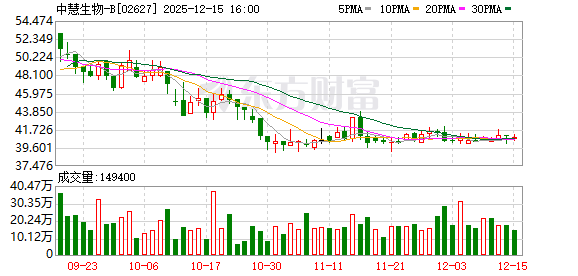
Core Insights - Zhonghui Biotech has accelerated its differentiated innovation in the vaccine sector, successfully listing on the Hong Kong Stock Exchange in August with a subscription multiple exceeding 4000 times, driven by its first four-valent subunit influenza vaccine for individuals aged 6 months and older [2][3] Group 1: Product Development and Market Positioning - Zhonghui Biotech focuses on innovative vaccines and the commercialization of traditional vaccines using new technologies, with its core product, the four-valent influenza subunit vaccine (Hui Er Kang Xin), approved for a broader age range [3] - The company has established a competitive edge through a differentiated positioning strategy, with 9 out of 13 vaccine candidates already receiving clinical approval, currently in various clinical trial phases [3][5] - The market price for Hui Er Kang Xin is set at 319 yuan per dose, significantly higher than many competing products, supported by the complex manufacturing process that requires high purity and effective immunogenicity [3][5] Group 2: Financial Performance and Future Projections - Since its market launch in September 2023, Hui Er Kang Xin has generated over 50 million yuan in revenue within three months, with projected revenues of 260 million yuan in 2024 and over 500 million yuan in 2025, demonstrating strong commercial viability [3][5] - The company aims to achieve a revenue target of 2 billion yuan by 2030, positioning itself among the top domestic vaccine enterprises [4][6] Group 3: Strategic Initiatives and International Expansion - Zhonghui Biotech's strategy emphasizes "innovation-driven" growth, supported by quality leadership, management efficiency, and international expansion [4] - Approximately 30% of the funds raised from the IPO will be allocated to existing products and the development of a human diploid rabies vaccine, with expectations of reaching a revenue target of 1 billion yuan by 2027 [5] - The company is also focusing on international markets, particularly in Southeast Asia, the Middle East, and Latin America, with ongoing product registration efforts in countries like the Philippines and Malaysia [5][6]
创新驱动疫苗升级 加码核心产品与管线
Zhong Guo Zheng Quan Bao· 2025-12-15 20:19
Core Insights - Zhonghui Biotech has accelerated its differentiated innovation in the vaccine sector, successfully listing on the Hong Kong Stock Exchange in August with a subscription multiple exceeding 4000 times, driven by its core product, a quadrivalent subunit influenza vaccine [1][2] Group 1: Product Development and Market Position - The company focuses on innovative vaccines and traditional vaccines using new technologies, with its core product, the quadrivalent influenza vaccine (Hui Er Kang Xin), approved for all individuals aged 6 months and older, making it the first of its kind in China [1][2] - The quadrivalent influenza vaccine is priced at 319 yuan per dose, significantly higher than many competing products, supported by a complex purification process that requires five traditional vaccines to produce one subunit vaccine [2] - Since its market launch in September 2023, the quadrivalent vaccine has generated over 50 million yuan in revenue within three months, with projected revenues of 260 million yuan in 2024 and over 500 million yuan in 2025, demonstrating strong commercial viability [2] Group 2: Strategic Goals and Future Plans - The company aims to become a leading player in the domestic vaccine industry by 2030, targeting revenue of 2 billion yuan, with a strategic focus on "innovation-driven" development, quality leadership, management efficiency, and international expansion [3][5] - Zhonghui Biotech is exploring the development of a universal influenza vaccine and is advancing research in rabies vaccines using human embryonic cells, which offer advantages over traditional animal-derived cells [3][4] - Approximately 30% of the funds raised from the IPO will be allocated to existing products and the development of a diploid rabies vaccine, with plans for commercialization by 2027 [4] Group 3: International Expansion - The company has identified Southeast Asia, the Middle East, and parts of Latin America as key regions for international expansion, focusing on product registration in countries like the Philippines, Malaysia, Thailand, and Indonesia [5] - The international strategy includes leveraging existing production capabilities to efficiently produce vaccines for both hemispheres, with plans for business development projects related to the monkeypox vaccine in Africa, expected to materialize by 2026 [5]