人形机器人

Search documents
伯特利:系列点评十三拟收购豫北转向控股权,智能电动齐驱-20260227
Guolian Minsheng Securities· 2026-02-27 00:25
Investment Rating - The report maintains a "Buy" rating for the company [3] Core Insights - The company plans to acquire a 50.9727% stake in Yubei Steering, which will enhance its competitiveness in the steering business. The acquisition is valued at no more than 2.2 billion yuan, with a maximum payment of 1.121 billion yuan. If Yubei Steering's audited net assets fall below 930 million yuan by the end of 2025, the valuation will be adjusted accordingly [9] - Yubei Steering is expected to generate 3.179 billion yuan in revenue and a net profit of 151 million yuan in 2025, with a net profit margin of 4.75%. This acquisition is projected to bring nearly four times the revenue increment to the company's steering business, improving its technical capabilities, revenue scale, market share, and profitability [9] - The company is actively expanding its smart and electric vehicle technologies, becoming the first domestic supplier to mass-produce line control braking systems and electric parking brakes (EPB). It has 109 projects in research for line control braking systems and 181 for electric systems as of the first three quarters of 2025 [9] - The company is also advancing its global footprint, with a production base in Mexico and plans for a facility in Morocco starting in 2024 [9] - The company is positioned as a leader in the line control chassis sector and is making strides in humanoid robotics, with several subsidiaries and investments in this area [9] Financial Projections - Revenue is projected to grow from 9.937 billion yuan in 2024 to 18.76 billion yuan in 2027, with growth rates of 33.0%, 24.2%, 22.6%, and 23.9% respectively [3][10] - Net profit attributable to shareholders is expected to increase from 1.209 billion yuan in 2024 to 2.005 billion yuan in 2027, with growth rates of 35.6%, 9.1%, 22.2%, and 24.3% respectively [3][10] - Earnings per share (EPS) is forecasted to rise from 1.99 yuan in 2024 to 3.31 yuan in 2027, with corresponding price-to-earnings (PE) ratios of 27, 25, 20, and 16 [3][10]

再获近20亿融资,中国版Figure AI,估值超百亿!
Robot猎场备忘录· 2026-02-27 00:03
Core Viewpoint - The domestic humanoid robot market in China is experiencing a significant surge in investment, with several startups achieving valuations exceeding 10 billion yuan, driven by advancements in artificial intelligence and model technology [2][3]. Group 1: Investment Trends - After the Spring Festival, the financing trend continues with three leading humanoid robot startups announcing substantial funding rounds, all surpassing 10 billion yuan in valuation [3]. - Notable funding rounds include Zhujidongli securing $200 million and Xinghaitu raising 1 billion yuan in February, both achieving valuations over 10 billion yuan [2]. - Qianxun Intelligent, recognized as the "Chinese version of Figure AI," has completed seven funding rounds totaling over 3.4 billion yuan, with a recent round raising nearly 2 billion yuan [4][5]. Group 2: Company Profiles - Qianxun Intelligent focuses on AI and robotics, aiming to develop world-class humanoid robots and advanced embodied models, supported by a strong team with backgrounds in academia and industry [4][9]. - The founding team includes experts from top universities and previous leaders in the robotics field, enhancing the company's credibility and innovation potential [12][14]. - The company has established a unique ecosystem by attracting investments from major industrial players like Ningde Times and JD.com, facilitating its commercial deployment [27][29]. Group 3: Technological Advancements - Qianxun Intelligent adopts a full-stack self-research approach, integrating both hardware and software capabilities, which is crucial for its competitive edge in the market [15][19]. - The company has developed advanced models like Spirit v1 and v1.5, showcasing significant performance improvements in complex task execution, such as manipulating flexible objects [19][21]. - Data collection efforts have yielded over 200,000 hours of diverse interaction data, with plans to exceed 1 million hours by 2026, significantly reducing data acquisition costs [22][23]. Group 4: Market Dynamics - The humanoid robot sector is divided into two main camps: hardware-focused companies like Yushu Technology and software-centric firms like Qianxun Intelligent, with the latter gaining more traction due to their AI capabilities [30][31]. - The commercial landscape is still in its early stages, with many startups yet to establish a sustainable business model, raising questions about the long-term viability of the sector [31].


财经早报:中方回应第六轮中美经贸磋商,中德已达成十余项商业协议丨2026年2月27日
Xin Lang Cai Jing· 2026-02-26 23:38
Group 1 - China and the US are maintaining communication through the economic consultation mechanism, aiming for stable and sustainable development of bilateral trade relations [2] - German Chancellor Merz's visit to China resulted in over ten commercial agreements, emphasizing cooperation in AI and other advanced fields [3][51] - China has implemented export controls on Japan to prevent its militarization and nuclear ambitions, reflecting concerns over regional peace [4][52][53] Group 2 - The deployment of 11 US F-22 stealth fighters in Israel marks a significant military presence in the Middle East [5][54] - Indirect negotiations between the US and Iran have reportedly made significant progress, with further discussions scheduled [7][55] - China's AI model usage surged, surpassing the US for the first time, with a notable increase in model calls [8][56] Group 3 - New regulations for online food safety will take effect on June 1, requiring platforms to take responsibility for food safety throughout their operations [9][57] - The offshore RMB has appreciated significantly, breaking the 6.83 mark, indicating a strong upward trend in the currency [10][58] - Shanghai's gold recovery industry may soon require mandatory real-name registration to enhance security and traceability [11][59] Group 4 - Ctrip Group announced a change in leadership, with the resignation of its president and a significant increase in revenue for Q4 2025 [16][62] - The Guotou Ruijin silver fund compensation process has begun, with over 10,000 users engaging in the resolution process via an online platform [17][63] - The rumor regarding Sanzi Yang's successful backdoor listing has been officially denied, clarifying the company's current status [18][64] Group 5 - Nvidia reported record revenue for Q4 2026, driven by its data center business, which has seen substantial growth since the launch of ChatGPT [19][66] - Longcheng High-tech's new drug for treating boys' developmental issues has led to a significant increase in its stock price, reflecting market excitement [22][68] - The actual controller of Dongfang Fortune plans to donate a substantial amount of shares to Shanghai Jiao Tong University, highlighting corporate social responsibility [23][69]




稀土短缺问题加剧,海外半导体等产业公司已被迫“拒单”
Xuan Gu Bao· 2026-02-26 23:16
Group 1 - The supply of rare earth elements, particularly yttrium and scandium, is facing a significant shortage, impacting aerospace and semiconductor industries [1] - Yttrium prices have surged by 60% since the first report of shortages in November 2025, with a staggering increase of approximately 69 times compared to a year ago [1] - China dominates the global rare earth industry, accounting for 69% of the world's rare earth production in 2024, with a significant advantage in the refining and separation processes [1] Group 2 - The rare earth industry in China has developed a competitive landscape characterized by a "south-heavy, north-light" structure, with export controls on certain rare earth elements expected to drive price fluctuations [2] - The demand for neodymium is projected to grow due to the annual increase of 15-20% in global electric vehicle sales from 2025 to 2027, leading to a tight balance in the neodymium market [2] - The price index for rare earths is expected to oscillate between 200-250 points, with neodymium oxide prices anticipated to rise to 600,000-800,000 yuan per ton in 2025-2026 [2] Group 3 - Northern Rare Earth is a leading player in the global rare earth industry, benefiting from stable supply of rare earth concentrates through its mining rights in Baiyun Obo [3] - Dadi Xiong's high-performance rare earth permanent magnet materials and related products have significant export markets in the EU and other regions [4]


机构2月调研近240家上市公司 人形机器人等投资机遇获重视
Zhong Guo Zheng Quan Bao· 2026-02-26 21:09
Group 1: Market Overview - Since February, nearly 240 companies have received institutional research, with over half achieving positive returns during this period [1][3] - The A-share market has maintained a high-level fluctuation, with some companies seeing cumulative gains exceeding 80% [1][4] Group 2: Key Companies and Performance - TianShun Wind Power has been the most favored, receiving 237 institutional research visits and experiencing a nearly 32% increase in stock price since February [2][3] - Other notable companies include NaiPu Mining Machinery, Huanxu Electronics, and Daikin Heavy Industries, each receiving over 100 institutional visits [3] Group 3: Industry Focus - The mechanical equipment and electronics sectors are the primary focus for institutional research, with over 30 companies in each sector being investigated [6] - The basic chemical sector has also gained attention, with a cumulative increase of 18.10% since 2026, ranking fourth among all sectors [7] Group 4: Investment Opportunities - Investment opportunities in humanoid robots and AI infrastructure are highlighted, with recommendations to focus on companies that can capitalize on these trends [6][7] - In the electronics sector, there is a strong interest in AI-related applications, particularly in data processing and AI infrastructure [7] - The basic chemical sector is expected to see continued demand recovery, with leading companies poised for long-term growth [7]

机构2月调研近240家上市公司人形机器人等投资机遇获重视
Zhong Guo Zheng Quan Bao· 2026-02-26 20:28
Core Insights - In February, nearly 240 companies in China have received institutional research, with over half achieving positive returns during this period, and some stocks seeing cumulative gains exceeding 80% [1][2] - The mechanical equipment and electronics sectors are the primary focus of institutional research, with significant attention also on cyclical sectors like basic chemicals [1][5] - Investment opportunities are anticipated in humanoid robots, upstream AI infrastructure, and certain chemical sector stocks that offer high elasticity and dividends [1][6] Company Highlights - TianShun Wind Power has been the most favored company, receiving 237 institutional research visits since February, with its stock price rebounding nearly 32% during this period [1][2] - The company is expected to benefit from accelerated offshore wind project bidding and construction in Guangdong, with plans to enhance its logistics capabilities through local assembly in Europe [2][3] - Other companies like Nipe Mining, Huanxu Electronics, and Daikin Heavy Industries have also attracted significant institutional interest, each receiving over 100 research visits [2] Market Performance - As of February 26, 155 out of the nearly 240 companies that received institutional research reported positive returns, indicating a favorable market sentiment [3][4] - Oulai New Materials has seen a remarkable cumulative gain of 81.11% since February 26, driven by its advancements in high-performance sputtering targets and strong profit support despite rising raw material costs [3][4] Sector Analysis - The mechanical equipment and electronics sectors remain the focal points for institutional investment, with over 30 companies in each sector receiving research attention [5][6] - The basic chemicals sector has gained traction, with a cumulative increase of 18.10% since the beginning of 2026, indicating a robust outlook for leading companies in this space [7]
伯特利(603596):系列点评十三:拟收购豫北转向控股权,智能电动齐驱
Guolian Minsheng Securities· 2026-02-26 15:13
Investment Rating - The report maintains a "Buy" rating for the company [3] Core Insights - The company plans to acquire 50.9727% of Yubei Steering, which will enhance its competitiveness in the steering business. The acquisition is valued at no more than 2.2 billion yuan, with a maximum payment of 1.121 billion yuan. If Yubei Steering's audited net assets fall below 930 million yuan by the end of 2025, the valuation will be adjusted accordingly [9] - The company is actively expanding its smart and electric vehicle technologies, becoming the first domestic supplier to mass-produce line-controlled braking systems and achieving significant project advancements in both smart and electric vehicle sectors [9] - The company is also progressing in its robotics business, establishing subsidiaries focused on humanoid robots and related technologies, indicating a strategic diversification into high-growth areas [9] Financial Forecasts - Projected revenue for 2024 is 9.937 billion yuan, with a growth rate of 33.0%. By 2027, revenue is expected to reach 18.76 billion yuan, with a growth rate of 23.9% [3][10] - The net profit attributable to shareholders is forecasted to be 1.209 billion yuan in 2024, growing to 2.005 billion yuan by 2027, reflecting a compound annual growth rate of 24.3% [3][10] - Earnings per share (EPS) is expected to increase from 1.99 yuan in 2024 to 3.31 yuan in 2027, with corresponding price-to-earnings (PE) ratios decreasing from 27 to 16 over the same period [3][10]
伯特利丨拟收购豫北转向控股权 智能电动齐驱【国联民生汽车 崔琰团队】
汽车琰究· 2026-02-26 15:12
Core Viewpoint - The company plans to acquire a 50.9727% stake in Yubei Steering, becoming its controlling shareholder, which is expected to enhance its competitiveness in the steering business [2][3]. Group 1: Acquisition and Business Impact - The acquisition of Yubei Steering is valued at no more than 2.2 billion yuan, with a maximum payment of 1.121 billion yuan. There is a commitment to adjust the valuation if Yubei Steering's audited net assets fall below 930 million yuan by the end of 2025 [3]. - Yubei Steering's main business includes automotive steering systems and mechatronic components, with projected revenue of 3.179 billion yuan and a net profit of 151 million yuan by 2025. This acquisition is expected to provide nearly a fourfold increase in the company's steering business revenue [3]. - The acquisition is anticipated to improve the company's technical capabilities, revenue scale, market share, and profitability in the automotive steering sector, thereby enriching its product line in automotive safety systems [3]. Group 2: Strategic Developments - The company is actively expanding its smart and electric vehicle technologies, becoming the first domestic supplier to mass-produce line control braking systems. It has 109 projects under research as of the first three quarters of 2025 [3]. - The company is also the first in China to achieve mass production of EPB (Electronic Parking Brake) systems, with 181 projects in research as of the first three quarters of 2025, and plans to expand production capacity to alleviate bottlenecks [3]. - The company has established a production base in Mexico, with a project to produce 4 million lightweight components annually, and is planning a base in Morocco to further its globalization efforts [3]. Group 3: Financial Projections - The company has adjusted its revenue forecasts for 2025-2027 to 12.345 billion yuan, 15.14 billion yuan, and 18.76 billion yuan, respectively, with net profits projected at 1.319 billion yuan, 1.612 billion yuan, and 2.005 billion yuan [5][6]. - The earnings per share (EPS) are expected to be 2.17 yuan, 2.66 yuan, and 3.31 yuan for the years 2025, 2026, and 2027, respectively, with corresponding price-to-earnings (PE) ratios of 25, 20, and 16 [5][6].

赛摩智能(300466.SZ):暂不涉及人形机器人相关产品和业务
Ge Long Hui· 2026-02-26 13:24
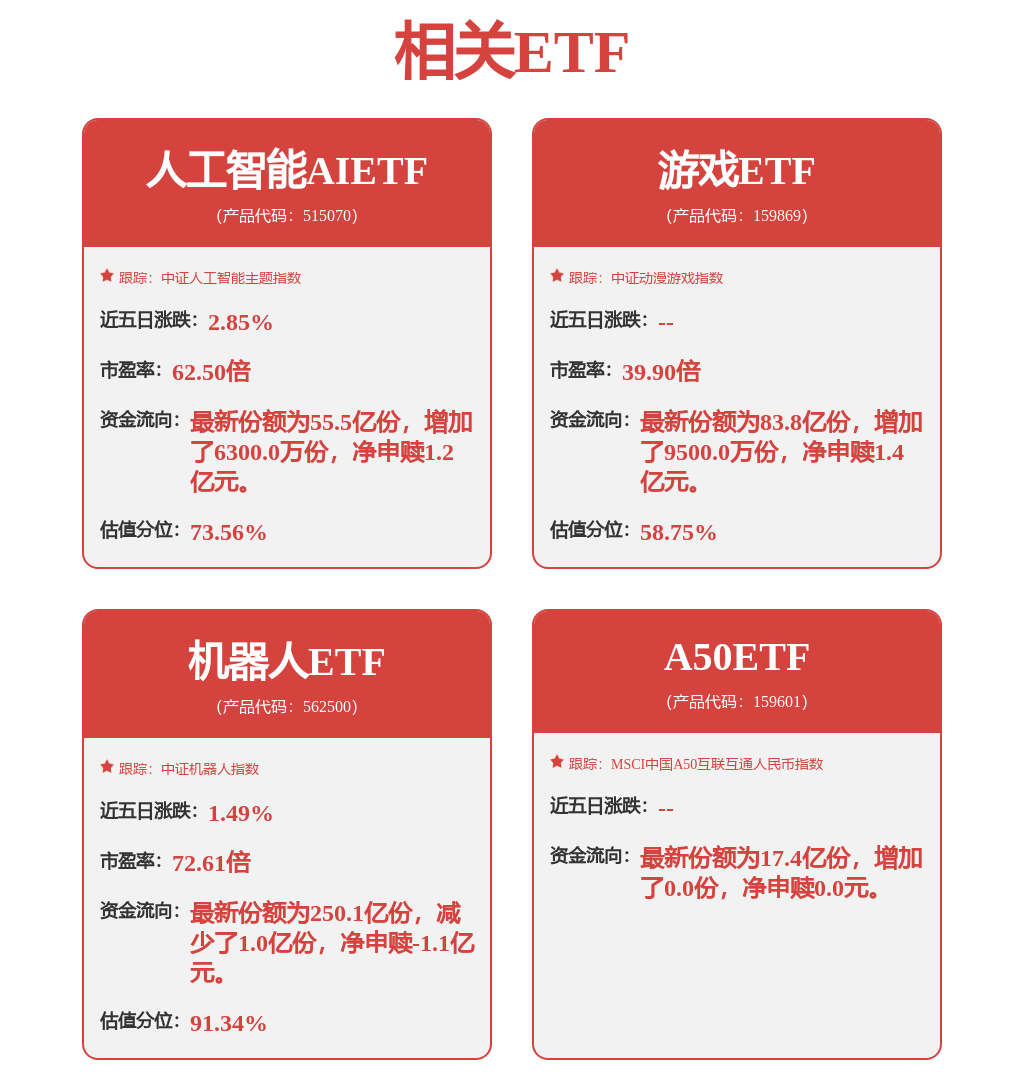
Group 1 - The core viewpoint of the article is that Saimo Intelligent (300466.SZ) has stated it is not currently involved in humanoid robot-related products and business [1] Group 2 - The Artificial Intelligence ETF (Product Code: 515070) tracks the CSI Artificial Intelligence Theme Index and has seen a recent increase of 6.3 million shares, with a net subscription of 120 million yuan [3][4] - The Gaming ETF (Product Code: 159869) tracks the CSI Animation and Gaming Index, with a recent increase of 9.5 million shares and a net subscription of 140 million yuan [4] - The Robotics ETF (Product Code: 562500) tracks the CSI Robotics Index, experiencing a decrease of 10 million shares and a net redemption of 110 million yuan [4] - The A50 ETF (Product Code: 159601) tracks the MSCI China A50 Connect RMB Index, with no recent changes in shares or net subscriptions [5]

中国机器人在跳舞,美国机器人在发论文
Xin Lang Cai Jing· 2026-02-26 13:22
Core Viewpoint - The article discusses the contrasting development paths of the robotics industry in China and the United States, highlighting China's focus on hardware and the U.S.'s emphasis on software, suggesting a competitive landscape in the robotics sector. Group 1: Industry Overview - The popularity of robots in China has significantly increased, with various performances showcased during the Spring Festival, while the U.S. robotics industry appears relatively quiet [2][27]. - Despite fewer robots in the U.S., there are numerous robotics companies, including World Labs and Physical Intelligence, focusing on data synthesis and model development [4][29]. - NVIDIA has developed the Isaac platform specifically for humanoid robots, indicating a strong push in software development for robotics in the U.S. [6][31]. Group 2: Hardware vs. Software - China is primarily focused on hardware development, with robots already being utilized in factories, while the U.S. is concentrating on software, producing numerous algorithms and patents [6][31]. - The long-term goal for humanoid robots is versatility, requiring both human-like physical capabilities and advanced software algorithms to understand the physical world [8][33]. - The hardware aspect of robots includes components like joints, which are crucial for complex operations, while the software is essential for understanding physical rules [9][36]. Group 3: Supply Chain Dynamics - The supply chain for robotics in China is heavily influenced by the automotive industry, with many suppliers transitioning to provide components for humanoid robots [16][41]. - Companies like Tesla leverage China's manufacturing capabilities for hardware while maintaining software development in the U.S., creating a symbiotic relationship between the two countries [17][42]. - The integration of automotive technology into robotics is evident, with components like batteries and control systems being shared between electric vehicles and humanoid robots [13][40]. Group 4: Future Outlook - The article suggests that the competitive landscape in robotics may mirror that of the electric vehicle industry, with Chinese companies potentially dominating the humanoid robot market in the future [24][49]. - The rapid advancement in software capabilities in China is narrowing the gap with U.S. companies, indicating a potential shift in competitive dynamics [23][48]. - Elon Musk has expressed concerns about the rising competition from Chinese companies in the humanoid robot sector, indicating a recognition of the shifting landscape [24][49].