
创新驱动

Search documents
中慧生物董事长安有才: 创新驱动疫苗升级 加码核心产品与管线
Zhong Guo Zheng Quan Bao· 2025-12-15 20:15
Core Viewpoint - Zhonghui Biotech has accelerated its differentiated innovation in the vaccine sector, aiming for a revenue target of 2 billion yuan by 2030, positioning itself among the top domestic vaccine companies [1][3]. Product Differentiation and Competitive Edge - Zhonghui Biotech focuses on innovative vaccines and traditional vaccines using new technologies, with its core product being the quadrivalent subunit influenza vaccine, which received approval for a broader age range [2][3]. - The company has established a strong competitive edge through a differentiated product strategy, with 9 out of 13 vaccine candidates already receiving clinical approval [2][3]. - The quadrivalent influenza vaccine, Huierkangxin, is priced at 319 yuan per dose, significantly higher than many competitors, reflecting its complex production process [2][3]. Financial Performance and Projections - Since its market launch in September 2023, Huierkangxin has generated over 50 million yuan in revenue within three months, with projected revenues of 260 million yuan in 2024 and over 500 million yuan in 2025 [2][3]. Future Development Strategy - The company aims to achieve dual breakthroughs in performance and industry status through innovation, quality leadership, management efficiency, and international expansion [3][4]. - Zhonghui Biotech is developing a universal influenza vaccine and other innovative products, including rabies vaccines using human embryonic cells, which enhance adaptability in humans [3][4]. Fundraising and Investment Plans - The funds raised from the Hong Kong IPO will be allocated primarily to the industrialization of existing products and innovative vaccines, with 30% dedicated to expanding production capacity and advancing the rabies vaccine project [4][5]. - Another 30% of the funds will support the clinical development and industrialization of the shingles vaccine, with plans for it to enter phase III clinical trials by 2026 [5]. International Expansion - The company has identified Southeast Asia, the Middle East, and parts of Latin America as key markets for international expansion, focusing on regions where products can be registered for direct sales [5]. - Zhonghui Biotech is also pursuing business development projects for its monkeypox vaccine in Africa, with expectations for implementation by 2026 [5].
招商新动能哪里来?徐州经开区招商队伍给出答案
Yang Zi Wan Bao Wang· 2025-12-15 13:47
Core Viewpoint - The Xuzhou Economic Development Zone is actively promoting investment through a "2+3" industrial layout, integrating manufacturing, technology, and services to drive high-quality economic development in Xuzhou [1] Group 1: Investment Attraction Strategies - The Xuzhou Economic Development Zone has formed specialized teams for manufacturing, technology, and services, focusing on precise targeting and alignment with industrial needs to strengthen the foundation for investment [2] - Manufacturing investment efforts are centered on enhancing the engineering machinery and intelligent manufacturing sectors, with a focus on attracting key projects in the "three electric" systems and digital hydraulics [2] - The technology investment strategy targets core areas such as biomedicine, health, and electronic information, aiming to connect industry needs with innovative projects and startups [3] Group 2: Resource Collaboration and Project Support - The zone emphasizes resource collaboration to support project implementation, recognizing that successful project landing requires synergy among industrial, innovation, and service chains [4] - A "school-enterprise dual advancement" mechanism has been established to facilitate cooperation between enterprises and academic institutions, resulting in over 80 collaborative projects and technology demands being matched [4] - The development of high-level platforms for innovation is underway, including national and provincial manufacturing innovation centers, to support the transition from research to production [5] Group 3: Long-term Empowerment and Ecosystem Optimization - The Xuzhou Economic Development Zone aims to create a supportive business environment through policy support and service optimization, ensuring that projects can thrive post-implementation [6] - Innovative policies, such as zero-rent initiatives for startups, are designed to alleviate financial burdens and encourage technology-driven enterprises to settle in the area [7] - Continuous improvements in supporting services, including logistics and commercial facilities, are being made to enhance the living and working conditions for talent and businesses in the region [7]
中国续当全球经济“稳定器”
Guo Ji Jin Rong Bao· 2025-12-15 10:51
Group 1 - China's strong export performance provides greater space for policy operations, with fiscal efforts expected to play a key role in addressing global economic uncertainties [1][6] - The Central Economic Work Conference outlined key tasks for 2026, emphasizing the need for a strong domestic market, innovation-driven growth, and coordinated development [3][4] - The focus on domestic demand indicates a potential reduction in external contributions to economic growth, necessitating macro policies aimed at boosting consumption and investment [4] Group 2 - The monetary policy will continue to be moderately accommodative, with the central bank likely to implement gradual interest rate cuts and reserve requirement ratio reductions [5] - Structural monetary policies will be optimized to support key sectors such as technology innovation, manufacturing upgrades, and green development [5] - The fiscal policy will remain proactive, with an emphasis on maintaining necessary fiscal deficits and optimizing expenditure structures to address local fiscal challenges [5] Group 3 - Global monetary policy paths are diverging, with the U.S. Federal Reserve recently lowering interest rates while other major economies like the Eurozone and the UK are expected to maintain or even increase rates [7][11][12] - Emerging markets may benefit from a weaker dollar and potential further rate cuts by the Federal Reserve, creating more room for local central banks to implement supportive monetary policies [14] - The economic outlook for emerging markets varies, with some countries like Brazil and India expected to maintain robust growth due to strong domestic demand [14]
A股年内指数体系全面“焕新”释放多重积极信号 “含科量”进一步增强
Yang Shi Wang· 2025-12-15 08:20
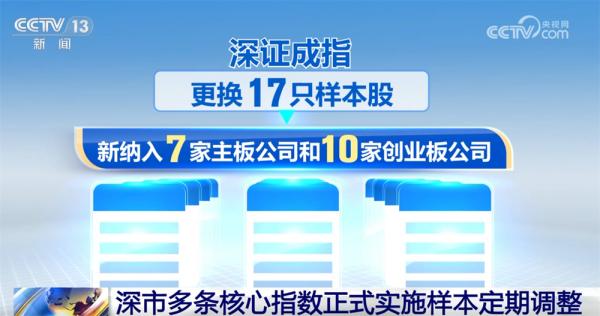
Core Insights - The recent adjustment of core indices in the Shenzhen market reflects a significant shift towards emerging industries, with the weight of strategic emerging industries in the ChiNext Index reaching 93% and 98% in the ChiNext 50 Index, highlighting a strong focus on sectors like artificial intelligence and semiconductors [3][5]. Group 1: Index Adjustments - The Shenzhen Stock Exchange announced a periodic adjustment of core indices, with the Shenzhen Component Index replacing 17 constituent stocks, including 7 from the main board and 10 from the ChiNext board [1]. - The Shanghai Stock Exchange also completed adjustments, with the SSE 50 Index changing 4 stocks, the SSE 180 Index changing 7, and the SSE 380 Index changing 38 stocks, indicating a comprehensive overhaul of the index system [1]. Group 2: Implications for Investors - The adjustments are expected to trigger significant reallocation of passive funds, with estimates suggesting over 100 billion yuan will be reallocated due to the changes in major indices [11]. - For index fund investors, the inclusion of new constituent stocks enhances the technological focus of their portfolios, allowing them to benefit from China's high-quality economic development [12]. Group 3: Market and Economic Significance - The adjustments serve as a market-driven incentive for listed companies to focus on their core businesses, innovate, and improve quality and returns, thereby attracting more medium to long-term capital [16]. - The changes in indices are seen as a calibration of the capital market's ability to serve the real economy, reflecting China's achievements in innovation-driven development [18][20].

山东能源新巨龙公司:百米井下铺就“无尘之路”
Qi Lu Wan Bao· 2025-12-15 07:21
"我们不仅要治标,更要治本。"该公司党委书记、董事长纪永虎指着新安装的全封闭控尘装置介 绍:"通过在转载点安装该装置,让煤尘无处可逃,从源头上就把它控制住。"在皮带机转载点这一最大 产尘源,团队摒弃传统局部防护思路,创新应用全封闭控尘装置,如同为奔腾的煤流搭建起一个个"透 明隧道",将扬尘彻底封锁在有限空间内,实现了从"被动降尘"到"源头控尘"的根本性转变。监测数据 显示,改造后转载点粉尘浓度由平均超100mg/m 降至8mg/m 以下,降尘效率高达92%。 针对胶带附着煤泥引发的二次扬尘,他们引入标准化分级清扫流程。在卸载点,弹簧式清扫器如"紧贴 的刷子"完成初步清理;在驱动与张紧段,"水冲式"清扫装置构筑两道坚固防线,通过一级冲刷、二次 精洗,确保煤泥"不进驱动、不出张紧"。实测数据表明,胶带表面残留煤泥量由每班15kg降至2kg以 内,清扫效率提升86%。 清理产生的煤泥水,经"水冲—挤压式"清扫器底部漏斗装置引入附近水沟,流入沉淀池后通过渣浆泵打 入压滤机处理。压滤后的煤泥重新回收进入运输系统,清水则沿水沟流入就近水仓,实现资源循环利 用。同时,机道内每隔200米安装一组全断面升降式自动喷雾装置,不仅 ...
博时基金陈显顺:中央经济工作会议释放积极信号,为“十五五”开局定向领航
Xin Lang Cai Jing· 2025-12-15 06:53
Core Viewpoint - The Central Economic Work Conference held on December 10-11 in Beijing outlines the economic work for 2026, emphasizing high-quality development to address uncertainties in the current economic landscape [1][8]. Group 1: Macroeconomic Policy - The conference signals a continuation of a more proactive fiscal policy and moderately loose monetary policy, enhancing the synergy of macroeconomic policies [1][2][3]. - Emphasis on "optimizing expenditure structure" and scientific management within fiscal policy aims to stabilize total demand while directing funds towards key areas such as technology innovation and public welfare [3][10]. - Monetary policy is set to remain "moderately loose," with flexibility in using various tools like reserve requirement ratio cuts and interest rate reductions to ensure adequate liquidity [3][10]. Group 2: Domestic Demand and Economic Structure - The conference prioritizes "expanding domestic demand" as a key task, reflecting a strategic decision to strengthen the internal economic drive amid rising external uncertainties [3][4][11]. - Key strategies for expanding domestic demand include stabilizing income, enhancing consumer confidence, optimizing supply, and promoting investment to create a virtuous cycle [4][11]. Group 3: Innovation and New Growth Drivers - Future growth drivers will focus on the integration of cutting-edge technology with industries, particularly in areas like artificial intelligence, new energy, and high-end manufacturing [5][11]. - The capital market is identified as a crucial element in nurturing new growth drivers, with a call for reforms to better support national innovation strategies [5][11]. Group 4: Reform and High-Quality Development - The conference highlights the need for reforms to eliminate "involutionary" competition and establish a unified national market, which is essential for enhancing economic vitality [6][12]. - Recommendations include setting high standards for market access and fair competition rules to guide enterprises in phasing out outdated capacities [12]. Group 5: International Cooperation and Investment Opportunities - China's opening up is shifting towards institutional openness, with future cooperation expected to focus on service trade, digital trade, and green low-carbon sectors [6][13]. - Investment opportunities are anticipated in domestic leading service enterprises, technology companies in digital trade, and firms in the renewable energy sector that can engage in international standard-setting [13].
盐城经开区新城街道:冲刺年底目标,大干实干补短板
Yang Zi Wan Bao Wang· 2025-12-15 04:24
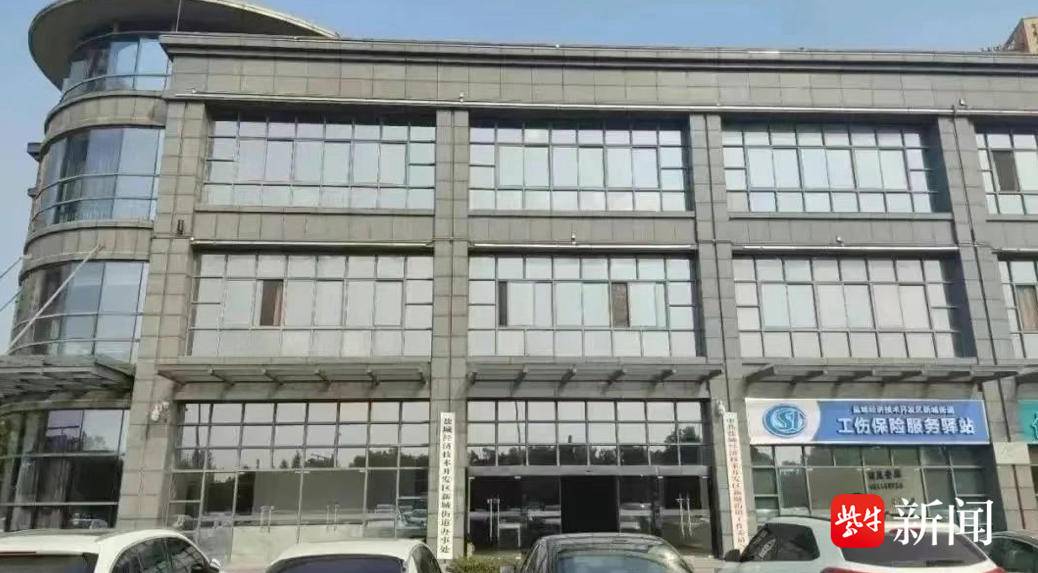
盐城市经济开发区新城街道党工委书记周姝姝表示,全区作风建设暨"大干两个月冲刺夺全年"动员大会凝聚共识、鼓足干劲,街道将紧扣"三新"要 求、抓实"三大"行动,以过硬作风冲刺全年目标,为"十五五"开局筑牢基础。 拼抢奋进抓落实,加速项目建设,全程代办亿元项目开工相关事宜,推动8个在手重点项目签约落地;筑牢安全防线,对18个商住小区1.3万户居民 开展消防安全"敲门入户"行动,组织秋冬季消防演习培训,普及"三清三关"知识;厚植民生福祉,依托就业服务站举办两场超300人招聘会及一期职 业培训,精准推进低保扩围、特殊困难人员复核等工作,织密民生兜底保障网。 通讯员:袁帆 扬子晚报/紫牛新闻记者周珉 今年以来,经开区新城街道锚定高质量发展方向,深化党建引领,统筹发展与安全,各项工作交出亮眼答卷。5项主要经济指标超序时进度或达区 调度目标,新签约亿元以上产业项目6.5个,其中4.5个通过市平台认定;圆满完成盐渎路北安置清零及盐渎路南正规户安置清零任务,6个安置小区 国企物业均顺利进场,民生保障与经济发展同步提质。 聚焦"十五五"发展,街道多点发力夯实根基。锤炼过硬作风强动能,扛牢主体责任,分层分类开展三轮大讨论,凝聚干部干 ...
学习贯彻中央经济工作会议精神·专家谈①丨张占斌:“必须充分挖掘经济潜能”具有鲜明的时代性
Sou Hu Cai Jing· 2025-12-15 04:15
Core Viewpoints - The urgency and strategic importance of tapping into economic potential are emphasized, highlighting the need for a comprehensive understanding of its multidimensional nature and key areas [3][4][5] Economic Potential - The current economic transition in China necessitates urgent exploration of potential, with external factors such as geopolitical conflicts and uncertain global demand impacting growth [5][6] - In 2024, China's GDP is projected to grow by 5.2%, with consumer spending contributing over 80% to economic growth, yet the consumption rate remains at 38.6%, indicating significant room for improvement [6][5] Key Areas for Potential Release - Domestic consumption is identified as a primary area for potential release, with 2024 retail sales expected to exceed 51 trillion yuan, but per capita consumption still lagging behind developed nations [8] - Investment potential is also crucial, with fixed asset investment expected to maintain stable growth, particularly in high-tech industries, which are projected to grow by 12.8% [8][9] Innovation and Industrial Upgrading - Innovation is recognized as a core engine for economic potential, with over 520,000 high-tech enterprises in 2024, necessitating support for enterprise-led innovation and improved technology transfer mechanisms [9][10] - The manufacturing sector's contribution to GDP remains stable, but there is a pressing need for advancements in high-end, intelligent, and green manufacturing [10] Reform and Market Dynamics - Continuous reform is essential for unlocking economic potential, with improvements in the business environment leading to a 53.5% share of private enterprises in total foreign trade [11] - Balancing government intervention and market forces is critical for effective resource allocation and stimulating market vitality [13] Systematic Support Framework - A comprehensive support system is required to ensure the effective release of economic potential, including policy coordination, legal frameworks, and risk management strategies [14][15] - The importance of fostering an open cooperation ecosystem is highlighted, with China's trade with Belt and Road Initiative countries accounting for 46.8% of total foreign trade in 2024 [15]
目标积极务实,政策提质增效,内需主导强化——2025年中央经济工作会议解读
Sou Hu Cai Jing· 2025-12-15 03:58
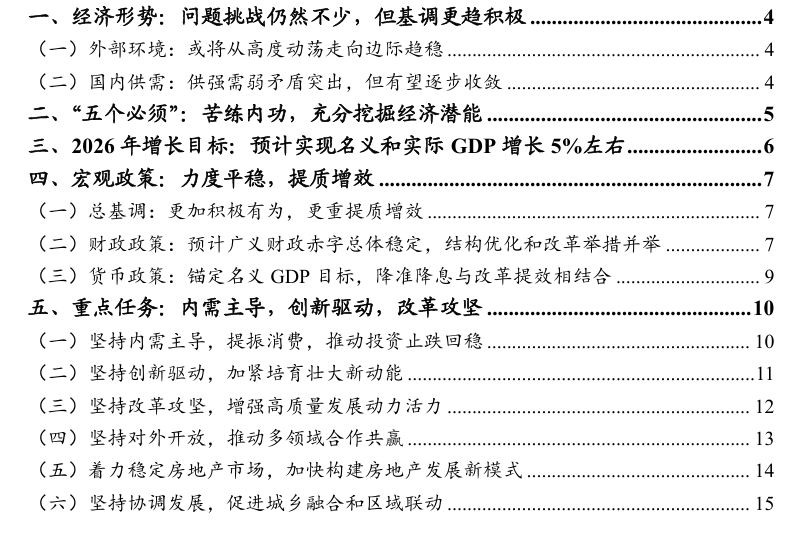
Economic Situation - The economic situation is characterized by persistent challenges, but the overall tone is becoming more positive. The external environment is expected to stabilize marginally, while domestic supply-demand imbalances are highlighted as significant issues [2][10][14]. Five Musts - The meeting outlined "Five Musts" to enhance economic potential, emphasizing the need for internal strengthening to address external challenges, and the importance of policy support and reform innovation [2][16][17]. 2026 Growth Target - The nominal and real GDP growth target for 2026 is set at around 5%. This target aligns with the need for a good start to the 14th Five-Year Plan and is slightly above the lower limit of the expected growth for the next decade [3][18][19]. Macro Policy - The macro policy framework is shifting from "promoting stability through growth" to "enhancing quality and efficiency," indicating a focus on structural optimization and effectiveness rather than just scale and intensity [4][22][25]. Fiscal Policy - The fiscal policy is expected to maintain a broad deficit rate of around 4%, with a focus on optimizing the expenditure structure and increasing investment in social welfare [4][26][28][29]. Monetary Policy - The monetary policy will continue to be moderately loose, with expectations for one rate cut and one reserve requirement ratio reduction in 2026. The focus will be on stabilizing nominal GDP and supporting key sectors [4][32][33][36]. Key Tasks - The emphasis is on domestic demand, innovation-driven growth, and reform efforts. Specific strategies include boosting consumption, stabilizing investment, and enhancing innovation capabilities [5][38][45]. Domestic Demand - The strategy prioritizes domestic demand, with a focus on increasing consumer income and optimizing supply. Retail sales growth is projected to recover to around 4.5% in 2026 [5][38][43]. Innovation - Innovation is positioned as a key task, with plans to strengthen the integration of education, technology, and talent development, and to establish major international technology innovation centers [5][45][46]. Reform - Key reforms will target the elimination of "involution" in competition, the clearing of overdue corporate debts, and the enhancement of the financial supply-side structure to support high-quality development [5][52][53][54]. Opening Up - The commitment to opening up remains strong, with a focus on expanding institutional openness and optimizing the business environment for foreign investment [5][55][56].
“八个坚持”拓开2026年中国经济大视野
Guo Ji Jin Rong Bao· 2025-12-15 03:12
Group 1: Macroeconomic Policy and Domestic Market - The core macroeconomic policy emphasizes a more proactive approach, focusing on quality and efficiency as key development themes, with the "Eight Persistences" as critical directives for economic work in the first year of the 14th Five-Year Plan [1] - Domestic demand has become the main driver of economic growth, contributing an average of 93.1% to economic growth from 2013 to 2024, highlighting the importance of a strong domestic market as a long-term strategy [2][3] Group 2: Innovation and New Growth Drivers - The necessity of innovation-driven growth is underscored, as new momentum is essential for future development and competitive positioning, requiring a systemic reshaping of production factors and business models [4][5] - The development of new momentum must support both high-end industries and traditional industry upgrades, creating high-quality employment and meeting the needs of the populace [5] Group 3: Reform and High-Quality Development - Continuous reform is essential to inject vitality into high-quality development, addressing deep-seated issues that have emerged due to changing development stages [6][7] - Emphasis on technological innovation as a key driver for high-quality development, necessitating a deep integration of innovation systems and breaking down institutional barriers [7] Group 4: Open Economy and International Cooperation - China aims for a higher level of openness, promoting multi-faceted cooperation to adapt to global economic changes and challenges, emphasizing the importance of collaborative networks in various fields [8][9] - The need for innovative cooperation mechanisms to address challenges posed by protectionism and geopolitical tensions is highlighted, focusing on quality and resilience in partnerships [9] Group 5: Coordinated Development and Urban-Rural Integration - The strategy of promoting coordinated development aims to address the growing disparities between urban and rural areas, emphasizing the need for a balanced and inclusive development approach [10][11] - Regional integration strategies like the Beijing-Tianjin-Hebei collaboration and the Yangtze River Economic Belt are examples of efforts to optimize resource allocation and promote high-quality regional economic layouts [11] Group 6: Green Transformation and Carbon Neutrality - The commitment to achieving carbon peak by 2030 and carbon neutrality by 2060 reflects China's responsibility in global climate governance and the need for a comprehensive green transformation [12][13] - Innovation is identified as the core engine for achieving carbon goals, requiring advancements in renewable energy, energy efficiency, and the establishment of supportive institutional frameworks [14] Group 7: Focus on People's Livelihood - The emphasis on prioritizing people's livelihoods reflects the increasing complexity of public demands, necessitating a responsive governance approach that addresses specific community needs [15][16] - Establishing long-term mechanisms to ensure sustainable improvements in public welfare is crucial, with a focus on resource allocation and social governance [16] Group 8: Risk Management - The need to manage risks in key areas such as real estate and local debt is highlighted, with a focus on maintaining stability while actively addressing potential threats [17][18] - A balanced approach to risk management is essential, combining immediate responses with long-term structural improvements to foster sustainable development [18]