光伏反内卷

Search documents
光伏反内卷点评:政策逐步落地,反内卷进入新阶段
Shenwan Hongyuan Securities· 2025-07-25 10:43
Investment Rating - The report rates the photovoltaic industry as "Overweight," indicating an expectation for the industry to outperform the overall market [2]. Core Insights - Recent policies reflect the central government's determination to combat "involution" in the photovoltaic sector, aiming to regulate market prices and prevent unfair competition [2]. - The manufacturing standards for polysilicon are being tightened, which is expected to control new capacity additions and promote the elimination of outdated production [2]. - The anticipated implementation of these policies is likely to trigger a new round of price increases in the industry, enhancing profit margins for companies involved [2]. - Recommended companies to watch include those benefiting most from the anti-involution measures, such as GCL-Poly Energy, Daqo New Energy, Tongwei Co., and TBEA [2]. Summary by Sections Policy Developments - The government is actively working on refining standards for identifying unfair pricing behaviors and low-price dumping, which is expected to stabilize the market [2]. - The proposed revisions to polysilicon energy consumption standards aim to lower the thresholds for energy efficiency, thus promoting better practices within the industry [2]. Market Outlook - The report suggests that the photovoltaic industry is poised for a recovery in pricing due to the recent policy changes, which are expected to eliminate price wars and restore profitability [2]. - The anticipated positive impact of these policies is already reflected in rising prices across the supply chain, indicating a shift in market sentiment [2]. Company Valuations - A table of key companies in the power equipment sector provides insights into their valuations, including metrics such as PB (Price to Book) and PE (Price to Earnings) ratios, highlighting the financial performance expectations for 2025 and beyond [3].
硅片7月涨20%、硅料期货更猛,控产力度将成后续出清关键
Di Yi Cai Jing· 2025-07-25 01:20
Core Viewpoint - The photovoltaic industry is currently following two main strategies: price increases and production limits, with price increases showing initial effectiveness while production control faces challenges [1][2][3]. Price Trends - Since July, prices across the photovoltaic supply chain have been rising, with silicon wafer prices increasing by at least 4.7% and a cumulative increase of over 20% within the month [2][3]. - The price of polysilicon futures has surged by 60% in July, while the spot price of silicon materials has approached 50,000 yuan per ton, reflecting a monthly increase of over 40% [2][3]. - The price of N-type G10L monocrystalline silicon wafers rose from 0.86 yuan per piece at the beginning of the month to 1.1 yuan per piece, marking a cumulative increase of 27.9% [3]. Regulatory Impact - The National Development and Reform Commission and the State Administration for Market Regulation have proposed amendments to the Price Law, aiming to clarify standards for identifying unfair pricing behaviors and regulate market price order [2][4]. - The proposed amendments are expected to help address "involution" competition within the photovoltaic sector by preventing sales below cost and promoting production capacity consolidation [4]. Market Sentiment and Demand - The current price increases are primarily driven by policy signals rather than substantial changes in supply and demand dynamics, as the output of silicon materials is expected to increase in the third quarter due to the resumption of production by some companies [4][5]. - Analysts predict a decline in global photovoltaic installation demand, with an expected decrease of 5% in new installations in 2025, and a domestic installation growth rate of approximately -10% [5][6]. Financial Health of Companies - The photovoltaic industry has been experiencing widespread losses, with many companies facing negative cash flow. Only a few companies have managed to reduce losses or achieve profitability through overseas markets and product iterations [6]. - The current situation necessitates a focus on production cuts to restore cash flow and prevent further asset depreciation, as the market anticipates a combination of policy implementation and industry self-discipline to help the sector recover [6].
光伏反内卷进展更新
2025-07-25 00:52
Summary of Key Points from the Conference Call on the Photovoltaic Industry Industry Overview - The photovoltaic (PV) industry is currently experiencing a shift towards "anti-involution," driven by factors such as near-capacity clearance, high policy attention, and relatively low valuations, indicating a high risk-reward ratio for investments in this sector [1][3][6] - The bottleneck in PV consumption is not due to insufficient grid construction but rather physical constraints, necessitating solutions through energy storage technology or new power system construction [1][4] Core Insights and Arguments - The current situation in the PV industry differs from the 2016 supply-side reform, characterized by lower specifications, high capital expenditure from private enterprises, and significant ongoing technological investments, making integration challenging [1][4] - Addressing inventory and on-site management issues is crucial for alleviating price pressures, as China dominates the global silicon material market, making overseas alternatives insufficient [1][7] - Future development in the PV sector will focus on enhancing utilization hours through integrated solar and storage solutions, aiming for stable power supply and reduced costs [1][8] Demand Challenges and Policy Implications - The PV industry faces demand challenges and consumption bottlenecks, with installed capacity reaching 1,050 GW compared to a peak load of 1,500 GW, highlighting the need for technological advancements in energy storage [4][5] - The anticipated "Green Electricity Direct Connection" policy aims to guide enterprises towards more efficient and stable power supply models through integrated wind, solar, and storage solutions [9] Price Fluctuations and Market Dynamics - Silicon material prices have seen significant fluctuations, with prices rising sharply following government interventions and market dynamics, indicating strong price support from leading enterprises [10] - The current inventory and management issues in the PV industry are more pressing than mere capacity concerns, with a focus on resolving these issues to mitigate price volatility [7] Future Outlook and Investment Opportunities - Despite facing challenges such as overcapacity and funding pressures, the long-term outlook for the PV industry remains optimistic, with potential market mechanisms leading to a natural clearing of the market [17] - Key segments likely to achieve market clearing include silicon materials, batteries, and glass, due to high capital expenditure requirements and rapid technological advancements [18] - Companies to watch in the silicon material sector include GCL-Poly and Tongwei, while battery and glass sectors may see opportunities with JunDa and Fuyao respectively [19] Conclusion - The anti-involution movement in the PV industry is gaining traction, with significant implications for future growth and stability, contingent on effective policy implementation and market adjustments [6][13]
光伏行业反内卷跟踪及展望
2025-07-23 14:35
Summary of the Photovoltaic Industry Conference Call Industry Overview - The photovoltaic (PV) industry is currently undergoing a recovery phase driven by self-discipline among companies and price stabilization efforts led by major players, resulting in a rapid restoration of prices across the supply chain [1][2][4] - In June, domestic PV installations reached 14.36 GW, remaining flat year-on-year, indicating the effectiveness of measures to curb low-price competition [1][4] Core Insights and Arguments - The primary strategies for addressing excessive low-price competition in the PV industry include price increases and production limits, with a focus on self-regulation and market-oriented approaches rather than blanket policies [2][8] - The price of polysilicon in the futures market has surged over 50% since the beginning of the month, with spot prices for N-type materials increasing by 28% to 29% and further rising by 12% to 13% in the following week [2][10] - Major polysilicon producers have stabilized their prices around 49,000 CNY/ton, benefiting from the upward price transmission effect throughout the supply chain [3][7] Long-term Outlook - Long-term price recovery in the PV industry will depend on improvements in supply-demand structure, requiring coordinated production cuts and storage strategies among leading companies [5][6] - Key factors influencing the future of the PV industry include further directives from higher authorities regarding anti-involution measures, progress on silicon material storage plans, and advancements in new technologies [6][8] Challenges and Strategies - The PV industry faces challenges such as supply-demand imbalances, price volatility, and technological iterations [8] - Effective strategies include promoting self-discipline among companies, implementing policy measures to guide price transmission, and focusing on new technologies like BC and Topcon 3.0 [8][9] Investment Focus - Investors are advised to concentrate on the polysilicon segment, which shows significant profit elasticity, and the glass segment, where leading companies have substantial market influence [14][15] - The demand for high-efficiency components continues to rise, with BC components expected to further reduce costs and improve efficiency [15] Historical Context - Historical analysis of previous cycles reveals that the current cycle's prolonged bottoming phase is due to rapid supply increases leading to oversupply, with polysilicon prices dropping by 88% from over 300,000 CNY to around 30,000 CNY [9][10] Recent Developments - Significant events include a central financial committee meeting that led to a surge in polysilicon futures prices and a coordinated effort among major producers to halt pricing below full costs, resulting in a notable increase in market sentiment [10][11] Current Market Position - The PV industry is currently characterized by low but concentrated holdings, with investors primarily focused on leading companies like Sungrow and LONGi [12][14]
电力设备行业周报:宇树启动上市辅导,光伏“反内卷”见效-20250721
Huaxin Securities· 2025-07-21 08:44
Investment Rating - The report maintains a "Recommended" rating for the electric equipment sector [20]. Core Insights - Yushu Technology has initiated IPO counseling, indicating a potential growth trajectory in the robotics sector, with a projected revenue exceeding 1 billion yuan in 2024 [5][17]. - The photovoltaic industry is experiencing a "reverse involution" effect, leading to price increases in silicon materials and wafers, with multi-crystalline silicon N-type materials averaging 41,700 yuan/ton, up 12.4% week-on-week [7][18]. - The report highlights the importance of supply-side reforms in the photovoltaic sector, with recommendations to focus on leading companies such as Tongwei Co., Ltd. and Aiko Solar [9][19]. Summary by Sections Yushu Technology and Robotics - Yushu Technology has completed counseling registration with the Zhejiang Securities Regulatory Bureau, with its CEO Wang Xingxing controlling 34.763% of the shares. The company is expected to be evaluated for IPO readiness between October and December [5][17]. - The company has achieved significant sales in quadruped and humanoid robots, with its flagship product, Unitree Go1, selling over 50,000 units, capturing over 60% of the global consumer quadruped robot market [5][17]. Photovoltaic Industry Dynamics - The domestic silicon material companies have adjusted their pricing strategies to be based on "not lower than full cost," leading to a significant increase in transaction volumes and prices [7][18]. - The average transaction price for multi-crystalline silicon N-type materials is reported at 41,700 yuan/ton, with a week-on-week increase of 12.4%, while N-type granular silicon averages 41,000 yuan/ton, up 15.2% [7][18]. - Silicon wafer prices have also risen significantly, with 183N wafers averaging 1.05 yuan/piece (up 22.09%), 210RN wafers at 1.15 yuan/piece (up 15.00%), and 210N wafers at 1.35 yuan/piece (up 13.45%) [8][19]. Investment Recommendations - The report suggests monitoring companies in the robotics supply chain, such as Obsidian Technology and Daotong Technology, as Yushu's market entry may boost these firms [9][19]. - For the photovoltaic sector, it recommends focusing on leading companies like Tongwei Co., Ltd. for silicon materials, and Fuyao Glass for photovoltaic glass, as well as Aiko Solar for new technologies [9][19]. Market Performance - The electric equipment sector saw a slight increase of 0.57%, ranking 14th among 28 sub-industries, underperforming compared to the Shanghai Composite Index and CSI 300 Index [40][41].
光伏行业周报(20250714-20250720):反内卷进程持续深化,主产业链价格呈现整体上调态势-20250721
Huachuang Securities· 2025-07-21 08:29
Investment Rating - The report maintains a "Buy" recommendation for the photovoltaic industry [1] Core Views - The ongoing process of reducing internal competition is leading to an overall increase in prices across the main industry chain [1][12] - The price of silicon materials and silicon wafers has significantly increased, with expectations for battery component prices to follow suit [11][12] - There is a growing expectation for supply-side reforms in the photovoltaic sector, which could improve industry supply and demand dynamics [12] Summary by Sections Price Trends in the Photovoltaic Industry - The average transaction price for N-type silicon materials has risen to 41,700 CNY/ton, a 12.4% increase week-on-week, while N-type granular silicon reached 41,000 CNY/ton, up 15.2% [1][11] - Silicon wafer prices are expected to increase, with current prices for N-type G10L at 1.45 CNY/piece, N-type G12R at 1.65 CNY/piece, and N-type G12 at 1.93 CNY/piece [1][11] Export Data - In the first half of 2025, battery component exports are estimated at approximately 177 GW, a year-on-year increase of 6%, with June exports at about 31 GW, up 8% year-on-year but down 7% month-on-month [1][13] - The total export value of battery components for the first half of 2025 is 95.37 billion CNY, a decrease of 24% year-on-year, with June's export value at 15.81 billion CNY, down 23% year-on-year and 9% month-on-month [1][13] - In June, inverter exports reached approximately 34 GW, a 14% increase year-on-year and a 13% increase month-on-month, with total export value for the first half of 2025 at 20.6 billion CNY, up 7% year-on-year [1][26] Market Performance - The overall industry index increased by 2.22%, while the photovoltaic equipment sector saw a decline of 2.01% [51][57] - Notable stock performances include Wenzhou Hongfeng with a 25.62% increase and Tuo Ri Xin Neng with an 18.16% decrease [58][60]
甘作光伏“坚守者”基金经理憧憬柳暗花明
Zhong Guo Zheng Quan Bao· 2025-07-15 20:57
Core Viewpoint - The photovoltaic sector is experiencing a recovery due to the "anti-involution" trend, with significant net value rebounds for actively managed equity funds focused on this industry [1][2]. Group 1: Fund Performance - Notable fund managers like Lu Bin and Zheng Chengran have seen their funds' net values recover significantly, with Lu Bin's funds achieving over 20% gains in a three-week period [2][3]. - From June 23 to July 14, Lu Bin's HSBC Jintrust Era Pioneer A fund recorded a net value increase of 23.10%, leading the active equity fund category [2]. - Other funds managed by Zheng Chengran also reported net value increases of over 10%, with significant holdings in leading photovoltaic companies [3]. Group 2: Industry Challenges and Adjustments - The photovoltaic industry is currently facing a phase of supply-demand imbalance and energy policy adjustments, indicating a deep adjustment phase [1][4]. - Leading companies in the photovoltaic sector are under pressure, with profitability across the industry being challenged and many companies operating at a loss [3][4]. - The industry is entering a consolidation phase, where less competitive capacities are expected to exit, leading to an optimized capacity structure and improved supply-demand dynamics [3][4]. Group 3: Future Outlook and Strategies - The industry is exploring various strategies for breakthrough, including new technologies and overseas channels, although these require time for validation [4]. - The Central Financial Committee has emphasized the need to regulate low-price competition and promote the exit of outdated capacities, positioning the "anti-involution" of the photovoltaic industry as a market focus [4][5]. - Analysts suggest that the recovery of industry chain prices is crucial for the "anti-involution" strategy, with a need for substantial improvement in market supply-demand relationships [5][6]. Group 4: Investment Opportunities - Companies transitioning to the energy storage sector, those with healthy balance sheets, and segments like silicon materials are expected to benefit from the ongoing supply-side reforms [6]. - The photovoltaic sector is anticipated to see a solidification of its fundamentals, with a focus on companies that demonstrate long-term competitiveness and price recovery elasticity [6].




中金:硅料报价大幅上涨 供给侧改革拐点渐行渐近
Zhi Tong Cai Jing· 2025-07-15 05:51
Core Viewpoint - The recent increase in silicon material prices indicates a potential turning point in the photovoltaic industry's supply-side reform, with a focus on the silicon material segment as the first to reflect changes [1][3]. Group 1: Silicon Material Price Trends - Silicon material prices have shown a continuous upward trend in July, with current average prices rising to 40-50 yuan per kilogram, an increase of 25-35% [1][2]. - The average price of various types of silicon materials in June was approximately 5% lower than in May due to demand front-loading from the current photovoltaic installation surge [2]. Group 2: Supply and Demand Dynamics - The production data for July indicates a silicon material output of 109,000 tons, which is higher than the output of silicon wafers, suggesting that the supply-demand relationship has not yet significantly improved [2]. - The acceptance of rising silicon material prices by downstream sectors remains uncertain, as current price increases are reflected more in quotes than in actual transaction prices [2]. Group 3: Government and Industry Response - The government's increased focus on combating low-price bidding and promoting high-quality development in the photovoltaic sector is expected to reshape the supply structure in the silicon material segment [3]. - The restructuring of the silicon material industry is anticipated to involve a selection process based on financial strength, cost management, and product quality among manufacturers [3].


产业链价格逐步进入正反馈,重视光伏反内卷投资机会
2025-07-15 01:58
Summary of Key Points from the Conference Call Industry Overview - The conference call focuses on the photovoltaic (PV) industry, specifically discussing the current state and future expectations of the solar supply chain [1][2][3]. Core Insights and Arguments - **Price Recovery**: The PV supply chain has seen significant price fluctuations, with polysilicon prices recovering from a low of around 30,000 yuan to over 45,000 yuan, indicating a strong investment opportunity [2][3]. - **Material Price Increases**: There has been a notable increase in raw material prices, with silicon material prices rising to nearly 40,000 yuan and silicon wafer prices increasing by over 10% [1][3]. - **Inventory Dynamics**: The upstream silicon material inventory is relatively high, while silicon wafer inventory is low, suggesting a potential supply-demand imbalance [3][11]. - **Government Intervention**: The central government is expected to implement specific anti-involution policies by the end of Q3, focusing on price limits, production caps, and storage measures [1][5][6]. - **Industry Self-Regulation**: Leading silicon material companies plan to collaborate on storage initiatives to stabilize prices, reflecting a commitment to self-regulation within the industry [5][8]. Additional Important Content - **Market Sentiment**: The current market sentiment is cautious but optimistic, with expectations that the anti-involution policies will differ significantly from previous years due to stronger government backing [2][6][9]. - **Investment Recommendations**: Investors are advised to closely monitor price changes in raw materials and consider allocating investments to leading companies across the supply chain, as there is substantial room for stock price recovery compared to last year's highs [7][12]. - **Demand Outlook**: Despite a potential decline in demand in June, the overall impact on company performance is not expected to be severe, especially for leading companies with high overseas revenue [10][11]. - **Production and Capacity**: Current silicon material inventory is estimated at 270,000 to 300,000 tons, with production figures for polysilicon and silicon wafers showing fluctuations but generally indicating a stable supply chain [11]. Conclusion - The photovoltaic industry is at a critical juncture with potential for recovery driven by government policies and market dynamics. Investors are encouraged to focus on leading companies and monitor raw material prices closely to capitalize on emerging opportunities.
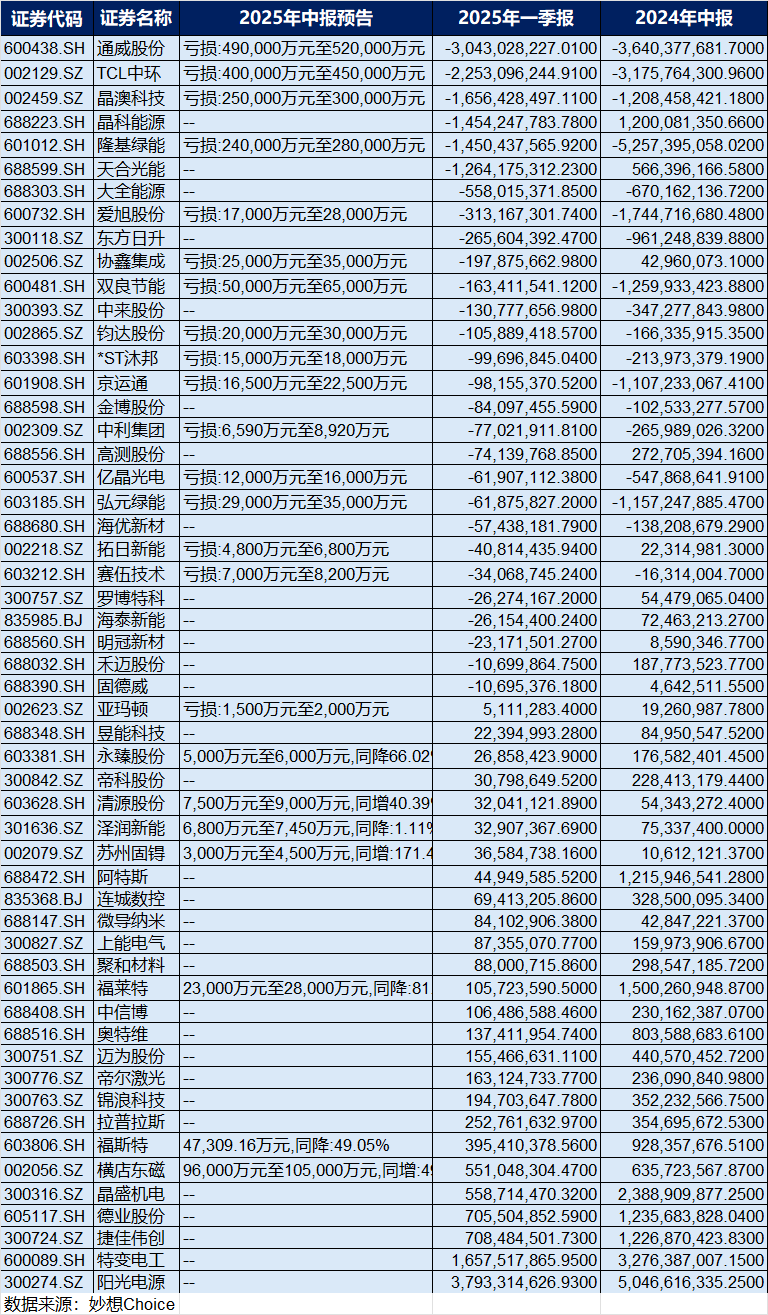
光伏企业的中期业绩预告,透露出怎样的趋势和规律?
Tai Mei Ti A P P· 2025-07-15 00:29
Core Viewpoint - The performance of photovoltaic material companies in the first half of 2025 is deteriorating, with significant losses reported across the sector, indicating that the industry is struggling to recover on its own [1][6][11]. Financial Performance Summary - A total of 24 photovoltaic companies have released their mid-year performance forecasts, with 13 out of 14 major material companies reporting losses [6][11]. - Notable losses include: - Tongwei Co., Ltd.: Expected loss of 4.9 billion to 5.2 billion CNY [1] - TCL Zhonghuan: Expected loss of 4 billion to 4.5 billion CNY [1] - JA Solar: Loss doubled compared to the previous year, with no improvement from the first quarter [9] - Longi Green Energy: Significant reduction in losses year-on-year, but no improvement from the first quarter [9] - Aiko Solar: Achieved profitability in the second quarter, attributed to innovative product offerings and market segmentation [9][10]. Industry Challenges - The photovoltaic industry is facing severe challenges, with increasing competition and financial pressures leading to widespread losses [11][12]. - The industry is characterized by high leverage, particularly among leading companies, making recovery difficult [11]. - The government is urged to implement measures to reduce excess capacity and enforce strict standards to prevent further deterioration of the industry [12][13]. Recommendations for Recovery - Suggestions include reducing polysilicon production capacity by half and halting expansions across all photovoltaic capacities [12][13]. - Establishing a unified standard system for product quality, energy consumption, and carbon emissions is essential to avoid quality issues in the future [13].