
市场流动性

Search documents
“大战正酣、岂言退兵!”基金抱团白马开始松动?最新调研明星私募:有人减仓,有人怒吼“不讲武徳”…
Zheng Quan Shi Bao Wang· 2025-08-01 07:26
Core Viewpoint - The A-share market has experienced significant volatility and divergence, with nearly 80% of stocks declining, particularly in the liquor and new energy sectors, indicating a potential shift in market dynamics and investor sentiment [1][3]. Market Performance - On January 11, the Shanghai Composite Index fell by 1.08%, the Shenzhen Component Index by 1.33%, and the ChiNext Index by 1.84%, with 3,311 out of 4,148 companies declining, representing 79.82% of the market [3]. - Notably, several heavily held stocks by funds, including Wuliangye, Longi Green Energy, and CATL, saw declines exceeding 3% [5]. Fund Holdings and Adjustments - Among the top 20 A-share companies by public fund holdings, 11 companies experienced declines on January 11, while Hikvision saw a significant increase of over 20% in just over a week [5][7]. - Large private equity firms generally maintain high positions, with some expressing optimism about selected industries despite recent market fluctuations [8]. Investment Strategies - Some private equity firms have reduced their positions in previously popular stocks, citing concerns over valuation levels, particularly in the new energy sector [14]. - A notable strategy involves a "barbell" approach, focusing on both reasonably valued growth stocks in the internet and consumer sectors and undervalued blue-chip stocks benefiting from cyclical recovery [10]. Market Outlook - The consensus among private equity firms is to lower investment expectations for 2021, with a focus on structural investment opportunities rather than broad market indices [13]. - The market is expected to remain volatile, driven by liquidity changes and the performance of core companies in consumer, pharmaceutical, and technology sectors [12][13].

流动性日报:市场流动性概况-20250801
Hua Tai Qi Huo· 2025-08-01 06:07
Report Summary 1. Report Industry Investment Rating No relevant content provided. 2. Core View The report presents the market liquidity overview of various sectors on July 31, 2025, including trading volume, holding amount, and trading - holding ratio, along with their changes compared to the previous trading day [1][2]. 3. Summary by Directory I. Plate Liquidity - The report shows multiple figures related to plate liquidity, such as the trading - holding ratio, trading volume change rate, holding volume, holding amount, trading volume, and trading amount of each plate, with data sources from Flush and Huatai Futures Research Institute [4][8] II. Stock Index Plate - On July 31, 2025, the stock index plate had a trading volume of 751.635 billion yuan, a +12.67% change from the previous trading day; the holding amount was 1138.644 billion yuan, a -2.24% change; the trading - holding ratio was 65.46%. There are also figures showing the rise - fall rate, trading - holding ratio, precipitation fund change, precipitation fund trend, trading amount change, and the top 20 net holding ratio trend of each variety in the stock index plate [1][5] III. Treasury Bond Plate - The trading volume of the treasury bond plate was 411.459 billion yuan, a -20.52% change; the holding amount was 867.472 billion yuan, a -1.07% change; the trading - holding ratio was 48.36%. Figures display the rise - fall rate, trading - holding ratio, precipitation fund change, precipitation fund trend, trading amount change, and the top 20 net holding ratio trend of each variety in the treasury bond plate [1][5] IV. Basic Metals and Precious Metals (Metal Plate) - The basic metals plate had a trading volume of 603.644 billion yuan, a +4.67% change; the holding amount was 491.372 billion yuan, a -5.10% change; the trading - holding ratio was 143.13%. The precious metals plate had a trading volume of 439.339 billion yuan, a +40.27% change; the holding amount was 440.018 billion yuan, a -0.95% change; the trading - holding ratio was 140.02%. Figures show the rise - fall rate, trading - holding ratio, precipitation fund change, precipitation fund trend, trading amount change rate, and the top 20 net holding ratio trend of each variety in the metal plate [1][5] V. Energy and Chemical Plate - The trading volume of the energy and chemical plate was 510.154 billion yuan, a -14.65% change; the holding amount was 419.437 billion yuan, a -2.55% change; the trading - holding ratio was 110.68%. Figures present the rise - fall rate, trading - holding ratio, precipitation fund change, precipitation fund trend, trading amount change rate, and the top 20 net holding ratio trend of the main varieties in the energy and chemical plate [1][5] VI. Agricultural Products Plate - The trading volume of the agricultural products plate was 323.950 billion yuan, a -3.95% change; the holding amount was 568.175 billion yuan, a -1.57% change; the trading - holding ratio was 52.80%. Figures show the rise - fall rate, trading - holding ratio, precipitation fund change, precipitation fund trend, trading amount change rate, and the top 20 net holding ratio trend of the main varieties in the agricultural products plate [1][5] VII. Black Building Materials Plate - The trading volume of the black building materials plate was 546.968 billion yuan, a -28.62% change; the holding amount was 378.365 billion yuan, a -6.52% change; the trading - holding ratio was 144.74%. Figures display the rise - fall rate, trading - holding ratio, precipitation fund change, precipitation fund trend, trading amount change rate, and the top 20 net holding ratio trend of each variety in the black building materials plate [2][5]
爆发式增长!港股公司掀起再融资热潮,今年金额已近1700亿港元
Zheng Quan Shi Bao· 2025-07-31 11:45
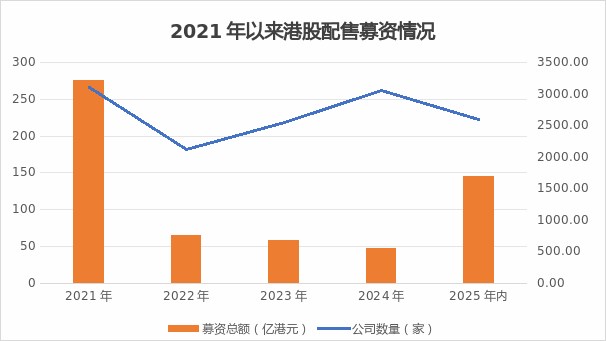
Core Viewpoint - The Hong Kong stock placement market is expected to experience explosive growth in 2025, driven by ample liquidity, valuation recovery, and corporate strategic expansion needs [1] Fundraising Overview - Hong Kong listed companies have raised nearly 170 billion HKD through placements this year, significantly surpassing the same period last year and exceeding the total for 2024 [1][3] - 223 Hong Kong listed companies have completed placements this year, raising a total of 169.83 billion HKD, which represents a 419.09% increase compared to the same period last year [3] - 67 companies have announced placement plans but have not yet implemented them, with a total planned fundraising amount of approximately 259.69 billion HKD [5][6] Notable Companies and Amounts - BYD Company Limited has raised the highest amount through placements this year, totaling 43.51 billion HKD, accounting for 25.62% of the total refinancing scale for 2025 [5] - WuXi AppTec plans to raise 7.38 million H-shares at a price of 104.27 HKD per share, aiming for a total of approximately 76.95 billion HKD, with 90% allocated for global expansion and capacity building [2][5] Market Dynamics - The historical peaks of placements in the Hong Kong market typically occur during periods of ample liquidity and relatively high valuations [7] - The current market environment has improved liquidity and valuation levels, providing a favorable backdrop for corporate refinancing [7] - The sectors leading in fundraising include new energy, internet, artificial intelligence, and biomedicine, with companies focusing on significant R&D investments and business expansion [7] Future Expectations - The Hong Kong stock exchange is expected to continue optimizing listing and refinancing mechanisms, enhancing market efficiency and attractiveness [8] - The estimated additional fundraising for the second half of the year is projected to be between 150 billion and 200 billion HKD [8]


最高60%!适用10至50港元股票和衍生品 港股交易最低报价即将下调
Di Yi Cai Jing· 2025-07-31 03:30
Core Viewpoint - The Hong Kong Stock Exchange (HKEX) is set to reduce the minimum price fluctuation unit for securities trading, with a maximum reduction of 60%, aimed at enhancing market liquidity and trading efficiency [1][2][3] Summary by Relevant Sections Minimum Price Fluctuation Unit Adjustment - Starting from August 4, the minimum price fluctuation unit for securities will be adjusted in phases. For securities priced between HKD 10 and 20, the minimum fluctuation will decrease from HKD 0.02 to HKD 0.01 (a 50% reduction). For those priced between HKD 20 and 50, it will drop from HKD 0.05 to HKD 0.02 (a 60% reduction) [2][5] - This adjustment applies to stocks, Real Estate Investment Trusts (REITs), and equity warrants [2] Market Liquidity and Trading Efficiency - The HKEX aims to improve market liquidity through this adjustment, making it easier for orders to be executed at expected prices and aligning trading prices closer to the actual value of stocks [1][4] - The average daily trading volume in the Hong Kong stock market reached HKD 240.2 billion in the first half of 2025, reflecting a 118% increase compared to the same period last year [3] Impact on Market Participants - Industry experts believe that the reduction in the minimum price fluctuation unit will lower trading costs and enhance efficiency, potentially attracting more quantitative funds into the market [4] - However, there are concerns that traders relying on small price differences for arbitrage may exit the market due to reduced profit margins, which could negatively impact overall market liquidity [1][7] Future Phases of Adjustment - A second phase of adjustments is planned for securities priced between HKD 0.5 and 10, which will see a 50% reduction in the minimum price fluctuation unit, expected to be implemented next year [2][5]


最高60%!适用10至50港元股票和衍生品,港股交易最低报价即将下调
Di Yi Cai Jing· 2025-07-31 03:28
2025年上半年港股日均成交额已达2402亿港元,同比增长118%。 港股证券的最小有效报价单位,即将迎来下调,最高下调幅度达到60%。 香港交易所宣布,自8月4日起将分阶段调整证券市场最小价格变动单位,首阶段调整涉及10至50港元区间的股票及相 关产品。 根据新规,10至20港元证券的最低上落价位将从0.02港元下调至0.01港元,20至50港元证券则从0.05港元降至0.02港 元,调整幅度分别达50%和60%。 这是港交所继2023年成立促进股票市场流动性专责小组后,推出的又一重要举措,旨在通过缩小价差提升市场流动性 和交易效率。港交所数据显示,2025年上半年,港股日均成交额已达2402亿港元,较去年同期增长118%。 业内人士认为,此次调整将使订单更易在预期价格内成交,同时让交易价格更贴近股票实际价值,有望进一步增强市 场流动性。同时,让高频交易的冲击成本降低,未来市场或迎来更多量化资金。 不过,也有市场参与者担忧,新规实施后依赖微小价差套利的"爬格仔"投资者,可能因利润空间压缩而被迫离场,从 而不利于市场流动性。 10—50港元证券最低下调六成 根据披露,第一阶段,价格范围位于10港元至20港元、 ...
华泰期货流动性日报-20250730
Hua Tai Qi Huo· 2025-07-30 02:56
Group 1: Report Core Information Report Industry Investment Rating - Not available Report's Core View - The report presents the market liquidity situation of various sectors on July 29, 2025, including trading volume, holding amount, trading - holding ratio, and their changes compared to the previous trading day [1][2] Summary According to the Directory 1. Plate Liquidity - The report provides figures on the trading - holding ratio, trading volume change rate, holding amount, and trading volume of each sector, with data sourced from Flush and Huatai Futures Research Institute [1][2][8] 2. Stock Index Plate - On July 29, 2025, the trading volume of the stock index plate was 516.437 billion yuan, a +1.60% change from the previous trading day; the holding amount was 1114.401 billion yuan, a -1.66% change; the trading - holding ratio was 46.26% [1] 3. Treasury Bond Plate - The trading volume of the treasury bond plate was 447.828 billion yuan, a +1.57% change from the previous trading day; the holding amount was 884.54 billion yuan, a -0.13% change; the trading - holding ratio was 51.07% [1] 4. Basic Metal and Precious Metal (Metal Plate) - The basic metal plate had a trading volume of 509.297 billion yuan, a -25.69% change from the previous trading day; the holding amount was 498.898 billion yuan, a -1.77% change; the trading - holding ratio was 132.69%. The precious metal plate had a trading volume of 313.997 billion yuan, a -33.49% change; the holding amount was 441.909 billion yuan, a -0.48% change; the trading - holding ratio was 80.00% [1] 5. Energy and Chemical Plate - The trading volume of the energy and chemical plate was 530.505 billion yuan, a -32.14% change from the previous trading day; the holding amount was 422.522 billion yuan, a -1.02% change; the trading - holding ratio was 109.79% [1] 6. Agricultural Product Plate - The trading volume of the agricultural product plate was 357.736 billion yuan, a -14.15% change from the previous trading day; the holding amount was 575.184 billion yuan, a -0.88% change; the trading - holding ratio was 55.48% [1] 7. Black Building Materials Plate - The trading volume of the black building materials plate was 585.449 billion yuan, a -33.29% change from the previous trading day; the holding amount was 394.971 billion yuan, a +2.84% change; the trading - holding ratio was 151.20% [2]
流动性7月第4期:7月IPO金额提升,南向、融资流入医药
Yong Xing Zheng Quan· 2025-07-29 12:51
Core Insights - The report indicates an increase in IPO amounts in July, with significant net inflows from southbound funds and financing into the pharmaceutical sector [1][4][34]. Macro Liquidity - Domestic: During the week of July 21-25, the yields on 2-year and 10-year government bonds rose, with the 10-year and 2-year bond yield spread widening. The central bank's net injection in the open market was 109.5 billion yuan, and the MLF net injection was 100 billion yuan [2][12]. - International: The 2-year U.S. Treasury yield increased while the 10-year yield decreased, leading to a decline in the dollar index. As of July 25, the spread between Chinese and U.S. 10-year government bonds narrowed to -2.67% [2][16][17]. Market Liquidity Public Funds - In July 2025, 110 new funds were established, with 62 being equity funds, totaling approximately 28.3 billion units issued [3][22]. ETF Funds - 35 new ETF funds were established in July 2025, with 25 being equity ETFs, totaling 11 billion units issued [3][25]. Southbound Funds - Significant net inflows were observed in southbound funds, with a total net inflow of 765.4 billion yuan year-to-date as of July 25 [3][34]. Margin Financing - The average financing purchase amount was 190 billion yuan, a 27.7% increase from the previous week, with notable net inflows in the non-ferrous metals and pharmaceutical sectors [4][42]. Fundraising - In July, there were 6 IPOs raising approximately 23.3 billion yuan, with total equity financing of about 60.7 billion yuan [4][46]. Sector Analysis - The non-bank financial sector saw the largest net inflow of 10.42 billion yuan, followed by pharmaceuticals and computers, totaling approximately 17 billion yuan [3][36].
市场流动性再起波澜,30年国债ETF(511090)连续6天净流入,最高单日“吸金”14.45亿元
Sou Hu Cai Jing· 2025-07-29 05:18
Core Viewpoint - The 30-year Treasury ETF has shown significant growth in trading volume and net inflows, indicating a positive market sentiment and liquidity support from the People's Bank of China [1][2]. Group 1: Trading Activity - As of July 29, 2025, the 30-year Treasury ETF's latest price is 122.59 yuan, with a turnover rate of 27.2% and half-day trading volume of 5.94 billion yuan, reflecting active market trading [1]. - The average daily trading volume for the past week reached 9.96 billion yuan [1]. Group 2: Fund Size and Inflows - The latest size of the 30-year Treasury ETF has reached 21.896 billion yuan, marking a new high since its inception [1]. - The ETF's latest share count is 17.8 million shares, also a record high since its establishment [1]. - Over the past six days, the ETF has experienced continuous net inflows, with a peak single-day net inflow of 1.445 billion yuan, totaling 3.961 billion yuan in net inflows, averaging 660 million yuan per day [1]. Group 3: Monetary Policy and Market Sentiment - The People's Bank of China announced a fixed-rate reverse repurchase operation of 495.8 billion yuan, achieving a net injection of 325.1 billion yuan into the market [1]. - Analysts predict that the People's Bank of China will continue to implement significant net liquidity injections before the end of the month to stabilize market expectations [1][2]. - The increase in reverse repos is aimed at calming market sentiment in the bond market, which has been affected by rising interest rates since mid-July [2].
华泰期货流动性日报-20250725
Hua Tai Qi Huo· 2025-07-25 07:05
1. Report Industry Investment Rating - Not provided in the content 2. Core View of the Report - The report presents the market liquidity situation on July 24, 2025, including the trading volume, holding amount, trading - holding ratio, and their changes compared with the previous trading day for various sectors such as the stock index, treasury bonds, basic metals, precious metals, energy and chemical, agricultural products, and black building materials [1][2] 3. Summary by Relevant Catalog I. Plate Liquidity - There are figures showing the trading - holding ratio, trading volume change rate, holding amount, and other data of each plate [5][8] II. Stock Index Plate - On July 24, 2025, the stock index plate had a trading volume of 572.714 billion yuan, a 7.90% decrease from the previous trading day; the holding amount was 1149.608 billion yuan, a 1.65% increase; the trading - holding ratio was 49.83% [1] III. Treasury Bond Plate - On July 24, 2025, the treasury bond plate had a trading volume of 527.757 billion yuan, a 2.36% decrease from the previous trading day; the holding amount was 908.774 billion yuan, a 0.69% increase; the trading - holding ratio was 58.15% [1] IV. Basic Metals and Precious Metals (Metal Plate) - Basic metals: On July 24, 2025, the trading volume was 790.139 billion yuan, a 3.20% decrease from the previous trading day; the holding amount was 537.2 billion yuan, a 3.13% increase; the trading - holding ratio was 191.19% [1] - Precious metals: On July 24, 2025, the trading volume was 569.421 billion yuan, a 17.45% increase from the previous trading day; the holding amount was 469.493 billion yuan, a 4.46% decrease; the trading - holding ratio was 146.66% [1] V. Energy and Chemical Plate - On July 24, 2025, the energy and chemical plate had a trading volume of 719.87 billion yuan, a 4.22% increase from the previous trading day; the holding amount was 431.49 billion yuan, a 0.37% increase; the trading - holding ratio was 157.51% [1] VI. Agricultural Products Plate - On July 24, 2025, the agricultural products plate had a trading volume of 397.076 billion yuan, a 1.34% increase from the previous trading day; the holding amount was 589.056 billion yuan, a 0.77% decrease; the trading - holding ratio was 63.82% [1] VII. Black Building Materials Plate - On July 24, 2025, the black building materials plate had a trading volume of 660.066 billion yuan, a 4.44% increase from the previous trading day; the holding amount was 393.851 billion yuan, a 1.87% increase; the trading - holding ratio was 160.90% [2]
MLF净投放“续航” 保障流动性充裕
Zhong Guo Zheng Quan Bao· 2025-07-24 21:08
Group 1 - The People's Bank of China (PBOC) will conduct a 400 billion MLF operation on July 25, 2025, to maintain ample liquidity in the banking system, marking the fifth consecutive month of increased MLF operations [1] - In July, the total net liquidity injection reached 300 billion, combining a 200 billion reverse repo and a 1000 billion net MLF injection, indicating a sustained net injection of liquidity [2] - The current liquidity situation is characterized as structurally imbalanced, with the PBOC's actions aimed at optimizing the liquidity structure and supporting the real economy [2] Group 2 - Experts anticipate that MLF operations will continue to exceed expectations in the coming phase, with the PBOC likely to employ various monetary policy tools to ensure liquidity remains abundant [3] - The overall trend for MLF in the second half of the year is expected to maintain an increasing momentum, which will enhance banks' lending capabilities and support the real economy [3] - There is a possibility of further reserve requirement ratio (RRR) cuts in the third and fourth quarters, as the PBOC assesses the effectiveness of previous policies [3]