
汽车电动化

Search documents
针对隐藏式车门把手安全问题,工信部出手了!
证券时报· 2025-05-10 00:22
《汽车车门把手安全技术要求》强制性国家标准项目建议书中提到了—— 该标准将填补对隐藏式车门内把手等规范不足的空白。 聚焦潜在逃生、救援风险 记者从工业和信息化部获悉,针对隐藏式车门把手在实际应用过程中暴露出来的一些问题, 工业和信息化部公 开征集对《汽车车门把手安全技术要求》强制性国家标准制修订计划项目的意见,截止日期为2025年6月7日 。 新标准的修订具有重要意义 专家表示,随着汽车电动化、智能化的快速发展,市场上的车门把手产品呈现出工作原理、形式多样化趋势,在市 场应用过程中暴露出多种问题: 强度不足、控制逻辑潜在安全风险、识别操作难(隐蔽无标志)、断电失效、夹手 等,潜在逃生、救援风险 。比如:碰撞、起火等事故中,造成断电现象,使电动式外门把手、电动式车门内把手失 效,增大救援及逃生阻碍。 汽车应急式车门内把手的安装要求 隐藏式车门内把手和应急式车门内把手的标志要求 电动式车门外把手的防夹要求与试验方法 车门外把手和车门内把手的强度要求与试验方法 电动式车门把手的动态试验要求与试验方法 从救援逃生角度,强化汽车车门外把手在碰撞以及车辆起火等事故场景的安全逻辑, 增加机械或者断电保护 等安全冗余设计要求 ...


中国汽研: 临2025-027 中国汽研关于接待投资者调研情况的公告
Zheng Quan Zhi Xing· 2025-05-09 11:01
Summary of Key Points Core Viewpoint - The company, China Automotive Engineering Research Institute Co., Ltd. (China Automotive Research), is actively engaging with investors to enhance understanding of its operational strategies and future plans, particularly in the context of the evolving automotive industry towards electrification, intelligence, connectivity, and low-carbon initiatives [1][2]. Group 1: Investor Communication and Engagement - The company held an investor communication meeting on May 9, 2025, in Chongqing to discuss its operational status and strategic execution for 2024 and the first quarter of 2025 [1]. - Various securities firms and investment management companies participated in the meeting, indicating a broad interest from the investment community [1]. Group 2: Industry Trends and Company Positioning - The automotive industry is undergoing significant changes due to the "new four modernizations" (electrification, intelligence, connectivity, and low-carbon), prompting testing institutions to shift from traditional compliance testing to new technology research and testing [2]. - China Automotive Research has a long history and is one of the earliest institutions to obtain regulatory testing qualifications, accumulating extensive experience in testing services and product development [3]. Group 3: Service Capabilities and Market Strategy - The company is enhancing its service capabilities by focusing on three main technical lines: safety, green technology, and user experience, while increasing R&D investment [3]. - It has established a comprehensive service capability that includes development, testing, certification, evaluation, and after-sales services, effectively addressing pain points in product development for automotive enterprises [3]. Group 4: Environmental and Health Initiatives - The company has launched the China Automotive Health Index and services in the "dual carbon" field, focusing on carbon emission accounting and green low-carbon assessments [4]. - The company is actively involved in setting new emission standards and expanding its capabilities in environmental testing, despite a slight decline in the overall market for automotive emission testing due to the rise of electric vehicles [4]. Group 5: Infrastructure Development and Internationalization - The construction of the East China headquarters is nearing completion, with 90% of equipment procurement achieved, expected to be operational by the end of 2025 [5]. - The company is focusing on internationalization, aiming to provide comprehensive quality technical services to support Chinese automotive enterprises in their global operations [5][6]. Group 6: Hydrogen Energy Initiatives - The National Hydrogen Energy Power Quality Inspection and Testing Center commenced operations in January 2024, providing testing services across the hydrogen energy industry chain [6][7]. - The company is developing hydrogen-related detection equipment and core components, with plans to expand into various hydrogen energy applications, including hydrogen power generation and storage [7].

确保断电、碰撞等险情下车门可打开!工信部出手整顿汽车隐形门把手
Hua Xia Shi Bao· 2025-05-09 10:48
Core Viewpoint - The Ministry of Industry and Information Technology (MIIT) of China is soliciting public opinions on the draft of a mandatory national standard for "Automotive Door Handle Safety Technical Requirements," aiming to enhance safety performance and ensure the standard reflects industry needs and technological trends [2] Group 1: Industry Trends - The popularity of hidden door handles in electric vehicles (EVs) is driven by design aesthetics, aerodynamic optimization, and competitive differentiation among automakers [3][4] - Among 14,341 models on the AutoHome platform, 1,578 models feature hidden door handles, with 74% being new energy vehicles, indicating a strong trend towards this design [4] - Hidden door handles can reduce vehicle drag coefficient by 0.01 to 0.03 Cd, which is significant for EVs where every kilometer of range matters [4][5] Group 2: User Experience and Safety Concerns - Despite their aesthetic and aerodynamic advantages, hidden door handles pose safety risks, including failure in extreme weather conditions and during accidents, which can delay rescue efforts [5][6] - Incidents have been reported where electric door handles failed to operate during emergencies, leading to tragic outcomes, highlighting the need for improved safety measures [6][7] - The reliance on electronic control systems for hidden door handles can lead to vulnerabilities in critical situations, contrasting with traditional mechanical handles [7] Group 3: Regulatory Response - The MIIT's new standard focuses on three core areas: mechanical redundancy for emergency access, standardized emergency device visibility, and strength testing for extreme conditions [8] - The standard emphasizes "anti-misoperation" design to prevent accidental activation of door handles during vehicle rollovers, reflecting a proactive approach to safety [8] - The evolution of hidden door handles symbolizes the automotive industry's shift from mechanical products to intelligent terminals, balancing engineering, marketing, and user experience [8]
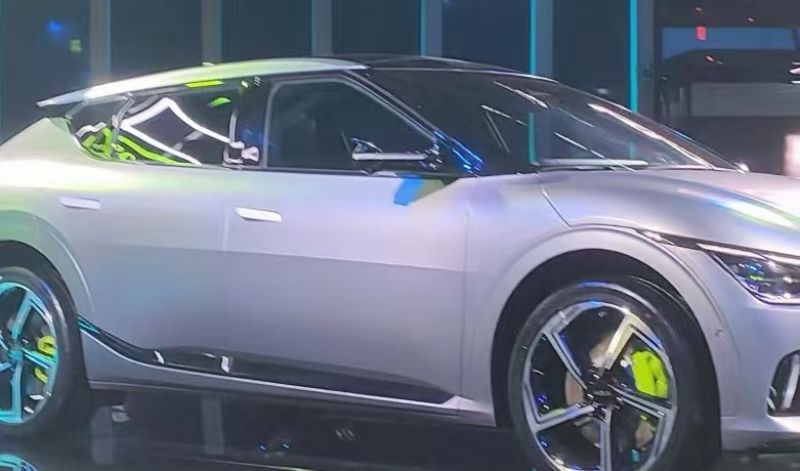
强化事故场景安全逻辑,工信部出手整顿隐藏式车门把手
Zhong Guo Jing Ji Wang· 2025-05-09 08:07
中国经济网北京5月9日讯(记者 张懿) 昨日,工信部官网发文,公开征集对《汽车车门把手安全技 术要求》强制性国家标准制修订计划项目的意见。 《汽车车门把手安全技术要求》强制性国家标准项目建议书显示,《汽车车门把手安全技术要求》 的起草单位为中国汽车技术研究中心有限公司、吉利汽车研究院(宁波)有限公司、北京车和家汽车科技 有限公司等。项目周期为22个月。 《汽车车门把手安全技术要求》规定了汽车应急式车门内把手的安装要求、隐藏式车门内把手和应 急式车门内把手的标志要求、电动式车门外把手的防夹要求与试验方法、车门外把手和车门内把手的强 度要求与试验方法、电动式车门把手的动态试验要求与试验方法。 工信部指出,近年来,随汽车电动化、智能化的快速发展,隐藏式车门把手凭借美观、科技感强等 优势被广泛应用。市场上的车门把手产品呈现出工作原理、形式多样化趋势,在市场应用过程中暴露出 以下问题:强度不足、控制逻辑潜在安全风险、识别操作难(隐蔽无标志)、断电失效、夹手等,潜在逃 生、救援风险。 工信部强调,新标准的修订具有重要意义。从救援逃生角度,强化汽车车门外把手在碰撞以及车辆 起火等事故场景的安全逻辑,增加机械或者断电保护等安 ...
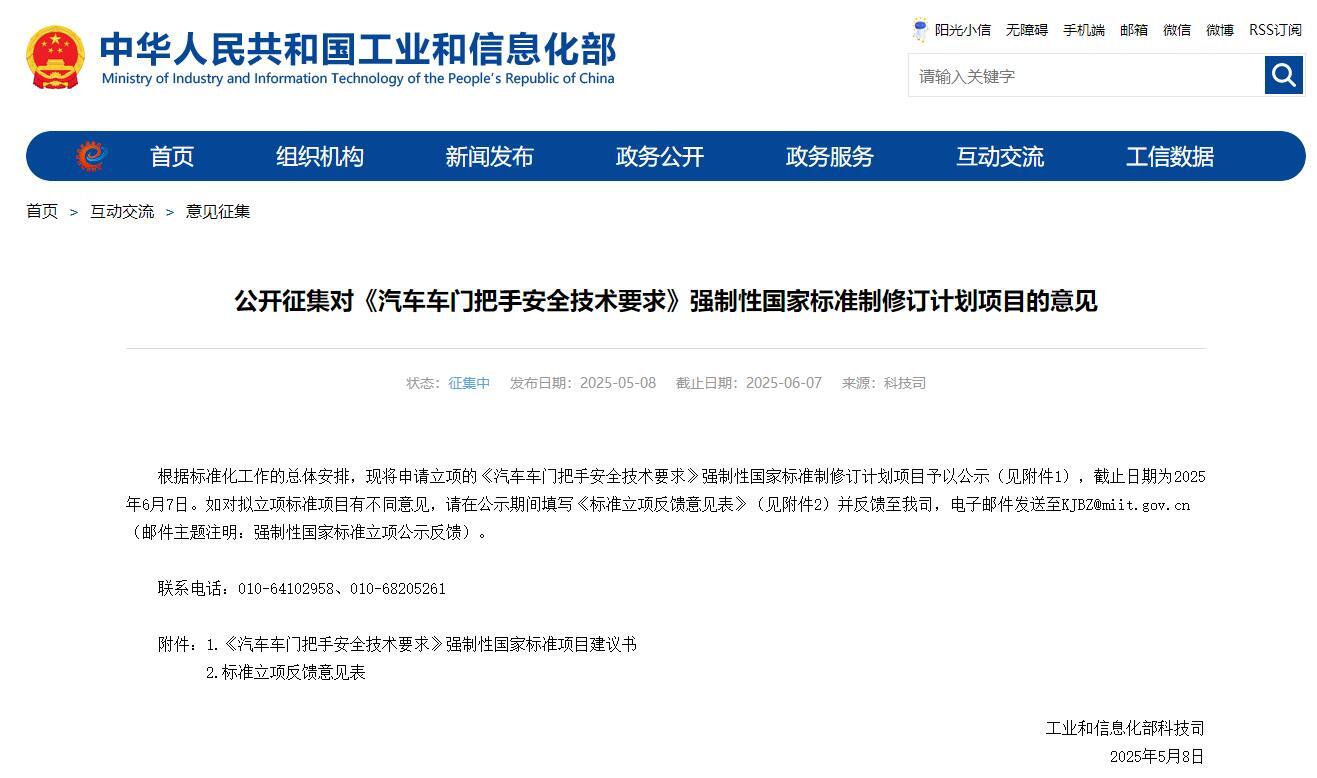
工信部出手!整顿隐藏式车门把手
第一财经· 2025-05-09 02:51
Core Viewpoint - The Ministry of Industry and Information Technology (MIIT) is soliciting opinions on the mandatory national standard revision plan for "Automotive Door Handle Safety Technical Requirements," highlighting the need for improved safety measures in automotive door handles due to the rapid development of electric and intelligent vehicles [1][2]. Group 1: Standard Revision Significance - The revision of the new standard is crucial for enhancing safety logic in emergency situations, such as collisions and vehicle fires, ensuring that door systems can be opened during power outages or accidents [2][3]. - The new requirements will include safety redundancy designs to prevent door handle malfunction during critical situations, thereby facilitating rescue and escape operations [2]. - The standard aims to improve the visibility and recognition of emergency door handle markings, reducing the difficulty of escape in emergencies [2]. Group 2: Current Market Issues - The current market for automotive door handles has revealed issues such as insufficient strength, potential safety risks in control logic, and difficulties in operation due to lack of visible markings [2]. - There are concerns regarding the failure of electric door handles during power outages, which can hinder escape and rescue efforts in emergencies [2]. - The absence of standards for the layout, markings, safety functions, and structural strength of electric and hidden door handles has been noted, indicating a gap in current regulations [3].
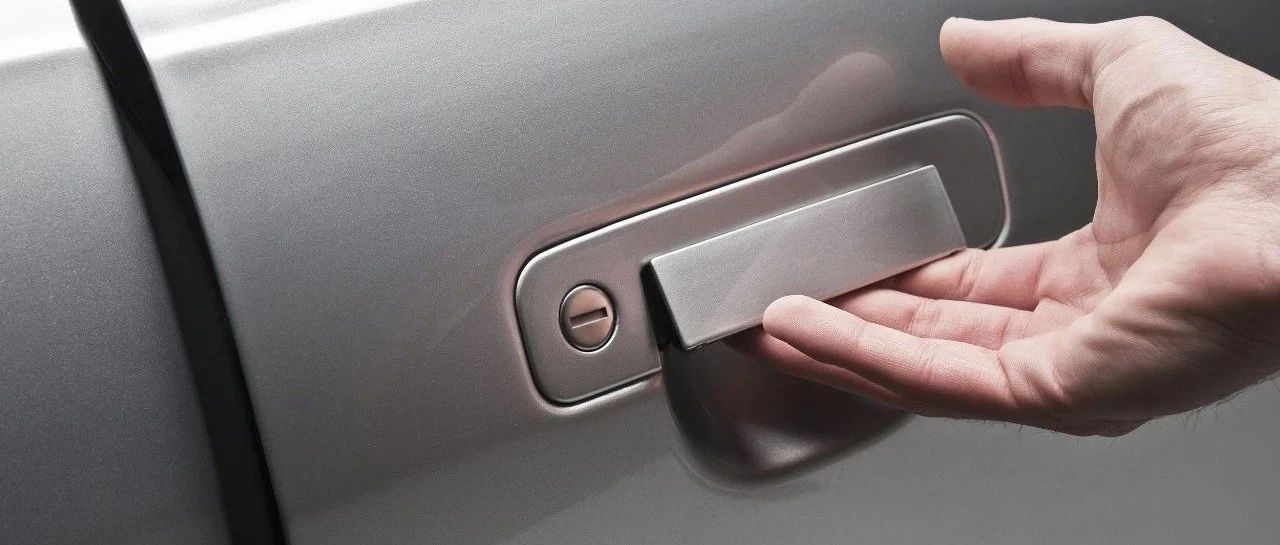
【2024年年报及2025年一季报点评/双环传动】公司业绩符合预期,电驱齿轮龙头强者恒强
东吴汽车黄细里团队· 2025-05-06 00:59
Core Viewpoint - The company reported steady growth in revenue and net profit for 2024, with a focus on the electric drive gear market and industrial robot precision reducers, indicating strong long-term growth potential [2][4][5]. Financial Performance - In 2024, the company achieved revenue of 8.781 billion yuan, a year-on-year increase of 8.76%, and a net profit attributable to shareholders of 1.024 billion yuan, up 25.42% year-on-year [2]. - For Q4 2024, the company reported revenue of 2.039 billion yuan, a year-on-year decrease of 7.42%, and a net profit of 286 million yuan, a year-on-year increase of 25.96% [2][3]. - In Q1 2025, revenue was 2.065 billion yuan, a slight year-on-year decrease of 0.47%, while net profit was 276 million yuan, up 24.70% year-on-year [2][3]. Margin and Expense Analysis - The gross margin for Q4 2024 was 31.04%, an increase of 6.46 percentage points year-on-year, while Q1 2025 saw a gross margin of 26.82%, up 4.17 percentage points year-on-year [3]. - The expense ratio for Q4 2024 was 13.13%, up 2.92 percentage points from the previous quarter, primarily due to increases in management and R&D expenses [3]. Industry Position and Growth Potential - The company is positioned as a leader in the electric drive gear market, benefiting from the ongoing electrification of vehicles and a shift towards gear outsourcing [4]. - The company has developed a comprehensive range of precision reducers for industrial robots, which are critical components with significant value [4][5]. - The establishment of Ring Drive Technology and the acquisition of Sanduo Le are strategic moves to enhance the company's presence in the consumer gear market [5]. Profit Forecast and Valuation - The company maintains profit forecasts for 2025-2026 at 1.269 billion yuan and 1.557 billion yuan, respectively, with a new forecast for 2027 at 1.874 billion yuan [6]. - Corresponding EPS for 2025-2027 are projected at 1.50 yuan, 1.84 yuan, and 2.21 yuan, with P/E ratios of 22.50x, 18.34x, and 15.24x [6].


双环传动(002472):公司业绩符合预期 电驱齿轮龙头强者恒强
Xin Lang Cai Jing· 2025-05-04 02:40
Core Insights - The company reported a revenue of 8.781 billion yuan for 2024, representing a year-on-year growth of 8.76%, and a net profit attributable to shareholders of 1.024 billion yuan, up 25.42% year-on-year [1] - In Q4 2024, the company achieved a revenue of 2.039 billion yuan, a decrease of 7.42% year-on-year and a decline of 15.76% quarter-on-quarter, while the net profit for the same period was 286 million yuan, reflecting a year-on-year increase of 25.96% and a quarter-on-quarter growth of 7.88% [1][2] - For Q1 2025, the company reported a revenue of 2.065 billion yuan, a slight year-on-year decrease of 0.47%, and a net profit of 276 million yuan, which is a year-on-year increase of 24.70% [1][2] Financial Performance - The gross margin for Q4 2024 was 31.04%, an increase of 6.46 percentage points year-on-year and 7.08 percentage points quarter-on-quarter; for Q1 2025, the gross margin was 26.82%, up 4.17 percentage points year-on-year [2] - The operating expense ratio for Q4 2024 was 13.13%, an increase of 2.92 percentage points quarter-on-quarter, primarily due to increases in management and R&D expense ratios; for Q1 2025, the operating expense ratio was 10.65%, up 0.74 percentage points year-on-year [2] - The company recorded asset impairment losses of 46 million yuan and credit impairment losses of 13 million yuan in Q4 2024 [2] Industry Outlook - The company is positioned as a leader in electric drive gears, benefiting from the ongoing electrification of vehicles and the reshaping of the automotive gear market [3] - The company has established a strong presence in the precision reducer market for industrial robots, covering a wide range of applications and maintaining partnerships with leading domestic robot manufacturers [3] - The establishment of Huanqu Technology and the acquisition of Sanduo Le are expected to enhance the company's capabilities in the consumer gear sector, broadening its customer base [3] Profit Forecast - The company maintains its profit forecasts for 2025-2026, estimating net profits of 1.269 billion yuan and 1.557 billion yuan, respectively, with a new forecast for 2027 at 1.874 billion yuan [3] - Corresponding EPS estimates are 1.50 yuan, 1.84 yuan, and 2.21 yuan for 2025-2027, with price-to-earnings ratios of 22.50, 18.34, and 15.24, respectively [3]
面对中国电动汽车市场的蛋糕,日系车企打出了明牌
Di Yi Cai Jing Zi Xun· 2025-05-01 09:33
Core Viewpoint - The Japanese automotive industry in China is facing significant challenges, with a notable decline in market share and a strategic shift towards electric vehicles to adapt to the rapidly changing market landscape [1][2]. Group 1: Market Performance - In 2024, Japanese automakers' market share in China dropped to 11.2%, a decrease of 3.2 percentage points from 2023, as domestic electric vehicle brands gained ground [1][2]. - The sales of Japanese brands, heavily reliant on fuel vehicles, have declined for two consecutive years, prompting a consensus among these companies to accelerate their entry into the electric vehicle market [1][2]. Group 2: Electric Vehicle Strategy - Japanese automakers are intensifying their electric vehicle offerings in China, with companies like Toyota and Nissan emphasizing local development and production [2][3]. - The first electric vehicle launched by Dongfeng Honda, the S7, has a starting price of 25.99 million yuan, which was later reduced to 19.99 million yuan to compete with local brands [3]. - By 2027, Honda plans to introduce 10 electric vehicle models in China, while Nissan aims to increase its electric vehicle offerings from 8 to 10 models [3]. Group 3: Local Collaboration and R&D - Japanese automakers are focusing on local partnerships and R&D to enhance their competitiveness in the Chinese market, with Toyota establishing a localized R&D mechanism [4][5]. - Honda is collaborating with Chinese tech companies like Momenta and CATL to leverage local expertise and speed up product development [5]. - Mazda is working with Changan to optimize costs related to electric drive and battery technologies, aiming to enhance profitability through strategic partnerships [5].


一汽奥迪以严苛标准重塑汽车行业安全与智能新标杆
2 1 Shi Ji Jing Ji Bao Dao· 2025-04-30 07:47
在全球汽车产业加速向电动化、智能化转型的背景下,一汽奥迪正以百年积淀的"科技温度"与极致严苛 的工业标准,重新定义豪华汽车的安全与智能边界。从动力电池的"地狱级"测试到燃油车驾驶辅助系统 的颠覆性创新,从灯光技术的交互革命到电磁防护的母婴级标准,奥迪正以一系列远超行业基准的技术 突破,推动中国汽车产业向更安全、更科技、更可持续的未来迈进。 电池安全:以"超国标数倍"的严苛,守护用户生命线 在新能源汽车快速普及的当下,电池安全始终是用户的核心关切。根据一汽奥迪披露的测试流程,其动 力电池需经历长达半年的"九重炼狱"——温度交变、机械冲击、盐雾湿热、浸水等9项测试是使用同一 块电池完成。以机械振动测试为例,国标的要求是三轴随机振动,每个轴向不少于12小时,而奥迪会进 行两轮测试,第一轮按照国标但每个轴向时间增加3.5倍。第二轮是按照奥迪企业标准,升级为参照真 实路谱的六轴振动,各个轴强度达到国标3倍以上,总测试时长172小时,相当于经历了30万公里的行驶 里程。更令人瞩目的是滑车试验:电池需承受60g的急停瞬间的加速度(F22战斗机最大值的9倍),远 超国标15-28g的极限。 安全不是冰冷的参数,而是对生命的敬 ...
上海车展迸发转型升级新动能
Zhong Guo Qi Che Bao Wang· 2025-04-30 01:24
Group 1: Core Themes of the Auto Show - The 2025 Shanghai Auto Show showcases over 1,300 vehicles and features more than 1,000 domestic and international companies, highlighting innovation and the theme "Embrace Innovation, Win the Future" [2] - The event serves as a significant review of the automotive industry's transformation and a window into future trends, acting as a "charging station" for the industry's upward momentum [2] Group 2: New Vehicle Launches - Over 100 new vehicle launches were presented, with domestic brands like BYD and Chery taking center stage, while joint ventures and multinational brands adapted to the Chinese market [3] - Notable launches include BYD's concept supercar and various electric models, as well as new offerings from other brands like Mercedes-Benz and Audi, emphasizing the shift towards electric and hybrid vehicles [3] Group 3: Safety and Intelligent Driving - The focus on intelligent driving has shifted towards safety, with companies now emphasizing secure technology rather than just advanced capabilities, reflecting a more cautious approach following recent accidents [5][6] - The automotive industry is urged to prioritize safety in both technology and marketing strategies to ensure consumer trust and reduce accidents [6] Group 4: Global Expansion and Market Dynamics - Despite global trade uncertainties, Chinese automotive exports reached 1.54 million units in Q1, with a 16% year-on-year increase, indicating strong overseas demand [7] - Companies like XPeng plan to enter 60 countries by 2025, highlighting the need for local production and service networks to enhance global competitiveness [7] Group 5: Investment and Commitment from Multinational Brands - Multinational companies are increasingly committed to the Chinese market, with Nissan planning to invest 10 billion RMB by 2026 to develop electric vehicles [9] - The trend shows a shift where foreign brands are designing electric vehicles in China for global markets, reflecting the country's growing influence in automotive innovation [8][9] Group 6: Evolving Consumer Landscape - The automotive consumption landscape is changing, with a focus on integrating vehicles into broader lifestyle contexts, promoting cross-industry collaborations [10] - The "Automobile +" ecosystem is expected to drive new consumption scenarios, enhancing the automotive industry's value and supporting economic growth [10]


