
粮食安全

Search documents
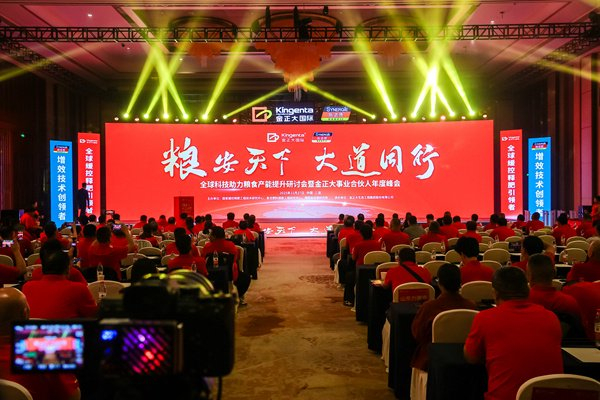
整合全球农业科技资源 金正大护航粮食安全再发力
Ren Min Wang· 2025-12-02 07:40
Core Viewpoint - The fertilizer industry is entering a critical period of continuous innovation and rapid development over the next decade, with global collaboration and integration becoming mainstream [1]. Group 1: Industry Trends - The conference focused on global agricultural development and discussed how to leverage cutting-edge agricultural technology to drive industry transformation and enhance food security [3]. - The fertilizer industry faces urgent tasks for transformation and upgrading, as highlighted by the Secretary-General of the China Phosphate and Compound Fertilizer Industry Association, emphasizing the need for product innovation and a shift towards service-oriented production [3]. Group 2: Technological Advancements - The bio-based coated slow-release fertilizer technology led by the company is set to gain recognition from the Food and Agriculture Organization of the United Nations by 2025, supporting agricultural quality and efficiency in China [5]. - The latest 2.0 enhancement technology from the German Schnoor Institute incorporates unique nutrient leakage prevention, plant vaccines, and microbial activation, improving fertilizer efficiency while reducing agricultural production costs [5]. Group 3: Future Directions - The agricultural sector is transitioning from "experience-based fertilization" to "precision nutrition," with enhanced and functional fertilizers identified as key directions for market demand and industry transformation [6]. - The company plans to promote integrated technological solutions through platforms like the FAO, utilizing experimental demonstrations and digital methods [6]. - The company aims to implement the strategy of "storing grain in the land and technology," leveraging 27 years of technological accumulation and industry practice to contribute to global food security and green agricultural development [6].


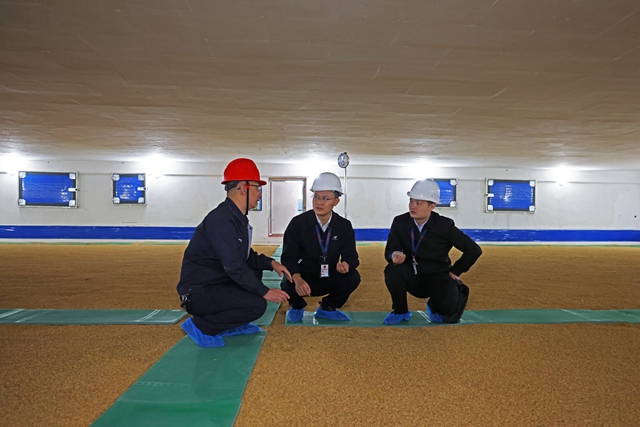
“粮食安全看山东”之临沂:聚焦绿色系统集成,筑牢粮食安全根基
Zhong Guo Fa Zhan Wang· 2025-12-02 07:11
Core Viewpoint - The key to ensuring grain storage safety lies in the transition to "green and quality storage," with Linyi City actively upgrading its traditional grain storage methods to incorporate new green technologies for better quality preservation and efficiency [1][2]. Group 1: Grain Storage Infrastructure - Linyi City is advancing the construction of grain storage facilities in alignment with grain production, reserves, and circulation, resulting in a robust storage infrastructure [2]. - The city has improved its grain storage conditions significantly by implementing green storage enhancement actions and modernizing facilities through new constructions and upgrades [2]. Group 2: Promotion of Green Storage Technologies - The city is accelerating the application of green storage technologies, such as external wall heat-reflective coatings and multi-parameter grain condition detection systems, achieving 100% application rates in state-owned grain reserve enterprises for certain technologies [3]. - New equipment, including intelligent sampling systems and hydraulic unloading machines, has increased daily storage capacity by 40% and reduced energy consumption per ton of grain stored by 30% [3][7]. Group 3: Management System Enhancements - Linyi City has strengthened its grain storage management system by revising local regulations and implementing standardized management practices, which have improved overall management levels [4]. - The city has adopted an information management system for grain reserves, ensuring comprehensive monitoring and compliance with national standards [5][6]. Group 4: Efficiency and Sustainability in Grain Storage - The application of advanced technologies has led to a reduction in grain loss during storage processes, achieving a comprehensive loss rate of 0.35%, which is better than the provincial average of 0.42% [7]. - The city has published several technical standards for low-temperature storage and efficient grain entry, positioning itself as a leader in green storage practices within the province [8].
“粮食安全看山东”之临沂:全力推动粮油产业价值提升
Zhong Guo Fa Zhan Wang· 2025-12-02 07:11
Group 1: Core Insights - Shandong Province's Linyi City is focusing on transforming the grain industry from "scale expansion" to "quality and efficiency improvement," with a grain processing output value of 30.804 billion yuan in the first half of the year, representing a year-on-year growth of 24.8% [1] Group 2: Industry Chain Development - The city is enhancing its industrial chain by supporting key enterprises like Jingsheng and Yuhuang in capacity upgrades, constructing modern grain logistics parks, and promoting technological renovations in 15 companies, resulting in the development of 38 high-value-added new products [1] - Collaboration with universities and research institutions has led to two companies winning first-class awards from the China Grain and Oil Society, and one company receiving a second-class award [1] - Online sales of Linyi's quality grain and oil products have increased by 19% through platforms like Douyin, Taobao, and JD [1] Group 3: Grain Circulation and Quality Improvement - The city is implementing a new grain purchase and sales circulation system to enhance agricultural quality and competitiveness, with 13 grain operating enterprises benefiting from a provincial grain purchase loan credit guarantee fund [2] - The total grain circulation volume in Linyi exceeds 20 million tons annually, with over 3.5 million tons of grain purchased from producers [2] Group 4: Brand Building - Linyi City is developing a pyramid structure for brand creation, focusing on regional, enterprise, and product brands, with the public service brand "Yimeng Peanut Oil" gaining recognition [3] - The city has participated in over 10 national promotional events annually, enhancing brand value and recognition across more than 20 provincial capitals [3] - Currently, Linyi's grain processing enterprises hold 5 well-known trademarks, 17 famous trademarks, 11 Shandong brand names, and 1 "China Time-honored Brand" [3]
北粮南运物流升级 铁路筑牢粮食安全经济根基
Zhong Guo Jing Ji Wang· 2025-12-02 05:45
Core Insights - The "North Grain South Transport" railway system is crucial for connecting Northeast China's agricultural production with Southern markets, ensuring food security and efficient logistics [1][2][3] Group 1: Transportation Innovations - The introduction of a modular transportation model by the China Railway Shenyang Bureau allows for pre-packaging of grain into standardized units, reducing operational time by 30% [2] - A new dedicated railway line in Changtu County enables seamless grain transfer from storage facilities to trains, enhancing logistics efficiency and lowering costs [2] Group 2: Economic Impact - The volume of autumn grain shipments by the China Railway Shenyang Bureau increased by 39% compared to the previous year, reflecting improved logistics and cost reductions that benefit both enterprises and farmers [2] - The integration of production, transportation, and sales creates a comprehensive support system that boosts farmers' motivation to cultivate grain [2] Group 3: Strategic Importance - The "North Grain South Transport" railway not only stabilizes the national food supply but also reshapes regional development patterns and modernizes the agricultural supply chain [3] - The efficiency of this railway system is a testament to the importance of speed as a productive force in the economy, aligning with the mission of serving the people [3]
供大于求格局延续,猪价承压下跌:农林牧渔
Huafu Securities· 2025-12-01 07:27
Investment Rating - The industry rating is "Strongly Outperform the Market" [5][72]. Core Viewpoints - The supply-demand imbalance in the pig farming sector continues, leading to downward pressure on pig prices. As of November 28, the pig price was 11.20 CNY/kg, a decrease of 0.42 CNY/kg week-on-week. The average weight of pigs sold increased to 129.22 kg, up 0.41 kg week-on-week, indicating a potential recovery in prices in the long term due to capacity reduction policies [2][10][30]. - In the beef sector, calf prices have rebounded, and the long-term trend for beef prices is upward. As of November 28, the price for fattened bulls was 25.55 CNY/kg, down 0.12% week-on-week, while calf prices rose to 32.09 CNY/kg, up 0.28% week-on-week. The market is expected to tighten due to a reduction in breeding cows [3][33]. - The poultry sector is experiencing a decrease in the enthusiasm for restocking broiler chicks, with prices slightly adjusting. As of November 28, the price for white feather broilers was 7.19 CNY/kg, up 0.04% week-on-week, while broiler chick prices were 3.47 CNY each, down 0.01 CNY [4][40]. - The agricultural products sector, particularly soybean meal, is seeing price fluctuations. As of November 28, the spot price for soybean meal was 3100 CNY/ton, up 30 CNY/ton week-on-week. The market is expected to continue its oscillating trend due to high domestic inventory levels [4][55]. Summary by Sections Pig Farming - The supply-demand imbalance persists, leading to a decrease in pig prices. The average price on November 28 was 11.20 CNY/kg, with a week-on-week decrease of 0.42 CNY/kg. The average weight of pigs sold increased to 129.22 kg, indicating a potential recovery in prices in the long term due to capacity reduction policies [2][10][30]. - The average profit for self-bred pigs was -147.99 CNY/head, and for purchased piglets, it was -248.82 CNY/head, reflecting ongoing losses in the sector [10]. Beef Industry - Calf prices have shown signs of recovery, with the price for fattened bulls at 25.55 CNY/kg, down 0.12% week-on-week, and calf prices at 32.09 CNY/kg, up 0.28% week-on-week. The market is expected to tighten due to a reduction in breeding cows, leading to a potential upward trend in beef prices in the coming years [3][33]. Poultry Sector - The enthusiasm for restocking broiler chicks has decreased, with broiler prices at 7.19 CNY/kg, up 0.04% week-on-week, and broiler chick prices at 3.47 CNY each, down 0.01 CNY. The ongoing avian influenza outbreak may lead to a contraction in upstream production capacity [4][40][43]. Agricultural Products - The soybean meal market is experiencing price fluctuations, with a spot price of 3100 CNY/ton, up 30 CNY/ton week-on-week. The market is expected to continue its oscillating trend due to high domestic inventory levels and external factors affecting supply [4][55].
四川铁纪护航粮食安全推动打造更高水平“天府粮仓”
Zhong Yang Ji Wei Guo Jia Jian Wei Wang Zhan· 2025-12-01 00:40
Group 1 - The Sichuan Provincial Discipline Inspection and Supervision Commission focuses on issues in the grain purchase and sales sector, implementing comprehensive supervision from grain acquisition to storage and sales [2][5] - The commission emphasizes the importance of safeguarding food security as a key supervisory focus, addressing areas such as grain sales, high-standard farmland construction, and agricultural insurance [2][6] - A systematic approach is adopted to tackle corruption in the grain sector, utilizing various methods including big data screening and inter-departmental collaboration [3][4][9] Group 2 - The recent case of a former agricultural official convicted of bribery and money laundering highlights the ongoing efforts to address corruption in the grain sector [3][4] - The commission is expanding its oversight to include seed cultivation, farmland construction, and grain production and sales, with a focus on ensuring compliance with regulations [5][11] - The implementation of the "Tianfu Granary" brand aims to enhance the integrity and risk management in grain storage and procurement processes [11][12] Group 3 - The commission has resolved over 6,000 issues related to grain security that were raised by the public, demonstrating a commitment to addressing urgent concerns [8][10] - A new management regulation for high-standard farmland construction has been enacted to provide legal support for the entire process of investment, construction, and management [10][13] - The focus on technological advancements in agriculture is seen as essential for improving production efficiency and addressing the challenges of food security [14][15]
法治筑屏障 中原粮更安——河南用法治力量保障好粮食安全
He Nan Ri Bao· 2025-11-30 23:50
Core Viewpoint - The introduction of the "Henan Province Grain Security Guarantee Regulations" marks a significant step towards legal and systematic governance of grain security in Henan, a key grain-producing province in China, which contributes substantially to national grain production [1][2]. Group 1: Legislative Background - The regulation aligns with national legal frameworks, particularly the upcoming "Grain Security Guarantee Law" effective June 1, 2024, and aims to enhance grain supply and risk prevention capabilities [2]. - Henan's grain production has remained stable at over 1.3 trillion jin (approximately 650 billion kg) for eight consecutive years, but challenges such as structural and regional disparities persist [2]. Group 2: Agricultural Foundations - The regulation emphasizes the importance of arable land and seed quality, mandating the construction of high-standard farmland and strict management of land use [3]. - High-standard farmland in Henan has increased productivity by 10%-20%, contributing over 22 billion jin (approximately 11 million tons) to grain output [3]. Group 3: Comprehensive Risk Management - The regulation establishes a comprehensive grain security framework, focusing on optimizing storage management and enhancing the grain circulation system [4]. - Local grain reserves are sufficient to meet approximately three months of market demand, with specific cities like Zhengzhou having reserves for 15 days of supply [4]. - A dedicated chapter on grain regulation is included, introducing monitoring and early warning systems for grain security [4]. Group 4: Industrial Empowerment - The regulation promotes a shift from raw grain production to value-added processing, emphasizing the importance of industry integration and brand development [5][6]. - Financial support mechanisms are established to incentivize grain production, with rural residents' disposable income projected to reach 21,330 yuan in 2024 [5]. - The grain processing industry in Henan has maintained a total output value of over 300 billion yuan, positioning it among the top in the country [5]. Group 5: Brand Development - The regulation supports the creation of public brands for major agricultural products and promotes marketing efforts through various channels [6]. - Initiatives such as promotional events in major cities aim to enhance the visibility and competitiveness of Henan's grain products [6].
全国全域土地综合整治取得积极成效
Sou Hu Cai Jing· 2025-11-30 15:49
编辑:令文芳 (央视财经《经济信息联播》)"十四五"期间,全国全域土地综合整治取得积极成效。共有24个省份实 施1700多个项目,完成整治总规模1000多万亩,其中农用地整治700多万亩,实现新增耕地80多万亩, 夯实了粮食安全基础。 转载请注明央视财经 ...
明天起,这些新规将影响你的生活
证券时报· 2025-11-30 03:41
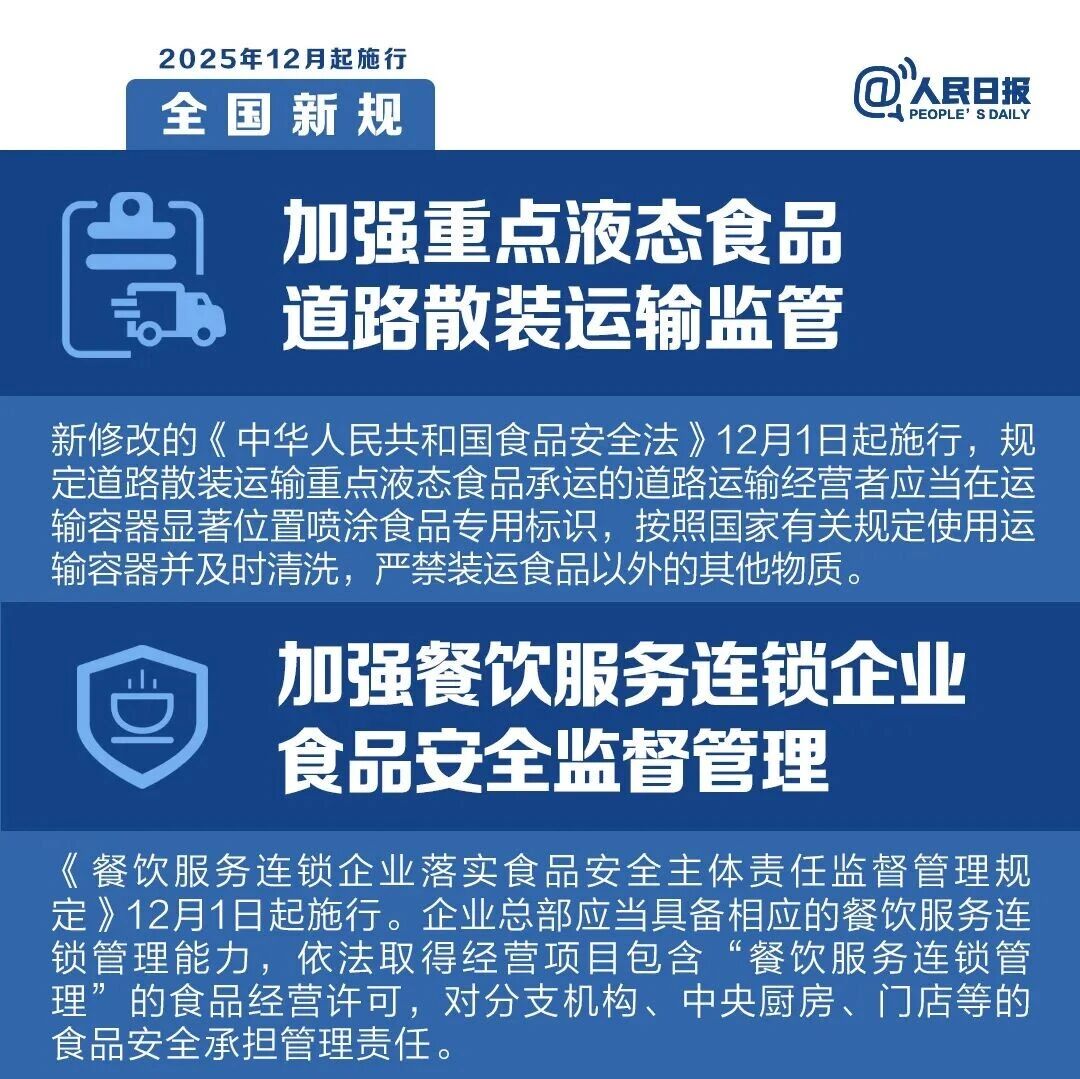
Regulatory Changes in Food Safety and Transportation - The revised Food Safety Law of the People's Republic of China will take effect on December 1, 2025, mandating that road transport operators of key liquid foods must prominently display food-specific labels on transport containers and adhere to national regulations for container use and cleaning [1] - The new regulations for chain catering service enterprises will also be implemented on December 1, requiring headquarters to possess the necessary management capabilities and assume responsibility for food safety across branches and central kitchens [2] Electric Bicycle Regulations - Starting December 1, all electric bicycles that do not meet the new national standards will be banned from sale, emphasizing the importance of CCC certification for consumers [3][4] School Meal Transparency - The Campus Meal Service Management Guidelines will be enforced on December 1, requiring food processing operations to be integrated with an "Internet + Bright Kitchen" system, allowing parents and students to view key food processing steps [5][6] Resource Tax Regulations - New resource tax regulations will clarify that certain mined products used for project backfilling will not be subject to resource tax, effective December 1 [7] Medical Mask Standards - The revised national standard for medical protective masks will prohibit the use of breathing valves in disposable masks, effective December 1, ensuring they are equipped with a nose clip or equivalent design for a secure fit [8] Anti-Money Laundering Regulations - The Anti-Money Laundering and Counter-Terrorism Financing Supervision Management Measures will take effect on December 1, requiring financial institutions to submit annual reports by the end of March each year [11] Individual Business Credit Evaluation - The Individual Business Credit Evaluation Indicators standard will be implemented on December 1, aimed at assisting financial institutions in developing tailored financial products for individual businesses, thereby expanding loan accessibility [13] Environmental Regulations - New regulations in Beijing will ban the use of high-emission non-road mobile machinery starting December 1, promoting environmental sustainability [14] Vocational Education Development - The Liaoning Province Vocational Education Regulations will be enacted on December 1, encouraging the establishment of vocational colleges and expanding enrollment in applied undergraduate programs [16] Weather Modification Management - The Fujian Province Weather Modification Management Regulations will take effect on December 1, emphasizing the use of new technologies in weather modification for disaster prevention and agricultural safety [18] Historical Building Protection - The Shandong Province Historical Building Protection Measures will be implemented on December 1, detailing nine criteria for recognizing historical buildings [19] Food Security in Grain Production - The Henan Province Grain Security Guarantee Regulations will be enforced on December 1, focusing on enhancing the supply of quality and functional grain products [22] Data Flow Regulations - The Hunan Province Data Regulations will take effect on December 1, promoting orderly and efficient data circulation among individuals and organizations [23] Tourism Regulations - The Hainan Free Trade Port Tourism Regulations will allow for the establishment of all-night bars and entertainment venues in key tourist areas starting December 1 [25] Sanitation Worker Rights - The Sichuan Province Urban Sanitation Worker Salary Special Account Implementation Rules will be enacted, aiming to protect the rights of sanitation workers [27]
陕西省灌区现代化建设保障粮食安全培训班在杨凌示范区举办
Shui Li Bu Wang Zhan· 2025-11-28 13:05
Core Viewpoint - The training session on modernizing irrigation districts in Shaanxi Province aims to enhance food security through improved irrigation management and technology integration [1] Group 1: Training Session Overview - The training session took place from October 21 to 23 in Yangling Demonstration Zone, organized by the Provincial Organization Department and the Provincial Water Resources Department [1] - It included experts from the National Irrigation and Drainage Center and Northwest A&F University, focusing on national and provincial policies, planning, and technical standards for irrigation modernization [1] Group 2: Key Topics Covered - Topics included high-standard farmland irrigation, smart irrigation, measurement facilities, and integrated water-saving technologies [1] - The session analyzed agricultural water pricing reform policies, typical models, challenges, and countermeasures, along with successful case studies from within and outside the province [1] Group 3: Implementation and Goals - Participants were encouraged to relate learning to local irrigation realities, fostering practical application of knowledge gained [1] - The goal is to translate learning outcomes into actionable steps to enhance irrigation standards, management efficiency, water-saving effectiveness, and overall food production capacity in Shaanxi [1]