
通胀压力

Search documents
美联储政策博弈引爆黄金,领峰环球$30000赠金助您驾驭巅峰行情
Sou Hu Cai Jing· 2025-08-04 06:32
Core Viewpoint - The international gold market is experiencing a critical turning point in August, driven by increasing divergence in Federal Reserve policy and adjustments in global tariff policies, leading to significant fluctuations in gold prices [1][3]. Group 1: Federal Reserve Policy - The Federal Reserve maintained its benchmark interest rate at 4.25%-4.50% during the July meeting, but internal disagreements have become more pronounced [3]. - Fed Chair Powell emphasized the need for more data to confirm the downward trend in inflation and noted that tariff policy adjustments could reshape inflation prospects [3]. - There is a split within the Fed, with some members supporting a rate cut in September due to concerns over high rates suppressing business investment, while others warn that premature cuts could trigger a second wave of inflation [4]. Group 2: Economic Indicators - The latest data from the U.S. Bureau of Labor Statistics shows that the core CPI rose by 2.9% year-on-year in June, significantly above the Fed's 2% target [3]. - Rising prices in various sectors, including a 0.4% increase in clothing prices and a 1.9% surge in household appliance prices, indicate growing inflationary pressures [3]. - The Markit manufacturing PMI for July fell back into contraction territory, reflecting the lowest business confidence in the past two and a half years [3]. Group 3: Market Outlook - The upcoming month is expected to see accelerated gold market activity, with key central bank meetings and important economic data releases on the horizon [6]. - Significant dates include the Bank of England's rate decision on August 7, the Reserve Bank of Australia's decision on August 12, and the Jackson Hole global central bank conference on August 21 [6]. - The market is poised for potential peaks in gold prices, with various economic indicators set to be released, including U.S. retail sales and CPI data [6].


宏观海外周报:美国关税再度抬升,非农大幅下修-20250803
HTSC· 2025-08-03 14:20
Economic Overview - The U.S. GDP growth for Q2 was revised up to 3.0%, exceeding expectations of 2.6%, with net exports contributing 5 percentage points[5] - The Atlanta Fed's GDP Now forecast indicates a slight decrease in Q3 GDP growth to 2.1%[3] - The final domestic private purchases growth (consumption + investment) fell by 0.7 percentage points to 1.2%[5] Employment Data - July non-farm payrolls increased by only 74,000, significantly below the expected 104,000, with prior months' data revised down by 258,000[5] - Initial jobless claims decreased by 23,000 to 193,000, better than the expected 211,000, indicating no significant layoffs yet[3] - The unemployment rate rose by 0.1 percentage points to 4.2%, primarily due to a drop in labor force participation[5] Inflation and Monetary Policy - The core PCE inflation for June was reported at 2.6%, above the expected 2.5%, indicating persistent inflationary pressures[5] - The Federal Reserve maintained the benchmark interest rate at 4.25%-4.5% during the July FOMC meeting, with a hawkish tone from Powell[6] Market Reactions - U.S. stock indices fell, with the S&P 500, Nasdaq, and Dow Jones down by 2.4%, 2.2%, and 2.9% respectively[7] - The U.S. dollar index rose by 1% to 98.7, while the euro and yen depreciated by 2.8% and 2.1% respectively[7] Commodity Prices - COMEX gold prices increased by 1.9% to $3,399.8 per ounce, while Brent crude oil rose by 1.8% to $69.7 per barrel[7]
国际货币基金组织小幅上调全球经济增长预测
Shang Wu Bu Wang Zhan· 2025-08-02 15:47
Group 1 - The International Monetary Fund (IMF) forecasts global economic growth at 3.0% for this year, an increase of 0.2 percentage points from the April prediction, and 3.1% for 2026, also up by 0.1 percentage points [1] - The global trade growth forecast has been raised by 0.9 percentage points to 2.6% for this year, indicating resilience in the global economy amid increasing uncertainties [1] - China's economic growth forecast has been adjusted upward by 0.8 percentage points to 5.6% for this year, and by 0.2 percentage points to 4.4% for next year [1] - The growth forecast for India has been slightly increased by 0.2 percentage points to 6.4% for this year and by 0.1 percentage points for next year [1] - Developed economies' growth predictions have been raised by 0.1 percentage points to 1.5% for this year and 1.6% for next year [1] - The U.S. economic growth forecast has been increased by 0.1 percentage points to 1.9% for this year and by 0.3 percentage points to 2.0% for next year [1] - The growth forecast for developing countries has been raised by 0.4 percentage points to 4.1% for this year and by 0.1 percentage points to 4.0% for next year [1] - The Eurozone growth forecast has been adjusted upward by 0.2 percentage points to 1.0% for this year, while the next year's forecast remains at 1.2% [1] Group 2 - The IMF warns that there are still widespread downside risks to the economic situation, including potential increases in average tariff rates and unresolved trade tensions stemming from the Trump administration [2] - Ongoing uncertainties may begin to suppress economic activity, while geopolitical tensions could exacerbate inflationary pressures and disrupt supply chains [2] - High debt levels, unstable public finances, and various structural imbalances continue to pose significant risks [2]
美国关税“回旋镖”杀来,谁在为加征的关税买单?
Sou Hu Cai Jing· 2025-08-02 00:45
Group 1 - The core inflation rate in the U.S. has reached its highest increase in two years, with the CPI rising by 2.7%, indicating a potential economic crisis [1] - Companies face a dilemma of either passing on tariff costs to consumers, which could suppress consumer spending, or absorbing the costs, which would squeeze profit margins and hinder investment and innovation [1][2] - Historical data suggests that U.S. importers and Chinese exporters typically share tariff costs, but ultimately, U.S. consumers bear the majority of the burden, highlighting the unintended consequences of protectionist policies [1] Group 2 - The Federal Reserve is caught in a challenging position, balancing between rising inflation pressures and a cooling growth outlook, which complicates monetary policy decisions [1][2] - The potential for layoffs looms as companies struggle with profit margins, which could put additional pressure on the labor market, affecting lower-wage workers and job seekers [1]
特朗普关税影响市场信心银价动荡
Jin Tou Wang· 2025-08-01 06:55
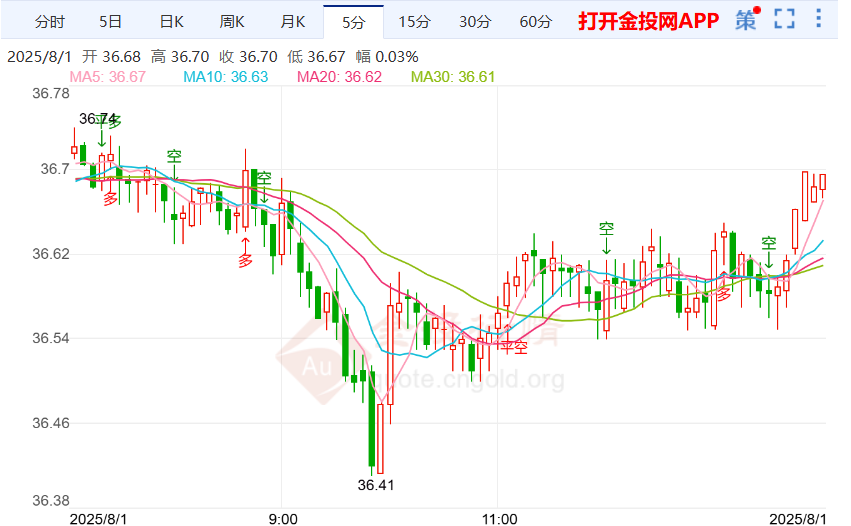
Group 1 - The core viewpoint of the news highlights ongoing inflation pressures indicated by PCE data, making it difficult for the Federal Reserve to signal any early easing of monetary policy, thus providing solid support for the US dollar [3] - The Trump administration has implemented a new round of tariffs ranging from 10% to 41% on imports from multiple economies, including Canada and India, starting August 1, which may impact global supply chains and corporate costs [3] - The US labor market remains robust, as indicated by the latest initial jobless claims at 218,000, slightly below market expectations and previous values, which may support the Fed's current policy stance [3] Group 2 - The current trading of spot silver shows a downward trend, with a daily head and shoulders pattern and a four-hour free-fall pattern, indicating a bearish outlook if it fails to rebound above $36.70 [4] - Key support levels for silver are identified at $36 and $35.80, while resistance levels are noted at $37.10 and $37.50 [4] - The short-term trading of spot silver is expected to remain volatile, with a focus on the $36.20 and $35.60 support levels [4]
黄金今日行情走势要点分析(2025.8.1)
Sou Hu Cai Jing· 2025-08-01 01:13
Core Viewpoint - The article discusses the recent fluctuations in gold prices driven by geopolitical tensions, inflationary pressures in the U.S., and changes in U.S. tariff policies, leading to increased demand for gold as a safe-haven asset. Fundamental Analysis - Tariff uncertainties have heightened risk aversion among investors, with the U.S. increasing tariffs on Canada from 25% to 35% and imposing additional tariffs on imports from Brazil and South Korea, which is expected to escalate inflationary pressures and market tensions [3]. - U.S. inflation is rising, with the June Personal Consumption Expenditures (PCE) price index increasing by 0.3% month-over-month, and the core PCE inflation rate growing by 2.8% year-over-year, complicating market expectations for potential interest rate cuts by the Federal Reserve [4]. - Geopolitical tensions are escalating, particularly in the Middle East, with Israel conducting airstrikes against Hezbollah and considering broader military actions, which, combined with trade war dynamics, is driving investors towards gold [5]. - The Federal Reserve maintained its interest rate target range at 4.25%-4.50% during its July 31 meeting, with Chairman Powell indicating that current inflation pressures are too high, reducing the likelihood of rate cuts in September [6]. Technical Analysis - On the daily chart, gold prices showed a recovery after a significant drop, closing with a long upper shadow indicating potential resistance around the 5-day moving average near 3300 [9]. - The four-hour chart indicates that gold is at a critical juncture, with the 3268 level being pivotal for potential upward movement. If this level holds, a rebound towards 3353/3354 and 3373/3374 could occur [10].

利率市场重新定价:美联储主席提前离任可能性进一步降低
Hua Er Jie Jian Wen· 2025-07-31 13:39
美联储罕见的双重异议票降低了市场对主席鲍威尔今年提前离任的预期。利率市场和Polymarket平台的隐含概率显示,鲍威尔的职位相较此前更 加稳固,尽管美联储内部鸽派声音日趋强烈。 昨日的美联储会议出现了自1993年以来首次两名理事同时投出异议票的情况。沃勒和鲍曼均支持降息,与鲍威尔的维持利率不变立场形成对比。 这一罕见分歧凸显了美联储内部政策倾向的分化。 鲍威尔选择在关税通胀影响尚不明朗时保持谨慎立场,维持利率不变。市场将此解读为其领导地位的进一步巩固,鲍威尔提前离任的市场预期因 此下降。 通胀压力重新抬头的多重迹象为鲍威尔的谨慎立场提供了支撑,但美联储内部日益强烈的鸽派声音可能削弱其对抗收益率上升的防线。 罕见双重异议票重现,市场重估鲍威尔地位 美联储昨日会议的双重异议投票创下32年来首次。沃勒和鲍曼两名理事均投票支持降息,与鲍威尔维持当前利率政策的决定形成鲜明对比。 这一罕见情况表明美联储内部政策分歧正在加剧。两名理事的降息倾向显示了央行内部"风向"的变化,但鲍威尔仍选择坚持更为谨慎的立场。 利率市场和预测平台Polymarket的数据均显示,鲍威尔今年提前离任的隐含概率进一步下降。7月份Polymark ...
7月31日上期所沪银期货仓单较上一日减少61千克
Jin Tou Wang· 2025-07-31 09:44
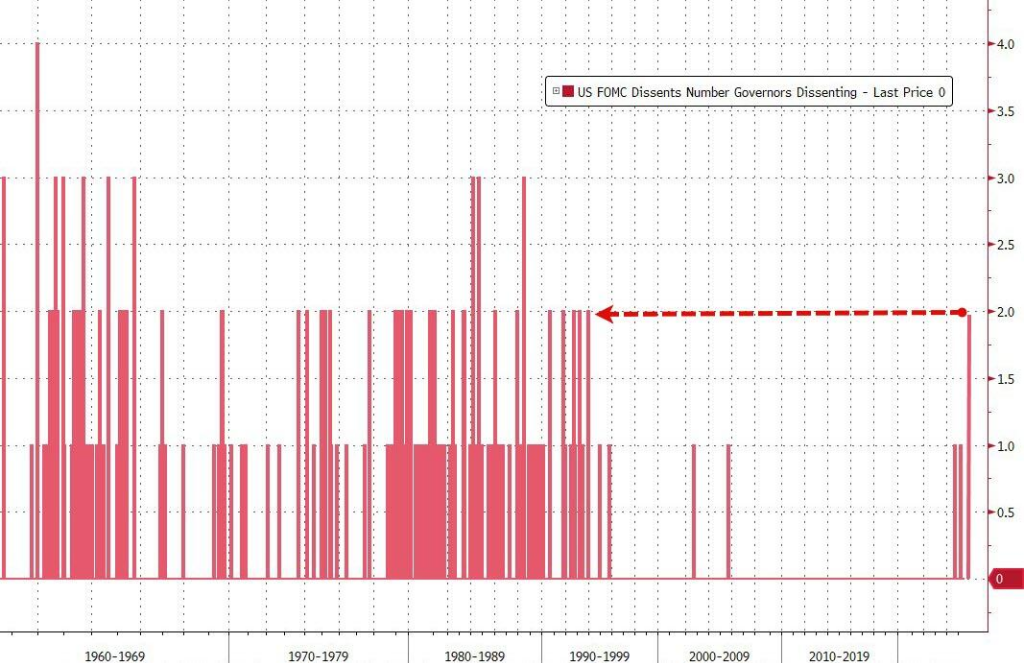
当地时间周三(7月30日)下午,美联储宣布将政策利率维持在4.25%-4.50%不变,这一决定不仅引发了 投资者对未来货币政策的激烈讨论,还因为美联储主席鲍威尔的谨慎表态,让市场对9月降息的预期大 幅下滑。与此同时,美国总统特朗普对降息的强烈诉求与美联储的稳健立场形成鲜明对比,进一步加剧 了市场的不确定性。 上海期货交易所指定交割仓库期货7月31日仓单日报显示,白银期货总计1208033千克,今日仓单较上一 日减少61千克。 沪银主力短线维持震荡下跌格局,今日白银期货开盘报9145元/千克,最高触及9145元/千克,最低触及 8964元/千克,截止收盘报9008元/千克,下跌2.21%。 | 地区 | 仓库 | 期货 | 增减 | | --- | --- | --- | --- | | 上海 | 中储吴淞 | 119085 | 0 | | 外运华东虹桥 | 200828 | 5815 | | | 中工美供应链 | 532659 | -6765 | | | 合计 | 852572 | -950 | | | 广东 | 深圳威豹 | 355461 | 889 | | 总计 | 1208033 | -61 | | 【 ...
澳大利亚最后一期零售销售报告表现强劲
news flash· 2025-07-31 02:51
澳大利亚最后一期零售销售报告表现强劲 金十数据7月31日讯,澳大利亚零售销售数据表现强劲,超出预期,这与支持澳洲联储最早于下月降息 的近期经济趋势形成反差。澳大利亚6月零售销售额环比增长1.2%,远超预期的0.4%。此前5月数据也 由0.3%上修至0.5%。值得注意的是,这将是澳大利亚统计局发布的最后一期零售销售报告。未来,该 机构将转向"家庭支出指标",以更全面地反映消费状况。目前,货币市场几乎完全确信,澳洲联储将在 8月会议上降息,这将是其今年的第三次降息。然而,本月初,该行出人意料地维持利率不变,令交易 员和经济学家大跌眼镜。澳洲联储主席布洛克当时表示,委员会希望先看到季度通胀数据再做决定,而 本周公布的数据显示通胀压力正在缓解。零售销售数据传统上是货币政策的重要参考指标,但统计局本 周在声明中指出,当前该数据的重要性已持续下降。 ...
欧洲央行管委维勒鲁瓦:通胀压力受控,要对未来政策保持“完全开放”
news flash· 2025-07-25 10:27
Core Viewpoint - The European Central Bank (ECB) needs to remain flexible in adjusting interest rates as inflation pressures are under control, with the eurozone inflation rate at the target level of 2% and France's at a lower rate of 0.9% [1] Group 1 - ECB's Governing Council member and Bank of France Governor Francois Villeroy de Galhau emphasized the importance of keeping an open stance on future monetary policy decisions [1] - The market is gradually reducing the likelihood of a final rate cut in the current cycle [1] - Villeroy noted that the increase in U.S. tariffs, the extent of which remains unclear, is not expected to lead to rising inflation [1] Group 2 - The appreciation of the euro is having a significant downward effect on inflation [1]