
美联储政策分歧

Search documents
美指震荡冲高难改弱势 底色多空博弈白热化
Jin Tou Wang· 2026-01-30 13:31
Core Viewpoint - The US dollar index is experiencing volatility, with short-term rebounds not altering the mid-term downtrend, driven by three main variables: Federal Reserve policy divergence, US fiscal concerns, and global de-dollarization [1][2] Group 1: Federal Reserve Policy Divergence - The Federal Reserve's decision to maintain interest rates and end consecutive rate cuts has led to a short-term dollar spike, but internal divisions among officials regarding potential rate cuts weaken the dollar's appeal [1] - Market expectations for two rate cuts within the year contribute to policy uncertainty, limiting the rebound momentum of the dollar [1] - Ongoing personnel and judicial issues within the Federal Reserve raise questions about its independence, further suppressing the dollar's mid-term outlook [1] Group 2: US Economic and Fiscal Concerns - Despite an upward revision of the 2026 GDP forecast by the Federal Reserve, high fiscal deficits and debt levels, along with recurring government shutdown risks, create credit concerns for US Treasury bonds [1] - The Trump administration's tacit approval of a declining dollar suggests further downside potential, with historical patterns indicating that intervention may only occur if the dollar falls below critical levels [1] Group 3: Global De-dollarization - The acceleration of global de-dollarization is intensifying pressure on the dollar, as multiple countries pursue local currency settlements and reduce reliance on the dollar [2] - The dollar's share in global foreign exchange reserves has declined to a nearly 30-year low, with central banks selling US Treasuries and increasing gold holdings, undermining the dollar's credit foundation [2] - Technical indicators show that the dollar's short-term rebound lacks strength, with key resistance levels and insufficient trading volume limiting bullish momentum [2] Group 4: Market Outlook - The dollar is expected to remain in a tug-of-war between bulls and bears, with long-term weakness likely to persist [2] - Short-term attention should be on Federal Reserve officials' speeches, core economic data, and government shutdown developments, as hawkish signals or positive data could lead to temporary rebounds [2] - However, the mid to long-term outlook remains constrained by policy divergence, fiscal concerns, and de-dollarization trends, making any rebound likely to be short-lived [2]
美元指数走强多变量博弈
Jin Tou Wang· 2026-01-08 02:56
Group 1 - The core viewpoint is that the strengthening of the US dollar index is driven by the divergence in Federal Reserve policies, mixed economic data, and global central bank policy differences [1] - The Federal Reserve's policy divergence is leading to volatility in the dollar, with significant disagreements among officials and institutions regarding interest rate cuts and future policy direction [1] - Economic data in the US is mixed, with a rebound in January CPI to 3.0% supporting the dollar, while retail sales fell by 0.9%, creating uncertainty in market expectations [1] Group 2 - Global central bank policy divergence is creating a competitive dynamic with de-dollarization, as the Bank of Japan raises rates and the European Central Bank is cautious about rate cuts, reducing the dollar's interest rate advantage [1] - The technical analysis indicates that the dollar index has broken through short-term resistance and is above several short-term moving averages, with support levels at 98.455 and 98.230, and resistance levels at 98.660 and 99.381 [2] - Institutions predict a potential decline of 3% in the dollar index by 2026, influenced by economic resilience and policy uncertainties that may trigger a rebound [2]
美指年度跌幅逼近八年之最 降息预期政策分歧成推手
Jin Tou Wang· 2025-12-25 02:34
Core Viewpoint - The US dollar index (DXY) has reached a two-month low, with a year-to-date decline exceeding 9%, potentially marking the largest annual drop since 2017, driven by Federal Reserve policy divergence, rising rate cut expectations, and concerns over the US economy [1][2] Group 1: Dollar Performance - As of December 25, the dollar index was at 97.95, having fallen below the 98.50 support level for three consecutive days, confirming its weak trend [1] - The dollar's weakness is attributed to a combination of factors including the Federal Reserve's recent rate cut to 3.5%-3.75% and internal divisions among officials regarding future policy direction [1][2] - The market anticipates only a 21% probability of a rate cut in January 2026, indicating significant policy uncertainty that is suppressing the dollar's potential for recovery [1] Group 2: Economic Indicators - The US GDP annualized growth rate for Q3 was 4.3%, which did not bolster the dollar, as investors are more focused on cooling inflation and slowing employment, with the unemployment rate rising to 4.6% in November [1] - Concerns over US debt and deficits are shaking investor confidence in the dollar, with expectations of two additional rate cuts in 2026 [1] Group 3: Non-USD Currencies - Non-US currencies have collectively strengthened, with the euro appreciating approximately 14% this year, supported by European Central Bank rate hike expectations [2] - The Swiss franc and Swedish krona have risen by 14.5% and 19% respectively, while the Japanese yen and offshore Chinese yuan have also gained strength, further diminishing the dollar's attractiveness [2] Group 4: Technical Analysis and Future Outlook - Technical indicators suggest a bearish outlook for the dollar, with a daily chart showing a downward trend and the RSI near 40, indicating it has not yet reached oversold conditions [2] - Analysts predict that if the dollar cannot regain the 98.50 level, it may test the 97.00 mark [2] - The ongoing policy uncertainty is expected to continue to suppress the dollar, with potential for a rebound if economic conditions or inflation improve [2]
有色60ETF(159881)涨超1.5%,工业金属供需格局引关注
Sou Hu Cai Jing· 2025-12-17 02:39
Group 1 - The core viewpoint of the article highlights that the aluminum market is expected to maintain a tight balance in supply and demand over the next 2-3 years, supported by low inventory levels and production cuts due to power issues in overseas projects [1] - Aluminum prices experienced a temporary decline after the Federal Reserve's hawkish interest rate cut, but global aluminum inventory has slightly decreased, maintaining levels between 1.2 million to 1.25 million tons, indicating a low safety stock [1] - The copper-aluminum ratio has reached a new high for the year, suggesting that aluminum still has room for price increases, especially if production cuts occur in the U.S. due to electricity shortages [1] Group 2 - The electrolytic aluminum industry is expected to maintain high profit levels, with alumina prices declining, leading to a reduction in aluminum production costs, averaging around 5,500 yuan per ton [1] - Companies in the aluminum sector are experiencing improved cash flow and low capital expenditure intensity, highlighting their dividend attributes [1] - Short-term metal prices may be influenced by the Federal Reserve's policy divergences, but the fundamentals and financial attributes of aluminum support its long-term performance [1] Group 3 - The Nonferrous 60 ETF (159881) tracks the China Securities Nonferrous Index (930708), which selects listed companies involved in the mining, smelting, and processing of nonferrous metals from the Shanghai and Shenzhen markets [1] - The China Securities Nonferrous Index reflects the overall performance of the nonferrous metal industry in the A-share market, covering various sectors such as copper, gold, aluminum, rare earths, and lithium, with a balanced industry distribution and characteristics of both cyclicality and growth [1]
Ultima Markets非农就业报告前瞻:分裂美联储的“决胜票”
Sou Hu Cai Jing· 2025-12-16 10:58
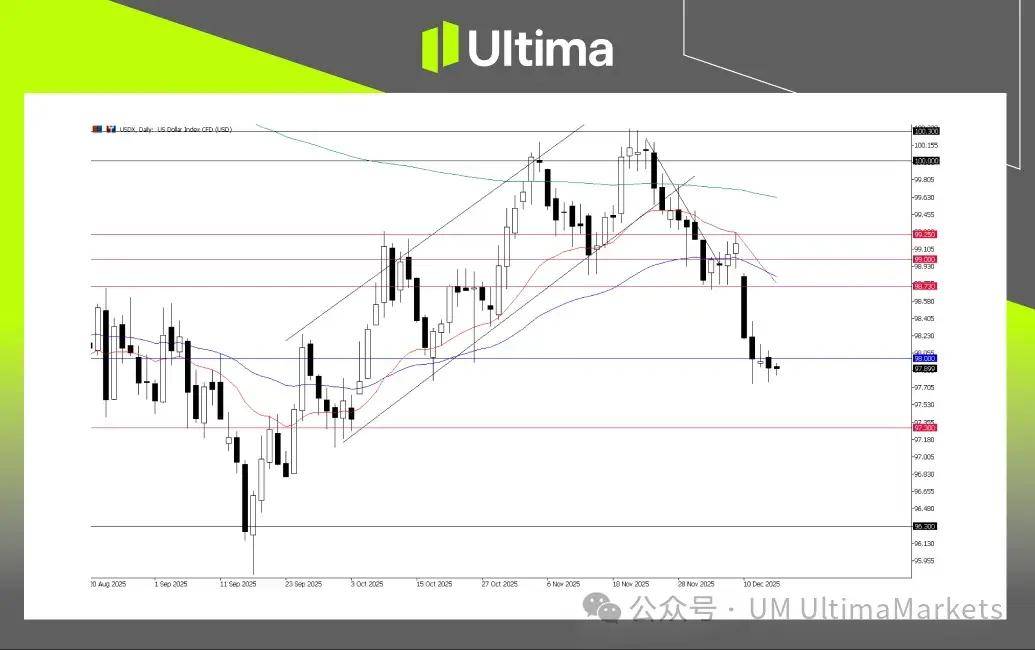
Core Insights - The focus of the market is on the U.S. Non-Farm Payroll (NFP) report, which has become a decisive factor in the divergent policy paths of the Federal Reserve [1] - The recent FOMC meeting revealed deep divisions within the Federal Reserve, with a 25 basis point rate cut implemented but three formal dissenting votes, the highest since 2019, indicating differing priorities [2] - The NFP report is expected to significantly influence market narratives for early 2026, with potential for volatile reactions based on the data [4] Federal Reserve Dynamics - The Federal Reserve is currently adjusting its policies based on weekly economic data rather than following a predetermined path, making the dot plot for 2026 less reliable [3] - There are contrasting views within the Fed: hawkish members emphasize the need for moderate tightening due to high inflation, while dovish members advocate for larger rate cuts due to a weakening labor market [8] Market Reactions to NFP - A weak NFP report (less than 80,000 new jobs) would confirm a cooling labor market, supporting dovish views and potentially causing the dollar index (DXY) to drop below 98.00, while gold prices may rise [8] - Conversely, a strong NFP report (more than 180,000 new jobs with robust wage growth) would indicate economic resilience, supporting hawkish views and possibly pushing DXY up to 99.50, while gold could retreat to around $4,150 [8] Asset Outlook - The U.S. Dollar Index (USDX) is currently under pressure below 98.00, awaiting the NFP data to trigger directional movement; a weak report could accelerate the bearish trend [5] - Technical analysis indicates that 98.00 is a critical support level for USDX, with potential for further declines if the NFP data falls short of expectations [6] - Gold continues to benefit from a weaker dollar, although recent short-term pullbacks suggest caution among bulls ahead of the NFP report [7] Summary and Future Outlook - The Federal Reserve's internal divisions between inflation hawks and labor market doves mean that monetary policy for 2026 remains uncertain and will be dictated by upcoming economic data [12] - The NFP report is crucial for determining market direction: weak data would support dovish sentiment and suppress the dollar, while strong data would bolster hawkish sentiment and could trigger a dollar rebound [12] - Following the NFP volatility, attention will shift to the upcoming CPI release to assess inflation trends in relation to labor market dynamics [12]

白宫取消原定面试流程!新美联储主席哈塞特“呼之欲出”
华尔街见闻· 2025-12-03 10:32
Core Viewpoint - The article discusses the imminent appointment of Kevin Hassett as the next Federal Reserve Chairman, following President Trump's cancellation of scheduled interviews for other candidates, indicating that Hassett is the likely choice for the position [1][2][3]. Group 1: Appointment Process - Trump's cancellation of the candidate interviews suggests that the selection process has been effectively concluded, with Hassett emerging as the frontrunner [1][2]. - The initial candidate pool was narrowed from 11 to 5 by Treasury Secretary Mnuchin, but Trump has expressed disinterest in continuing this formal interview process [2][3]. - Trump's public statements have indicated that he has already decided on Hassett, referring to him as a "potential Fed Chairman" during a public event [1][4]. Group 2: Implications of the Appointment - The new Chairman will face a divided decision-making environment, with the current Fed needing to balance risks of a slowing job market against ongoing inflation concerns [5]. - Trump's previous choice of Jerome Powell as Chairman has been criticized, with Trump reportedly regretting that decision and blaming former Treasury Secretary Mnuchin for the recommendation [6][7]. - The appointment of Hassett is seen as one of Trump's most significant decisions for his second term, with potential implications for monetary policy direction [5][6].

瑞郎政策博弈下区间震荡格局
Jin Tou Wang· 2025-12-02 03:00
Group 1 - The Swiss economy experienced a contraction in Q3 2023, with GDP declining by 0.5%, marking the first negative growth since mid-2023, primarily due to a 39% tariff imposed by the US on Swiss goods, leading to weakened exports [1] - The Swiss economy's heavy reliance on the pharmaceutical sector is under pressure as US policies promote domestic production, potentially weakening Switzerland's current account surplus and support for the Swiss franc [1] - The recent data release on Swiss GDP did not significantly impact the USD/CHF exchange rate, indicating that the Swiss franc's safe-haven attributes continue to provide some support [1] Group 2 - The Federal Reserve's November consensus statement abandoned the average inflation target, reverting to a traditional symmetric target with a clear long-term goal of 2% inflation, which has created a divergence in short-term employment stabilization efforts [2] - The USD/CHF exchange rate has shown a lack of clear direction, with recent trading around the 0.8000 level indicating a balance between bullish and bearish sentiments [2] - Market participants are advised to monitor the upcoming Swiss CPI data and the Federal Reserve's statements, as well as developments regarding US-Swiss tariffs, which could influence future exchange rate movements [2]
币圈惊魂!比特币雪崩式暴跌,国家队撤离,万人爆仓黑幕曝光?
Sou Hu Cai Jing· 2025-11-20 10:30
Group 1 - Bitcoin price fell below $93,000, marking a decline of over 20% from the historical high in early October, officially entering a bear market [1] - On the same day, the U.S. Bitcoin ETF experienced a net outflow of $870 million, the second-largest single-day withdrawal since its launch [1] - The market turmoil is attributed to the most intense policy divergence from the Federal Reserve in six years and the impact of the U.S. government's strategic reserve of 198,000 Bitcoins [1] Group 2 - There has been a significant capital outflow from the Bitcoin market, with a total net outflow of $1.11 billion from U.S. Bitcoin ETFs from November 13 to 17, including $532 million from BlackRock's IBIT and $89 million from Fidelity's FBTC [3] - Over the past three weeks, these funds have lost a total of $2.64 billion, equivalent to the cost of two Nimitz-class aircraft carriers, representing 2.1% of their total assets [3] Group 3 - The Federal Reserve's internal expectations for a rate cut in December have dropped from 91% to 72%, with hawkish members opposing further cuts and dovish members warning about employment market risks [6] - This divergence has led to significant volatility in the federal funds futures market, directly impacting the value of cryptocurrencies [6] Group 4 - The U.S. government holds 198,000 Bitcoins as a strategic reserve, primarily seized from law enforcement actions, with a minimum holding period of 20 years established by an executive order [7] - These Bitcoins are valued at approximately $18.5 billion at current prices, equivalent to 1.5 quarters of Apple's net profit, and represent 0.94% of the total circulating supply [7] Group 5 - The structure of the cryptocurrency market is undergoing fundamental changes, with Bitcoin market depth decreasing by 30% from this year's peak, leading to greater price volatility for large transactions [9] - On November 17, the total liquidation in the cryptocurrency market reached $1.04 billion, with over $4.5 billion liquidated in the past two weeks, equivalent to the sales of 2.25 million iPhone 15 units [9] Group 6 - The current market faces three overlapping risks: uncertainty in Federal Reserve policy, continued capital withdrawal by institutional investors, and the failure of technical support levels [11] - Analysts note a significant trading zone around $90,000 for Bitcoin, but further deterioration in macro sentiment could lead to a drop to $85,000 [11] - The U.S. government's holding cost is approximately $32,000, which may serve as a psychological support level for the market [11]

黄金惊魂一日:4000美元关口失而复得,多空激战后谁主沉浮?
Sou Hu Cai Jing· 2025-11-20 07:48
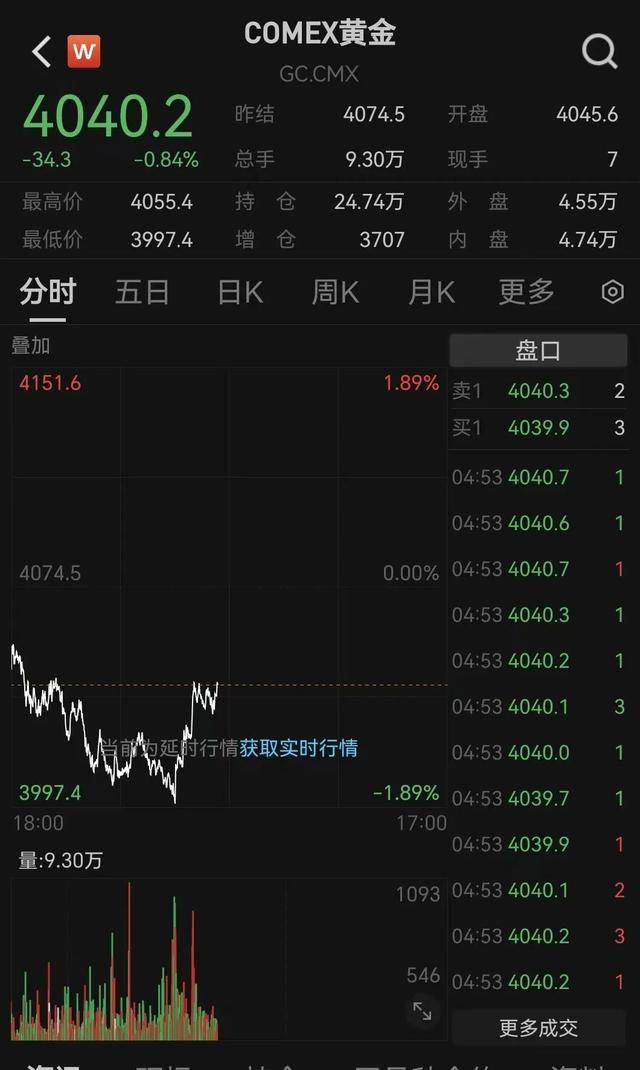
Core Viewpoint - The gold market experienced significant volatility on November 18, 2025, with spot gold prices dropping below $4000 per ounce before rebounding due to comments from Federal Reserve Governor Waller supporting interest rate cuts [1][3][4] Group 1: Market Movements - Spot gold prices fell to $3998.2 per ounce, marking the first drop below $4000 since November 10 [3] - COMEX gold futures also declined, reaching a low of $3985.6 per ounce, while silver prices fell below $50 per ounce, with a daily drop exceeding 2% [3] - Following Waller's comments, spot gold rebounded nearly $40, closing at $4038.677 per ounce, while COMEX futures recovered above $4040 [3][4] Group 2: Federal Reserve Policy Impact - Recent hawkish statements from several Federal Reserve officials dampened market expectations for interest rate cuts, with the probability of a December cut dropping from 93.7% to 48.6% [3][4] - Waller's dovish remarks emphasized the need for rate cuts to mitigate risks in the labor market, which reignited bullish sentiment in the gold market [4][5] Group 3: Long-term Outlook - Despite short-term volatility, the long-term bullish outlook for gold remains intact, supported by central bank gold purchases and geopolitical risks [4][6] - Central banks are expected to continue significant gold purchases, with 800 tons acquired in the first three quarters of 2024, a 34% year-on-year increase [4] - Analysts predict gold prices could rise to $4900 by the end of 2026, driven by ongoing demand from both central banks and private investors [4] Group 4: Upcoming Economic Data - The upcoming non-farm payroll report and unemployment rate will be critical for the gold market, as strong employment data could delay rate cuts, while weak data may boost gold prices [5][6] - Other significant events, such as the October CPI data and the European Central Bank's interest rate decision, will also impact the gold market [6]
美指政策分歧震荡偏强 静待鲍威尔指引方向
Jin Tou Wang· 2025-11-18 03:37
Group 1 - The core viewpoint of the articles highlights the recent fluctuations in the US dollar index, driven by Federal Reserve policy disagreements and economic data performance [1][2] - The US dollar index has shown a strong upward movement since hitting a low of 98.865 on November 3, forming a potential "W-bottom" pattern [2] - The market is currently focused on Federal Reserve Chairman Jerome Powell's upcoming speech, which is expected to be a key catalyst for the dollar index's direction [1] Group 2 - As of November 18, the dollar index is trading within a narrow range of 99.20-99.60, with a recent high of 99.477 and a low of 99.245, indicating a buildup for a potential breakout [2] - The probability of maintaining interest rates in December has risen to 57.1%, while the likelihood of a rate cut has decreased to 42.9%, providing support for the dollar index [1] - Technical indicators show a bullish structure with the RSI reading at 52 and MACD showing signs of a bullish crossover, suggesting a moderate release of bullish momentum [2]